 Claude
  Perplexity
The 12 Best CRM With Email Marketing Platforms of 2026
Looking for the best CRM with email marketing? Discover our ranked list of the top 12 platforms with integrated sales and marketing automation for 2026.
TL;DR: Looking for the best CRM with email marketing? Discover our ranked list of the top 12 platforms with integrated sales and marketing automation for 2026.
In today’s competitive landscape, juggling a separate CRM and email marketing tool creates data silos, missed opportunities, and a disjointed customer experience. The most effective teams use a unified platform where sales activities and marketing campaigns live together. This guide cuts through the noise to analyze the 12 best CRM with email marketing solutions, helping you find a system that aligns your teams, automates workflows, and drives growth.
We’ll examine each platform’s unique strengths, from sophisticated automation for e-commerce and SaaS companies to SMB-friendly simplicity perfect for startups. You will get an honest assessment of limitations, practical use case scenarios, and implementation considerations to help you make a decision based on real-world needs, not just marketing fluff. For UK businesses, finding the right integrated system also involves considering region-specific factors like GDPR and local pricing, making a comparison of the best CRM for small business in the UK a valuable next step.
A crucial, but often overlooked, aspect of this integration is maintaining a clean email list. Before migrating or syncing contacts, using an email validation service like Truelist is essential. It ensures your new, powerful CRM isn’t handicapped from day one by high bounce rates and a damaged sender reputation. This simple step maximizes the ROI of both your software and your campaigns, especially for teams focused on high-volume cold outreach. This comprehensive resource provides the direct links, screenshots, and in-depth analysis you need to select the right platform confidently.
1. HubSpot
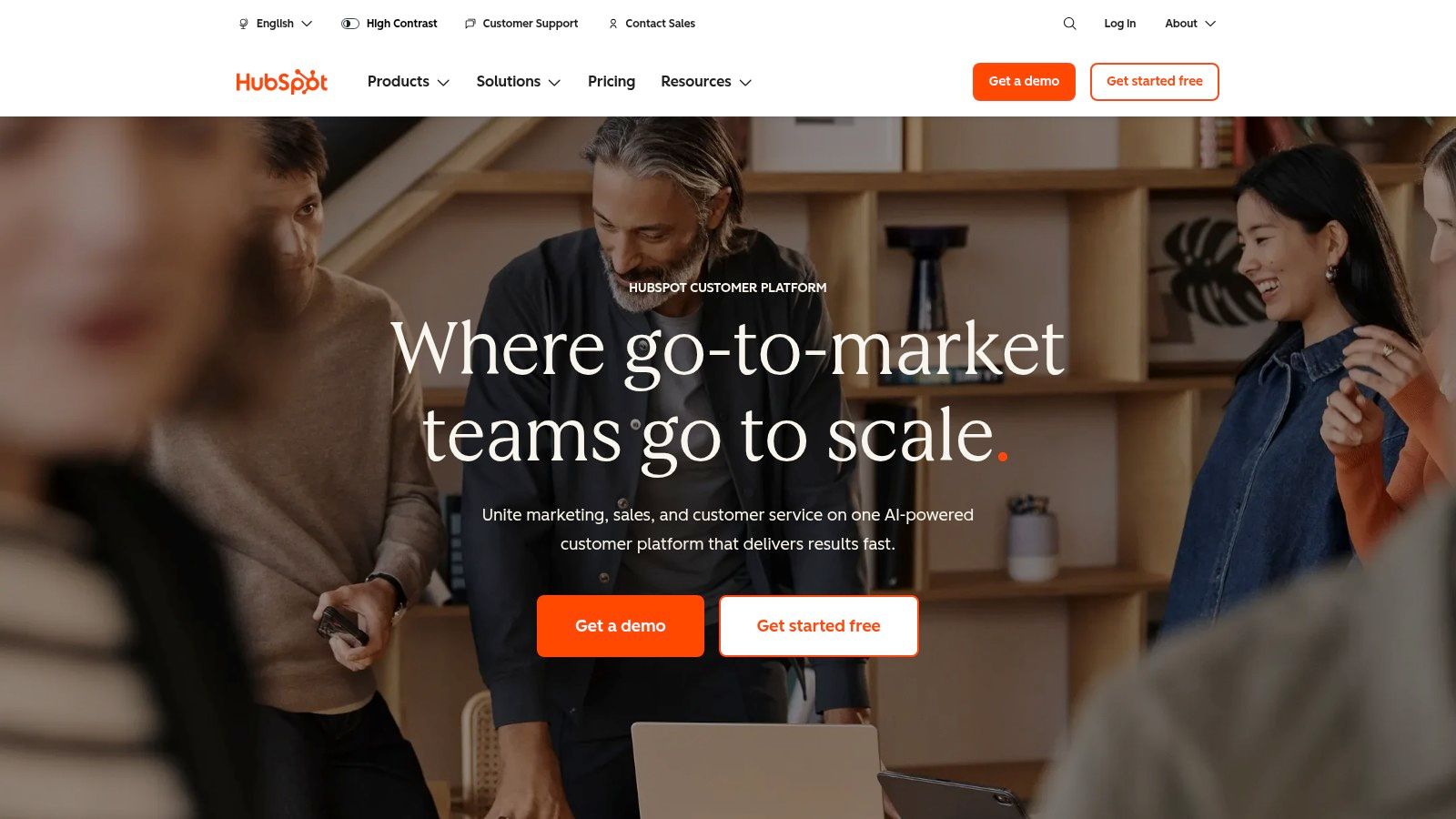
HubSpot is arguably the most well-known all-in-one platform, and for good reason. It offers a powerful, natively integrated suite of tools where its free CRM acts as the central hub for all marketing and sales activities. This tight integration is its standout feature, making it one of the best CRM with email marketing solutions for businesses that want a single source of truth for customer data. Everything from an email open to a form submission is logged directly on the contact’s record, providing a complete 360-degree view.
The platform is designed for scalability. You can start with a robust free plan and graduate to sophisticated features like visual automation workflows, lead scoring, and A/B testing as your needs grow. This makes it ideal for startups and scaling businesses that need a system to grow with them.
Key Features & Use Cases
| Feature | Best For |
|---|---|
| Unified CRM & Email | Sales and marketing alignment, tracking full customer lifecycle. |
| Visual Automation | Nurturing leads with behavior-triggered email sequences. |
| Lead Scoring & Forms | Prioritizing high-intent leads for sales follow-up. |
| App Marketplace | Extending functionality with specialized tools. |
HubSpot excels for teams that want to eliminate data silos. For instance, a sales rep can see the exact marketing emails a lead has engaged with before making a call, all from the same interface. For optimal campaign performance, it’s crucial to maintain a clean contact list. You can explore integrating an email verification tool and learn more about effective list cleaning strategies to improve deliverability.
- Pros: Excellent onboarding resources, powerful automation without heavy IT, and a vast ecosystem of apps.
- Cons: Professional and Enterprise tiers can get expensive as your contact list grows, and onboarding fees apply to higher-tier plans.
Website: https://www.hubspot.com/
2. ActiveCampaign
ActiveCampaign is a customer experience automation platform that excels at combining deep email marketing capabilities with a sales-focused CRM. Its core strength lies in its sophisticated automation engine, which allows for highly personalized, behavior-triggered customer journeys. This makes it an exceptional choice for businesses that want to move beyond basic email blasts and implement complex, conditional logic in their marketing and sales follow-up, solidifying its place as one of the best CRM with email marketing options.
The platform is designed for businesses that rely heavily on automation to scale their operations. Its CRM is built directly into the marketing automation tool, creating a seamless flow of information. A lead’s engagement with an email campaign can automatically update their deal stage, assign a task to a sales rep, or adjust their lead score, all without manual intervention. This tight integration empowers teams to act on customer behavior in real-time.
Key Features & Use Cases
| Feature | Best For |
|---|---|
| Sophisticated Automation | Creating complex, behavior-driven email and sales sequences. |
| Built-in Sales CRM | Managing deals, tasks, and sales automation within marketing. |
| Lead & Contact Scoring | Identifying and prioritizing the most engaged leads for sales. |
| Multi-Channel Options | Engaging contacts via email, SMS, and site messages. |
ActiveCampaign is ideal for SMBs and mid-market teams needing powerful automation without the enterprise-level price tag. For example, an e-commerce store can use it to create an abandoned cart sequence that also notifies a sales rep if the cart value is over a certain threshold. To ensure these automated emails reach the inbox, it’s vital to follow email deliverability best practices and maintain a high sender reputation.
- Pros: Best-in-class email automation for the SMB/mid-market, strong deliverability tools, and a user-friendly visual workflow builder.
- Cons: The learning curve can be steep for its most advanced automation features, and pricing is contact-based, which can become costly.
Website: https://www.activecampaign.com/
3. Zoho CRM
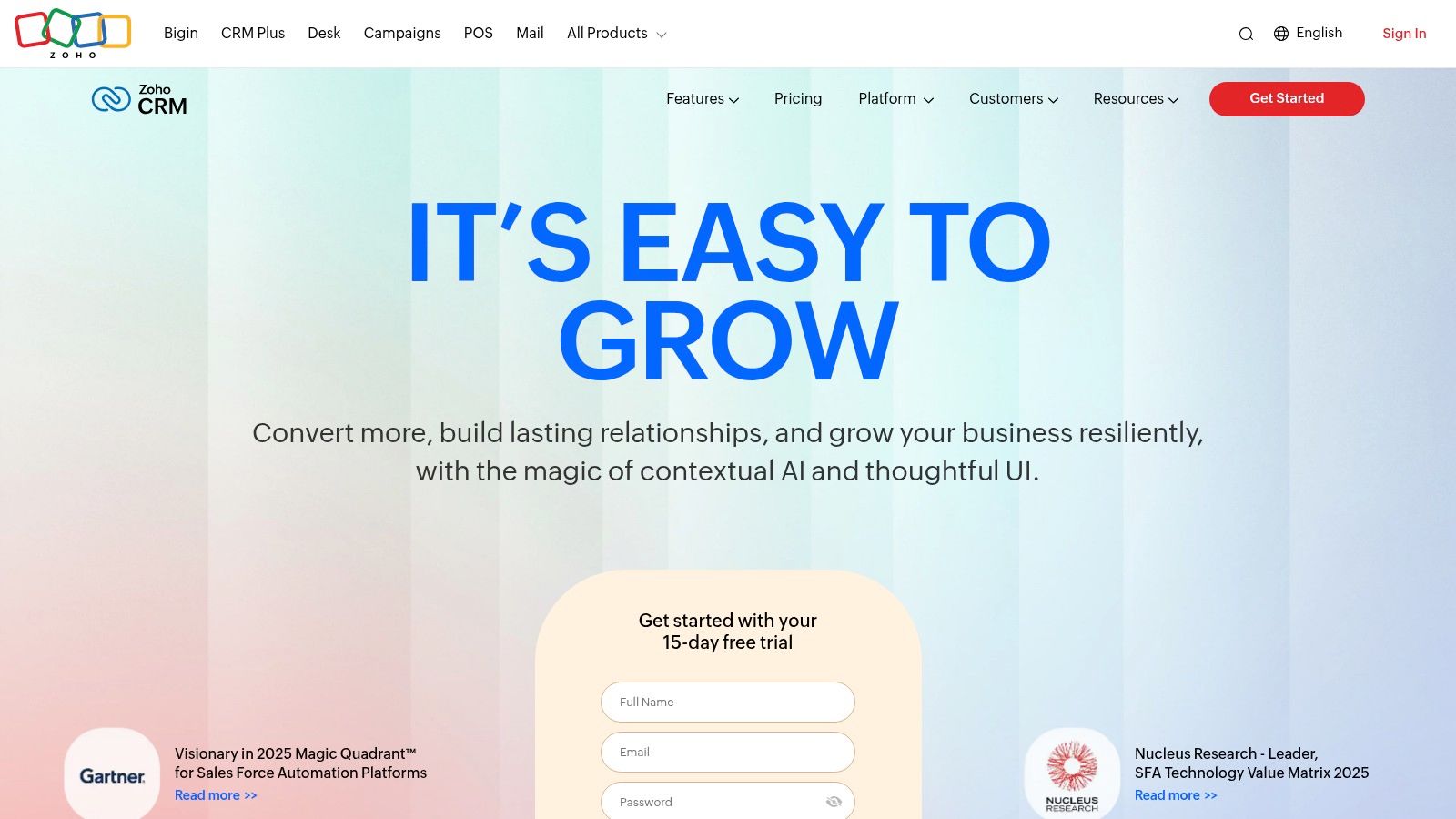
Zoho CRM is a powerhouse for small and medium-sized businesses, offering an incredibly deep and customizable platform at a competitive price point. Its strength lies in its tight integration with the broader Zoho ecosystem, particularly Zoho Campaigns for email marketing. This connection transforms the CRM into one of the best CRM with email marketing solutions for businesses that need granular control over their sales and marketing processes without the enterprise-level price tag. The platform is designed to be a central command center for all customer-facing operations.
The customization options are extensive, allowing you to tailor modules, fields, and workflows to your exact business needs. As you scale, you can tap into advanced features like Zia, Zoho’s AI assistant, which provides predictions and suggestions to improve sales activities. This level of adaptability makes it a strong contender for businesses with unique processes that don’t fit into a rigid, out-of-the-box system.
Key Features & Use Cases
| Feature | Best For |
|---|---|
| Integrated Email & Automation | Sending targeted campaigns based on CRM data and triggers. |
| AI Sales Assistant (Zia) | Analyzing data to suggest best times to contact leads. |
| Extensive Customization | Adapting the CRM to unique sales funnels and processes. |
| Broad App Ecosystem | Integrating with other Zoho apps like Books and Projects. |
Zoho CRM shines for teams that want an all-in-one suite without being locked into a single vendor’s high-cost tiers. A marketing manager can build highly specific audiences for Zoho Campaigns directly from CRM views, a critical step for effective personalization. For those looking to maximize campaign ROI, it’s essential to understand the fundamentals of email list segmentation to deliver the right message to the right contacts.
- Pros: Strong value for money, highly configurable with many native add-ons, and a comprehensive suite of business tools.
- Cons: The depth of the UI can feel complex for new users, and some advanced AI and reporting features are gated behind higher-tier plans.
Website: https://www.zoho.com/crm/
4. Brevo (formerly Sendinblue) + Brevo Sales Platform
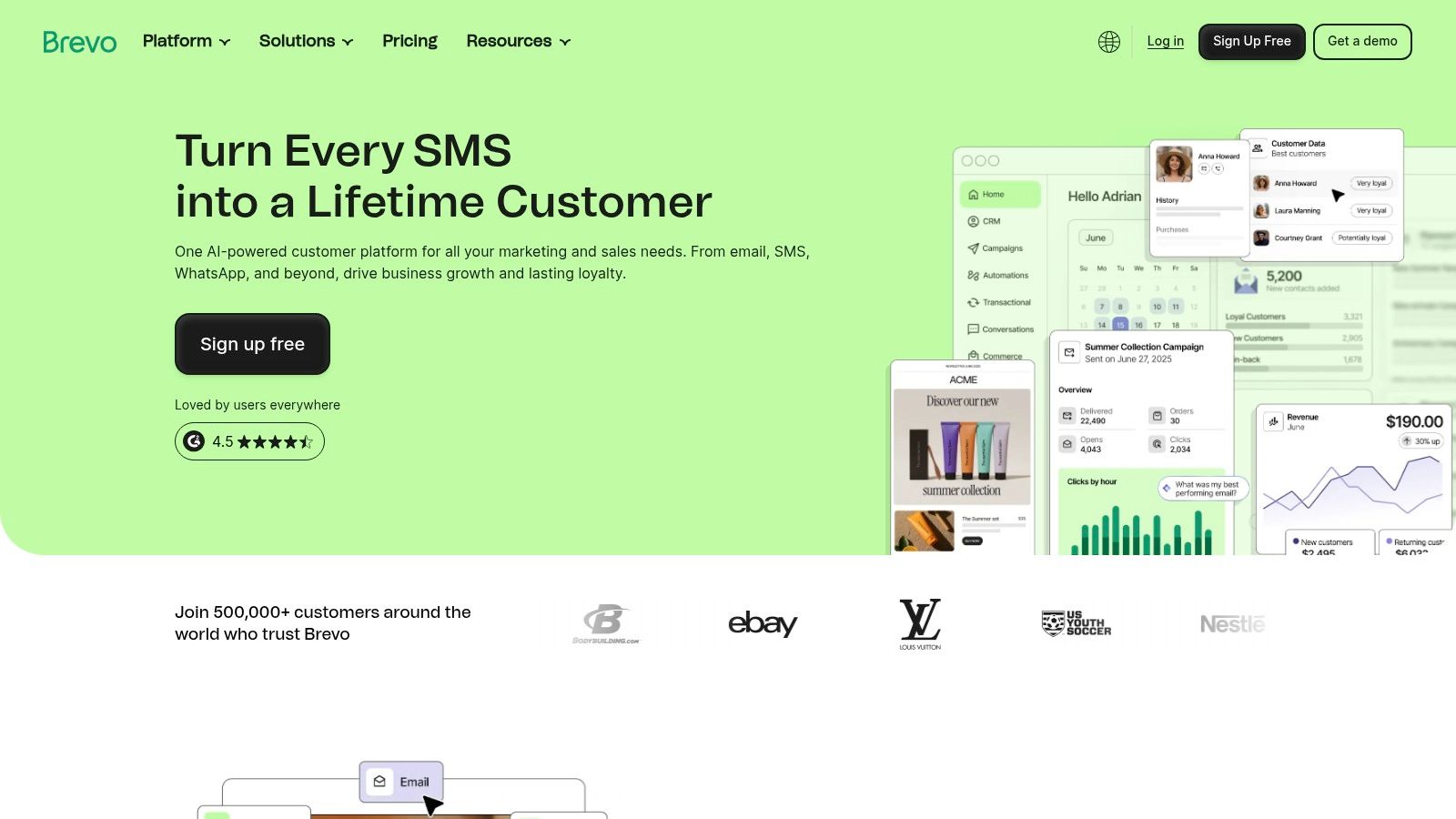
Brevo, formerly known as Sendinblue, offers a comprehensive marketing and sales toolkit that has evolved far beyond its email marketing origins. It provides a natively integrated Sales Platform (CRM) alongside its powerful email and SMS marketing features, making it a strong contender for the best CRM with email marketing, especially for budget-conscious businesses. This single-vendor approach simplifies workflows, allowing you to manage leads, pipelines, and marketing campaigns from one unified dashboard.
The platform is particularly appealing for its generous free tier and affordable entry-level plans, which include marketing automation and CRM access. This makes it an excellent starting point for small businesses and startups looking to implement a structured sales and marketing process without a significant initial investment. Its strength lies in combining core communication channels with essential sales tools.
Key Features & Use Cases
| Feature | Best For |
|---|---|
| Integrated Sales & Marketing | Small teams managing both lead generation and sales pipelines. |
| Multi-channel Communication | Engaging contacts via email, SMS, and live chat from one hub. |
| Generous Free Plan | Startups and solo entrepreneurs needing a cost-effective solution. |
| Marketing Automation | Automating email sequences based on user behavior or CRM triggers. |
Brevo is ideal for businesses where email marketing is the primary driver of sales. A user can create a landing page to capture a lead, automatically add them to the CRM, enroll them in a welcome email series, and create a deal in the sales pipeline simultaneously. This seamless integration ensures no lead falls through the cracks between marketing and sales efforts.
- Pros: All-in-one platform with transparent, affordable pricing and a robust free plan.
- Cons: The CRM is less advanced than dedicated enterprise solutions, and per-user fees apply to the Sales Platform Pro tier.
Website: https://www.brevo.com/
5. Pipedrive (+ Campaigns add-on)
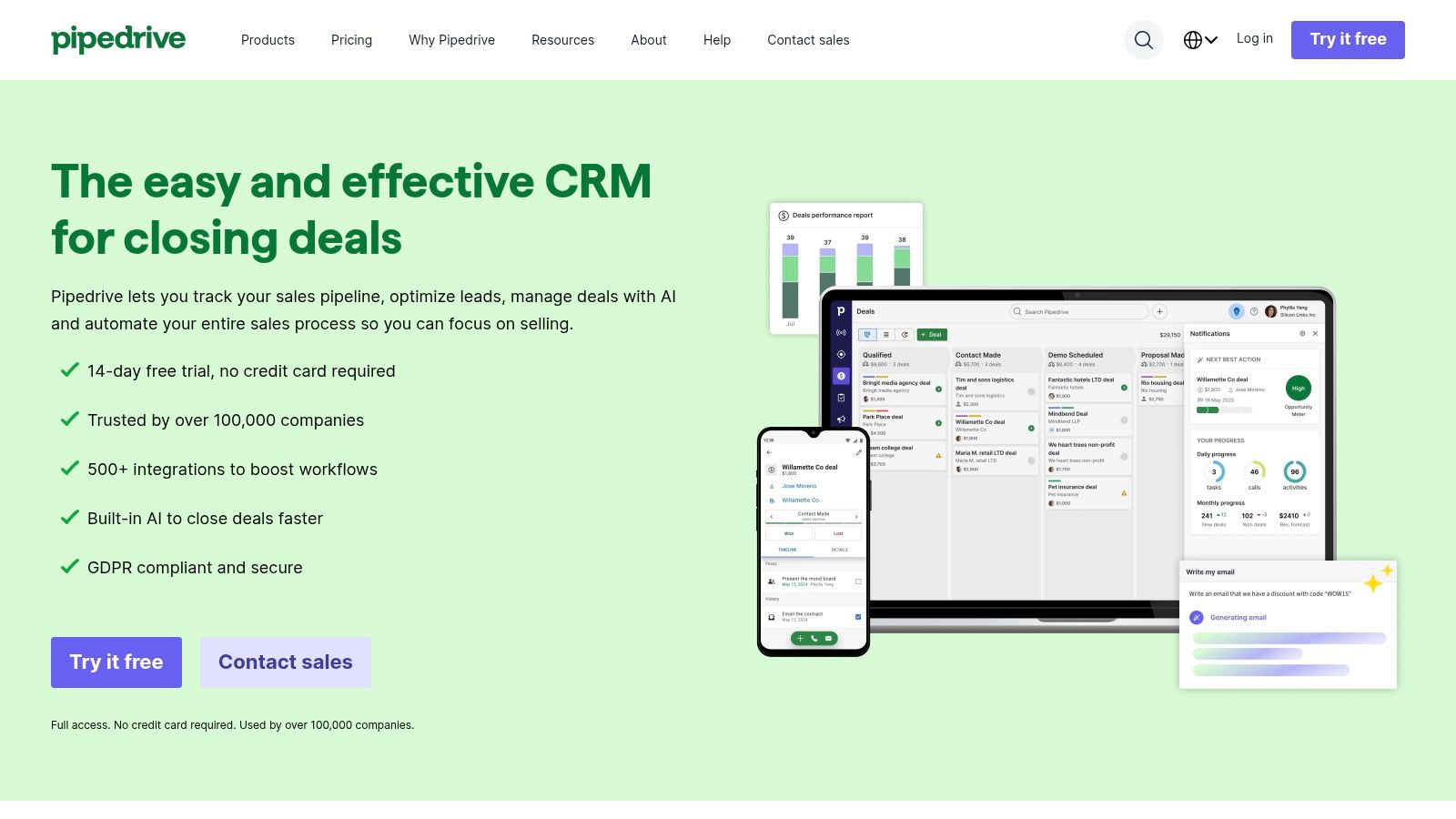
Pipedrive is renowned for its sales-first, pipeline-centric CRM that is exceptionally intuitive for sales teams. While not an all-in-one suite by default, its Campaigns add-on seamlessly integrates email marketing directly into the sales workflow. This modular approach makes it one of the best CRM with email marketing options for businesses that want a powerful, sales-focused CRM and only need to add marketing features as required, keeping the core interface clean and simple. The system focuses on moving deals forward, and email marketing becomes a tool to support that primary goal.
This design philosophy is perfect for sales-driven organizations where marketing’s main role is to generate and nurture leads for the sales pipeline. Instead of navigating a separate platform, users can create segments, send campaigns, and track results right alongside their deals and contacts. The focus is on practical, actionable email marketing that directly fuels sales activities without overwhelming users with features they don’t need.
Key Features & Use Cases
| Feature | Best For |
|---|---|
| Sales-First CRM | Teams that live in their sales pipeline and need an easy-to-use interface. |
| Campaigns Add-on | Sending targeted email broadcasts and simple nurtures to CRM contacts. |
| LeadBooster Add-on | Capturing inbound leads with chatbots and live chat for immediate follow-up. |
| Modular Pricing | Businesses that want to build a custom tool stack and pay only for needed features. |
Pipedrive shines for teams prioritizing sales velocity. A sales rep can easily filter their deals, create a segment based on a specific pipeline stage, and send a targeted follow-up campaign directly from the CRM. This tight loop between sales action and marketing communication is its greatest strength. The modularity allows you to add other tools like the LeadBooster chatbot to capture website visitors and drop them directly into a pipeline, ready for an email nurture sequence.
- Pros: Very user-friendly with fast adoption by sales teams, and its modular pricing lets you add only what you need.
- Cons: The depth of email automation is less advanced than dedicated ESPs, and costs can add up quickly with multiple add-ons.
Website: https://www.pipedrive.com/
6. Keap (formerly Infusionsoft)
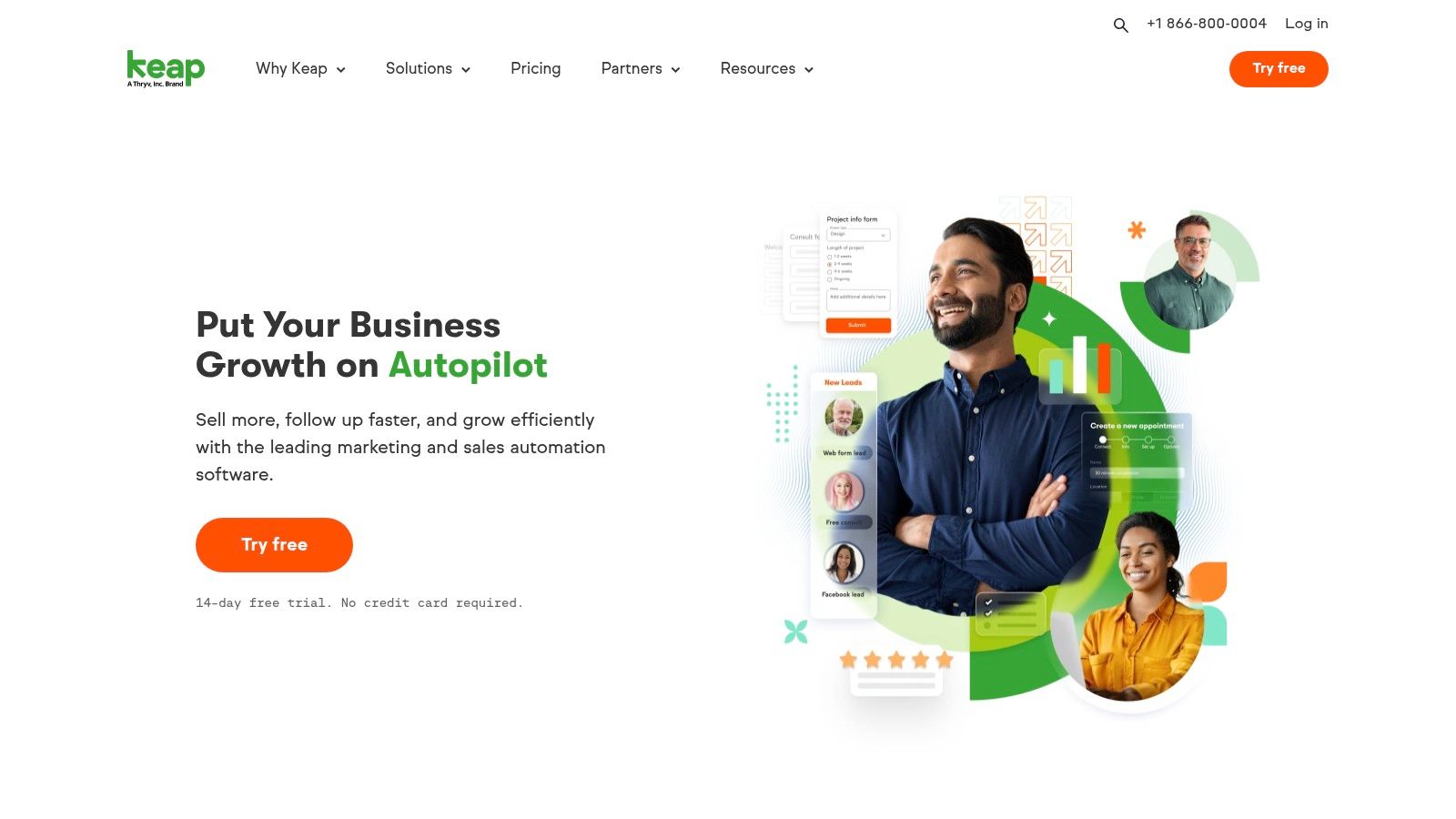
Keap, widely known by its former name Infusionsoft, is a veteran in the automation space, specifically designed for established small businesses and solopreneurs. It differentiates itself by tightly bundling CRM, email marketing, and e-commerce functionalities like invoicing and payments into a single platform. This makes it one of the best CRM with email marketing options for service-based businesses that need to manage the entire customer journey from lead capture to final payment within one system.
The platform is renowned for its powerful “Easy Automations” and an advanced campaign builder that allows for sophisticated, logic-based workflows. Its focus is on automating sales and marketing processes to save time for busy entrepreneurs. With guided setup and strong customer support, Keap aims to help users implement complex strategies without needing a dedicated marketing technologist on staff.
Key Features & Use Cases
| Feature | Best For |
|---|---|
| Visual Automation | Creating complex, multi-step marketing and sales follow-up funnels. |
| Integrated Payments | Service businesses that need to send quotes, invoices, and get paid. |
| 1:1 Email Sync | Sales teams needing to track personal email conversations in the CRM. |
| Appointment Booking | Coaches, consultants, and agencies scheduling client meetings. |
Keap excels for businesses where sales and marketing are closely intertwined, often managed by the same person or a small team. For example, a consultant can set up an automation that sends a lead magnet, follows up with a nurture sequence, allows the lead to book an appointment, and then automatically generates an invoice after the meeting. This end-to-end capability is its core strength.
- Pros: Strong focus on small business needs with excellent onboarding, and a powerful sales, marketing, and payments bundle.
- Cons: Can be less customizable than enterprise-level CRMs, and SMS marketing features can vary based on region.
Website: https://keap.com/
7. Freshsales Suite (Freshworks)
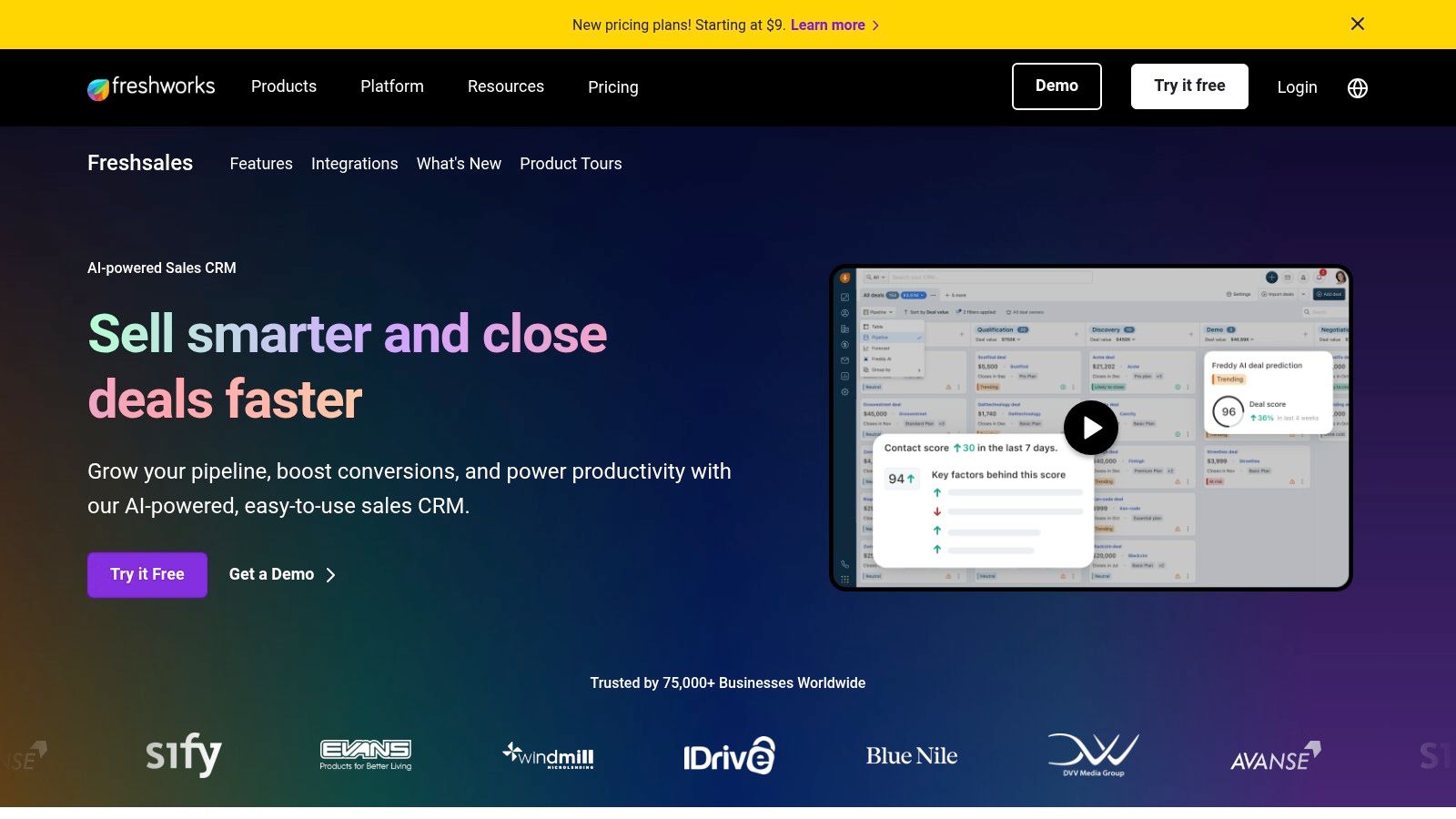
Freshsales Suite by Freshworks bundles sales and marketing automation into a single, cohesive platform. It stands out by providing an affordable, unified CRM that doesn’t sacrifice core functionality, making it a powerful contender for the best crm with email marketing for small to mid-sized businesses. The system is built around a 360-degree view of the customer, combining sales activities, email campaigns, and chat interactions into one streamlined interface.
This integrated approach means a sales rep can launch an email sequence, track engagement, and then chat with a lead on the website without ever switching tools. Its AI assistant, Freddy, helps with predictive lead scoring and deal insights, offering a taste of enterprise-level features at an SMB-friendly price point. The platform’s quick setup and intuitive UI make it accessible for teams that need to get running quickly without a steep learning curve.
Key Features & Use Cases
| Feature | Best For |
|---|---|
| Unified Sales & Marketing | SMBs seeking an all-in-one CRM without a high price tag. |
| Freddy AI Assistant | Automating lead scoring and identifying high-potential deals. |
| Built-in Email & Sequences | Sales teams running personalized outreach and follow-up campaigns. |
| Freshworks Ecosystem | Businesses needing seamless integration with helpdesk (Freshdesk). |
Freshsales Suite is ideal for teams that prioritize speed and value. A growing company can use it to manage its entire funnel, from running targeted email marketing campaigns to convert new leads to leveraging the sales CRM to close deals efficiently. The native integration with Freshdesk is a huge plus for businesses focused on a holistic customer experience, linking sales and support data effortlessly.
- Pros: Very competitive pricing for a bundled suite, quick setup and good SMB usability, and a generous free plan.
- Cons: Customization depth is less extensive than enterprise-focused CRMs, and some advanced AI or bot features may be metered as add-ons.
Website: https://www.freshworks.com/crm/
8. Salesforce (Starter/Pro Suite + Marketing Cloud)
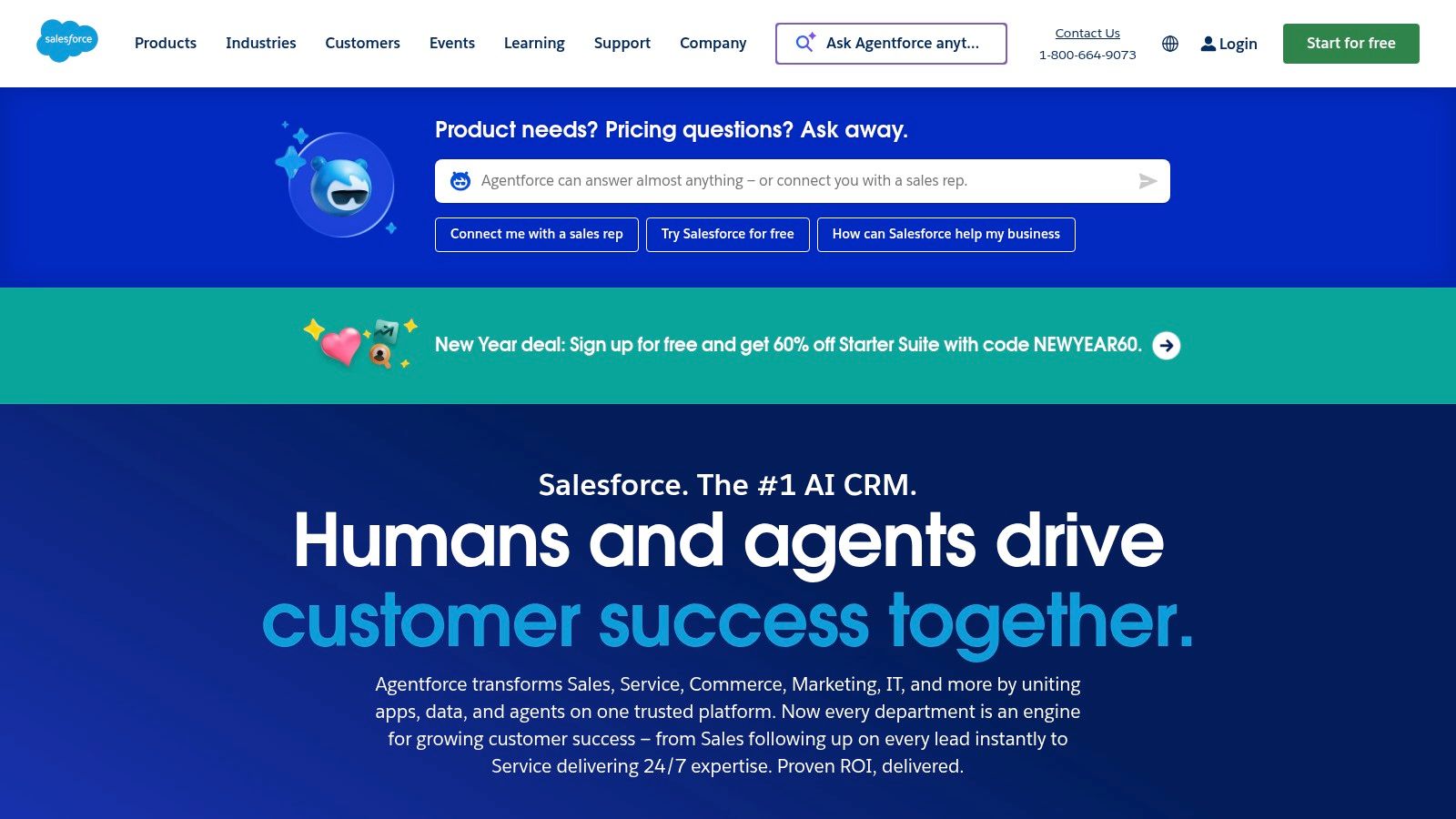
Salesforce is the dominant force in the CRM market, known for its extreme scalability and deep customization capabilities. While its core CRM platform (Sales Cloud) offers foundational email and campaign management, its true power as one of the best CRM with email marketing solutions is unlocked when paired with Marketing Cloud. This combination creates an enterprise-grade ecosystem where sales and marketing data are deeply intertwined, enabling highly sophisticated, cross-channel customer journeys.
The platform is designed for growth and complexity. Smaller businesses can start with the more accessible Starter and Pro Suites, which include essential email marketing features. As a company scales, it can graduate to Marketing Cloud for advanced automation, AI-powered personalization with Einstein, and multi-channel engagement (SMS, social, ads). This modular approach allows businesses to build a solution that precisely fits their needs, from simple outreach to complex, global marketing operations.
Key Features & Use Cases
| Feature | Best For |
|---|---|
| Deep CRM Customization | Enterprises with unique sales processes and data requirements. |
| Marketing Cloud Integration | Creating sophisticated, multi-channel customer journey automation. |
| Einstein AI Capabilities | Predictive lead scoring and personalized email content at scale. |
| AppExchange Ecosystem | Extending functionality with thousands of third-party apps. |
Salesforce excels in environments where data governance and scalability are paramount. For example, a global B2B enterprise can use Marketing Cloud Account Engagement (formerly Pardot) to run complex lead nurturing campaigns, while the sales team works in Sales Cloud with a complete view of every marketing touchpoint. The platform’s extensive customization and vast AppExchange make it possible to tailor the system to virtually any business process.
- Pros: Extremely scalable and extensible, vast partner network, and comprehensive training resources via Trailhead.
- Cons: Can be costly and complex to implement, and advanced email automation typically requires a separate Marketing Cloud license.
Website: https://www.salesforce.com/
9. Nutshell
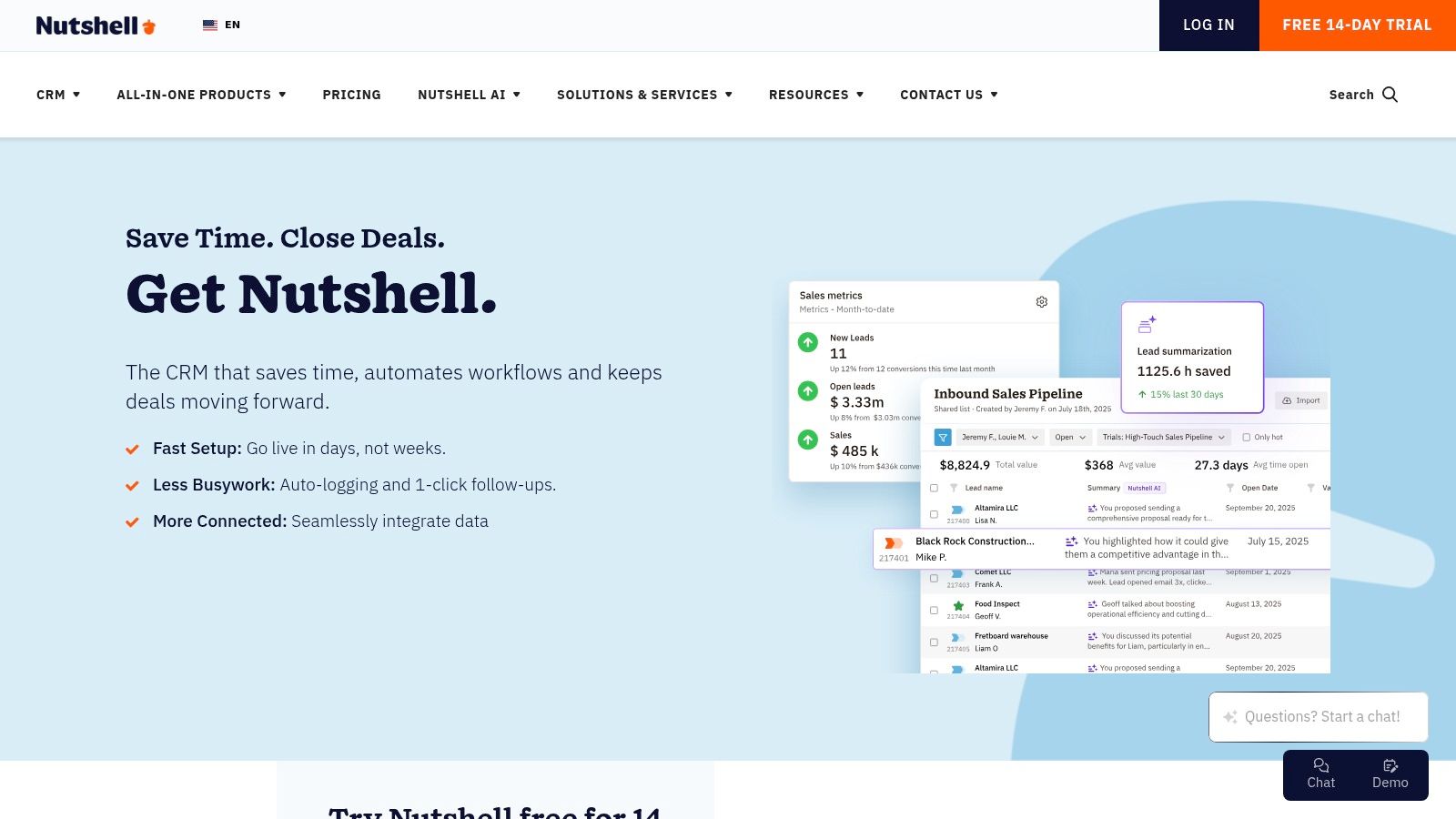
Nutshell is an easy-to-use CRM designed specifically for small and medium-sized businesses that want simplicity and power without a steep learning curve. Its approach is unique in that email marketing isn’t bundled by default but offered as an affordable add-on called Nutshell Marketing. This allows companies to start with a powerful, straightforward CRM and bolt on email marketing capabilities like broadcasts and drip campaigns only when they need them, making it one of the best CRM with email marketing solutions for teams that value flexibility and cost control.
The platform stands out for its user-friendly interface and quick deployment, which is a major plus for teams without dedicated IT support. The CRM itself includes features like landing pages, web chat, and forms, providing significant value even before adding the marketing component. This structure ensures businesses only pay for the features they actively use while keeping all their sales and marketing data unified in a single, clean UI.
Key Features & Use Cases
| Feature | Best For |
|---|---|
| Email Marketing Add-On | SMBs wanting to add drip campaigns and broadcasts on demand. |
| Unlimited CRM Contacts | Businesses with large contact lists but who don’t need advanced marketing yet. |
| Simple, Modern UI | Teams that require fast onboarding and high user adoption rates. |
| Built-in Forms & Chat | Capturing leads directly into the CRM without third-party tools. |
Nutshell excels for sales-first teams that are expanding into marketing. A sales team can use the core CRM for pipeline management, and once ready, the marketing team can activate the add-on to launch targeted drip campaigns to nurture those same contacts. The transparent, SMB-friendly pricing and unlimited contacts on core CRM plans make it an attractive and predictable choice.
- Pros: Transparent SMB-friendly pricing, unlimited CRM contacts on core plans, and a very intuitive user interface.
- Cons: Email marketing is a separate, tiered cost based on contact numbers, and it lacks some enterprise-grade governance features.
Website: https://www.nutshell.com/
10. Mailchimp
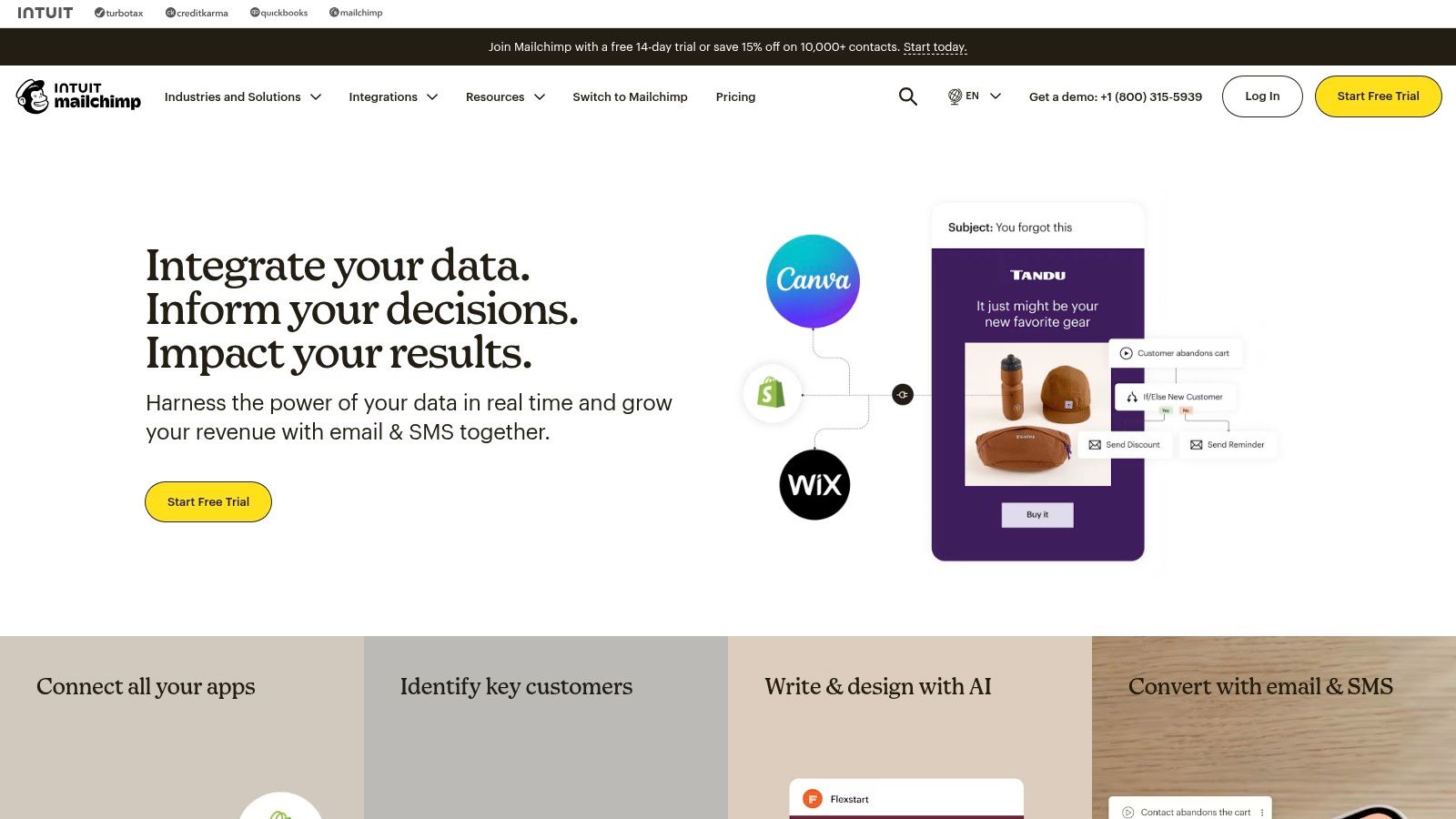
Mailchimp is a powerhouse in email marketing that has evolved to include a capable marketing CRM. While it started as a newsletter service, it now offers a centralized audience dashboard where businesses can manage contact profiles, apply tags, and create complex segments. Its strength lies in being an email-first platform, making it a contender for the best CRM with email marketing for companies prioritizing campaign performance and creative control.
The platform is renowned for its user-friendly interface, beautiful templates, and intuitive automation builder, allowing even non-technical users to create sophisticated, behavior-triggered email sequences. This makes it an excellent choice for e-commerce businesses and content creators who need to connect with their audience effectively without a steep learning curve. While it’s not a traditional sales CRM with pipelines, its integrations fill that gap for many users.
Key Features & Use Cases
| Feature | Best For |
|---|---|
| Marketing CRM | E-commerce stores managing customer segments based on purchase history. |
| Email Templates & Automation | Businesses needing high-quality, visually appealing marketing campaigns. |
| E-commerce Tracking | Sending targeted follow-ups like abandoned cart or product recommendation emails. |
| Large Integration Ecosystem | Connecting with a dedicated sales CRM like Salesforce for full pipeline management. |
Mailchimp is ideal for businesses where marketing, not sales, drives the customer relationship. For example, an online retailer can use its e-commerce tracking to automatically segment customers who purchased a specific product and send them a targeted email about complementary items. Its robust automation and deep data analysis tools provide everything needed to nurture customer relationships through email.
- Pros: Very strong email tooling and templates, and it is supported by a huge number of integrations and resources.
- Cons: Not a full sales CRM, as it lacks native sales pipelines, and pricing can scale quickly as your contact list grows.
Website: https://mailchimp.com/
11. EngageBay
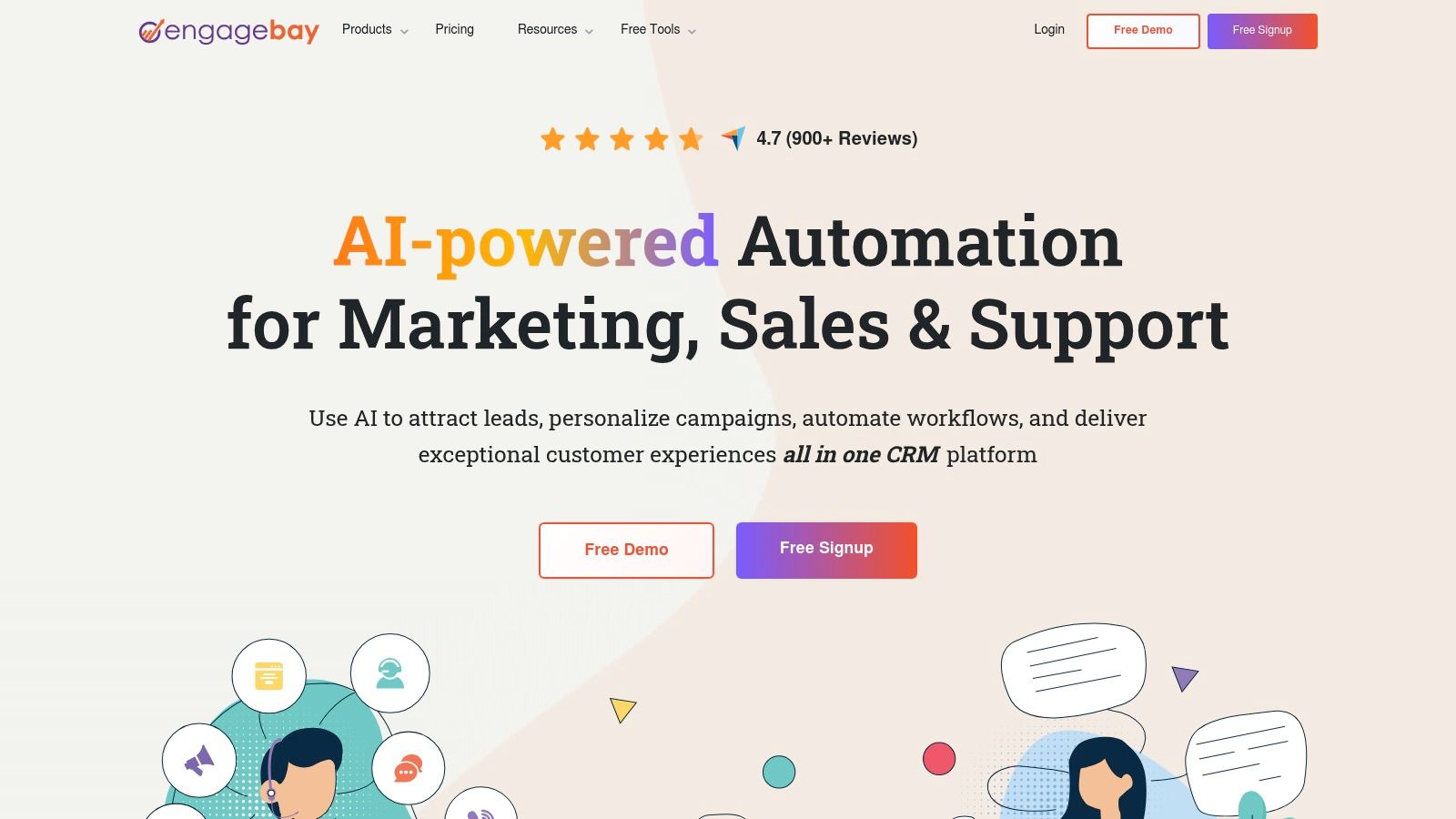
EngageBay has carved out a niche as an aggressive, budget-friendly alternative to the larger all-in-one platforms. It provides a surprisingly comprehensive suite combining CRM, marketing automation, and service desk tools, all built around a central contact database. This makes it a strong contender for the best CRM with email marketing for startups and small businesses that need enterprise-grade functionality without the enterprise-level price tag. Its core strength lies in offering a unified system where all customer interactions are tracked in one place.
The platform is designed to cover the entire customer journey, from lead capture with landing pages to nurturing with email sequences and closing deals in the CRM pipeline. Its pricing model, including a generous free plan, makes it highly accessible for teams that need to start small but plan to scale their marketing and sales operations without switching vendors.
Key Features & Use Cases
| Feature | Best For |
|---|---|
| All-in-One Suite | Small businesses wanting a single vendor for sales, marketing, and service. |
| Email Automation | Running automated nurture campaigns and follow-up sequences. |
| Free Plan | Startups and solopreneurs needing core CRM and marketing tools. |
| Landing Pages | Capturing leads directly into the CRM for immediate follow-up. |
EngageBay is ideal for teams looking to consolidate their tech stack and reduce costs. A small e-commerce business, for example, can use it to build a lead capture form, send a welcome email series, track the lead’s progress in the sales pipeline, and manage any post-sale support tickets, all from one dashboard. This unified approach simplifies operations significantly.
- Pros: Aggressive pricing with a usable free tier, single vendor for core marketing, sales, and service tools.
- Cons: Fewer enterprise features and integrations than larger suites, and the UI depth and documentation can vary by module.
Website: https://www.engagebay.com/
12. GoHighLevel
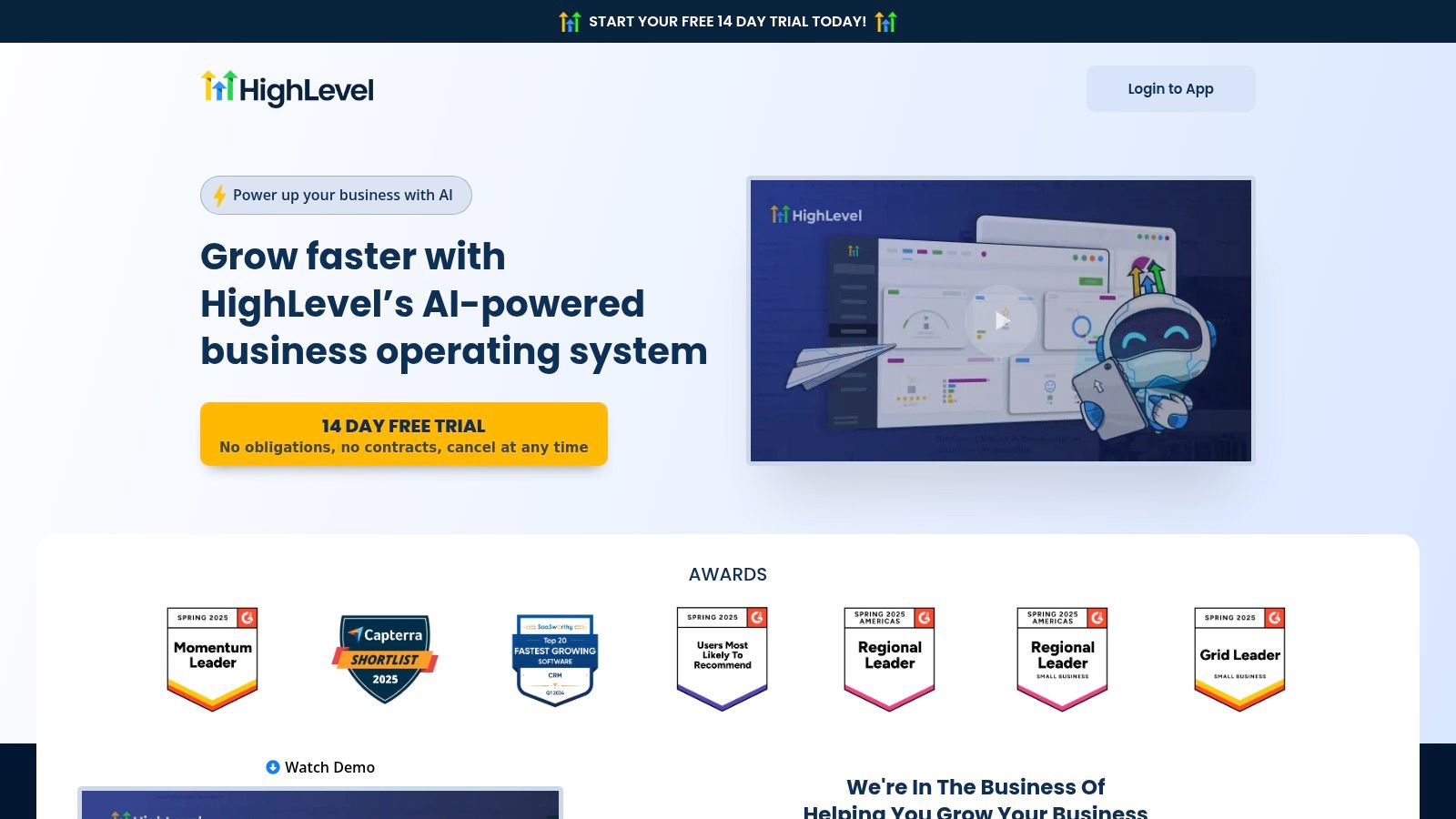
GoHighLevel is a powerhouse all-in-one platform built specifically for marketing agencies and service-based businesses. It consolidates an entire tech stack, including a CRM, funnel builder, email marketing, SMS, and appointment scheduling, into a single white-label solution. Its unique value lies in its sub-account architecture, allowing users to manage multiple clients or brands from one dashboard, making it one of the best CRM with email marketing options for agencies seeking efficiency and scalability.
This integrated approach means you can build a complete customer journey, from a landing page lead capture to an automated email and SMS follow-up sequence, all within one system. The platform is designed to replace multiple individual tools like ClickFunnels, ActiveCampaign, and Calendly, offering significant cost savings and simplifying operations for teams managing complex marketing campaigns across different channels.
Key Features & Use Cases
| Feature | Best For |
|---|---|
| White-Label Platform | Agencies reselling marketing services under their own brand. |
| Unified Campaigns | Combining email, SMS, and automated calls in one workflow. |
| Funnel & Site Builder | Creating lead generation assets tied directly to the CRM. |
| Unlimited Sub-Accounts | Scaling agency operations without per-client software fees. |
GoHighLevel excels for agencies that want to provide a comprehensive, branded marketing solution to their clients. For instance, a digital marketing agency can set up a complete lead nurturing system for a local business, including a booking calendar and automated reminders, and manage it entirely within that client’s dedicated sub-account. The value proposition is strongest on its higher-tier plans, where unlimited sub-accounts are included.
- Pros: Consolidates many separate tools into one platform, strong fit for agencies and multi-brand use with white-label options.
- Cons: Best value realized at higher tiers and can be overkill for simple needs; telecom/SMS fees and usage-based add-ons to factor in.
Website: https://www.gohighlevel.com/
Top 12 CRM + Email Marketing Comparison
| Product | Core focus | Email capabilities ★ | Unique strength 🏆 | Pricing/value 💰 | Best fit 👥 |
|---|---|---|---|---|---|
| HubSpot | CRM + native email marketing & automation | ★★★★ — visual workflows, analytics, lead scoring | 🏆 All-in-one CRM + large app marketplace ✨ | 💰💰💰💰 — can get expensive as contacts grow | 👥 Sales + marketing teams scaling |
| ActiveCampaign | Sales CRM + deep email automation | ★★★★★ — behavior journeys, advanced segmentation | 🏆 Best-in-class automation & deliverability tooling ✨ | 💰💰💰 — contact-based pricing | 👥 SMBs & mid-market email marketers |
| Zoho CRM | Highly configurable CRM + Zoho Campaigns | ★★★★ — integrated campaigns, AI on higher tiers | 🏆 High configurability & strong value ✨ | 💰💰 — competitive for SMBs | 👥 Budget-conscious SMBs |
| Brevo (Sendinblue) | Email & SMS marketing + light CRM | ★★★★ — email/SMS automation, landing pages | 🏆 Simple packaging & quick start ✨ built-in Sales Platform | 💰💰 — free tier / entry pricing | 👥 Small teams focused on email/SMS |
| Pipedrive (+ Campaigns) | Pipeline-first CRM with Campaigns add-on | ★★★ — templates, segmentation, basic automations | 🏆 Intuitive pipelines & modular add-ons ✨ | 💰💰💰 — modular costs can add up | 👥 SDRs & sales teams needing fast adoption |
| Keap (Infusionsoft) | SMB CRM + marketing automation + payments | ★★★ — visual automation, broadcasts, sync | 🏆 Combined sales + payments bundle & guided onboarding ✨ | 💰💰💰 — mid-tier SMB pricing | 👥 Solopreneurs & growing small businesses |
| Freshsales Suite | Unified sales & marketing CRM | ★★★★ — sequences, multichannel engagement | 🏆 Affordable bundled suite with AI (Freddy) ✨ | 💰💰 — competitive for SMBs | 👥 SMBs wanting quick setup and bundles |
| Salesforce | Enterprise CRM + Marketing Cloud options | ★★★★★ — enterprise-grade, cross-channel automation | 🏆 Scalability, ecosystem & Einstein AI ✨ | 💰💰💰💰💰 — costly & complex | 👥 Large enterprises & complex deployments |
| Nutshell | Simple CRM + optional marketing add-on | ★★★ — broadcasts, drip campaigns, landing pages | 🏆 SMB-friendly pricing & transparent limits ✨ | 💰💰 — transparent, contact-tied sends | 👥 Small teams wanting simplicity |
| Mailchimp | Email marketing + marketing CRM features | ★★★★ — templates, automations, e‑commerce tracking | 🏆 Strong email tooling & wide integrations ✨ | 💰💰💰💰 — contact-based scaling | 👥 Campaign-focused marketers & e‑commerce |
| EngageBay | Budget all-in-one CRM & marketing suite | ★★★ — broadcasts, automation, landing pages | 🏆 Very low-cost all-in-one option ✨ | 💰 — aggressive pricing / usable free tier | 👥 Startups & cost-conscious teams |
| GoHighLevel | Agency-focused CRM + funnels & white-label | ★★★★ — multi-channel campaigns, funnels, automations | 🏆 Agency white-label & unlimited sub-accounts ✨ | 💰💰💰 — best value at higher tiers | 👥 Agencies & multi-client operators |
Making Your Final Choice and Ensuring Success
Navigating the landscape of CRM platforms with integrated email marketing can feel overwhelming. We’ve explored a dozen powerful contenders, from all-in-one giants like HubSpot and Salesforce to nimble, focused solutions like Pipedrive and Nutshell. The sheer variety underscores a critical truth: there is no single “best” platform for everyone. The ideal choice is deeply personal to your business’s unique circumstances.
The selection process isn’t about finding the tool with the most features. It’s about identifying the one with the right features to solve your specific challenges. Your final decision should be a direct reflection of your primary use case, team size, technical expertise, and, of course, your budget.
Recapping the Core Strengths
Let’s distill the key takeaways from our analysis. If your priority is sophisticated automation and deep segmentation for lead nurturing, platforms like ActiveCampaign and Keap shine brightest. They are built from the ground up to connect marketing actions with sales outcomes seamlessly.
For businesses seeking a unified platform that can scale from a free-tier starting point to an enterprise-level powerhouse, HubSpot remains a dominant force. Its user-friendly interface combined with a vast feature set makes it an excellent, albeit pricier, long-term investment. Conversely, cost-conscious teams and small businesses will find incredible value in the comprehensive, all-in-one offerings of EngageBay, Brevo, and Zoho CRM, which pack a surprising amount of functionality into budget-friendly packages.
A Practical Framework for Your Decision
To move from analysis to action, use this simple framework to guide your final choice for the best CRM with email marketing:
- Define Your Must-Haves vs. Nice-to-Haves: Is advanced e-commerce automation a deal-breaker? Is a built-in phone dialer essential? List your non-negotiable requirements to quickly shortlist the most relevant tools.
- Map to Your Sales Process: Does your team live in their inbox and need a CRM that feels like an extension of Gmail? Pipedrive or Freshsales might be a perfect fit. Do you have a complex, multi-stage sales cycle that requires extensive customization? Salesforce or a higher-tier HubSpot plan will provide the necessary flexibility.
- Conduct a Trial with a Real-World Scenario: Don’t just click around during your free trial. Task your team with a real project. Try to import a list of contacts, build a three-step email automation sequence, and create a custom deal stage. This hands-on test will reveal more about a platform’s usability than any demo.
- Factor in Total Cost of Ownership (TCO): Look beyond the monthly subscription fee. Consider costs for additional contacts, user seats, necessary add-ons (like Pipedrive’s Campaigns), and potential implementation or training fees.
The Unspoken Prerequisite for Success: Data Quality
Ultimately, the most powerful CRM in the world will fail if it’s fed bad data. A contact list riddled with invalid, outdated, or risky email addresses sabotages your efforts before they even begin. Every bounced email damages your sender reputation, reduces the deliverability of all your future campaigns, and wastes valuable sales and marketing resources.
This is not an afterthought; it’s a foundational pillar of success. Integrating a robust email validation service from day one is the single most important step you can take to protect your investment. By ensuring your contact data is clean and accurate, you guarantee your carefully crafted messages actually land in the inbox, maximizing ROI and setting your team up for sustainable growth. No matter which CRM you choose, prioritizing data hygiene is the master key to unlocking its full potential.
Stop validating once and hoping for the best. Truelist’s recurring validation automatically re-checks your lists on a schedule — catching new bounces, dead mailboxes, and risky addresses before they damage your sender reputation. Pay-as-you-go credits that never expire, plus unlimited plans for high-volume senders.