 Claude
  Perplexity
Uncovering the Real Cost of Poor Data Quality
Discover the hidden financial impact of the cost of poor data quality. Learn to calculate tangible losses and implement proven strategies to fix bad data.
TL;DR: Discover the hidden financial impact of the cost of poor data quality. Learn to calculate tangible losses and implement proven strategies to fix bad data.
Poor data quality isn’t just some abstract tech problem—it’s a silent, creeping tax that quietly drains your company’s resources and stalls its growth. While some studies estimate the average company loses between $12.9 to $15 million annually to bad data, that number barely scratches the surface of the real damage.
Uncovering The Hidden Data Tax On Your Business
Think of it like a leaky pipe hidden in the walls of your office. You don’t see it, but drop by drop, it’s causing rot, mold, and expensive structural damage. Poor data quality works exactly the same way. Every incorrect email, outdated phone number, or duplicate contact is a tiny leak. Over time, these small drips combine into a flood of wasted marketing dollars, lost sales opportunities, and a tarnished brand reputation.
This “data tax” is something you pay every single day, and it hits every team from sales and marketing to finance and operations.
Here, we’re going to pull back the curtain on this silent drain. We’ll break down the tangible costs you can see and the hidden ones you can’t. More importantly, we’ll give you a clear, practical framework to not only spot these costs but to calculate their real impact and, finally, get rid of them for good. This isn’t just about cleaning a spreadsheet; it’s about plugging the leaks and turning a huge liability into a real competitive edge.
To get started, let’s break down where this “data tax” shows up. The table below gives a quick snapshot of the main costs you’re likely paying right now.
Quick Overview: The Main Costs of Poor Data Quality
| Cost Category | Description | Example Impact |
|---|---|---|
| Direct Financial Waste | Money spent on marketing, sales, and operations that yields zero return due to invalid or outdated contact information. | Paying for email sends that bounce or ads shown to non-existent leads. |
| Operational Inefficiency | Time and resources consumed by employees manually cleaning data, correcting errors, or chasing down bad leads. | Sales reps wasting hours calling disconnected numbers instead of talking to qualified prospects. |
| Missed Revenue | Potential sales opportunities that are lost forever because you can’t reach the prospect due to bad contact details. | A warm lead from a webinar goes cold because their email address was entered incorrectly. |
| Reputation Damage | The negative impact on your brand’s credibility and sender score caused by high email bounce rates and poor engagement. | Your company’s emails start landing in the spam folder, making you invisible to customers. |
| Flawed Decision-Making | Strategic business decisions made based on inaccurate analytics, leading to misguided strategies and wasted investment. | Launching a product in a new region based on flawed customer demographic data. |
As you can see, the problem runs much deeper than a few bounced emails. Let’s dig into the most obvious and immediate impacts first.
The Immediate Hit To Your Bottom Line
The most visible cost of bad data shows up right where it hurts: your marketing and sales budget. When your CRM or email platform is clogged with errors, you’re literally paying to talk to ghosts. Every dollar you spend on a campaign targeting an invalid contact, or every hour an SDR wastes dialing a dead phone number, is a direct, measurable financial loss.
This isn’t a minor issue; it’s a massive drain. Just look at email deliverability. On average, nearly one out of every six marketing emails never even makes it to the inbox. Recent data puts the average email deliverability rate at just 83.1%, which means a shocking 16.9% of emails simply disappear into the void. You can explore the full findings on global deliverability rates to see just how much this varies by region and industry.
Beyond Wasted Spend
While flushing money down the drain is bad enough, the true cost of bad data spreads far beyond the marketing budget. It gums up your operations, erodes the trust you’ve built with customers, and leads to terrible strategic decisions.
Here’s what that looks like in the real world:
- Damaged Sender Reputation: Every bounced email is a red flag to providers like Gmail and Outlook. Too many bounces, and they’ll start sending your campaigns straight to the spam folder, making you invisible.
- Missed Revenue Opportunities: That perfect lead with the wrong phone number or a typo in their email address? That’s a sale you’ll never get a chance to make. It’s an opportunity lost forever.
- Inefficient Operations: Your team ends up wasting countless hours on “data wrangling”—manually fixing errors, de-duping contacts, and chasing down bad leads—instead of focusing on what they were hired to do.
Once you start seeing these interconnected costs, it becomes clear that data quality isn’t just an “IT problem.” It’s a core business issue that directly impacts your profitability and your company’s ability to survive and grow.
Breaking Down the Financial Damage
To really get a grip on the financial damage bad data causes, we need to split it into two different buckets. Think of it like a car that won’t start. Some problems are obvious—an empty gas tank, for instance. Those are your direct costs. But other issues are sneakier, like a faulty alternator slowly killing your battery. Those are the indirect costs, and they’re often far more dangerous.
Both types of costs eat away at your bottom line, just in different ways. The direct costs are the ones you can see on expense reports and marketing budgets; they’re the tangible, measurable losses you can point to on a spreadsheet. On the other hand, indirect costs are the silent killers of growth, causing damage that’s harder to pin down but often much more severe over time.
The Obvious Leaks: Direct Costs
Direct costs are the most straightforward part of the bad data problem. This is money you’re actively spending with absolutely no chance of seeing a return because the data behind the spend is junk. It’s like paying for a billboard that’s facing a brick wall—the money is gone, and nobody saw the message.
These costs are almost always tied to specific operational tasks.
- Wasted Marketing Spend: This one’s a classic. It’s the money spent on emails to addresses that bounce, direct mail sent to the wrong house, or digital ad campaigns targeting leads that don’t exist.
- Wasted Labor: Your team’s time is money, and when they spend hours manually cleaning lists, fixing typos in the CRM, or calling disconnected phone numbers, that’s a direct operational cost that generates zero value. In fact, research shows sales reps can waste over 27% of their time just wrestling with bad data.
- Bloated Tech Fees: Many sales and marketing platforms charge you based on the number of contacts in your database. When your list is full of duplicates, invalid emails, and old info, you’re paying higher subscription fees for a bunch of contacts you can’t even reach.
These direct costs sting because they represent pure, unadulterated waste. Every dollar that goes down the drain here could have been invested in reaching real customers, developing a new feature, or hiring another salesperson.
Gartner research puts the average financial impact of poor data quality at a staggering $9.7 million per year for organizations. That number really drives home how quickly these “small” direct costs can pile up into a massive financial headache.
The Hidden Rot: Indirect Costs
While direct costs are easy to spot, the indirect costs are much more insidious. They won’t show up as a line item on an invoice. Instead, they appear as missed opportunities, a tarnished reputation, and a business strategy built on shaky ground. This is where the true, long-term cost of poor data quality really lurks.
Think of indirect costs as the rot spreading beneath the floorboards, silently weakening the entire foundation of your business.
- Lost Sales Opportunities: This is the big one. A single typo in an email address for a hot lead means your sales team never even gets a chance to follow up. The potential revenue from that one customer—and their entire lifetime value—is gone forever because of a simple data error.
- Damaged Brand Reputation: Sending a constant stream of emails that bounce is a huge red flag for providers like Gmail and Outlook. It tanks your sender reputation, which means even your valid emails start landing in the spam folder. Your entire marketing engine becomes invisible, and customers start to lose trust.
- A Terrible Customer Experience: Bad data leads to cringeworthy mistakes. You call a customer by the wrong name, send them offers that make no sense for them, or completely forget their history with your company. It all adds up to a poor experience that sends them running to your competitors.
- A Flawed Business Strategy: When your analytics and reports are fueled by garbage data, your entire strategy is at risk. Your leadership team ends up making critical decisions on product, market expansion, and budgeting based on a completely distorted picture of reality.
These indirect costs are what separate the companies that merely get by from the ones that truly dominate their market. Fixing direct costs saves you money, but tackling indirect costs is what unlocks real growth and builds a lasting competitive advantage. Once you understand both, you can more accurately calculate the ROI of marketing automation and data cleanup efforts.
How to Calculate Your Cost of Poor Data Quality
So, how do we move from theory to reality and actually figure out what bad data is costing your business? It’s one thing to hear that poor data quality is expensive; it’s another to see the hard numbers and understand the hit to your own bottom line. A great starting point is the “Rule of 10.”
This isn’t some complex algorithm, but a simple, powerful way to think about the escalating cost of a single bad record.
- It costs about $1 to verify a piece of information as you collect it.
- It costs $10 to clean up and fix that same data once it’s in your system.
- It costs a whopping $100 per record if you do nothing at all.
That $100 isn’t an exaggeration—it represents all the wasted marketing spend, the missed sales opportunities, and the operational drag that a single bad entry can cause down the line. The takeaway is clear: being proactive about data hygiene is exponentially cheaper than cleaning up a mess later.
A Practical Walkthrough: Calculating the Cost
Let’s put this into a real-world scenario. Imagine you have a sales development (SDR) team of five people getting ready to launch a cold outreach campaign. Their target list has 10,000 prospects.
To make this tangible, let’s nail down some basic numbers:
- List Size: 10,000 contacts
- Average SDR Salary: $60,000/year (which breaks down to about $29/hour)
- Cost Per Email Send (from your tool): $0.005
- Average Deal Size: $5,000
- Lead-to-Close Rate: 2%
With these figures in hand, we can start to see just how quickly the financial drain from bad data adds up.
Step 1: Calculate the Direct Wasted Costs
The most obvious costs are the ones you can see right away—the time and money spent on contacts you can’t even reach. Let’s assume a conservative 20% of that 10,000-contact list is junk (bounced emails, wrong numbers, etc.). That’s a pretty standard industry average.
This is where you see costs break into two main categories: direct and indirect.
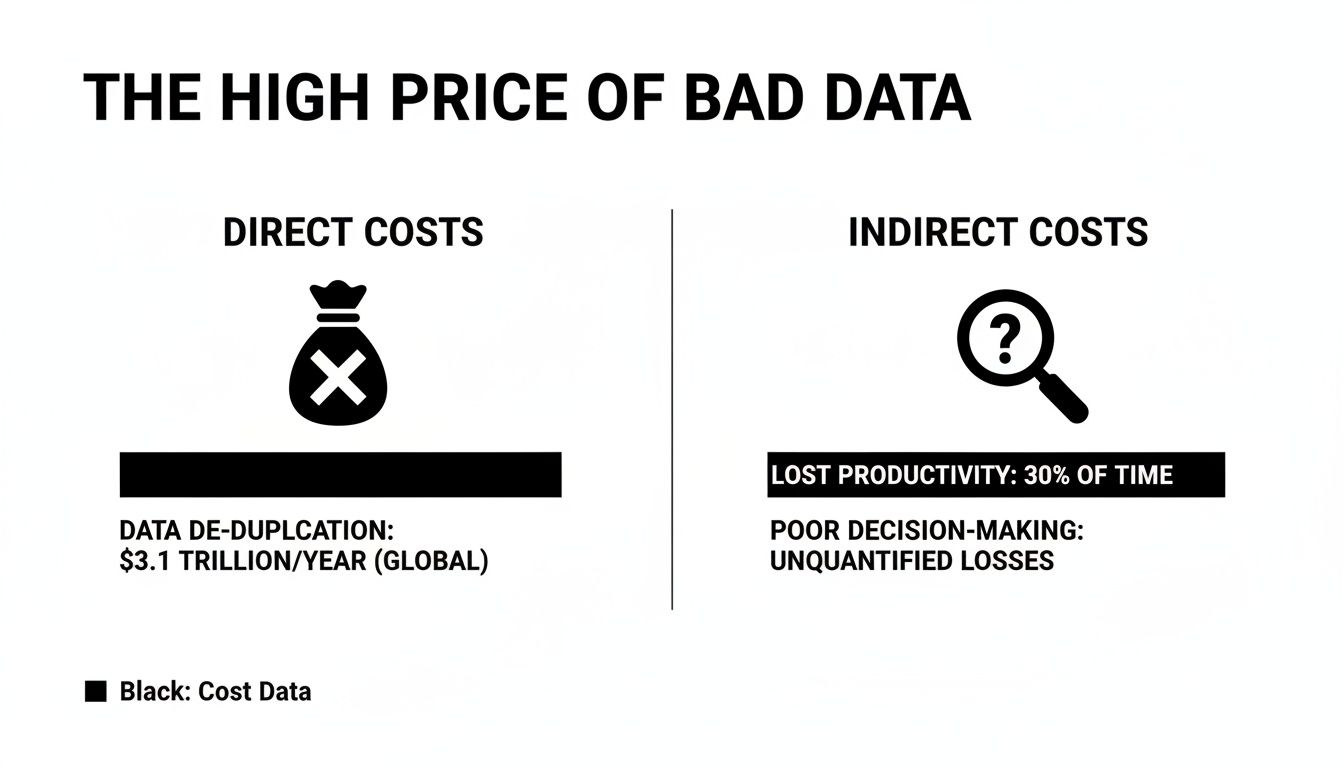
Direct costs are the easy-to-measure financial losses, while indirect costs are the sneakier drains on productivity and missed opportunities.
Let’s run the numbers for our SDR team’s direct waste:
- Invalid Contacts: 10,000 contacts × 20% = 2,000 invalid contacts
- Wasted Tooling Spend: 2,000 contacts × $0.005/email = $10 in direct tool costs
Okay, $10 doesn’t sound like much. But the real hit comes from wasted labor. If each SDR spends just two minutes on each bad contact—trying to find the right info, logging the bounce, marking the lead as dead—the time-cost explodes.
- Total Wasted Time: 2,000 contacts × 2 minutes/contact = 4,000 minutes (or 66.7 hours)
- Wasted Labor Cost: 66.7 hours × $29/hour = $1,934.30 in wasted salary
Before the campaign has even really begun, the company is already in the hole for $1,944.30.
Step 2: Calculate the Indirect Opportunity Costs
This is where the numbers get scary. Those 2,000 invalid contacts aren’t just a line item of wasted time; they represent 2,000 chances to make a sale that you never got. Using our close rate, we can estimate the revenue that just vanished.
Opportunity cost is the hidden killer. It’s not just about the money you wasted, but the money you never had a chance to earn. For every invalid contact, you lose the entire potential lifetime value of a customer.
Let’s do the math on that missed revenue:
- Potential Deals Lost: 2,000 unreachable contacts × 2% close rate = 40 potential deals
- Total Lost Revenue: 40 deals × $5,000/deal = $200,000 in lost potential revenue
All of a sudden, a “small” data issue has snowballed into a six-figure problem. That initial $1,944 in direct costs is completely overshadowed by the massive opportunity cost.
To really get a handle on this, it’s crucial to know how to properly measure marketing ROI in the first place. This calculation proves that the true cost of poor data quality isn’t just about what you spend, but what you fail to earn.
How Bad Data Sabotages Your Email Deliverability
Poor data quality does more than just waste a bit of money on a few bad contacts. It systematically poisons your entire email marketing operation from the inside out. The real damage happens to your email deliverability—your ability to actually land an email in someone’s inbox instead of the spam folder or, even worse, have it bounce right back.
Think of your company’s sending domain like it has a credit score. This is your sender reputation, and it’s constantly being judged by Internet Service Providers (ISPs) like Gmail, Outlook, and Yahoo. Just like a financial credit score, you build it slowly over time by being a responsible sender. Every good signal, like high open rates, nudges your score up. Every bad signal drags it down.
And bad data? It’s the fastest way to absolutely tank that score. When you fire off an email to an address that doesn’t exist, it creates a hard bounce. This is a permanent delivery failure, and it’s a massive red flag for ISPs. It screams that you aren’t managing your list properly.
The Domino Effect of a Damaged Reputation
A few hard bounces here and there might not seem like a big deal, but they kick off a destructive domino effect. ISPs see the bounces and start getting suspicious. Keep sending to bad addresses, and your sender reputation plummets.
Once that score drops, ISPs start treating your emails very differently.
- Spam Folder Placement: Suddenly, your carefully crafted campaigns are being routed straight to spam, where they’ll almost certainly never be seen.
- Throttling: ISPs might start deliberately slowing down your email delivery, killing the impact of any time-sensitive offers.
- Blocking: In the worst-case scenario, your domain or IP address gets completely blacklisted. Now, you can’t reach anyone at all.
This downward spiral transforms your email marketing from a revenue driver into a pure cost center. Every dollar you pour into content, design, and email platforms is wasted if the messages never even arrive. This is where the true cost of bad data becomes painfully obvious—when your main line of communication gets cut off.
The fallout from a damaged sender reputation isn’t just some abstract concept. Once you end up on a blacklist, it can take weeks or even months of painstaking effort to get off, all while your ability to talk to your customers is completely neutralized.
The Rules Are Getting Tougher
The bar for what’s considered “good sending” is getting higher every year. Major players like Gmail and Yahoo now demand a spam complaint rate below 0.3%. Go over that line, and the penalties are swift and severe. Your emails either get junked or blocked outright. As you can discover from deliverability trends and challenges, the goalposts are constantly moving.
This leaves absolutely zero room for error. A single campaign to a dirty, unverified list is all it takes to trip that wire, triggering immediate and harsh consequences for your ability to reach the inbox.
Keeping a clean list is no longer a “best practice.” It’s a fundamental requirement for survival. The bedrock of a strong sender reputation—and a profitable email program—is proactive data hygiene. That means consistently weeding out invalid, outdated, and risky email addresses to protect your score. You can dive deeper into the process with our complete guide on email list cleaning and see how to put it into action.
The Hidden Costs of Data Decay Over Time
Let’s say you just finished a massive data cleaning project. Your contact list is perfect—every email is validated, every entry is accurate. You can’t just set it and forget it, though. Data isn’t a one-time purchase; it’s a living asset that starts to degrade the second you acquire it.
This natural erosion is called data decay. It’s the quiet, constant process that turns your most valuable contact list into a minefield of bad information. People switch jobs, get new email addresses, and move on. Companies rebrand or go out of business. Without regular upkeep, the clean list you celebrated today will be a major source of problems a year from now.
The Unseen Drain of Natural Attrition
Think of it this way: doing nothing is still a choice. By not actively maintaining your list, you’re choosing to let it rot. Every marketing email you send to a decayed address is money down the drain. Every sales call to a contact who left their job six months ago is time your team can never get back.
This isn’t a small problem. One analysis of over 10 billion emails found that a shocking 28% of email data goes bad in just one year. If you have a database of 100,000 contacts, that’s 28,000 leads and customers becoming unreachable every single year, just from natural decay. You can discover more about these data quality findings and see how this directly impacts marketing budgets and sender scores.
This is why data hygiene has to be a continuous process, not a one-and-done project. It needs to be woven into the fabric of your daily operations.
Quantifying the Impact of Decay
The financial hit from data decay goes far beyond a few bounced emails. It’s a compounding issue that quietly chips away at your bottom line, turning what should be a valuable asset into a growing liability.
Let’s break down exactly how this decay costs you real money:
- Shrinking Reach: You think you’re marketing to 100,000 people, but the real number is shrinking every single day. Your total addressable market is constantly getting smaller, even as your database size stays the same.
- Inflated Campaign Costs: As your pool of valid contacts shrinks, the cost to reach a real person skyrockets. You’re spending the same campaign budget to connect with fewer and fewer people, which absolutely tanks your ROI.
- Damaged Sender Reputation: Emailing addresses that have decayed and are now invalid is a fast track to getting high bounce rates. As we covered, hard bounces are a huge red flag for email providers. They directly harm your sender reputation and jeopardize the deliverability of all your future campaigns.
Data decay is the silent tax on stored information. It guarantees that any list, no matter how clean it is today, will become a source of wasted spend and operational drag tomorrow if left unchecked.
Ultimately, ignoring data decay is like trying to run your sales and marketing engines on increasingly bad fuel. Your teams will work harder just to get diminishing returns, and your entire strategy will be based on data that no longer reflects reality. The only way to fight back is to treat data quality as an ongoing, essential part of your workflow.
Your Proactive Data Quality Action Plan
Knowing just how much bad data costs is one thing; doing something about it is what actually protects your bottom line. To get from problem to solution, you need a proactive framework—a clear set of steps that shifts data hygiene from a reactive headache to a core business process. This isn’t about a one-time cleanup. It’s about building a sustainable defense against bad data for the long haul.
A solid action plan is your best defense against the financial drain, operational drag, and reputational damage we’ve been talking about. It gives your marketing, sales, and development teams the confidence to trust the information they work with every single day. Let’s walk through the four essential pillars of an effective data quality strategy.

Step 1: Audit Your Existing Data
You can’t fix a problem you don’t fully understand. The very first move is to figure out where you stand by auditing your current database. This process means running your entire contact list through a validation service to get a crystal-clear picture of its health.
An audit will spit out some critical metrics:
- The percentage of invalid emails that are guaranteed to hard bounce and hurt your sender reputation.
- The presence of spam traps, which are a massive red flag for ISPs and a fast track to getting blacklisted.
- The number of disposable domains—those temporary addresses that are totally useless for building real relationships.
This initial analysis gives you a tangible starting point. It quantifies the scope of your data quality problem and shows you exactly where to focus your efforts.
Step 2: Implement Real-Time Validation
Once you’ve established a clean baseline, the next priority is to stop bad data from getting in the door in the first place. This is where real-time validation is a game-changer. By integrating an email verification API at every single entry point—your sign-up forms, demo requests, newsletter subscriptions—you can check an email’s validity before it ever touches your database.
Honestly, this is the most cost-effective way to maintain data quality. Think of it as a bouncer at the door of your CRM, checking IDs and making sure only legitimate contacts get inside. This simple step catches typos, fake emails, and other junk on the spot.
Step 3: Perform Regular Bulk Cleaning
Real-time validation stops new bad data, but what about the data that’s already in your system? As we’ve covered, even perfectly good contacts go stale. People change jobs, abandon old inboxes—it’s just a fact of life. To fight this natural decay, you need to perform regular, bulk list cleaning.
For active lists, it’s best practice to validate them at least quarterly to combat natural data decay. If you’re a high-volume sender, validating before each major campaign is even better.
This means exporting your contact list, running it through a bulk validation tool, and then updating your CRM by removing or flagging the invalid entries. This is just good preventative maintenance. It ensures you aren’t wasting money or torching your sender reputation by emailing dead-end contacts.
Step 4: Automate Your Validation Workflow
The final step is to bring it all together with automation. Let’s be real, manually exporting and importing lists for cleaning is a time-suck nobody wants. The most effective data quality strategies connect validation tools directly to your existing marketing and sales platforms.
Using tools like Zapier, you can build simple, automated workflows. For example, you can set up a “Zap” that automatically verifies every new lead added to your CRM or email platform. This creates a self-healing system where your data is constantly monitored and cleaned without anyone lifting a finger, freeing up your team to focus on growth instead of playing data janitor.
Frequently Asked Questions
What’s the quickest way to see what bad data is costing me?
The fastest way to get a real number is to look straight at your email marketing. Figure out what it costs you to send a single email—that includes your email platform fees, content creation, and staff time.
Now, multiply that cost by your hard bounce rate from a recent campaign. The number you get is the exact amount of money you just wasted on emails that went nowhere. It’s a simple, powerful starting point for understanding the real financial drain.
Can email validation actually fix my sender reputation?
Yes, it’s one of the most direct ways to do it. When you scrub your list before hitting “send,” you’re weeding out all the bad addresses—the invalid ones, the risky ones, and the ones that just don’t exist. This immediately slashes your hard bounce rate and drastically lowers your chances of hitting a spam trap.
Internet Service Providers (ISPs) pay close attention to bounce rates and spam complaints when they calculate your sender reputation. A clean send tells them you’re a legitimate, responsible sender, which is crucial for protecting and even improving your score over time.
Think of proactive email validation as preventative maintenance for your sender reputation. It’s less about fixing a reputation after it’s broken and more about making sure you never damage it in the first place.
How often should I be cleaning my email list?
That really depends on how you’re using it. Your sending volume and how quickly you add new contacts are the biggest factors.
Here are a few good rules of thumb:
- For active lists: A full-scale validation at least once a quarter is a great practice to fight off natural data decay.
- For high-volume sending: The safest bet is to validate your list right before you launch any major campaign.
- For new contacts: Always use real-time validation at every single point where you collect data, like your website sign-up forms. No exceptions.
Is it better to clean my current list or just buy a new one?
Cleaning the list you already have is almost always the smarter, more profitable choice. These are people who have already raised their hands and shown interest in what you do—they’re warm leads. Cleaning that list is about restoring its value and making sure your messages actually get to them.
Buying a new, cold list is a total gamble. You often end up with a huge number of data quality problems right out of the gate, which can do serious damage to your sender reputation in a hurry.
Stop validating once and hoping for the best. Truelist’s recurring validation automatically re-checks your lists on a schedule — catching new bounces, dead mailboxes, and risky addresses before they damage your sender reputation. Pay-as-you-go credits that never expire, plus unlimited plans for high-volume senders.