
 Claude
  Perplexity
Email Deliverability Consultant: Improve Inbox Placement Today
Discover how an email deliverability consultant can boost inbox placement, reduce spam risks, and optimize your sending practices.
TL;DR: Discover how an email deliverability consultant can boost inbox placement, reduce spam risks, and optimize your sending practices.
So, what exactly is an email deliverability consultant? Think of them as a specialist who figures out why your emails aren’t making it to the inbox and then fixes the problem. They’re your guide through the maze of rules set by giants like Gmail and Outlook, tackling everything from technical setup to your sender reputation so your messages actually get seen.
Why Your Emails Go Missing and How a Consultant Brings Them Back
Sending an email feels simple, right? You hit “send” and assume it arrives. But what’s really happening is more like trying to get a package through international customs. Every single email is inspected. Mailbox providers are the border agents, and their rules are strict and constantly changing.
If your email doesn’t have the right “digital passport” (think technical authentication) or if your sending history looks sketchy, it gets turned away or tossed into the junk pile. This is where an email deliverability consultant is a lifesaver.
They’re part technical wizard, part data detective. Their entire job is to diagnose why your emails are vanishing and put a stop to it, ensuring your marketing campaigns and important updates clear customs every single time.
The Problem is Bigger Than You Think
Most businesses don’t realize just how many of their emails are lost in transit. On average, only about 83.1% of marketing emails ever make it to the inbox. That means nearly 17% of all emails simply disappear, which is a huge blow to potential revenue and customer relationships. For every six emails you send, one is essentially lost forever.
An email deliverability consultant doesn’t just offer generic tips; they dig deep to find the specific reasons your emails are failing. Following foundational B2B email marketing best practices is a great start, but a consultant takes it to the next level by tailoring a strategy just for you.
Common Headaches a Consultant Is Hired to Fix
Companies usually call in a consultant when they’re facing frustrating problems that are starting to hurt the bottom line. These issues often boil down to a few common culprits. It becomes especially urgent when you notice your mail is going to spam and can’t figure out why.
Let’s look at the most frequent deliverability nightmares and how an expert swoops in to solve them.
Common Deliverability Problems and Consultant Solutions
The table below breaks down the typical issues that cause email delivery to fail and shows the targeted solutions a consultant brings to the table.
| Problem | Impact on Business | Consultant’s Solution |
|---|---|---|
| High Bounce Rates | Wasted marketing budget, a damaged sender reputation, and lost sales opportunities. | Performs deep list hygiene, sets up real-time email validation, and segments out inactive contacts to protect your reputation. |
| Landing in the Spam Folder | Abysmal open rates, poor engagement, and customers missing important messages. | Audits content for spammy words, fixes technical authentication (SPF, DKIM, DMARC), and properly warms up new sending IPs/domains. |
| Domain/IP Blacklisting | A complete stop to all email communications, bringing campaigns and outreach to a grinding halt. | Pinpoints the reason for the blacklisting, manages the delisting process with blacklist operators, and implements new protocols to prevent it from happening again. |
| Low Sender Reputation | Mailbox providers start limiting your sending volume or aggressively filtering your emails into junk. | Creates a reputation recovery plan, manages sending volume and frequency, and optimizes campaigns to encourage positive user engagement (opens, clicks). |
Ultimately, a consultant’s goal isn’t just to fix the immediate fire but to build a resilient, healthy email program that keeps your messages flowing to the inbox long-term.
What a Deliverability Consultant Actually Does
An email deliverability consultant does way more than just pull your emails out of the spam folder. They perform a complete, top-to-bottom overhaul of your entire email program, fixing the deep-seated issues that got you into trouble in the first place.
Think of them less like a quick-fix handyman and more like a master architect for your email strategy. They’re part technical wizard, part marketing strategist. They don’t just fix one bad campaign; they dig into everything from your domain’s hidden reputation score to the infrastructure sending your messages. The goal is to build a sending presence that’s resilient and trustworthy in the eyes of inbox providers like Gmail and Outlook.
This flowchart really captures the essence of their job: they step in to figure out why your emails are vanishing and then build the bridge to get them back where they belong—the inbox.
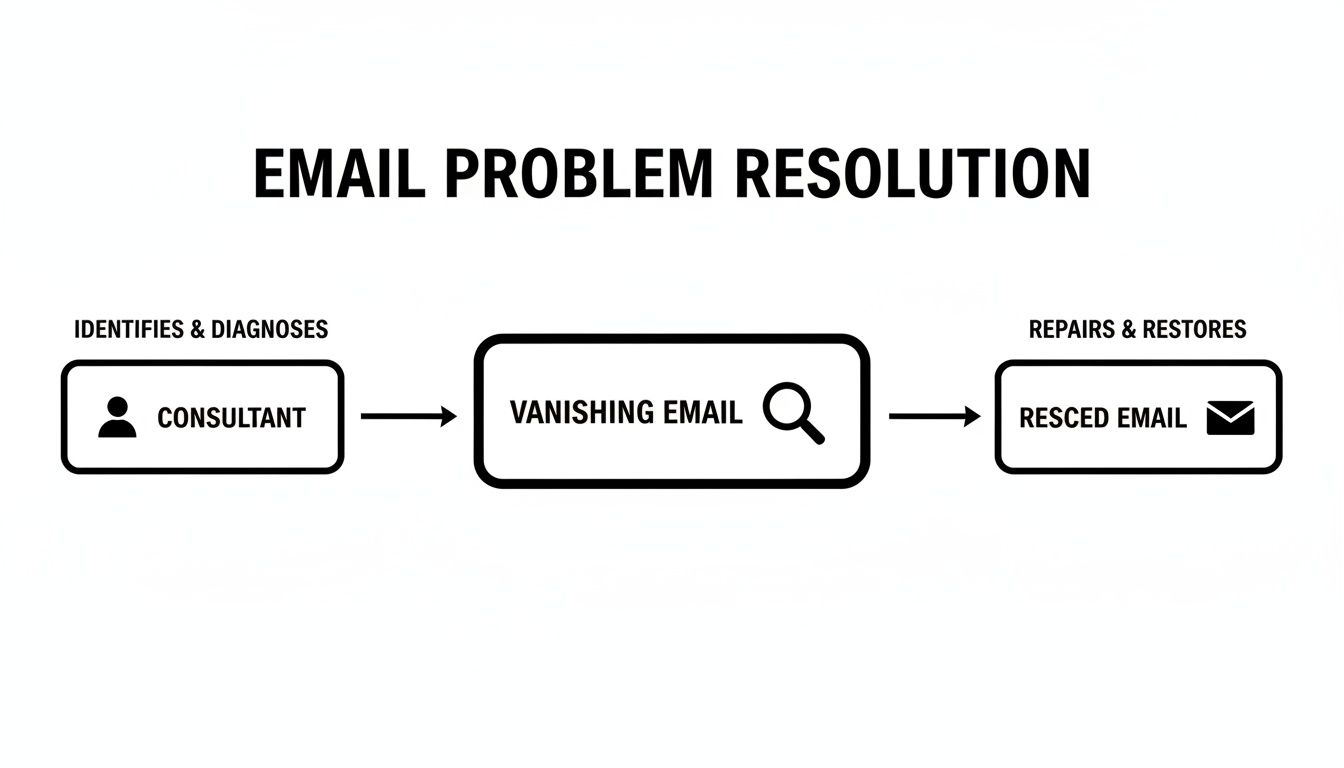
Without this expert intervention, those lost emails are just lost opportunities. With it, you get a reliable channel for genuine customer engagement.
The Comprehensive Deliverability Audit
The first thing any good consultant will do is a comprehensive deliverability audit. This isn’t just a quick peek at your open rates. It’s a full-blown forensic investigation into every single piece of your sending process. Imagine a master mechanic running diagnostics on an engine to find that one tiny, hidden problem causing all the trouble.
During the audit, they’ll meticulously pick apart:
- Authentication Records: Is your SPF, DKIM, and DMARC set up correctly? These are like your domain’s passport, and one mistake can lead to instant rejection.
- Reputation Metrics: They’ll check the health of your sending IPs and domains using tools like Google Postmaster Tools and Microsoft SNDS to see how the big providers view you.
- Historical Performance: They’ll comb through past campaigns, looking for patterns like high complaint rates or bounce codes that point to bigger issues.
- Content and Infrastructure: Even your email templates and sending platform get a close look to spot any potential spam triggers.
Technical Authentication Management
One of the most vital jobs for an email deliverability consultant is handling the technical side of authentication. As we mentioned, protocols like SPF, DKIM, and DMARC are absolutely essential for proving your emails are legitimate. But setting them up is notoriously tricky and a common point of failure.
A consultant makes sure these records aren’t just there, but are perfectly configured for all the services you use to send email. They’ll also help you establish a DMARC policy that shields your domain from phishing attacks—a huge trust signal for mailbox providers. If you want to get into the weeds, our guide explains what is email authentication in much more detail.
Key Takeaway: Think of proper authentication as the foundation of your email program. Without it, even the world’s best email content will land in spam, because inbox providers simply can’t verify that you are who you claim to be.
Strategic IP and Domain Warm-Up
When you start sending from a new IP address or domain, you have zero reputation. Blasting out thousands of emails right away is like a total stranger walking into a bank and asking for a massive loan—it’s immediately suspicious and gets shut down.
A consultant manages the IP and domain warm-up process, which is all about building a good reputation over time, much like building a credit score. They’ll map out a careful sending schedule, starting with small batches of emails to your most engaged subscribers. This slow, steady approach proves to Gmail and others that you’re a legitimate sender with content people actually want. Skipping this is one of the fastest ways to kill a new domain’s reputation for good.
List Hygiene and Blacklist Remediation
Finally, a consultant wears two more hats: data quality expert and crisis manager. They’ll put serious list hygiene practices in place, going far beyond just checking for typos. This means segmenting out subscribers who never open your emails and finding potential spam traps before you hit them.
And if the worst happens and you land on a blacklist, they lead the remediation process. This involves finding out why you were listed, contacting the blacklist operators to get you removed, and putting new safeguards in place so it never happens again. This kind of crisis management is crucial for getting your email program back on its feet. Of course, even for experts, a steady stream of new business is key; effective lead generation for consultants helps them find the clients who need their help the most.
Warning Signs You Urgently Need an Expert

So, how do you know when your email program is actually in trouble? It’s rarely a sudden crash. More often, it’s a slow burn—a gradual decline that signals a deep-seated problem that needs a professional eye. Spotting these signs early can be the difference between a quick tune-up and lasting damage to your sender reputation.
Many marketers keep an eye on the basic metrics, but the real red flags are often more subtle and tangled together. If you’re nodding along to several of these symptoms, it’s a pretty clear sign you need to bring in an email deliverability consultant to run a proper diagnosis.
Your Engagement Metrics Are in a Nosedive
The most glaring sign of trouble? A steady, relentless drop in your open and click-through rates. Look, a single bad campaign happens to the best of us, but a downward trend across multiple sends points to a much bigger issue. This isn’t just “list fatigue.” It’s a quiet signal that mailbox providers like Gmail and Outlook are starting to filter your emails straight to the spam folder.
When your messages don’t even make it to the inbox, your subscribers can’t engage. This kicks off a nasty feedback loop: low engagement tanks your sender reputation, which makes it even harder for your next email to get delivered.
An unhealthy email program doesn’t fix itself—it slowly erodes your most valuable communication channel. Ignoring declining metrics is like ignoring a check engine light; the problem only gets worse and more expensive to fix over time.
Getting into the inbox is a massive challenge, and the filters are only getting smarter. Recent data paints a stark picture, showing inbox placement at Outlook/Hotmail can be as low as 26.77%. Numbers like these prove that without an expert managing your reputation, your messages are likely getting lost. You can discover more insights about these deliverability statistics and see just how tough the landscape is.
You See an Unexplained Spike in Bounces
Is your bounce rate suddenly shooting up, especially hard bounces? That’s a huge red flag. Assuming you haven’t just uploaded a dusty old list, a spike like this often means mailbox providers are actively rejecting your mail before it even gets close to an inbox.
Your Email Service Provider (ESP) will likely give you a generic reason code, but they can rarely tell you why your specific sending practices are causing the rejections. A deliverability consultant, on the other hand, can dig into the raw bounce logs to find the root cause and build a plan to fix it.
Critical Emails Go Missing
This is the one that really hurts. Customers start complaining that they never received their password reset link. Or their order confirmation vanished. This is when you know you have a serious problem.
I’m talking about the emails people are actively waiting for:
- Password reset links
- Order confirmations and shipping updates
- Welcome emails with account activation steps
- Two-factor authentication codes
When these don’t show up, it’s not just a minor hiccup. It blows up your customer support queue, kills conversions, and directly erodes trust in your brand. This isn’t an inconvenience; it’s a critical breakdown of your email infrastructure.
Your Spam Complaint Rate Is Climbing
Keep a close watch on this number. The industry standard for a healthy spam complaint rate is below 0.1%. Once you start creeping toward or past that line, you are in the danger zone. Every spam complaint is a direct vote from your audience telling mailbox providers, “I don’t want this.”
High complaint rates are one of the fastest ways to torch your sender reputation and land on a blocklist. A consultant can pinpoint exactly which campaigns, segments, or sign-up sources are driving the complaints, helping you pivot before the damage becomes irreversible.
How to Hire the Right Deliverability Consultant
Finding the right email deliverability consultant isn’t like filling any other marketing role. A sharp resume and a confident interview are nice, but they mean nothing without deep, proven technical chops.
You’re hunting for a specialist who lives and breathes the complex, ever-shifting rules of mailbox providers. Choosing the wrong person doesn’t just waste your money; it can leave your sender reputation in an even deeper hole than when you started.
The trick is to push past the surface-level claims and really dig into their process. You need a structured way to vet candidates, focusing on their track record, how they solve problems, and whether they truly grasp the specific challenges your business is up against. This ensures you’re hiring a hands-on expert who gets results, not just a theorist who talks a good game.
Platforms like LinkedIn are a decent place to start. A quick search will bring up plenty of people with the title, from solo freelancers to experts at larger agencies. But this is just the first step. You’ll need a solid vetting process to separate the real experts from the crowd.
Essential Questions to Ask a Potential Consultant
Your interview process should feel less like a friendly chat and more like a technical deep-dive. Ask questions that force them to show you what they know, not just tell you.
Here’s a checklist to help you evaluate a consultant’s expertise, strategic thinking, and how well they fit your business needs.
Essential Questions to Ask a Potential Consultant
| Category | Question to Ask | What to Listen For in Their Answer |
|---|---|---|
| Experience & Case Studies | “Walk me through a time you helped a client recover from a major domain blacklisting. What were your exact steps?” | They should provide a specific, step-by-step account. Vague answers are a red flag. |
| Technical Knowledge | “Describe the deliverability challenges of Gmail versus Outlook. How do your strategies differ for each?” | A real expert knows that each mailbox provider is its own ecosystem with unique rules. |
| Problem-Solving | “What’s your process for a full deliverability audit? What tools and data points do you rely on?” | Look for a methodical approach, not just “checking best practices.” They should name specific tools. |
| Strategy & Planning | “How do you approach a new IP and domain warm-up? How do you adjust it based on performance?” | Their answer should be data-driven, mentioning feedback loops and performance metrics. |
| Industry Awareness | “How do you stay current with the latest algorithm changes from major mailbox providers?” | They should mention specific sources like industry blogs, forums, or direct relationships. |
The answers you get should be confident, detailed, and full of technical specifics. If you hear a lot of buzzwords and generic talk about “best practices,” it’s a clear warning sign.
Key Insight: A top-tier consultant won’t just tell you what they do; they’ll explain why they do it. Every action they propose should connect directly back to the core principles of sender reputation and email authentication.
Understanding Common Pricing Models
The cost of hiring an email deliverability consultant varies quite a bit, but it usually falls into one of three buckets. Knowing these models helps you budget properly and find a partnership that makes sense, whether you’re dealing with a one-time crisis or need ongoing support.
1. Project-Based Fees
This is the go-to model for specific, one-off jobs like a comprehensive audit, getting off a blacklist, or setting up authentication for a new domain.
For a single project, expect to invest anywhere from $5,000 to $20,000, depending on how complex and urgent the situation is. It’s the perfect fit if you have a clear, immediate problem that needs a focused solution.
2. Monthly Retainers
If you need continuous oversight and strategic guidance, a monthly retainer is the standard. This gets you ongoing monitoring, performance analysis, and proactive management of your sender reputation.
Retainers can range from $2,000 to $10,000+ per month, driven by your sending volume and how much hands-on work is needed.
3. Hourly Consulting
Some consultants offer their time by the hour, which is great for smaller tasks, team training sessions, or just getting some quick advice.
Hourly rates typically fall between $150 and $400. This gives you flexibility if you don’t need a full-time commitment but still want expert guidance when issues pop up.
Making the right hire is a critical investment in the health of your entire email program. By asking the tough questions and understanding the costs, you can confidently bring in an expert who will not only fix your current problems but also protect a vital channel for your business’s growth.
A Simple Deliverability Self-Audit Checklist
Before you call in the cavalry, it’s a good idea to do a quick self-audit. Think of it as a preliminary check-up that gives you a snapshot of your email program’s health. You won’t solve everything, but you’ll definitely spot the most obvious red flags.
This process arms you for a much more productive conversation with a consultant later.

This checklist hits the foundational pillars of good deliverability. By running through these items, you’ll start to see where the cracks in your system are and get a better handle on the scope of the problem.
1. Verify Your Domain Authentication
Think of your domain’s authentication records—SPF, DKIM, and DMARC—as a digital passport for your emails. They prove to mailbox providers that you are who you say you are. This is ground zero for avoiding the spam folder.
A simple misconfiguration here is one of the most common reasons for deliverability failure. You can use free online tools like DMARC analyzers or MXToolbox to see if your records are set up and passing validation.
- SPF (Sender Policy Framework): This record is just a list of the IP addresses that are approved to send email for your domain. If an email comes from an IP not on this list, it’s a huge red flag for receivers.
- DKIM (DomainKeys Identified Mail): This adds a digital signature to your emails, which basically proves the message wasn’t messed with after it left your server.
- DMARC (Domain-based Message Authentication, Reporting & Conformance): DMARC pulls SPF and DKIM together. It tells receiving servers what to do with emails that fail those checks (like quarantine them or reject them outright).
2. Check Your Sender Reputation
Your sender reputation is exactly what it sounds like: a score that internet service providers (ISPs) give your sending domain and IP. A bad score is a one-way ticket to the junk folder.
You can get a look at this score using free services from the big players themselves, like Google Postmaster Tools for Gmail or Microsoft SNDS for Outlook. These dashboards give you a direct window into how they see your sending habits.
Expert Insight: While B2B emails can hit a delivery rate of 98.16%, that success hinges on best practices—especially a clean sender reputation. An email deliverability consultant often gets the call when this reputation starts to slide, because even small dings can cause deliverability to crater. Discover more insights about email deliverability statistics on trulyinbox.com.
These tools will show you your domain and IP reputation (usually on a scale from Bad to High) and, most importantly, how many users are reporting your emails as spam. If you see a “Medium” or “Low” reputation, that’s a clear signal you have issues that need fixing.
3. Review Your Email Content
Even with a perfect technical setup, the words and images inside your email can still set off spam filters. You have to take an honest look at your recent campaigns. It’s a crucial part of any real audit.
Keep an eye out for common spam triggers that might be doing more harm than good.
Common Content-Related Spam Triggers:
- Misleading Subject Lines: Ditch the clickbait, excessive capitalization, and strings of exclamation points.
- Spammy Keywords: Overusing words like “free,” “winner,” or “act now” can get you flagged.
- Image-Heavy Emails: An email that’s mostly one big image with very little text is a classic spammer tactic and gets scrutinized heavily.
- Hidden Unsubscribe Link: If your unsubscribe link is hard to find, you’re breaking trust and practically begging for spam complaints. Make it obvious.
This initial once-over gives you a solid baseline. For a more detailed breakdown of diagnostics, our guide on how to test email deliverability offers additional steps you can take. When you finally bring in a consultant, you’ll be ready with specific data and a much clearer picture of where you need their help the most.
Frequently Asked Questions
If you’re digging into email deliverability, you’ve probably got a few questions. That’s a good thing. Let’s tackle some of the most common ones that come up when people are thinking about bringing in a specialist.
How Long Does It Take to See Results?
This is always the first question, and the honest answer is: it depends entirely on what we’re starting with. If the problem is purely technical, say a botched authentication record, we could see a positive shift within a few days of getting it fixed. Simple as that.
But if we’re dealing with a damaged sender reputation, that’s a different ballgame. Think of it like trying to fix a bad credit score—it just doesn’t happen overnight. Rebuilding trust with mailbox providers like Gmail and Outlook takes time and a pattern of consistently good sending behavior.
Realistic Timeline: Most of the time, you can expect to see real, stable improvements in your inbox placement within 4 to 12 weeks. A good consultant won’t promise you the world in a week; they’ll audit your situation and give you a timeline that actually makes sense.
Can’t My Email Service Provider Just Handle This?
Your Email Service Provider (ESP)—whether it’s Mailchimp, Klaviyo, or another platform—is definitely part of the equation. Their job is to keep their sending network healthy, and they offer some foundational support. But their focus is on the entire platform, not just your specific account.
An ESP’s support team is great for basic setup questions, but they aren’t going to roll up their sleeves and dive deep into your list hygiene, your content strategy, or the unique reputation issues tied to your domain.
That’s where a consultant comes in. They work for you. Every piece of advice is tailored to your audience, your sending patterns, and your business goals. It’s a level of dedicated, personalized service that goes way beyond what a general ESP support desk can offer.
What’s the Difference Between Delivery and Deliverability?
People throw these two terms around like they’re the same thing, but they are worlds apart. Getting this right is the key to understanding why deliverability is so critical.
- Email Delivery: This is just the first step. It means the receiving server said, “Okay, I got it.” The message was sent from your server and accepted by the recipient’s server without bouncing.
- Email Deliverability: This is what happens next. It’s all about where that email lands after being accepted—the inbox, the spam folder, or a tab like Promotions.
You can have a 100% delivery rate and still have a 0% deliverability rate if every single email you send goes straight to the spam folder. A consultant’s job is to focus on that second part: maximizing your inbox placement. That’s the metric that actually drives opens, clicks, and revenue.
Is Hiring a Consultant Worth It for a Small Business?
If email is a primary channel for your business—for sales, customer communication, or keeping users engaged—then the answer is an emphatic yes. The cost of doing nothing is almost always higher than the consultant’s fee.
Poor deliverability isn’t just some abstract problem; it has a direct impact on your bottom line.
Just think about what’s really at stake:
- Lost Sales: Every promotional email that hits the spam folder is a sale you never had a chance to make.
- Customer Churn: When a password reset or order confirmation email goes missing, you’re not just losing a message; you’re creating a frustrating experience that erodes customer trust.
- Damaged Brand Reputation: Landing in the spam folder over and over tells both your audience and the mailbox providers that your brand isn’t trustworthy.
Bringing in an expert isn’t an expense; it’s an investment in protecting and reviving a vital revenue channel. A great deliverability consultant doesn’t just fix problems—they unlock the true potential of your entire email program, delivering a return you can see in your metrics.
Ready to stop guessing and start reaching the inbox? Truelist provides the essential email validation tools needed to clean your lists, reduce bounce rates, and protect your sender reputation. With pay-as-you-go credits that never expire, plus unlimited plans for high-volume senders, you can ensure every email you send has the best possible chance of landing where it belongs. Start validating for free today at Truelist and build a foundation for deliverability success.