 Claude
  Perplexity
email marketing tools for small business: Top 12 in 2025
Discover the best email marketing tools for small business to boost campaigns, automate emails, and grow sales. Compare features, pricing, and reviews.
TL;DR: Discover the best email marketing tools for small business to boost campaigns, automate emails, and grow sales. Compare features, pricing, and reviews.
Navigating the crowded market of email marketing tools for small business can be a significant challenge. With dozens of platforms all promising to boost your engagement and drive sales, it’s difficult to determine which solution truly aligns with your specific needs, budget, and technical skills. Do you need a simple newsletter editor, a complex automation engine for e-commerce, or a robust API for transactional emails? The right choice can accelerate your growth, while the wrong one can lead to wasted resources and frustrating limitations.
This comprehensive guide cuts through the noise. We’ve curated a detailed list of the top platforms, moving beyond generic feature lists to provide a practical analysis of each tool. You’ll find a breakdown of core functionalities, from campaign creation and automation to analytics and deliverability. Crucially, we also cover specialized tools like email validation services, which are essential for maintaining a healthy sender reputation and maximizing your outreach effectiveness. For a deeper dive into the broader strategies and concepts behind effective email outreach, you might also explore more resources on email marketing.
Our goal is to equip you with the information needed to make a confident decision. Each entry includes:
- A concise overview of its ideal use case.
- An honest assessment of its pros and cons.
- Clear pricing information.
- Direct links and screenshots to see the platform in action.
This resource is designed to be your definitive roadmap for selecting the perfect email marketing tools to scale your small business. Let’s get started.
1. Truelist
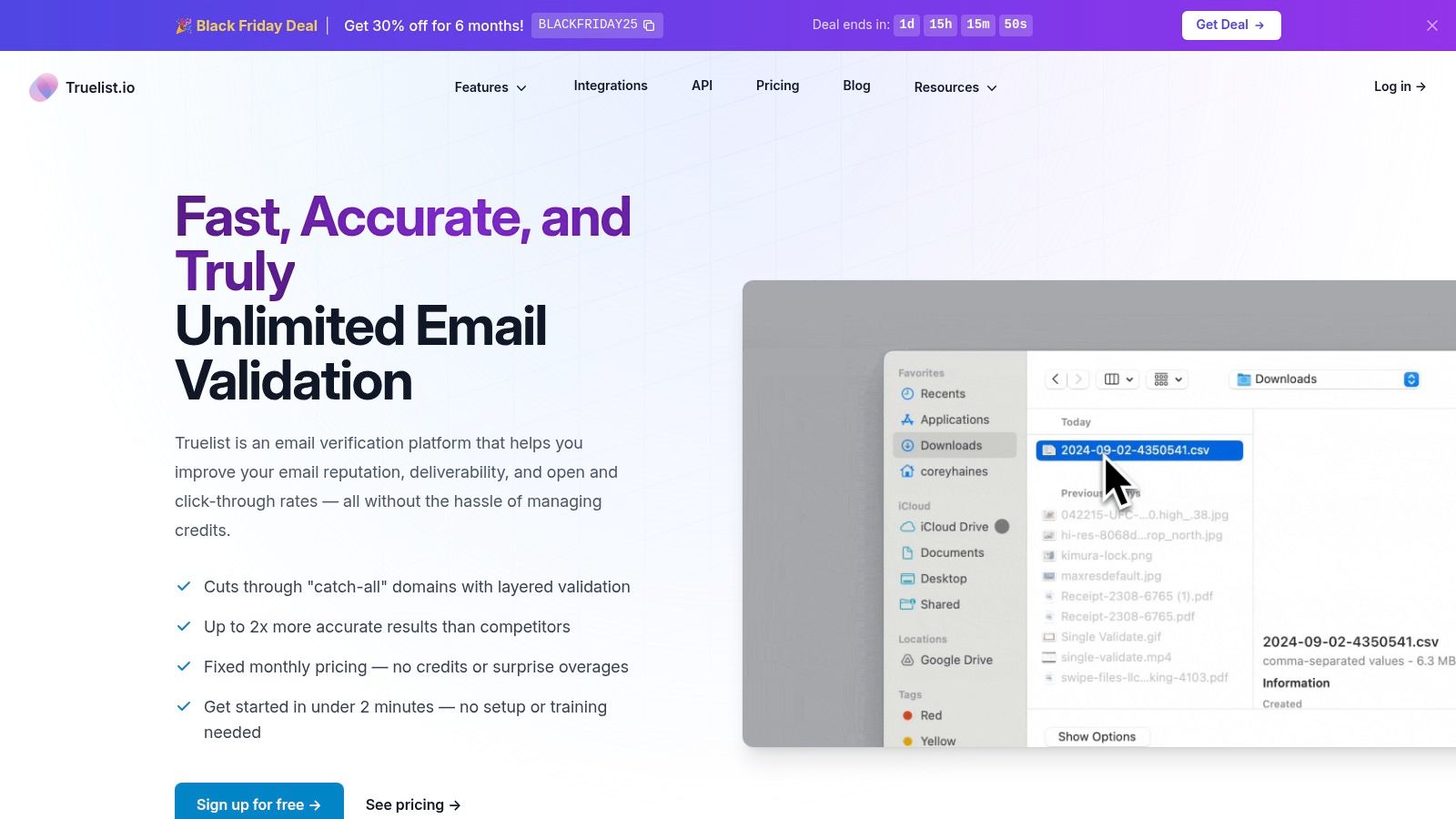
Truelist emerges as a standout email validation service, fundamentally changing how small businesses approach list hygiene. Truelist offers flexible, predictable pricing: pay-as-you-go credits that never expire, plus unlimited plans for high-volume senders. This model removes the friction of expiring credits and surprise overages, making it an exceptional choice for businesses with high-volume or unpredictable list growth. It’s a powerful tool for maintaining a high sender reputation and maximizing email deliverability without cost-related bottlenecks.
The platform’s core strength lies in its multi-layered validation engine, which goes beyond simple SMTP checks. It combines these probes with automated browser checks, third-party API data, and breach intelligence to provide a more accurate verdict. This advanced methodology is particularly effective at minimizing “unknown” results from tricky accept-all domains, giving users a clearer, more actionable dataset.
Why Truelist Stands Out
Truelist is more than just a validator; it’s a complete deliverability toolkit designed for efficiency. It integrates seamlessly into existing workflows with one-click connections to platforms like Mailchimp, ConvertKit, Zapier, and Clay.com. For developers, the real-time API and webhooks enable automated list cleaning directly within custom applications. The platform is GDPR-compliant and co-founded by Grant Ammons, the former head of engineering at ConvertKit, adding a layer of industry credibility.
| Feature Analysis | Use Case & Practical Benefit |
|---|---|
| Flexible Pricing | With credits that never expire plus unlimited plans for high-volume senders, a growing startup can clean its entire database as list health demands, scaling spend to match usage. |
| Multi-Strategy Verification | Reduces bounce rates from catch-all servers by applying extra logic, protecting your sender score and improving inbox placement. |
| One-Click Integrations | An e-commerce store can automatically verify every new subscriber from their Mailchimp list, ensuring transactional and marketing emails reach real customers. |
| Advanced Reporting | An SDR team can use bounce risk codes and domain quality reports to prioritize outreach and refine their lead generation lists for higher engagement. |
Best for: Small businesses, startups, and marketing teams seeking a cost-effective, high-volume email validation solution with robust automation capabilities.
Website: https://truelist.io
2. Mailchimp
Mailchimp is often the first platform small businesses encounter when starting with email marketing, and for good reason. It has built its reputation on an incredibly user-friendly interface, making it one of the most approachable email marketing tools for small business owners who may not have deep technical expertise. The platform excels at guiding new users through creating their first campaigns, from its intuitive drag-and-drop builder to its vast library of professional templates.
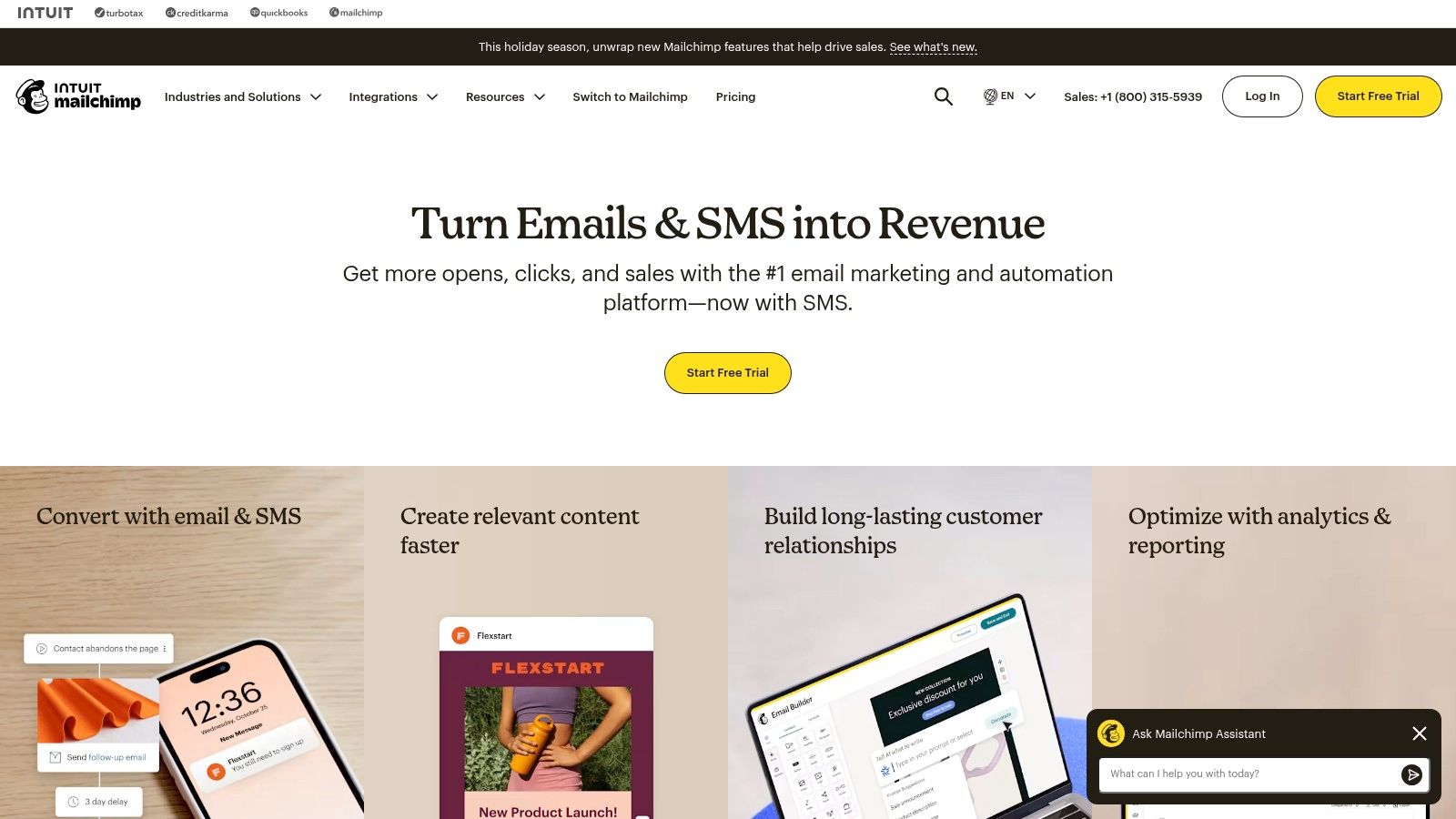
Beyond the basics, Mailchimp offers a robust suite of features that grow with your business. This includes multi-step automation workflows, A/B testing, and AI-powered tools like the Content Optimizer, which analyzes your email copy to suggest improvements. Its reporting dashboard is clear and actionable, helping you understand campaign performance without getting lost in data.
Key Features and Considerations
- Best For: Businesses looking for an all-in-one platform with a gentle learning curve and a clear path to scale.
- Pricing: Offers a free plan for up to 500 contacts and 1,000 sends per month (with daily limits). Paid plans (Essentials, Standard, Premium) start at $13/month and scale based on contact count. Be mindful that pricing can increase significantly as your list grows.
- Integrations: Boasts a massive ecosystem with over 300 integrations, connecting to everything from Shopify and WooCommerce to Salesforce and Canva. You can learn more about integrating Mailchimp with list validation tools to maintain a healthy audience.
Pros:
- Extremely intuitive and beginner-friendly interface.
- Strong free plan to get started.
- Excellent reporting and analytics.
Cons:
- Can become expensive compared to competitors at higher contact tiers.
- Automation features on lower-tier plans are limited.
3. Constant Contact
Constant Contact has been a mainstay in the digital marketing world for decades, carving out a niche by focusing on the specific needs of small businesses, nonprofits, and entrepreneurs. It stands out by combining a straightforward email editor with exceptionally accessible customer support, including live phone and chat services. This makes it one of the best email marketing tools for small business owners who value hands-on guidance and want a reliable platform for more than just emails, including event management and social media posting.
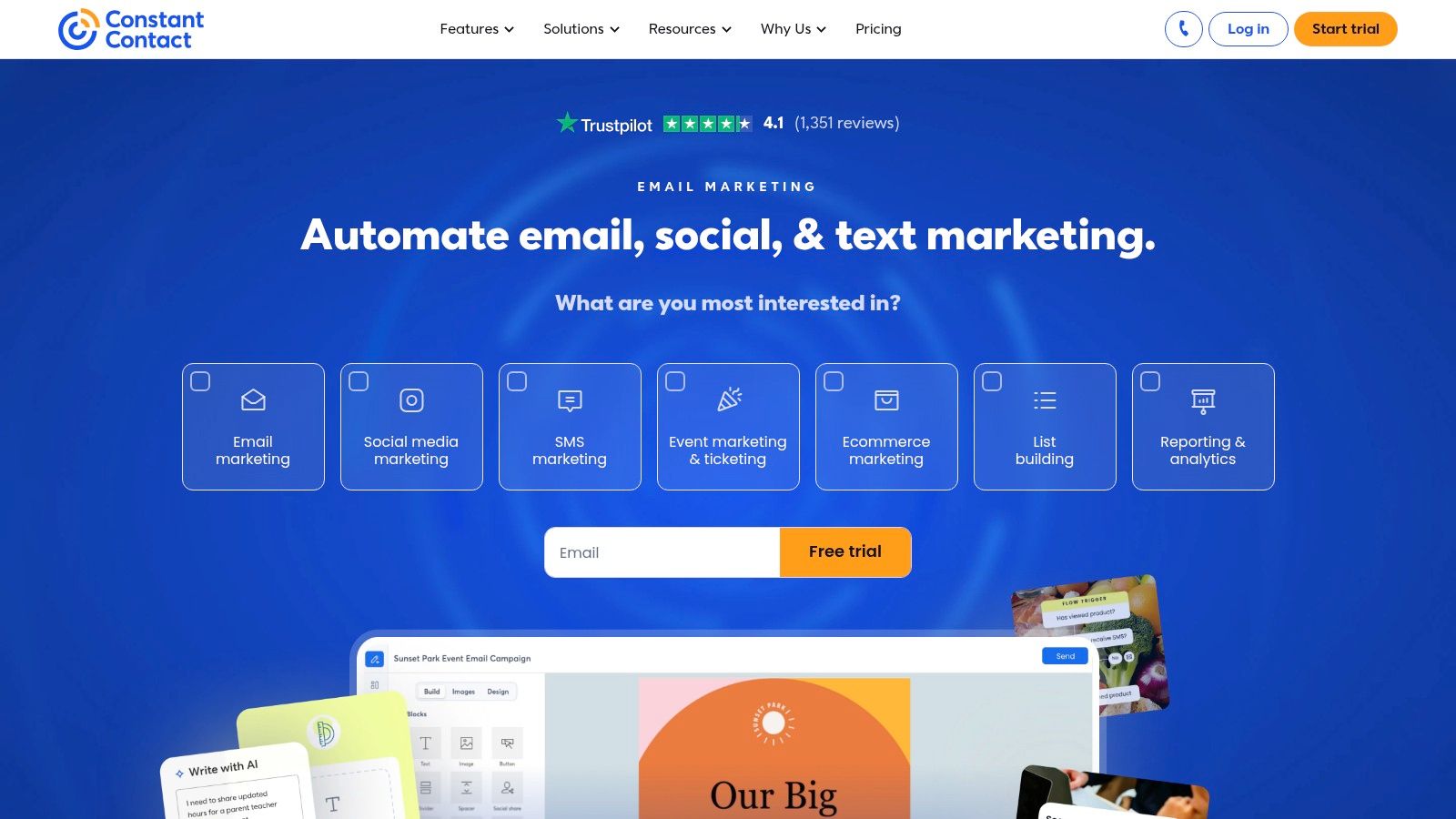
The platform features an intuitive drag-and-drop editor complemented by a growing library of templates and an AI Content Generator to help overcome writer’s block. Its feature set is practical and geared toward direct results, offering basic automation, A/B testing for subject lines, and powerful integrations with platforms like Eventbrite and Shopify. For businesses that host events or sell products online, Constant Contact provides a unified hub to manage promotions and communications effectively.
Key Features and Considerations
- Best For: Small businesses, event organizers, and nonprofits that prioritize excellent customer support and an easy-to-use, all-in-one marketing toolkit.
- Pricing: Plans start at $12/month for the Core plan (up to 500 contacts) and $35/month for the Plus plan, which adds more advanced features. Pricing increases with the number of contacts, and a 30-day money-back guarantee is offered.
- Integrations: Connects with hundreds of popular apps and services, with particularly strong integrations for e-commerce (Shopify), event management (Eventbrite), and lead generation tools.
Pros:
- Outstanding customer support with phone, chat, and onboarding options.
- User-friendly interface and practical feature set.
- Offers discounts for nonprofits that prepay.
Cons:
- Email send limits are tied directly to your contact count.
- Advanced features like inbox preview come at an additional cost.
4. Brevo (formerly Sendinblue)
Brevo positions itself as a powerful, all-in-one sales and marketing suite that goes far beyond simple email campaigns. For small businesses watching their budget, its most appealing feature is a pricing model primarily based on send volume rather than contact list size. This makes it one of the more accessible email marketing tools for small business owners who want to grow their audience without facing immediate, prohibitive cost increases. The platform seamlessly integrates email, SMS, WhatsApp, and even a CRM into one unified dashboard.
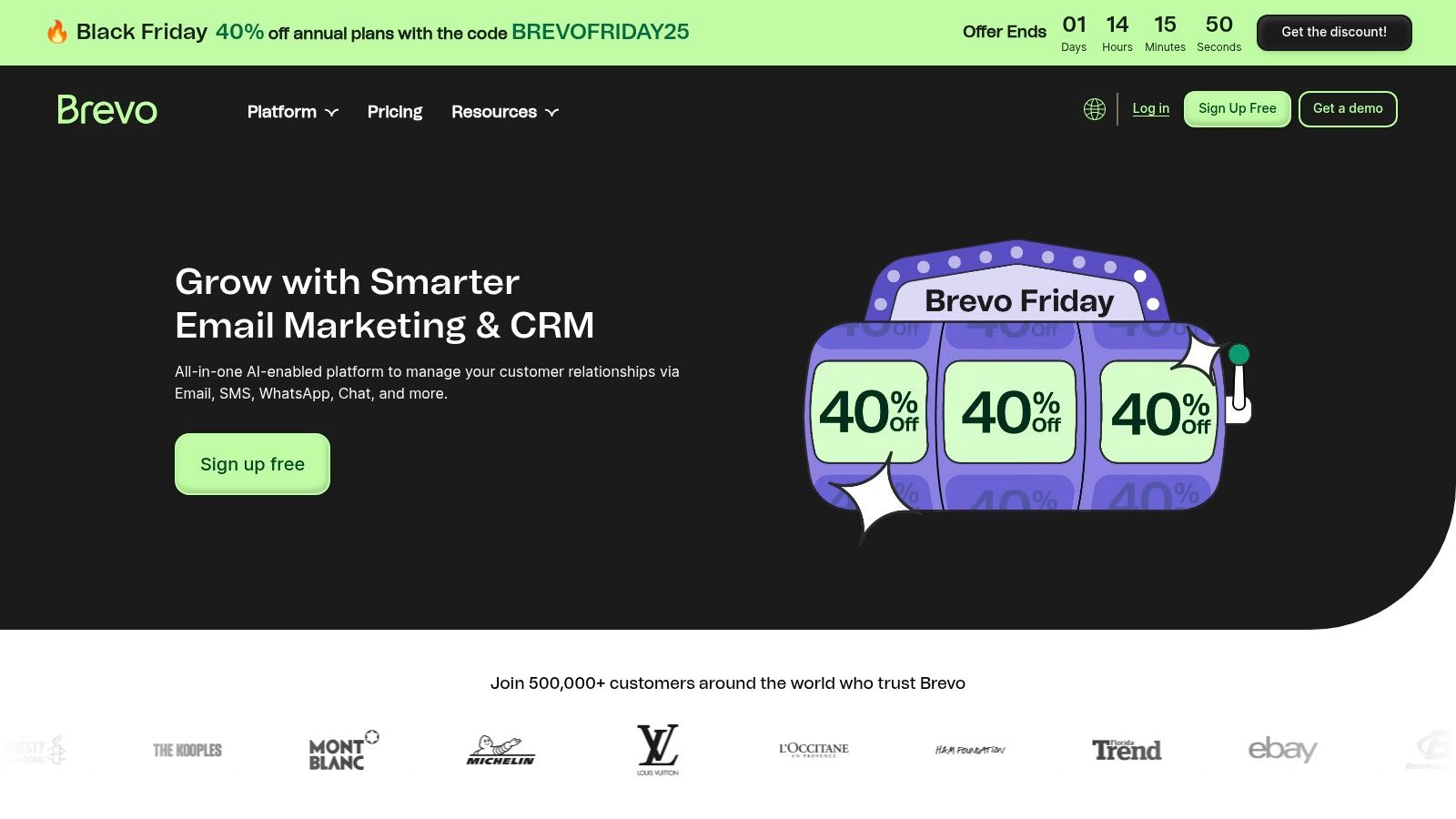
What truly sets Brevo apart for growing teams is the availability of robust marketing automation for unlimited contacts, even on its lower-tier plans. While some competitors gate their best automation features, Brevo allows users to build complex workflows, segment audiences, and personalize communication channels early on. Its suite also includes landing pages, transactional emails, and A/B testing, providing a comprehensive toolkit to nurture leads and engage customers effectively across multiple touchpoints.
Key Features and Considerations
- Best For: Budget-conscious businesses needing a multichannel marketing platform with strong automation features that don’t scale in price with contact list size.
- Pricing: Offers a generous free plan with up to 300 emails/day and unlimited contacts. Paid plans (Starter, Business, Brevo Plus) start at $25/month for 20k emails and add features like A/B testing and advanced reporting.
- Integrations: Connects with major platforms like Shopify, WordPress, and Salesforce. Keeping your list clean is vital, and you can learn more about verifying your Brevo lists to improve deliverability.
Pros:
- Transparent, send-based pricing is highly cost-effective for large lists.
- Solid automation features are included at lower price points.
- Flexible multichannel options (SMS, WhatsApp) are built-in.
Cons:
- The jump in price to the Business tier can be significant.
- Some advanced features are only available as paid add-ons.
5. MailerLite
MailerLite positions itself as a powerful yet elegantly simple platform, making it a favorite among creators, freelancers, and small businesses. It stands out by bundling a full suite of marketing tools beyond just email, including a website builder, landing pages, and blogs, even on its generous free plan. This makes it one of the best email marketing tools for small business owners who need an affordable, all-in-one solution without a steep learning curve. The interface is clean and uncluttered, focusing on an intuitive user experience from the drag-and-drop editor to its straightforward automation builder.
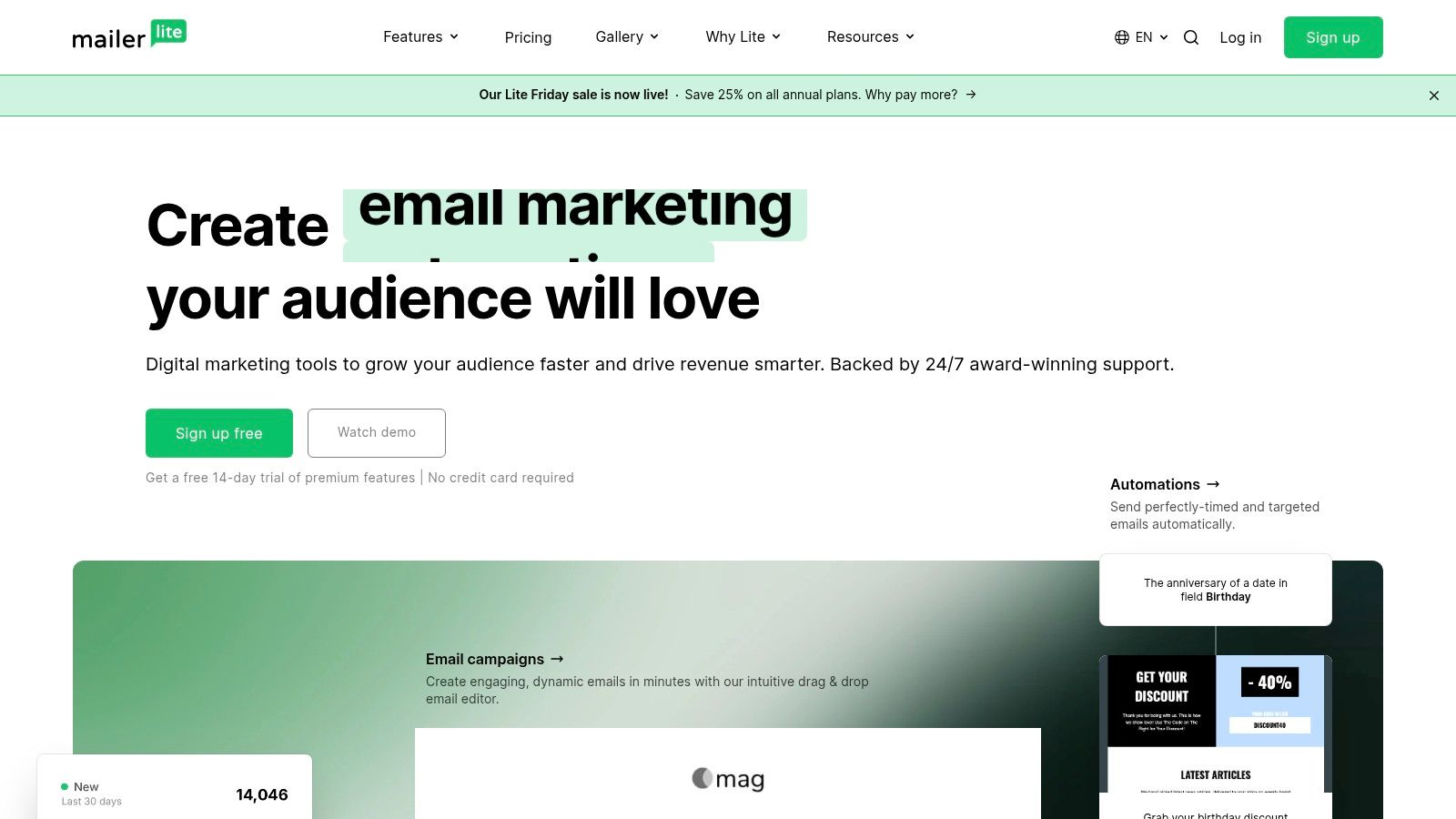
The platform offers sophisticated features like A/B testing, dynamic content, and an AI writing assistant to help you craft more effective campaigns. Its approachability, combined with a feature set that supports growth, makes it a compelling choice for businesses that want professional tools without the enterprise-level price tag or complexity. Keeping your contact list clean is crucial for deliverability, and you can read about cleaning MailerLite lists to ensure your messages reach the inbox.
Key Features and Considerations
- Best For: Creators, bloggers, and small businesses seeking an affordable, multi-functional platform that combines email, landing pages, and websites.
- Pricing: Offers a great free plan for up to 500 subscribers and 12,000 monthly sends. Paid plans (Growing Business, Advanced) start at just $10/month, with transparent, contact-based pricing and discounts for nonprofits.
- Integrations: Connects with over 140 popular tools, including Shopify, WooCommerce, Stripe, and Zapier, allowing for seamless workflow integration across your business apps.
Pros:
- Very generous free plan that includes automation and 12,000 sends.
- Extremely competitive and clear pricing as you scale.
- Bundled website and landing page builders add significant value.
Cons:
- Free plan is limited to 500 subscribers.
- Some advanced website and e-commerce features are reserved for higher-tier plans.
6. Klaviyo
For small businesses rooted in e-commerce, Klaviyo has become the gold standard. It’s an email marketing tool for small business owners who need to tie every campaign directly to revenue. The platform is engineered from the ground up to leverage customer purchase data, allowing for incredibly powerful segmentation and automation based on what customers buy, how often they shop, and their predicted lifetime value.
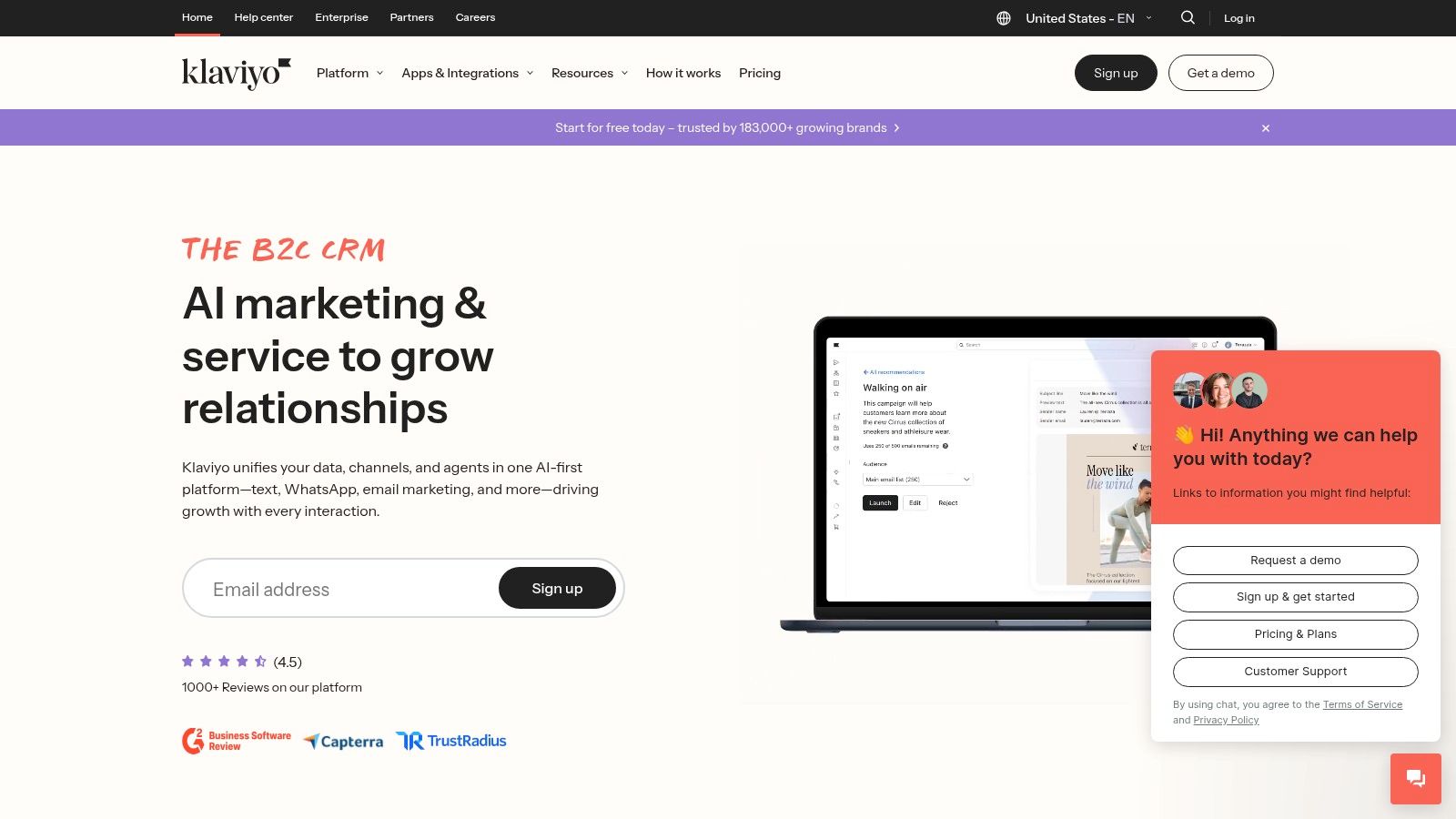
Klaviyo’s true strength lies in its pre-built automation “flows” designed for e-commerce, such as abandoned cart reminders, browse abandonment follow-ups, and post-purchase thank you series. These are not just basic templates; they are sophisticated workflows that can be customized with dynamic product recommendations. This deep integration with e-commerce platforms like Shopify, BigCommerce, and WooCommerce allows for a seamless flow of data that fuels highly personalized and profitable marketing efforts.
Key Features and Considerations
- Best For: E-commerce businesses, particularly those on Shopify, that want to maximize revenue through data-driven automation.
- Pricing: Offers a free plan for up to 250 contacts and 500 email sends. Paid plans (Email, Email & SMS) are flexible, starting around $20/month, and scale based on your contact list and SMS sending volume.
- Integrations: Features over 350 pre-built integrations with a heavy focus on the e-commerce ecosystem, including payment gateways, review apps, and loyalty programs.
Pros:
- Unparalleled depth in e-commerce automation and segmentation.
- Excellent revenue-based reporting and analytics.
- Free tier is great for new stores to get started.
Cons:
- Can become one of the more expensive options as your contact list and order volume grow.
- The interface can feel complex for businesses not focused on e-commerce.
7. HubSpot Marketing Hub
HubSpot offers a powerful suite of email marketing tools for small business integrated directly within its world-class CRM platform. This approach is its key differentiator: every email, landing page, and form submission is automatically tied to a contact record. This creates a unified view of each customer’s journey, allowing for deeply personalized marketing that goes far beyond simple email blasts.
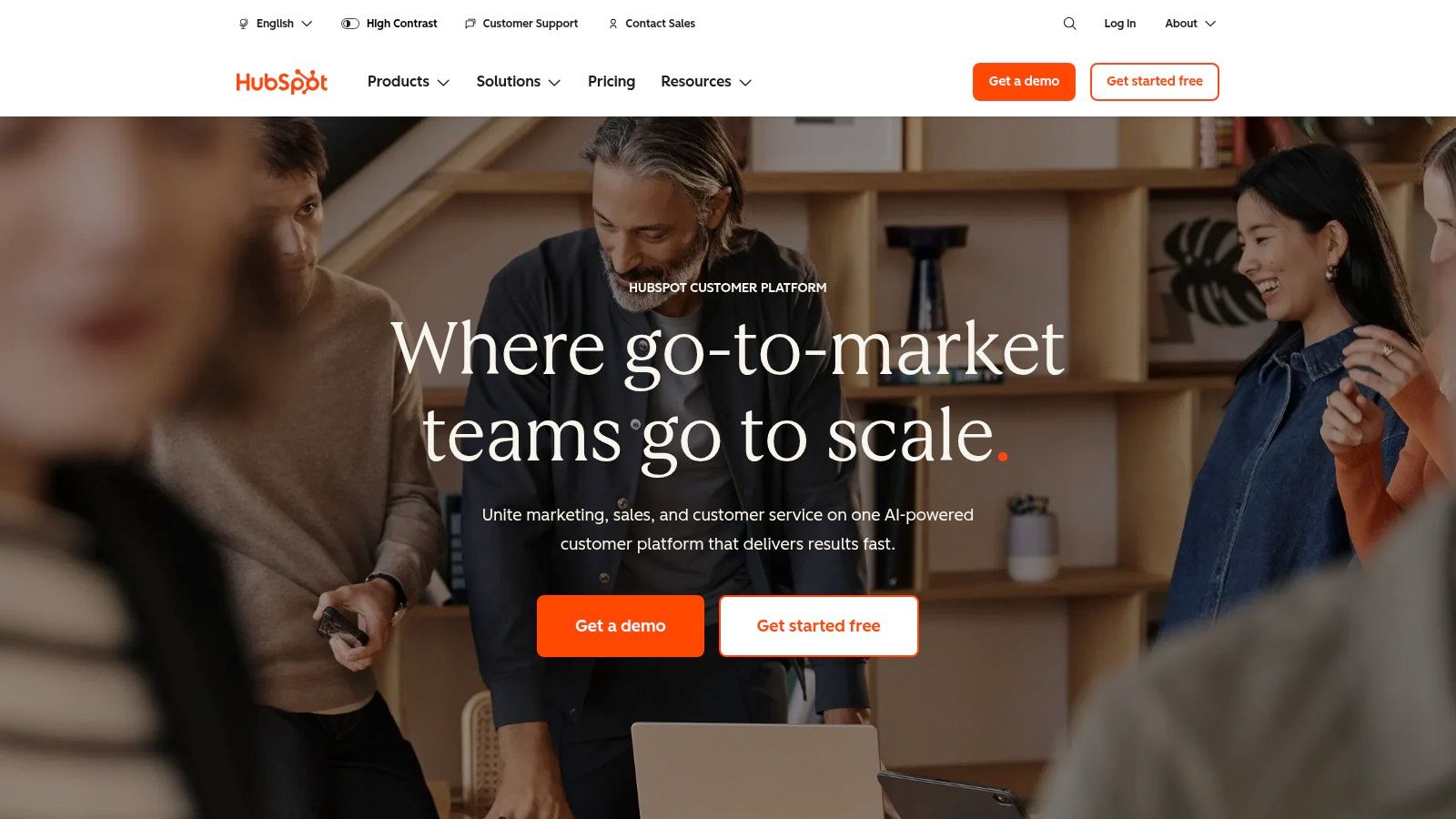
The platform is designed for businesses that want a single source of truth for their marketing, sales, and service efforts. Its visual automation builder allows you to create sophisticated workflows based on user behavior, from lead nurturing sequences to internal team notifications. The tight integration between the CRM and marketing tools means you can segment your audience with incredible precision, using data from across the entire customer lifecycle.
Key Features and Considerations
- Best For: Businesses aiming to build a fully integrated marketing and sales system and those who value a single customer view.
- Pricing: Starts with a generous set of free tools, including email marketing for up to 2,000 sends/month. Paid plans (Starter, Professional, Enterprise) begin at $18/month, but pricing for higher tiers and additional contacts can be complex.
- Integrations: Features a massive app ecosystem with over 1,000 integrations, including native connections to major platforms like Salesforce, Shopify, and Zapier, allowing you to sync data seamlessly.
Pros:
- Unparalleled integration with a comprehensive CRM for a single customer view.
- Scales from powerful free tools to enterprise-grade features.
- Extensive free educational resources, templates, and certifications.
Cons:
- Can be more complex than standalone email tools.
- Higher-tier plans often require mandatory onboarding fees, which can be costly.
8. ActiveCampaign
ActiveCampaign positions itself as a customer experience automation platform, going far beyond standard email blasts. It’s one of the most powerful email marketing tools for small business owners who need sophisticated automation and segmentation capabilities without the enterprise-level price tag. The platform truly shines with its visual journey builder, allowing you to create complex, logic-based workflows that react to customer behavior, site visits, and purchase history.
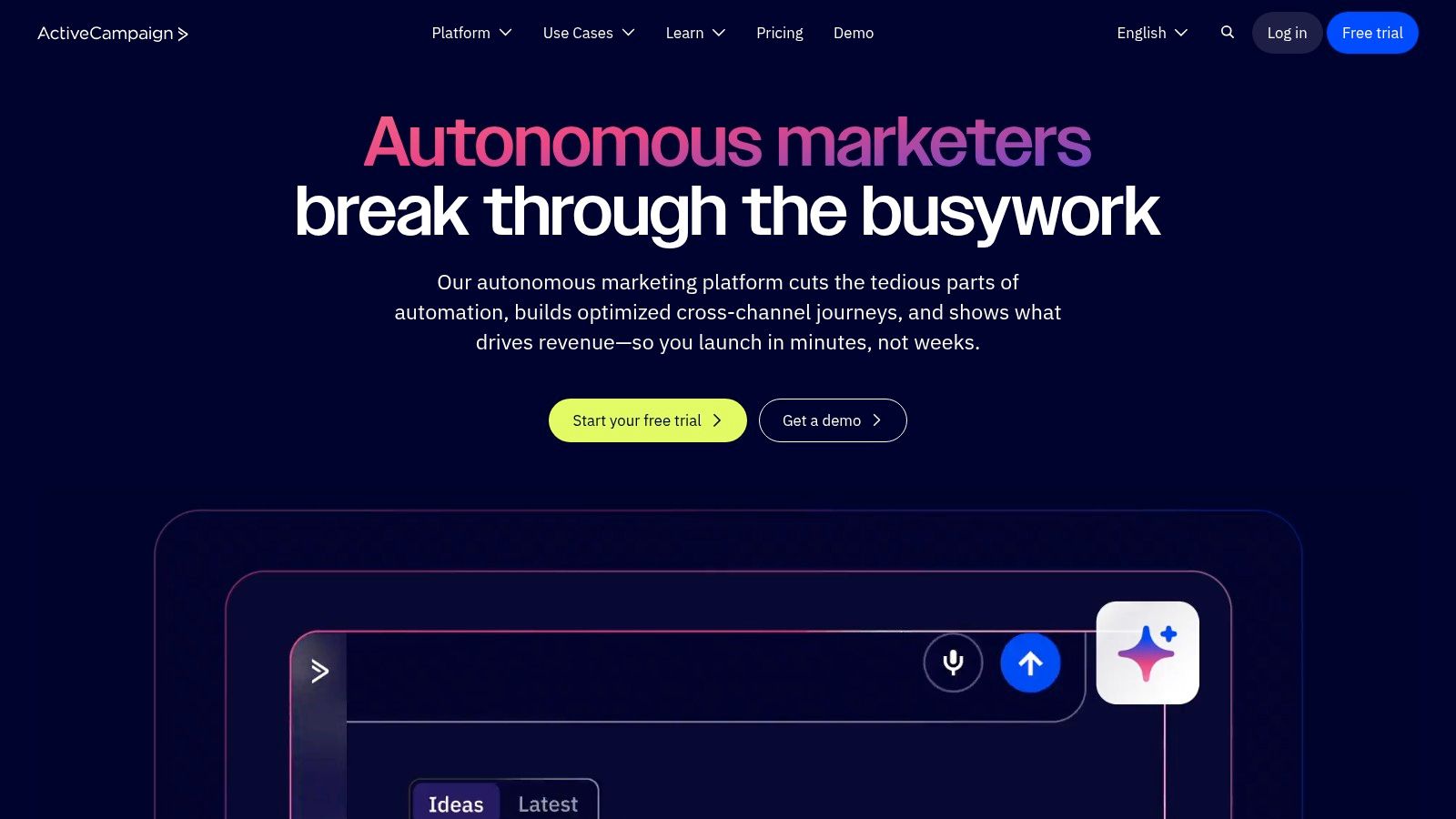
This tool is ideal for businesses that are ready to automate more than just their email follow-ups. With a built-in CRM, ActiveCampaign helps you manage the entire customer lifecycle, from initial lead capture to post-sale engagement. Features like site and event tracking, lead scoring, and conditional content empower you to deliver highly personalized experiences that drive conversions and build loyalty.
Key Features and Considerations
- Best For: Growing businesses that need advanced automation, segmentation, and CRM features to manage a complex customer journey.
- Pricing: Starts with a free 14-day trial that provides access to high-tier features. Paid plans (Marketing Lite, Plus, Professional) begin at $29/month (billed yearly) and increase based on contact count and selected add-ons.
- Integrations: Connects with over 900 apps, including major e-commerce platforms like Shopify, payment gateways like Stripe, and lead generation tools like Unbounce. You can visit ActiveCampaign to explore its full capabilities.
Pros:
- Extremely powerful automation and segmentation at a competitive entry price.
- Integrated CRM provides a holistic view of the customer.
- Generous trial lets you fully evaluate its advanced features.
Cons:
- The sheer number of features can present a steeper learning curve for beginners.
- Pricing structure with add-ons and recent plan changes can be confusing to navigate.
9. GetResponse
GetResponse positions itself as more than just an email platform; it’s an “inbound marketing solution.” This makes it one of the more versatile email marketing tools for small business owners who want to consolidate their marketing efforts into a single dashboard. It uniquely combines email marketing with conversion funnels, landing pages, webinars, and even basic e-commerce features, offering a broader scope than many of its competitors.
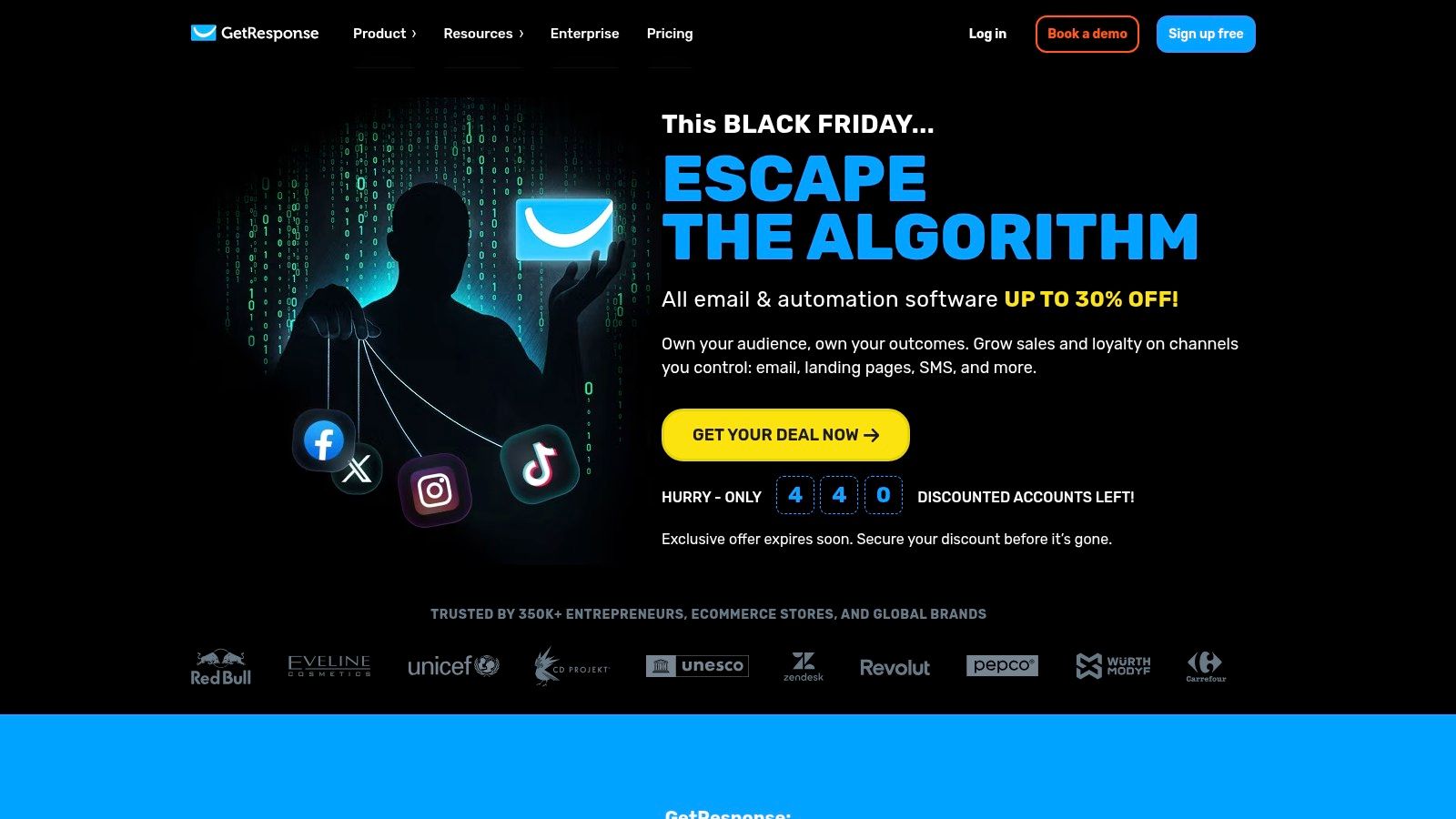
The platform’s strength lies in its all-in-one approach. For a small business, this means you can build a landing page, run a webinar to capture leads, and then nurture them through automated email sequences without ever leaving the GetResponse ecosystem. Its visual automation builder is powerful, allowing for complex workflows based on user behavior, which helps in delivering highly targeted and timely messages. This integrated functionality can save significant time and subscription costs.
Key Features and Considerations
- Best For: Businesses that want an integrated marketing solution that includes email, funnels, and webinars.
- Pricing: Offers a free-forever plan for up to 500 contacts. Paid plans (Email Marketing, Marketing Automation, Ecommerce Marketing) start at approximately $15.58/month. A 14-day free trial is available for paid features.
- Integrations: Connects with over 150 applications, including major e-commerce platforms like Shopify, content management systems like WordPress, and payment gateways like Stripe.
Pros:
- Comprehensive all-in-one feature set at a competitive price point.
- All paid plans include unlimited monthly email sends.
- Includes valuable tools like landing pages and conversion funnels.
Cons:
- Advanced features like webinars are only available on higher-tier plans.
- The interface can feel less intuitive for absolute beginners compared to other tools.
10. Campaign Monitor
Campaign Monitor carves out its niche by focusing on beautiful, brand-centric email design and an exceptionally straightforward user experience. It stands out as one of the best email marketing tools for small business owners who prioritize visual appeal and want to create stunning, professional campaigns without a steep learning curve. The platform’s drag-and-drop builder is clean and powerful, complemented by a library of over 100 mobile-responsive templates that make on-brand messaging simple.
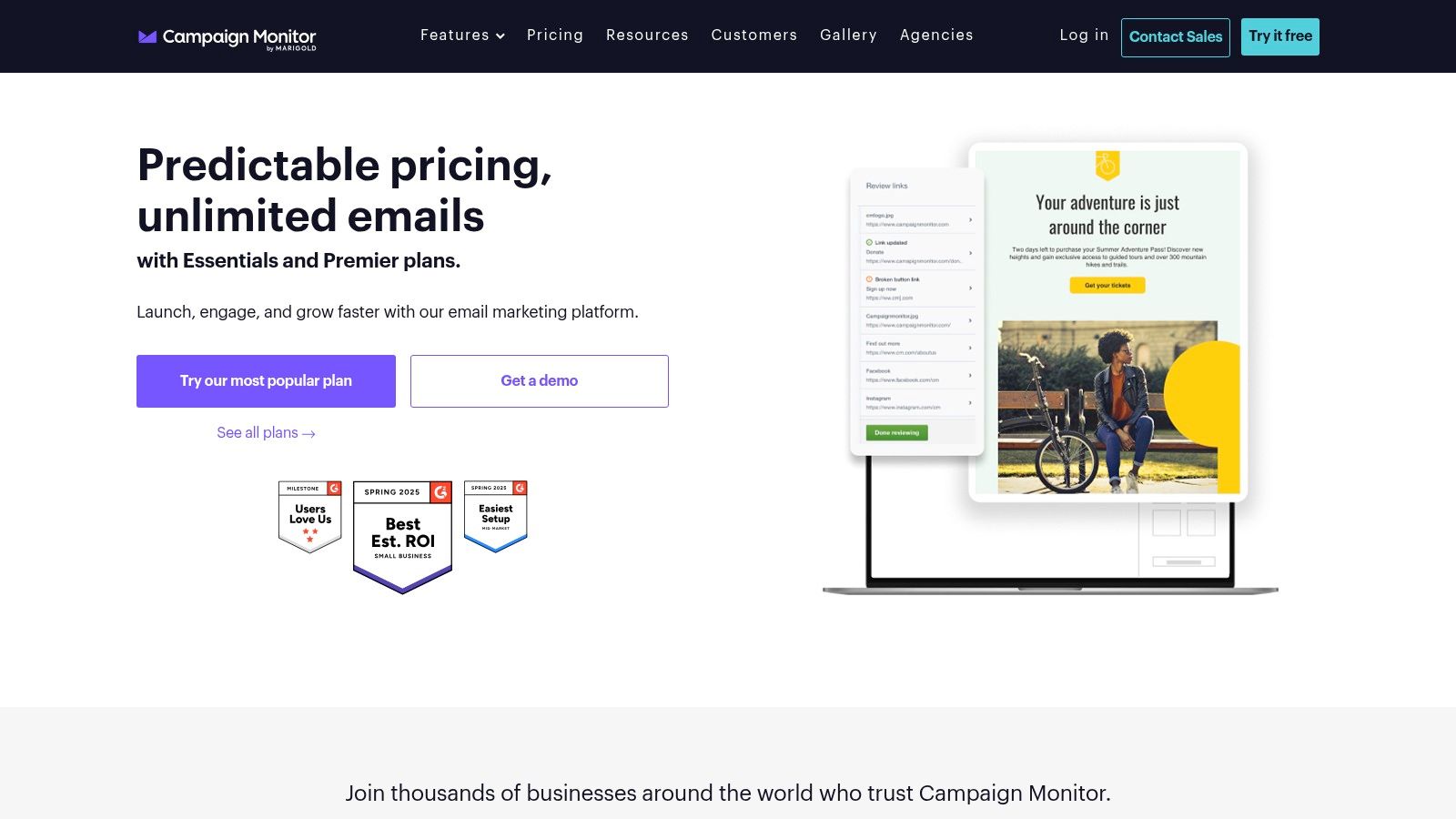
The platform is more than just a pretty face; it provides robust analytics that are easy to interpret, showing real-time engagement and geographic data. A key differentiator is its flexible pricing, particularly the pay-per-campaign option. This model is ideal for businesses that send newsletters or promotions infrequently, allowing them to pay as they go without a monthly commitment. This makes it a cost-effective choice for seasonal businesses or those just starting their email marketing journey.
Key Features and Considerations
- Best For: Design-conscious businesses, nonprofits, and infrequent senders who need a flexible, pay-as-you-go option.
- Pricing: Offers a free plan for testing with up to 5 contacts. Paid plans (Basic, Unlimited, Premier) start at $11/month. A pay-per-campaign option is also available, starting at $12 per campaign plus a per-recipient fee. Significant discounts are offered for registered nonprofits.
- Integrations: Connects with over 250 apps, including major e-commerce platforms like Shopify and WooCommerce, CRM systems, and tools like WordPress and Zapier, ensuring it fits into most existing workflows.
Pros:
- Superior email templates and an easy-to-use design editor.
- Flexible pay-per-campaign pricing model is great for infrequent senders.
- Generous discounts available for nonprofit organizations.
Cons:
- Lacks the advanced multi-channel marketing features of some competitors.
- Key features like send-time optimization require more expensive plans.
11. AWeber
AWeber is one of the original players in the email marketing space, and its longevity is a testament to its reliability and focus on small business needs. It stands out by offering a straightforward, no-fuss approach, making it an excellent email marketing tool for small business owners who prioritize ease of use and dependable deliverability. The platform simplifies core tasks like list building, email design, and sending campaigns, providing a solid foundation without overwhelming users with overly complex features.
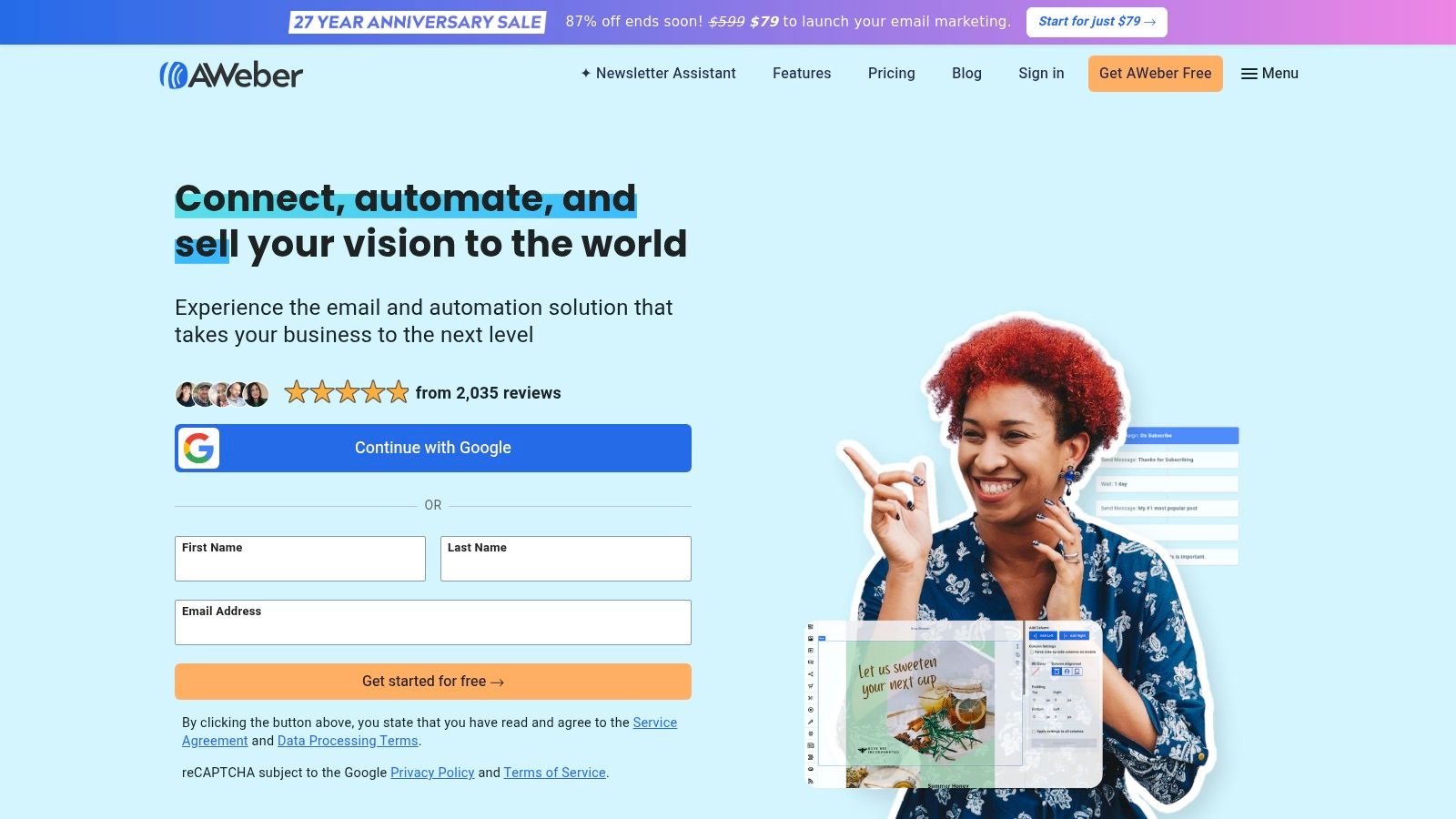
While many platforms offer free migration, AWeber is known for providing dedicated support to help you move your lists, forms, and templates from a previous provider. This hands-on assistance is invaluable for solo entrepreneurs and small teams. Its platform includes a good range of templates, basic automation capabilities, landing pages, and ecommerce tools, covering all the essential bases for a growing business.
Key Features and Considerations
- Best For: Solo operators, content creators, and small businesses seeking a reliable platform with strong customer support and simple, predictable pricing.
- Pricing: A generous free plan is available for up to 500 subscribers and 3,000 sends/month. Paid plans (Plus and Unlimited) start at $20/month billed annually and offer more features, higher sending limits, and remove AWeber branding.
- Integrations: Connects with hundreds of popular apps and services, including WordPress, PayPal, Shopify, and various landing page builders. See more at AWeber.com.
Pros:
- Strong free plan for starting a new list.
- Predictable and transparent pricing structure.
- Excellent customer support and migration assistance.
Cons:
- Advanced automation and analytics features are reserved for higher-tier plans.
- The user interface feels less modern than some newer competitors.
12. Amazon Simple Email Service (SES)
For businesses with technical resources, Amazon Simple Email Service (SES) represents the ultimate in cost-effective, scalable email sending. It’s not a traditional all-in-one platform but rather a powerful cloud-based service designed to send marketing and transactional emails at an incredibly low cost. This makes it one of the most powerful email marketing tools for small business teams that prefer to build their own stack or integrate a reliable sending engine into existing applications.
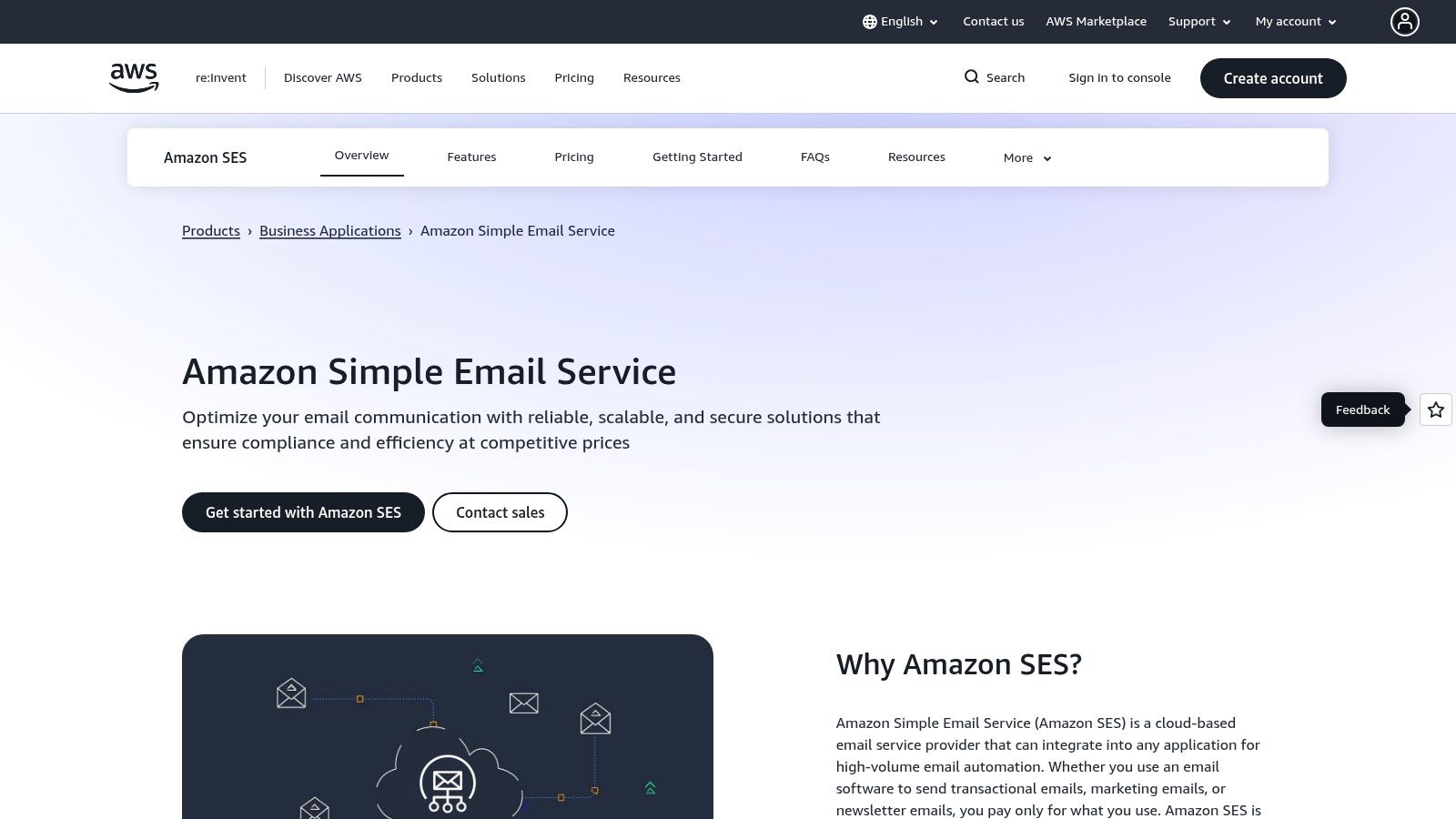
The primary advantage of SES is its pay-as-you-go model and raw sending power. Instead of a graphical interface for campaign creation, you get an API and SMTP endpoint that developers can use to send high volumes of email. Many popular email marketing platforms are actually built on top of SES, and businesses can achieve the same level of deliverability and scale by using it directly or pairing it with a front-end marketing tool.
Key Features and Considerations
- Best For: Technically proficient teams, developers, and businesses using a third-party marketing application that integrates with SES for sending.
- Pricing: Extremely low-cost pay-as-you-go model. The first 62,000 emails sent each month are free (if sent from an application hosted in AWS), after which it costs around $0.10 per 1,000 emails. Additional costs may apply for dedicated IPs or add-ons.
- Integrations: As part of the AWS ecosystem, it integrates deeply with other Amazon services. It also serves as the back-end sending infrastructure for countless third-party email marketing platforms.
Pros:
- Unbeatable cost-effectiveness, especially for high-volume senders.
- High scalability and excellent deliverability when configured correctly.
- Flexible API provides deep control over the sending process.
Cons:
- Requires significant technical expertise to set up and manage.
- Lacks a built-in user interface for creating and managing campaigns.
- The learning curve for understanding AWS and deliverability best practices is steep.
Top 12 Email Marketing Tools Comparison
| Product | Core features | Target audience 👥 | Pricing / Value 💰 | Notable strengths & Quality ✨/★ |
|---|---|---|---|---|
| Truelist 🏆 | Multi-layer checks (SMTP, browser, 3rd‑party); REST API & webhooks | SDRs, email marketers, devs, startups 👥 | Credits that never expire + unlimited plans; free tier; no overages 💰 | ✨High accuracy (reduces “unknown”); founder-led trust; ★★★★☆ |
| Mailchimp | Drag‑and‑drop builder, templates, automation, analytics, integrations | Small → growing businesses 👥 | Free → tiered; pricing grows with contacts 💰 | ✨Easy onboarding & ecosystem; broad integrations; ★★★★ |
| Constant Contact | Drag‑and‑drop, AI copy, automations, phone/chat support | SMBs, nonprofits, events 👥 | Tiered plans; phone support; 30‑day guarantee 💰 | ✨Hands‑on support; deliverability focus; ★★★☆ |
| Brevo (Sendinblue) | Email + SMS/WhatsApp, send‑based pricing, automation, landing pages | Budget-conscious small teams 👥 | Transparent send-based plans; unlimited contacts on automation 💰 | ✨Multichannel & send optimization; ★★★★ |
| MailerLite | Builder, landing pages/sites, automation, AI writing assistant | Creators & SMB starters 👥 | Generous free tier; low starting prices 💰 | ✨Bundled site tools; simple UI; ★★★★ |
| Klaviyo | Advanced segmentation, purchase-driven automation, email+SMS credits | Ecommerce/Shopify brands 👥 | Free tier; can be expensive as profiles scale 💰 | ✨Deep ecommerce analytics & revenue tracking; ★★★★ |
| HubSpot Marketing Hub | CRM‑tied email, visual workflows, segmentation, reporting | Teams wanting integrated CRM & marketing 👥 | Free→Enterprise; complex tiers and onboarding fees 💰 | ✨Single customer view; robust reporting; ★★★★ |
| ActiveCampaign | Advanced automation builder, CRM, site & event tracking | SMBs needing complex journeys 👥 | Competitive entry price; pricing by contacts/add‑ons 💰 | ✨Powerful automations & integrations; ★★★★ |
| GetResponse | Unlimited sends (paid), funnels, webinars, landing pages | Users wanting all‑in‑one funnels + email 👥 | Unlimited sends on paid plans; competitive pricing 💰 | ✨Funnels & webinars bundled; ★★★★ |
| Campaign Monitor | Design-forward builder, 100+ templates, analytics, pay-as-you-go | Brand/design-focused teams & occasional senders 👥 | Pay‑as‑you‑go + tiered plans; flexible billing 💰 | ✨On‑brand templates & simple pricing; ★★★★ |
| AWeber | Templates, automations, landing pages, support/migration | Solo operators & very small lists 👥 | Free up to 500 subscribers; predictable tiers 💰 | ✨Ease of use & deliverability; ★★★★ |
| Amazon SES | API/SMTP sending, pay‑as‑you‑go, AWS integrations, IP options | Developers & high‑volume senders 👥 | Extremely low cost at scale; granular billing 💰 | ✨Highly scalable & cheap; requires dev ops; ★★★★☆ |
Your Next Step: Building a Smarter Email Strategy
Navigating the expansive landscape of email marketing tools for small businesses can feel overwhelming, but making an informed choice is the foundational step toward building a powerful, revenue-generating communication channel. Throughout this guide, we’ve explored a diverse array of platforms, each with its unique strengths, from all-in-one powerhouses like HubSpot and ActiveCampaign to user-friendly starters like MailerLite and industry-specific specialists like Klaviyo for e-commerce.
The central takeaway is that there is no single “best” tool; there is only the best tool for your specific business context. Your ideal platform hinges on a clear understanding of your goals, budget, technical comfort, and scalability needs. The right choice is the one that not only meets your current requirements but also provides a clear path for growth as your business evolves.
How to Choose the Right Tool for Your Business
Making the final decision requires a strategic evaluation. Before you commit to a subscription, filter your options by asking these critical questions:
- What is my primary goal right now? Are you focused on lead nurturing through complex automation (consider ActiveCampaign), driving e-commerce sales with hyper-targeted segmentation (look at Klaviyo), or simply building a reliable newsletter with beautiful templates (Mailchimp or Constant Contact might suffice)? Define your immediate priority.
- What does my budget realistically allow? Free plans are excellent for testing the waters, but be honest about when you’ll hit their limits. Analyze the pricing tiers of your top contenders and project your costs based on your expected list growth over the next 6-12 months. Remember to factor in the cost of essential add-ons or integrations.
- How crucial are integrations? Your email platform doesn’t exist in a vacuum. Map out your current tech stack, including your CRM, e-commerce platform, and landing page builders. Ensure your chosen tool integrates seamlessly to avoid creating data silos and manual workarounds.
- What is my team’s technical skill level? A drag-and-drop editor is perfect for a solo entrepreneur, but a developer-heavy team might prefer the flexibility of an API-first solution like Amazon SES. Choose a platform that empowers your team, not frustrates them.
Key Implementation Considerations
Once you’ve selected a tool, successful implementation is paramount. Don’t just import your list and start sending. Instead, focus on these foundational elements to maximize your return on investment from day one.
First, prioritize list hygiene and deliverability. A large but unengaged or invalid email list is a liability. It damages your sender reputation, wastes money, and ensures your carefully crafted messages never reach the inbox. This is where a dedicated validation tool becomes a non-negotiable part of your toolkit.
Second, start with a simple automation sequence. You don’t need a 20-step, multi-branching workflow on day one. Begin with a welcome series for new subscribers. This single automation can significantly boost engagement and set the right tone for your new relationship.
Finally, commit to a testing mindset. Your audience is unique. A/B test your subject lines, send times, and calls to action. Use the analytics provided by your platform to understand what resonates and continuously refine your approach. The most successful email marketing strategies are not set in stone; they are dynamic and responsive to data.
Choosing from the best email marketing tools for small business is the first step on a longer journey. The real power comes from combining the right technology with a smart, data-informed strategy that puts your audience first. By focusing on clean data, targeted automation, and consistent optimization, you can transform your email list from a simple contact database into your business’s most valuable asset.
Before you send your next campaign, ensure your list is clean and your sender reputation is protected. Start with a foundation of high-quality data by using Truelist to verify your emails in real-time. Sign up for free at Truelist and instantly improve the deliverability and performance of your email marketing efforts.