 Claude
  Perplexity
Your Guide to Email Validation Software
Discover how email validation software boosts your ROI. This guide explains how it works, what to look for, and how to build a winning strategy.
TL;DR: Discover how email validation software boosts your ROI. This guide explains how it works, what to look for, and how to build a winning strategy.
Think of email validation software as a gatekeeper for your email list. Its entire job is to vet every single email address before you hit “send,” making sure it’s a real, active inbox that can actually receive your message. It’s a simple check, but it’s absolutely fundamental to making email marketing work today.
Why Email Validation Software Is A Must-Have For Growth
Launching an email campaign can feel a bit like a rocket launch. You pour time, creativity, and budget into crafting the perfect message, and you fully expect it to land in your customer’s inbox. But what happens if a huge chunk of your addresses are just digital dead ends? This is where email validation becomes an indispensable tool for any business serious about growth.
At its heart, this software is your quality control. It methodically cleans your email lists, weeding out the bad addresses before they can do any real damage. Every time you send to an invalid, misspelled, or old email address, you get a “bounce”—a failed delivery notice. Internet Service Providers (ISPs) like Gmail and Outlook pay very close attention to these.
A high bounce rate is a massive red flag for ISPs. It tells them you aren’t maintaining your list, which can tank your sender reputation and get your future emails sent straight to the spam folder.
A damaged sender reputation is a real headache to fix and directly hits your bottom line. If your emails can’t even make it to the inbox, your open rates, click-throughs, and sales will obviously crater.
The Real-World Business Benefits
Protecting your sender reputation is just the start. The ripple effects of a clean email list spread throughout your entire marketing operation. When you start using email validation software, you unlock some powerful advantages that directly fuel business growth.
These aren’t just abstract concepts; they show up as real, measurable wins in your campaign performance and budget.
- Sky-High Deliverability Rates: When you ditch the bad addresses, a much higher percentage of your emails actually land where they’re supposed to: the inbox. This is the first and most important step to any winning email strategy.
- A Healthier Marketing ROI: Most email marketing platforms charge you based on your list size. By scrubbing useless contacts, you stop paying to message people who will never hear from you anyway. That’s an instant cost saving and a direct boost to your ROI.
- Better Engagement Metrics: It’s simple math. When your emails reach real people who are actually interested, your open and click rates go up. This creates a virtuous cycle, signaling to ISPs that you’re a sender worth trusting.
- More Reliable Customer Data: Clean data powers smarter decisions. After all, what if the key to business growth was hiding in your customer data, and the key to unlocking it starts with having accurate contact information?
Ultimately, email validation software forces a critical shift from list quantity to list quality. It’s a strategic move that builds your marketing on a solid foundation of clean, deliverable data, setting the stage for more effective campaigns and stronger customer relationships.
How Does Email Validation Actually Work?
Ever wonder what’s happening behind the scenes when you run a list through an email validation service? Think of it like a meticulous, high-tech postal inspector. It doesn’t just peek at the address; it runs each one through a gauntlet of tests to make sure it’s a real, active mailbox you can actually deliver to.
The best part? This entire inspection process happens in a flash, giving you a clean, reliable email list before you even think about hitting “send.”
The first and most basic test is the syntax check. This is a simple once-over, like a postal worker checking for a street name and a house number. The software scans the email address to ensure it follows the rules: it must have an ”@” symbol and a proper domain structure (like name@example.com). This quick step catches all the obvious typos and formatting blunders right away.
After that initial look, the software digs a little deeper.
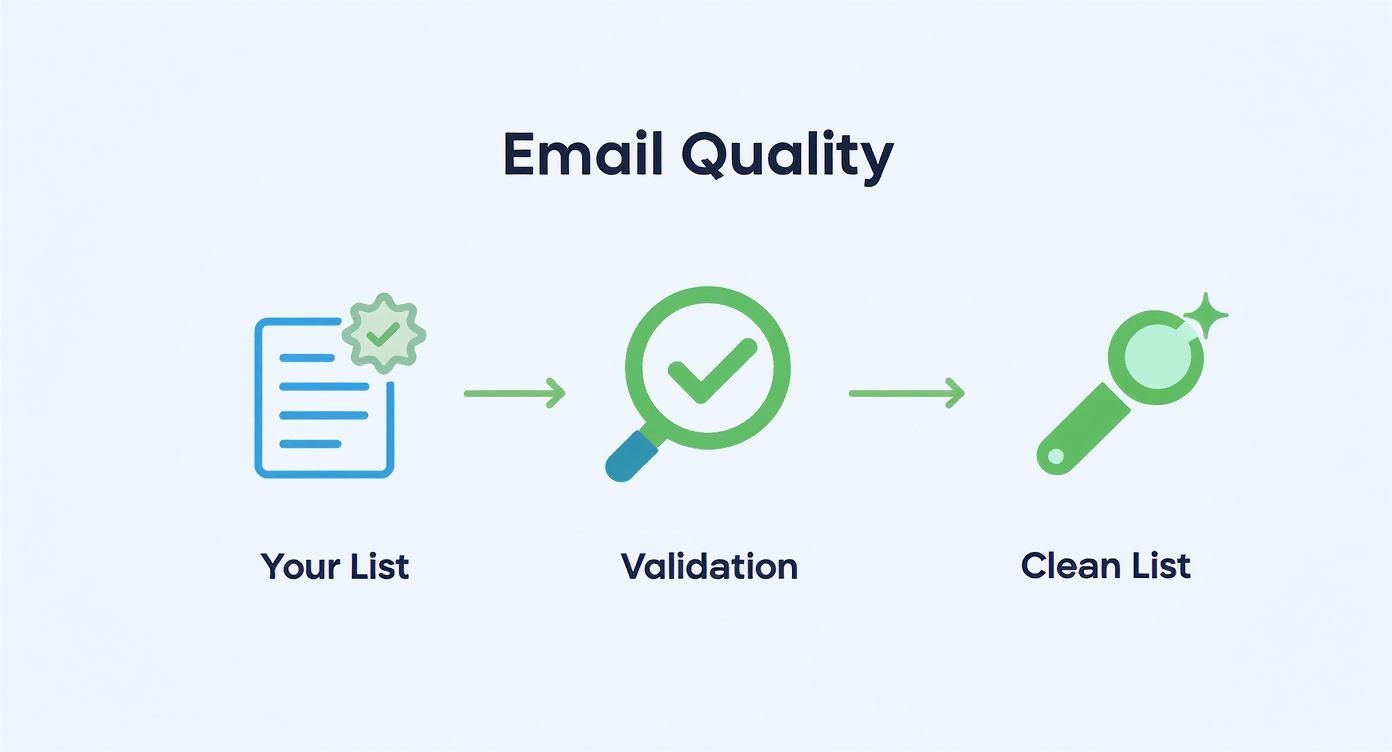
This simple diagram really gets to the heart of it. Email validation is all about filtering out the junk data, leaving you with a valuable asset for your marketing campaigns.
Checking the Domain and Mail Server
With the basic format confirmed, the software moves on to an MX record check. An MX (Mail Exchanger) record is like the post office’s internal directory for a specific zip code—it tells mail where to go.
This check queries the Domain Name System (DNS) to confirm two critical things:
- Does the domain (
example.com) actually exist? - Is that domain set up to receive email?
If the domain is fake or not configured for mail, the email address is immediately flagged as invalid. This step is incredibly effective at weeding out addresses tied to defunct websites or misspelled company names, which are a major source of hard bounces.
This layer is powerful, but the real magic happens in the final step.
The Mailbox “Handshake” Verification
The last and most definitive test is the SMTP check. This is where the validation software communicates directly with the recipient’s mail server. It’s the digital equivalent of a mail carrier walking up to an apartment building and asking the concierge, “Does John Smith live in unit 4C?”
This process, known as an SMTP handshake, initiates a conversation without actually sending an email. The tool pretends to start a delivery, and the receiving server responds by confirming whether that specific mailbox exists. This is how email addresses are verified quickly and accurately and what allows the software to tell the difference between a valid john.smith@example.com and a non-existent j.smith@example.com, even though they share the same domain.
The SMTP check is the gold standard in email validation. It provides the highest degree of certainty because it gets a direct “yes” or “no” from the source—the mail server itself.
These different checks often happen in real-time through an API, which can verify an email the instant a user types it into a form on your website. To see how you might implement this, you can learn more about how an email verify API works in our guide.
By layering these checks together, the software delivers a clear verdict on every single email—valid, invalid, or risky—giving you the power to keep your lists clean and your campaigns effective.
Exploring the Different Types of Email Validation
A good email validation tool does way more than just see if an email address can receive mail. It’s more like a multi-point inspection for your contact list, with each check looking for a different kind of problem. A simple format check is just scratching the surface; a truly thorough service digs much deeper to protect the health of your entire email program.
This layered approach is critical because not all “bad” emails are created equal. Some are just honest typos, but others are sophisticated traps designed to get your domain blacklisted. A powerful validation platform can tell the difference, giving you a clear, honest look at your data quality.
To really understand how it works, let’s break down the different layers of verification, from the basic essentials to the more advanced checks that separate the pros from the amateurs.
A Breakdown of Email Validation Check Types
Email validation isn’t a single action but a series of checks, each with a specific job. Think of it as a funnel, where the most obvious errors are filtered out first, followed by more nuanced and high-risk problems. The table below outlines the most common checks you’ll find in any reputable service.
| Validation Type | What It Does | Example of What It Catches |
|---|---|---|
| Syntax Check | Verifies the email address format (e.g., has an ”@” symbol, a valid domain). | john.doe@gmail, jane@.com |
| MX Record Check | Confirms the domain has a Mail Exchange (MX) record and is set up to receive email. | contact@nonexistentdomain.com |
| SMTP Verification | Pings the mail server to see if a specific user mailbox actually exists. | fakename123@gmail.com |
| Catch-All Detection | Identifies servers that accept email for any address at that domain, making real verification impossible. | anything@catchalldomain.com |
| Role-Based Check | Flags generic, non-personal addresses that often have low engagement. | info@company.com, support@brand.com |
| Disposable Check | Detects temporary email addresses that self-destruct after a short time. | user@mailinator.com |
| Spam Trap Detection | Identifies known “honeypot” addresses used by ISPs to catch spammers. | (These are hidden and look real) |
These checks work together to give you a complete picture of each contact’s quality, allowing you to clean your list with confidence and precision.
The Foundational Checks: Your First Line of Defense
At the very beginning of the process are the fundamental checks: syntax, MX record, and SMTP verification. These are the non-negotiables, the absolute basics. They form your first line of defense, catching the most obvious typos and errors before they have a chance to become hard bounces.
Once those are out of the way, the software starts looking for the sneakier issues—the ones that can quietly drag down your campaign performance and sender reputation over time. This is where you start to see the real value of a professional-grade tool.
Advanced Detection: Spotting the High-Risk Addresses
This is where the software’s real intelligence comes into play. It starts identifying addresses that, while technically able to receive an email, pose a huge risk to your marketing efforts. These advanced checks go beyond simple validity to analyze the quality and intent behind an email address.
Here’s a breakdown of the most important ones:
- Role-Based Email Detection: This check flags those generic, non-personal addresses like
info@,support@, orsales@. Sure, they’re often valid, but these inboxes are usually managed by entire teams and are notorious for low engagement and high complaint rates. It’s best to segment them out. - Disposable Email Detection: We’ve all seen them—temporary email addresses people create just to grab a freebie or sign up for a trial. These inboxes are designed to self-destruct after a short time, which means they’re guaranteed to bounce later and are a clear sign of a low-quality lead.
- Spam Trap Detection: This is arguably the most critical check of all. A spam trap is an email address used by ISPs and anti-spam organizations specifically to catch spammers. Hitting just one can get your domain or IP address blacklisted almost instantly.
Sending to even a single spam trap can have severe, long-lasting consequences for your entire email marketing program. High-quality email validation software is your best defense against this hidden threat.
Dealing with Ambiguity: Catch-Alls and List Decay
Not every email address gets a simple “valid” or “invalid” label. Some domains are configured in a way that makes a definitive answer tricky. This is where a sophisticated tool’s ability to handle ambiguity becomes essential.
A catch-all server, for example, is set up to accept email for any address at that domain, even ones that don’t exist. So, an email to anything@example.com won’t bounce, but you have no idea if a real person will ever see it. A good validation service identifies these domains and flags them as “risky,” letting you decide if you want to take a chance on them.
Finally, there’s the reality of list decay. Email addresses go bad at a surprising rate—over 22% per year as people switch jobs, change providers, or just abandon old accounts. A one-time cleanup isn’t a permanent fix. That’s why re-checking and list monitoring are so important. The software should periodically re-verify your contacts to catch addresses that have gone stale, keeping your list healthy for the long haul.
The Real-World Benefits of a Clean Email List
It’s one thing to talk about technology, but it’s another to see it make a real difference in your business. That’s the story with email validation software. It isn’t just a technical tool for tidying up a database; it’s a strategic asset that directly boosts your bottom line, protects your brand, and makes your marketing efforts actually work. The benefits aren’t theoretical—they’re the kind you can see right in your analytics and campaign reports.
Let’s be honest: a clean email list is everything. Without it, your most creative and compelling message is dead on arrival, either bouncing back or getting buried in a spam folder. When you make sure you’re only sending to real, active inboxes, you kick off a chain reaction of good things that benefit your entire marketing operation.
Dramatically Improve Email Deliverability
The first and most obvious win from a clean list is a huge jump in deliverability. It’s simple, really. When you launch a campaign, you want as many of those emails as possible to land safely in a real person’s inbox. But when you send to addresses that are misspelled, fake, or no longer exist, you get a “hard bounce.”
Internet Service Providers (ISPs) like Gmail and Outlook are always watching your bounce rate. If it’s too high, they see it as a red flag that you’re not managing your list well. This damages your sender reputation and can lead them to filter your future campaigns straight to the spam folder.
By weeding out these bad addresses before you hit “send,” email validation software can slash your bounce rate, often bringing it from a worrying double-digit percentage down to less than 1%. This tells ISPs you’re a trustworthy sender, which is key to ensuring your emails actually get seen.
Protect Your Precious Sender Reputation
Think of your sender reputation as a credit score for your email marketing. It’s an invisible grade that ISPs give your sending domain based on how you behave. A good score means your emails are trusted and get priority placement in the inbox. A bad score? You’re heading straight for the junk folder.
High bounce rates and spam complaints are two of the biggest reputation killers. Email validation gets rid of bounces at the source, which is a massive help. It also identifies and removes other risky addresses, like known spam traps—which are basically landmines designed to get your domain blacklisted. A protected reputation isn’t a one-time fix; it’s what keeps your deliverability strong for the long haul.
Achieve a Higher Marketing ROI
Every bad email address on your list is costing you money. Most email marketing platforms charge you based on how many subscribers you have. By regularly cleaning your list, you stop paying to store and send emails to contacts who will never, ever see them. That alone delivers an immediate return on your investment.
But it goes deeper. A cleaner list means your campaigns are reaching people who are actually interested. This naturally leads to better engagement—more opens, more clicks, and, ultimately, more sales. When every dollar you spend is focused on a real, potential customer, your marketing ROI can’t help but improve.
The numbers are staggering. In 2024, an estimated 361.6 billion emails are sent every single day. Yet, with all that noise, average open rates hover just under 20%. This shows a huge gap between sending and connecting. By validating your lists, you stop shouting into the void and start having meaningful conversations with a more engaged audience. You can find more insights on how list quality impacts campaign success in this report from Fortune Business Insights.
Fuel Smarter Decisions with Better Data Accuracy
Finally, a clean email list gives you something invaluable: reliable data. When your list is full of junk contacts, all your key metrics get watered down. Your open rates, click-through rates, and conversion numbers will look worse than they really are simply because the total number of contacts is artificially inflated.
Once you remove that dead weight, you get a crystal-clear picture of how your campaigns are actually performing with your active subscribers. This accurate data is gold. It empowers you to make smarter decisions about your content, your audience segments, and your overall strategy, creating a cycle of continuous improvement that drives better results over time.
How to Choose the Right Email Validation Software
https://www.youtube.com/embed/7JM_8Ce0Y1o
With so many email validation tools on the market, picking the right one can feel overwhelming. But it doesn’t have to be. If you break down the decision into a few key areas, you can quickly narrow the field and find a service that’s a perfect fit for your business.
Think of it like buying a car. You wouldn’t get a two-seater sports car if you have a family of five, and you wouldn’t buy a giant truck for a simple city commute. The right choice depends on your specific goals, the size of your email list, and how you plan to use the tool every day.
Prioritize Accuracy Above All Else
When it comes down to it, the single most important metric for any email validation software is its accuracy. A tool that gets it wrong isn’t just useless—it’s actively harmful. It gives you a false sense of security while you continue sending emails to bad addresses, chipping away at your sender reputation.
Look for providers who are upfront about their accuracy rates and stand behind them. A top-tier service will confidently guarantee 98% accuracy or higher. Anything less than that is a red flag, as it means too many bad emails will inevitably slip through the cracks and drive up your bounce rate.
A great service won’t just give you a simple “valid” or “invalid” result. It should offer more detailed feedback, like flagging “risky” catch-all addresses or “unknown” statuses. This is the kind of insight you need to make smart decisions about how to segment and manage your list.
This level of detail is what separates a decent tool from a great one and is absolutely critical for keeping your list healthy for the long haul.
Evaluate Integration and Automation Capabilities
An email validation tool shouldn’t be a standalone island. To get real value, it needs to plug right into the other tools you already use, like your CRM, email marketing platform, or website forms.
This is where a good API is non-negotiable. A flexible API lets you automate the entire validation process so it runs in the background without you ever having to think about it.
- Real-Time Verification: Check an email address the second a user types it into a signup form. This stops bad data from ever getting into your system in the first place.
- Workflow Automation: Connect your validation service to tools like Zapier or Clay to build hands-free workflows that clean contacts as they move between your apps.
- CRM Hygiene: Set up an integration with your CRM to periodically scrub your entire contact database, making sure your sales team always has clean, accurate data to work with.
Without solid integration options, you’ll be stuck manually exporting and uploading CSV files—a slow, clunky process that’s just begging for human error.
Understand the Different Pricing Models
The cost of email validation can swing wildly from one provider to another. It’s crucial to understand the different pricing models out there so you can pick one that makes sense for how you’ll actually use the service. Most fall into one of three buckets.
| Pricing Model | Best For | Key Consideration |
|---|---|---|
| Pay-As-You-Go | Businesses with occasional needs or one-time list cleaning projects. | Credits can expire, so make sure you’ll use them before you lose them. |
| Subscription | Companies with a steady, ongoing flow of new contacts to verify. | Look for plans with generous monthly limits or even unlimited options to get the best value. |
| Bulk Pricing | Enterprises or agencies that need to clean millions of emails at once. | The cost per email is incredibly low, but it requires a larger upfront investment. |
Picking the right model can save you a ton of money in the long run. For a deeper dive into how different platforms stack up, check out our guide on the best email verification tools on the market today.
Ensure Robust Security and Support
Last but certainly not least, don’t overlook data security and customer support. You’re handing over one of your most valuable assets—your customer data—to a third-party service. Make sure any provider you’re considering is GDPR compliant and has crystal-clear data privacy policies.
On top of that, good customer support is a must. When you run into a problem or just have a question, you need to know you can get help from a responsive and knowledgeable team. The growing focus on data integrity is a big reason why the global email verification software market is projected to nearly double, hitting around USD 2.46 billion by 2035. This boom is driven by a widespread need for tools that make campaigns more effective and help prevent fraud. You can discover more about this market growth on Business Research Insights.
Building Your Email Validation Strategy
Treating email validation as a one-off task is a common mistake. To get real, lasting results that protect your sender reputation and boost your ROI, you need to weave it into the very fabric of your marketing operations. It’s about creating a system that keeps your email list clean, accurate, and powerful day in and day out.
Think of it like this: you wouldn’t build a house without a solid foundation, a security system at the front door, and a plan for regular maintenance. Your email list needs the same level of care. Each part of the strategy tackles a different point where bad data can creep in.

The Three Pillars of List Health
A truly effective strategy is built on three core practices. By putting all three in place, you create a powerful defense that not only cleans up past mistakes but also prevents new ones and accounts for the natural churn of email addresses over time. This shifts validation from a reactive headache to a proactive business advantage.
Initial Bulk Cleanup: The first move is always to clean what you already have. Run your entire email database through a validation tool to get a clean baseline. This initial purge is your chance to remove years of accumulated invalid, risky, and dormant email addresses in one fell swoop. It’s the single most important step you can take to immediately improve deliverability.
Real-Time Verification: Next, you have to guard the gates. Integrate a validation API directly into your signup forms, pop-ups, and anywhere else you collect emails. This simple step verifies every new address the instant it’s entered, catching typos, fakes, and disposable emails before they ever infect your list.
Ongoing List Maintenance: Email lists aren’t static. People switch jobs, create new accounts, and abandon old ones. That’s why you need to schedule regular check-ups. Re-validating your entire list every quarter, or at least twice a year, catches addresses that have gone bad since your last cleaning and keeps your data fresh.
Common Strategic Mistakes to Avoid
Just having the software isn’t a silver bullet. I’ve seen many companies fall into common traps that completely undermine their efforts. The biggest one? Doing a single cleanup and calling it a day, ignoring the constant flow of new signups and the inevitable decay of their existing list.
A “one-and-done” approach to list cleaning is a recipe for failure. Without real-time verification and periodic maintenance, your list’s health will quickly degrade, erasing all the hard work from your initial cleanup.
Another classic mistake is picking a tool that doesn’t play well with your current marketing stack. If the software can’t integrate smoothly, you’re stuck with clunky, manual processes that are a pain to manage and are often abandoned. The goal should always be automation—making list hygiene an invisible, effortless process that runs in the background.
To get started on the right foot, it’s worth diving into the best practices for effective email list cleaning. Combining that initial deep clean with smart, automated checks is how you build a resilient and high-performing email program.
Got Questions? We’ve Got Answers
Even when the benefits are crystal clear, it’s natural to have a few questions before diving into email validation software. Let’s tackle the most common ones we hear from teams just like yours, so you can move forward with confidence.
How Often Should I Clean My Email List?
Think of it as a three-part rhythm. First, you need to do a one-time, deep clean of your entire existing list. This gives you a healthy, reliable baseline to work from.
Next, you’ll want to use a real-time API to check every new email address the second it comes in through your sign-up forms or CRM. This keeps bad data from ever getting a foothold.
Finally, get into the habit of re-validating your whole list every 3-6 months. Emails go bad, people change jobs, and addresses turn into spam traps. Regular check-ups keep your list in top shape.
Does Validation Guarantee 100% Deliverability?
Honestly, no tool can promise 100% deliverability. It’s just not possible. What validation does is give you the best possible shot by scrubbing out all the known-bad addresses. But getting into the inbox still comes down to your sender reputation, the quality of your content, and whether people are actually engaging with your emails.
Think of it this way: email validation paves the road, but your content and reputation are the vehicle that has to drive to the destination. A clean list clears the biggest obstacles out of your way.
By validating, you’re taking the single most important step to stack the odds in your favor and maximize your chances of reaching the inbox.
Is Email Validation the Same Thing as Email Verification?
Yes, for all practical purposes, they’re the same. You’ll hear the terms email validation and email verification used interchangeably across the industry.
Both refer to the same technical process of checking if an email address is real, active, and can actually receive messages. The end goal is identical: maintain a clean, high-performing email list that boosts your marketing results and protects you from the damage high bounce rates can cause.
Ready to stop worrying about bounces and start connecting with real customers? With Truelist, you get unlimited email validations for one simple monthly price. Clean your lists, protect your reputation, and improve your campaign ROI today. Start validating for free at Truelist.