
 Claude
  Perplexity
How to Build an Email List That Actually Grows
Learn how to build an email list with strategies that drive real growth. This guide covers creating lead magnets, optimizing forms, and engaging subscribers.
TL;DR: Learn how to build an email list with strategies that drive real growth. This guide covers creating lead magnets, optimizing forms, and engaging subscribers.
Learning how to build an email list really boils down to three key moves: creating an irresistible incentive, putting up a clear and simple sign-up form, and picking an email marketing service you can count on. It’s all about opening up a direct line to people who actually want to hear what you have to say.
Why an Email List Is Your Most Valuable Asset

Think of social media as rented land. You can build a beautiful presence on Instagram or LinkedIn, but a sudden algorithm change can tank your reach overnight, cutting you off from the very audience you spent months or years building.
Your email list, on the other hand? That’s property you own. It’s a direct, unfiltered connection to your people that nobody can take away from you.
This asset is your key to building real relationships and driving your business forward without constantly having to fight for visibility. You’re in complete control—you decide the message, the timing, and the delivery. That makes it one of the most stable and predictable channels for growth you can have.
A Direct Line to Your Audience
Let’s be clear: email is still a powerhouse. Projections show there will be 4.6 billion email users worldwide in 2025, and that number is expected to climb to 4.8 billion by 2027.
Even with crowded inboxes, a staggering 60% of consumers say they prefer to get communications from brands through email over any other channel. This makes it a uniquely effective tool for connecting directly with your audience.
Here’s a way I like to think about it: a social media follower is a casual acquaintance you met at a party. An email subscriber? They just invited you into their home. They’ve given you explicit permission to show up in their personal inbox, a space they personally curate.
The Financial Argument for List Building
Beyond building relationships, the return on investment (ROI) for email marketing is consistently one of the highest in the game. It’s not just a way to chat with your audience; it’s a strategic investment in the long-term health and profitability of your business.
Every single subscriber is a potential customer who has literally raised their hand to say, “I’m interested.” If you want to dive deeper, this comprehensive guide on building and growing an email list has some fantastic strategies. Ultimately, learning to build an email list isn’t just another marketing task—it’s a foundational business skill.
Creating Lead Magnets People Actually Want

At its heart, building an email list is a simple trade. Someone gives you their email, and you give them something genuinely useful in return. That “something” is your lead magnet, and its quality is the single biggest factor in how fast your list grows.
Let’s be honest, nobody wants another generic, low-effort PDF. The goal here is to create a resource so valuable that your ideal audience feels like they just hit the jackpot. This very first interaction sets the tone for your entire relationship.
Think about it: a well-crafted lead magnet doesn’t just get you more sign-ups; it gets you the right sign-ups. It works as a filter, attracting people with a specific problem you can solve. These are the folks who will actually open your emails and, eventually, buy from you. It’s an investment that pays off big time—email marketing consistently delivers a staggering $42 to $44 for every dollar spent. If you’re curious about the numbers, these email marketing statistics really paint a picture of the financial impact.
Match Your Magnet to Your Audience’s Needs
The best lead magnets solve a small, specific, and urgent problem. You need to get inside your audience’s head and figure out what immediate pain point you can fix for them.
For instance, say you run a SaaS company with project management software. A generic “10 Productivity Tips” ebook is fine, but it’s forgettable. What about an “Asana Project Kickoff Template”? Now that’s specific. It solves a real-world problem for your target user and gives them a small taste of the value your main product offers.
Over the years, I’ve seen a few formats that consistently knock it out of the park:
- Checklists & Worksheets: These are pure gold because they’re so actionable. They give people a clear path to getting something done.
- Templates: Whether it’s a budget spreadsheet, a pre-written email script, or a social media graphic template, you’re saving people time and brainpower.
- Exclusive Video Workshops: A quick, focused training session on a high-value topic often feels more personal and engaging than a simple PDF.
- Interactive Quizzes: People love quizzes. A quiz that helps someone understand a problem or discover something about their business is incredibly effective for capturing emails.
Your lead magnet needs to be a bridge. It should solve an immediate problem while naturally pointing your new subscriber toward your core product or service. If that connection is missing, you’ll end up with a list of people who have no interest in what you actually sell.
Ideas for Different Business Models
What works for a freelance writer won’t necessarily work for an e-commerce store. You have to tailor your offer to your industry and your specific audience to make it truly compelling.
To give you a clearer idea, here’s a breakdown of some effective lead magnet ideas for different types of businesses.
Lead Magnet Ideas for Different Industries
| Lead Magnet Type | Best For | Example Scenario |
|---|---|---|
| Exclusive Discount Code | E-commerce & Retail | A clothing boutique offers a ”15% Off Your First Order” coupon. It’s a classic for a reason—it drives immediate sales. |
| Case Study or White Paper | B2B Services & SaaS | A marketing agency shares a detailed case study on how they doubled a client’s traffic, attracting qualified business leads who want similar results. |
| 5-Day Email Challenge | Coaches & Consultants | A fitness coach creates a ”5-Day Core Strength Challenge” delivered via email, letting them build trust and show off their expertise every single day. |
| Free Resource Library | Content Creators & Bloggers | A food blogger gives subscribers exclusive access to a library of printable recipe cards and meal planning templates—a huge value-add. |
Ultimately, building a great email list starts with generosity. Deliver real, immediate value, and you’ll earn the trust—and the email address—of people who are actually excited to hear from you.
Designing Opt-In Forms That Convert
You’ve created a fantastic lead magnet, but it won’t do you any good if people can’t easily sign up for it. That’s where your opt-in form comes into play. Think of it as the handshake—the critical moment where a casual visitor decides to become a subscriber. Getting this part right is a blend of art and science.
The best opt-in forms don’t feel like an interruption; they feel like a helpful, natural part of the experience. The goal is to make signing up so frictionless that your ideal customer doesn’t even have to think twice.
Choosing the Right Form Type
There’s no one-size-fits-all solution for opt-in forms. The type you choose should be based entirely on context—where the user is on your site and what they’re trying to accomplish. Putting the right form in the right place is the secret to boosting sign-ups without annoying your visitors.
Here are a few of the most reliable types and when I’ve seen them work best:
- Embedded Forms: These are the workhorses. You can place them right inside your content, like at the end of a blog post or in your website’s footer. They’re great because they’re never in the way and are always there for someone who’s ready to sign up.
- Pop-up Forms: I know, I know—pop-ups get a bad rap. But when used thoughtfully, they are unbelievably effective. Exit-intent pop-ups, for instance, only show up when a user’s cursor moves towards the “back” button. It’s your last-chance saloon to capture their email before they’re gone for good.
- Dedicated Landing Pages: This is your “all-in” option. It’s a single page with one purpose and one purpose only: getting that email address. If you’re running ads or promoting your lead magnet on social media, sending traffic here is a killer strategy because it removes every possible distraction.
From my experience, a multi-pronged approach usually wins. I like to use an embedded form in every blog post for consistent visibility, a polite exit-intent pop-up to catch stragglers, and a dedicated landing page for any big promotional push.
Take a look at this example of an exit-intent pop-up from OptinMonster, a popular tool for building these. Notice how clean the design is, the headline sells a clear benefit, and the call-to-action button just begs to be clicked.
The Anatomy of a High-Converting Form
Beyond just picking a type, the actual design and words on your form play a massive part in whether it succeeds or fails. Every single element needs to work together to convince the visitor that handing over their email is a great idea.
Keep It Simple, Seriously The more information you ask for, the fewer sign-ups you’ll get. It’s a direct relationship. For most lead magnets, a name and an email address are plenty. Sometimes, just the email is even better. Your job is to reduce friction at every turn.
Write Copy That Sells the Dream Your headline needs to scream value. “Subscribe to Our Newsletter” is a snoozefest. Try something like, “Get 10 Easy Recipes to Save 3 Hours a Week.” See the difference? You’re selling the outcome, not the action of subscribing.
Craft a Powerful Call-to-Action (CTA) The text on your button matters more than you think. “Submit” is generic and uninspiring. Use specific, action-oriented language instead. “Download My Free Guide” or “Send Me the Cheatsheet!” are far more compelling. Make sure the button color contrasts with the rest of the form so it visually pops.
Don’t Forget Mobile This is non-negotiable. With around 42% of all emails now opened on mobile devices, you can bet a huge slice of your audience is also seeing your sign-up forms on their phones. If your form is clunky or hard to use on a small screen, you are actively turning away subscribers. You can dig into more on this trend with these recent email marketing statistics.
By carefully combining the right form type with persuasive copy and a clean design, you create an opt-in experience that feels like a logical next step for your visitors, helping you build your list faster and with higher-quality leads.
Choosing the Right Email Marketing Platform
Picking your email marketing platform is one of the first big decisions you’ll make, and it feels like a heavy one. This tool, often called an Email Service Provider (ESP), is more than just a place to send emails—it’s the home base for your entire list-building operation. It’s where you’ll manage subscribers, automate your first hellos, and see what’s actually working.
The good news? You don’t have to get it perfect on day one. Instead of getting bogged down by a dozen different options promising the world, let’s focus on what you genuinely need to get started and grow. The key is finding a platform that feels more like a partner than a puzzle.
What to Look For in Your First ESP
Your first ESP needs to nail the basics. The goal is to get your forms live and your first emails out the door without pulling your hair out. You want a tool that’s intuitive enough that you can focus your energy on creating valuable content, not fumbling through confusing menus.
Here are the non-negotiables to look for:
- A User-Friendly Interface: The platform should just make sense. Can you build a sign-up form and design a simple email without having to watch three hours of tutorials? That’s the real test.
- Simple Automations: You absolutely need the ability to create a “welcome sequence.” This is a series of emails that goes out automatically to new subscribers, and it’s your best chance to make a great first impression.
- List Segmentation: Even at the start, you’ll want to send different messages to different people. Look for the ability to “tag” subscribers based on what they signed up for or what they click on. This is the foundation of effective, personalized email marketing.
- Scalable Pricing: Find a provider with a solid free plan or a low-cost starting tier. Your list will grow, and you don’t want your bill to explode unexpectedly.
I’ve seen so many people pick a powerhouse platform because they think they’ll use all its advanced features “someday.” In reality, they just end up overwhelmed. Start with a tool that solves your immediate problems, and you can always migrate later if you outgrow it.
A Quick Comparison of Popular Platforms
To make this a bit more concrete, let’s look at three ESPs that are consistently great for people just starting out. Each one shines in slightly different areas, so it really comes down to your priorities.
This table gives you a quick, at-a-glance view of how they stack up for someone new to the game.
ESP Feature Comparison for Beginners
| Feature | Mailchimp | ConvertKit | MailerLite |
|---|---|---|---|
| Best For | All-in-one beginners | Creators & Bloggers | Small Businesses on a Budget |
| Ease of Use | Very high | High | Very high |
| Free Plan | Up to 500 contacts | Up to 1,000 subscribers | Up to 1,000 subscribers |
| Key Strength | Brand recognition & great templates | Powerful automations & segmentation | Generous free plan & simplicity |
While Mailchimp is a household name with fantastic templates, ConvertKit is built from the ground up for creators who need powerful segmentation. And if you’re looking for the most bang for your buck, MailerLite offers an incredibly generous free plan without sacrificing core features. There’s no single “best” choice—just the best choice for you.
This next image is a great reminder of why getting your ESP set up is so crucial. It shows where your subscribers are most likely to come from.
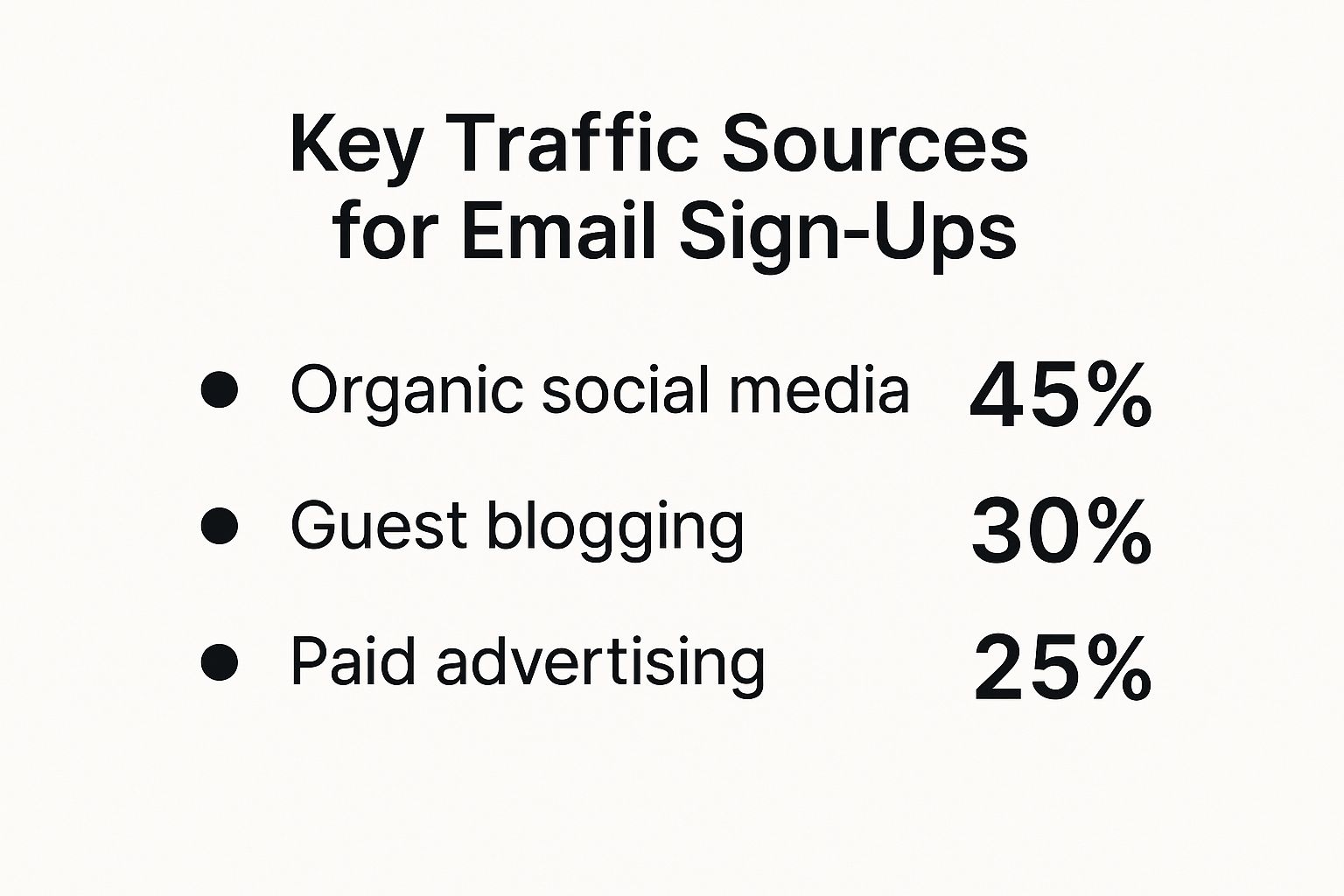
As you can see, social media is a huge driver. This really hammers home the importance of choosing a platform that easily connects with the other tools and channels you’re already using. Simple integrations will save you a world of headaches down the road.
How to Get Your Opt-in in Front of the Right People
You’ve built a fantastic lead magnet and a smooth opt-in form. That’s the hard part, right? Well, not quite. Now comes the real challenge: driving traffic. Think of it this way—you’ve built a high-performance engine, but now you need to get fuel into the tank.
The trick is to stop thinking about promotion as a one-off campaign. Instead, you need to weave list-building into the very fabric of everything you do online. This creates a sustainable system that consistently brings in new subscribers, not just a temporary spike.
Weave Promotion into Your Existing Content
Look at the content you’ve already created. Your blog, your social profiles, your videos—these are your most powerful promotional tools. The goal is to make it almost impossible for someone to interact with your brand without seeing a compelling reason to join your list.
Start with your website. Every single blog post is a golden opportunity. Forget the generic “subscribe to our newsletter” form buried in the footer. Instead, offer a content upgrade. This is a specific bonus resource that directly relates to that article’s topic. For example, if your post is about meal planning, offer a printable weekly meal planner. A targeted offer like this can convert 10x better than a generic, sitewide lead magnet.
Your social media profiles are another goldmine. Treat them like mini-landing pages for your email list.
- Your Bio Link: Don’t waste this prime real estate by just linking to your homepage. Send people directly to a dedicated landing page for your best lead magnet. Make your call-to-action crystal clear, something like, “Grab my free 5-day email course 👇“.
- Pinned Posts: On platforms like X (formerly Twitter) and Facebook, a pinned post is your digital welcome mat. Use it to showcase your lead magnet so it’s the very first thing new visitors see.
To really make this work, you have to master lead generation on social media and turn all that scrolling into actual sign-ups.
I’ve found the most success when I stop thinking of list promotion as a separate task. Instead, I ask one question for every piece of content I create: “How can this specific post, video, or tweet guide someone toward my email list?” That mindset shift changes everything.
Collaborate for Exponential Growth
Once you’ve maxed out your own channels, the fastest way to grow is to tap into other people’s audiences. Collaborations get your offer in front of a warm, engaged group of people who already trust the person you’re partnering with. It’s a massive shortcut.
Guest blogging is a classic for a reason. Find blogs in your niche that serve a similar audience but aren’t direct competitors. Pitch them a genuinely helpful article, and in your author bio, link directly to your lead magnet landing page, not just your homepage. You provide them with great content, and you get highly targeted subscribers in return. It’s a win-win.
Another incredibly effective tactic is participating in virtual summits or bundle promotions. These events gather a bunch of experts who all promote the event to their own email lists. You contribute one resource, and in return, you get exposure to thousands of potential new subscribers in just a few days. It’s a concentrated burst of growth that’s tough to replicate on your own.
Got Questions? Let’s Get Them Answered
Even with the best strategy, you’re going to have questions as you dive into building your email list. It’s just part of the process. Below, I’ve tackled some of the most common stumbling blocks I see people run into, with straight-up answers to help you keep moving forward.
How Often Should I Actually Email My List?
This is the classic question, and the honest answer is: there’s no single magic number. But if you’re just starting out, aim for once a week. That’s a solid rhythm that keeps you on your subscribers’ radar without flooding their inbox.
The real key here isn’t frequency, it’s consistency. Sending one great email every Tuesday is infinitely better than sending a flurry of messages one week and then disappearing for a month. Your audience learns to expect hearing from you. Keep an eye on your open rates and unsubscribe stats—those numbers are your best feedback for finding the perfect cadence.
Single Opt-In vs. Double Opt-In: Which One?
I see a lot of confusion around this, but it’s pretty simple. A single opt-in adds someone to your list the second they click “subscribe.” A double opt-in makes them take one extra step: they have to open a confirmation email and click a link to prove they really want to be on your list.
Sure, single opt-in gets you more subscribers, faster. The downside? You’ll inevitably get typos, fake email addresses, and people who aren’t that interested. All that junk hurts your deliverability over time.
Double opt-in is the way to go. Think of it as a quality filter. It guarantees you’re building a list of people who are genuinely engaged and have actively confirmed they want to hear from you. For the long-term health and value of your email list, it’s the smarter choice, hands down.
How Many Subscribers Do I Need to Make Money?
Everyone gets hung up on the number, but it’s the wrong thing to focus on. Profitability isn’t about list size; it’s about the quality of the relationship you have with the people on it. I’ve seen people with a tiny, hyper-engaged list of 500 subscribers run circles around someone with an ignored list of 10,000.
Instead of chasing a vanity metric, put your energy here:
- Deliver Real Value: Make sure every single email is helpful, interesting, or entertaining.
- Build Actual Trust: Show up consistently and be yourself. People buy from people they feel they know.
- Listen to What They Want: Pay attention to what they click on, reply to, and ask about.
When you make a genuine connection the priority from day one, the money follows. You don’t need a huge list to be successful; you need the right list.
A high-quality list starts with valid email addresses. Truelist offers pay-as-you-go credits that never expire, plus unlimited plans for high-volume senders, so your messages always reach the inbox — protecting your sender reputation and maximizing your engagement. Clean your list for free today and see the difference for yourself.