 Claude
  Perplexity
How to Write Cold Emails That Get Replies
Learn how to write cold emails that stand out and get responses. Our guide covers proven strategies for research, personalization, and effective follow-ups.
TL;DR: Learn how to write cold emails that stand out and get responses. Our guide covers proven strategies for research, personalization, and effective follow-ups.
Let’s be real—the secret to a great cold email isn’t some complicated formula. It’s actually pretty simple: stop trying to sell, and start trying to connect. The emails that actually get a response are the ones that feel personal, offer some genuine value right away, and ask for something simple and easy to agree to. If you can nail those three things, you’ll stop getting ignored and start having conversations.
Why Your Cold Emails Are Getting Deleted
We’ve all seen them. The generic, me-first emails that instantly land in the trash. If your campaigns are hitting a wall, it’s not just bad luck. You’re probably using old-school tactics that people have become experts at spotting and ignoring. The modern inbox is a warzone for attention, and those self-serving messages are always the first to go.
The biggest issue is a total mismatch in priorities. You’re focused on what you want—a demo, a meeting, a sale. But the person you’re emailing only cares about one thing: what’s in it for them. That self-centered vibe comes through loud and clear, and it’s an instant turn-off.
Shifting Your Mindset from “Selling” to “Connecting”
To break through, you need to completely change your perspective. Stop thinking of yourself as a salesperson pushing a product. Instead, act like a helpful expert who has a solution to a problem they’re actually facing. Your goal with that first email isn’t to close a deal; it’s just to get a conversation started.
Once you make this mental shift, everything about your email changes:
- You’ll go from generic to personal. No more “Dear Sir/Madam.” You’ll mention something specific, like a project they just launched, a recent article they wrote, or a connection you share on LinkedIn.
- You’ll stop listing features and start solving problems. You won’t rattle off what your software does. Instead, you’ll show you understand their world and hint that there’s a better way to handle a challenge you know they have.
- You’ll ditch the demanding ask for a simple question. Forget “Are you free for a 30-minute demo next week?” A much better approach is a low-friction question like, “Open to hearing how we helped [Similar Company] achieve [Specific Result]?”
The point of a cold email isn’t to make a sale on the spot. It’s to begin the process of turning a stranger into a potential partner. You’re just warming them up, one thoughtful email at a time.
The Four Pillars of Effective Cold Emailing
To keep these core ideas front and center, I like to think of them as four foundational pillars. Getting these right is non-negotiable for any successful outreach.
| Pillar | What It Means | Why It Matters |
|---|---|---|
| Personalization | Researching your prospect and tailoring the email to their specific situation, role, or company. | It shows you’ve done your homework and aren’t just spamming a list. This immediately builds a small amount of trust and makes them more likely to read on. |
| Value | Offering something useful upfront without asking for anything in return—an insight, a resource, or a relevant tip. | It shifts the dynamic from a sales pitch to a helpful interaction. You’re giving before you ask, which makes your eventual request feel much more reasonable. |
| Clarity | Writing a concise, easy-to-scan email that gets straight to the point. No fluff, no jargon. | People are busy and their inboxes are overflowing. A clear, direct message respects their time and has a much higher chance of being read and understood. |
| Call-to-Action | A single, low-commitment question or request that makes it incredibly easy for the recipient to say “yes.” | A complicated or demanding “ask” creates friction. A simple, interest-based question like “Worth a chat?” makes replying feel effortless. |
Nailing these four pillars consistently is what separates the pros from the amateurs who are still just blasting out generic templates.
The Harsh Reality of a Crowded Inbox
Let’s face it: getting a response is tough. You’re up against sophisticated spam filters and an overwhelming amount of noise. The odds are stacked against you. While some highly targeted campaigns do really well, the average response rate can be as low as 1%. A more realistic benchmark these days is around 8 responses for every 100 emails sent. That number really puts into perspective how fierce the competition for attention is. You can find more data on the competitive nature of cold email response rates at Brandwell.ai.
What this means is that every single part of your email, from your name in the “from” line down to your signature, has to work hard to earn trust and spark curiosity. People are naturally skeptical. They’re tired of seeing the same old templates and can sniff out a low-effort, generic email from a mile away. Your message has to prove, in an instant, that it’s different.
Building a Prospect List That Actually Converts
Let’s be blunt: the most brilliantly written cold email sent to the wrong person is just spam. Before you write a single word, the real work begins—building a hyper-targeted prospect list. This is precisely where most campaigns fall apart. A low-quality list guarantees low-quality results, no matter how persuasive your writing is.
Forget casting a wide net. True success in cold emailing comes from spearfishing. Your goal isn’t just to find companies that fit a demographic profile, but to pinpoint people who are in a specific situation where they need what you offer, right now. This means going beyond basic firmographics like industry and company size to dig for buying signals, or what we call “triggers.”
A trigger event is any change that creates a potential opening for your product or service. When you reach out right after a relevant trigger, your email feels timely and relevant, not random. This alone can dramatically increase your reply rates.
Identifying Actionable Trigger Events
So, what should you be looking for? Think of yourself as a detective. These triggers are clues that a company is facing new challenges, has a fresh budget, or is actively looking for solutions. Your job is to find these openings before your competitors do.
Here are some of the most powerful trigger events I always watch for:
- New Leadership Hires: A new VP of Sales or Head of Marketing has a mandate to shake things up. They’re often looking to bring in new tools and strategies within their first 90 days.
- Recent Funding Rounds: A company that just raised a Series A or B has cash to spend and immense pressure to grow. They are actively investing in anything that helps them scale.
- Company Expansion or New Office: Opening a new location creates immediate operational needs, from local marketing and logistics to hiring.
- Hiring Sprees for a Specific Role: See a company posting 10 new job listings for software engineers? They’re clearly scaling their tech team and are prime candidates for development tools or project management software.
- Negative Mentions or Bad Reviews: A string of bad reviews about customer service is a golden opportunity to pitch support software or training services.
Tools like LinkedIn Sales Navigator are fantastic for this, letting you set up alerts for job changes and company news. Even simple Google Alerts for keywords related to your target accounts can surface these timely opportunities. While cold email is a powerful channel, it’s just one piece of the puzzle. Understanding how it fits into broader outbound lead generation strategies will give you a much more robust framework for your prospecting.
The Critical Importance of List Hygiene
Okay, you’ve built your list of prospects and found their contact info. There’s one final, crucial step before you hit “send”: validation.
Sending emails to bad addresses isn’t just a waste of time—it actively damages your sender reputation. High bounce rates are a massive red flag for email providers like Google and Microsoft. If your bounce rate creeps above 2-3%, your domain can get flagged, and even your valid emails will start landing in the spam folder. This can cripple your entire outreach operation overnight.
This is where email verification tools become non-negotiable. These services ping each email on your list to ensure it’s active and can receive mail. They scrub your list of several types of toxic addresses:
- Invalid Emails: Addresses that simply don’t exist or have typos.
- Spam Traps: Emails created by providers specifically to catch spammers. Hitting one of these can get your domain blacklisted.
- Disposable Emails: Temporary addresses that self-destruct after a short time.
- Catch-All Servers: Domains that accept all incoming mail, making it impossible to know if your specific contact’s address is real.
Routinely cleaning your list isn’t just a best practice; it’s fundamental to survival. To get a deeper understanding of this, check out our guide on the essentials of https://truelist.io/blog/email-validation, which breaks down why this is so critical for campaign success. Protecting your domain’s health is the foundation of any successful cold email strategy.
Crafting Subject Lines That Demand to Be Opened

Let’s be honest: your subject line is the most critical sentence in your entire email. It’s the bouncer at the club door, deciding whether your message gets in or gets tossed. In a crowded inbox, you have about two seconds to earn a click.
Forget the cheap tricks and clickbait. The real goal is to spark a flicker of genuine curiosity. You want them to think, “Hmm, this looks like it was written just for me.” This is where all that research you did earlier starts to pay dividends. A generic subject line screams “mass email,” but a tailored one feels like a personal note that’s worth opening.
Subject Line Approaches That Actually Work
You don’t need to reinvent the wheel every time. I’ve found that leaning on a few battle-tested frameworks is a great starting point. The trick is to infuse them with the personal details you uncovered about your prospect.
Here are a few approaches that consistently get results for me:
- The Specific Question: “Question about [Project Name]” or “Idea for [Their Goal].” This works because it’s direct, personal, and creates a small “curiosity gap.” They can’t help but wonder what the question or idea is.
- The Referral: “John Smith suggested I reach out.” This is the gold standard. A referral instantly lends you credibility and melts away the usual skepticism that comes with a cold email.
- The Mutual Connection: “We both attended [Event Name].” Finding common ground immediately shifts you from a total stranger to a familiar face. It builds instant rapport before they even read your first sentence.
Remember, you want it to sound like an email a human would send to another human, not something spit out by a marketing bot. To get a better feel for what works in the wild, check out some effective email marketing campaign examples that have crushed their open rates. You’ll start to see the patterns.
A subject line has only one job: to get the email opened. It doesn’t need to sell your product or book a meeting. Its sole mission is to make the recipient think, “This looks interesting enough to open.”
While the industry average open rate for cold emails hovers around 23.9%, I find that metric a bit misleading. The number that really matters is the reply rate, which sits at a much lower 8.5%. But here’s the kicker: campaigns that are heavily personalized and engineered to avoid spam filters can see open rates of 80% or more. That massive gap shows just how powerful a thoughtful strategy is.
Nailing the All-Important Opening Line
Okay, so your subject line worked—you got the click. Now what? The first sentence has to immediately deliver on the promise you just made. This is your moment to prove your email is worth their time.
Please, whatever you do, avoid the lazy intros: “My name is…” or “I hope this email finds you well.” Cut straight to the chase and use the personalized hook you found during your research.
Let’s walk through a real-world scenario. Imagine you’re reaching out to a company that just hired a new VP of Marketing.
The Generic (and weak) Way: Subject: Quick question Hi Jane, My name is Alex, and I work for a company that helps B2B SaaS companies with their content strategy…
The Personalized (and powerful) Way: Subject: Congrats on the new role at InnovateCorp Hi Jane, I saw the announcement about you joining InnovateCorp as the new VP of Marketing—congratulations! I imagine you have big plans for shaping the content strategy in your first 90 days.
See the difference? The second version is entirely about them. It proves you’re paying attention, you understand their current world, and you’re hinting at a relevant solution without being obnoxious. With just a few tweaks, you’ve turned a cold pitch into the start of a warm conversation.
Writing an Email Body That Actually Gets a Reply
Your subject line worked. They clicked. Now, the real test begins. You have just a few seconds to prove your email is worth their time, and the body of your message is where that battle is won or lost.
This isn’t the place for long, winding stories about your company. The best cold emails I’ve seen are sharp, easy to scan, and built entirely around the person reading them. They follow a simple but incredibly effective formula: a personalized hook to show you’ve done your homework, a quick pitch that solves a real problem, and a call-to-action that’s almost effortless to respond to. Your job isn’t to close a deal in one email; it’s to start a conversation.
The Personalized Hook and Opening
Think of your first sentence as a direct follow-up to the promise you made in the subject line. It needs to instantly show this isn’t some generic blast sent to thousands. This is your moment to prove you’re different.
Pull something specific from the research you did earlier. This small detail forges an immediate connection and changes the entire feel of the email from a cold pitch to a relevant, timely discussion.
- Weak Opening: “My name is Sarah, and I work at a company that helps with logistics.”
- Strong Opening: “I saw on LinkedIn that your team is expanding into the European market, which is an exciting but complex move.”
See the difference? The second example is rooted in their world. It shows you’re paying attention and gives you a natural way to introduce the problem you’re about to solve.
Framing Your Concise Value Proposition
Once you’ve hooked them, you have to get to the point. Fast. Forget listing all your product’s bells and whistles. Nobody has time for that. Instead, frame your solution as the direct answer to a problem they’re likely grappling with right now.
Always speak in terms of benefits, not features. No one really cares that your software has an “AI-powered analytics dashboard.” What they do care about is that it can help them “cut reporting time by 10 hours a week so their team can finally focus on strategy.”
Here’s a simple way to structure it:
- Acknowledge Their Likely Problem: Tie it directly back to your research. “Expanding into new markets often creates supply chain headaches and unexpected tariff issues.”
- Position Your Solution as the Fix: Be direct and clear. “We help companies like yours navigate international logistics, cutting shipping times by an average of 15% and eliminating customs delays.”
- Add a Dash of Social Proof: Mentioning a similar company or a concrete result adds instant credibility. “We recently helped [Similar Company in Their Industry] launch in three new countries two months ahead of schedule.”
The best email body reads less like a sales pitch and more like a helpful recommendation from a peer. It’s all about them—their goals, their challenges, and their potential wins.
The Low-Friction Call-to-Action (CTA)
This is where so many otherwise good cold emails fail. A demanding or high-commitment CTA like, “Are you free for a 30-minute demo next week?” creates instant friction. It gives a busy person an easy reason to say no—or, more likely, to just archive your email and forget about it.
Your ask should be simple, clear, and require almost zero effort. Remember, the goal of this first email isn’t to book a meeting. It’s to get a simple “yes” or “no” to see if there’s any interest at all. We often call this an “interest-based CTA.”
High-Friction CTAs (Avoid These):
- “Can we schedule a call to discuss this further?”
- “I’d love to walk you through a demo.”
- “Click here to book a meeting on my calendar.”
Low-Friction CTAs (Use These):
- “Is this something that’s on your radar right now?”
- “Would it be worth exploring how we could do the same for you?”
- “Open to learning more?”
These questions can be answered with a one-word reply, which makes it incredibly easy for a prospect to engage. Once they signal interest with a “yes,” then you can move the conversation toward scheduling a call.
By keeping the initial ask small, you dramatically improve your chances of getting a response. For more ways to tweak your outreach, you can find tons of other practical cold email tips that can help you sharpen every part of your campaign. A well-written email body that ends with a soft CTA is how you turn a complete stranger into a warm lead.
Mastering the Art of the Follow-Up
So you sent your first cold email. Great. But that’s just the opening act. The hard truth is, most replies don’t come from that first message. They trickle in after the second, third, or even fourth touchpoint. This is exactly where most people throw in the towel, and it’s where your biggest opportunity lies.
The secret is to be persistent without being a pest. You need a strategy that keeps you on their radar but doesn’t get you flagged as spam. Forget just “bumping” your message to the top of their inbox—that adds zero value and just makes you look annoying. Every single follow-up needs to be a new, self-contained reason to get in touch.
Designing a Follow-Up Cadence That Works
A solid follow-up sequence feels natural to your prospect, but it’s completely predictable on your end. The timing is everything. You need to give them enough breathing room to reply, but not so much time that they forget who you are. A rapid-fire sequence comes off as desperate, while waiting too long kills all momentum.
Over the years, I’ve found a simple cadence works wonders. It’s built on the idea of gradually spacing out the time between your emails. This approach shows polite persistence and respects their packed schedule.
A Proven Follow-Up Schedule:
- Day 1: Initial Email
- Day 4: First Follow-Up (wait 2-3 business days)
- Day 8: Second Follow-Up (wait 4 more business days)
- Day 15: Third Follow-Up (wait 7 more business days)
This schedule hits the sweet spot, keeping the conversation warm without ever feeling overwhelming. If you don’t get a response after this sequence, it’s usually time to move on. Pushing further rarely works and drastically increases your chances of getting marked as spam.
The goal of a follow-up isn’t to remind them they ignored you. It’s to give them a fresh reason to engage. Each message should offer a new piece of value.
When you reframe each follow-up as a new opportunity, the entire dynamic shifts. You’re no longer asking, “Did you see my last email?” Instead, you’re saying, “Hey, I found something else I thought you’d find genuinely useful.”
Adding New Value with Every Message
This is, without a doubt, the most important part of a winning follow-up strategy. Never, ever send an email that just says “checking in” or “following up.” Each message must bring something new to the table, positioning you as a helpful expert, not just another salesperson.
So, what does “value” actually look like in a follow-up?
- Share a Relevant Resource: Find a recent industry article, a compelling case study (it doesn’t even have to be yours!), or a data report that connects directly to their role. Frame it casually: “Came across this article about [Topic] and immediately thought of our conversation.”
- Offer a Quick, Specific Tip: Give them a small, actionable piece of advice they could use right away. If you sell marketing software, you might share a tip for improving Instagram Reels engagement. It’s a small gesture that proves your expertise.
- Highlight a Different Benefit: Your first email probably focused on one core benefit. Use your follow-up to introduce another. “In my last note, I mentioned how we help with X, but I completely forgot to touch on how we solve Y, which might be top-of-mind given your recent [Company Event].”
For more inspiration on keeping your messages fresh and impactful, check out these effective sales email follow-up examples. They’re great for when you feel stuck.
Let’s put this into practice.
First Follow-Up Example (Day 4): Subject: Re: Congrats on the new role at InnovateCorp Hi Jane,
Just wanted to quickly follow up on my last note. I was reading this piece in Forbes about how new marketing leaders are tackling their first 90 days, and it made me think of you.
Here’s the link if it’s useful.
This simple shift turns your follow-up from a selfish nudge into a helpful gesture. It reinforces that you’re thinking about their specific situation and gives them an actual reason to write back—even if it’s just to say “thanks.” This is how you start building a real relationship and, ultimately, get that reply you’ve been waiting for.
Measuring and Optimizing Your Campaigns
If you’re sending cold emails without paying attention to the data, you’re essentially flying blind. You might feel productive, but you have no real idea if you’re getting closer to your goal. To move from just sending emails to actually getting results, you need to stop guessing and start measuring. This is where good campaigns become great ones.
You can’t fix what you don’t track. It all starts with looking beyond flashy but shallow numbers (like open rates) and zeroing in on the metrics that actually impact your bottom line. Sure, a high open rate feels good, but it doesn’t mean a thing if nobody replies.
Key Metrics That Truly Matter
To get a real feel for how your campaigns are performing, you need to watch a few core metrics. Each tells a unique part of the story, pointing out what’s working and what’s falling flat. This isn’t about collecting numbers for a spreadsheet; it’s about finding actionable insights.
- Deliverability Rate: What percentage of your emails actually made it to the inbox? If this number dips below 95%, you likely have a problem with your email list or your domain’s reputation. Following solid email deliverability best practices is the bedrock of any outreach.
- Open Rate: The share of recipients who opened your email. While it’s not the end-all-be-all, a persistently low open rate (think under 30-40%) is a screaming signal that your subject lines are weak or you’re getting flagged as spam.
- Reply Rate: This is the metric that pays the bills. It tells you how many people were intrigued enough by your email to actually hit “reply.” This number is a direct reflection of your personalization, value prop, and call-to-action.
- Conversion Rate: The percentage of prospects who took the final step you wanted, like booking a demo or starting a trial. This is the ultimate measure of whether your outreach is generating real business.
The difference between an average campaign and a top-tier one is staggering. Most cold email campaigns scrape by with reply rates between 1% and 8.5%. But when you get into hyper-personalized territory, you can see incredible response rates of 40% to 50%. That massive gap shows just how powerful precise targeting and genuine personalization really are.
Using A/B Testing to Refine Your Approach
A/B testing (or split testing) is your best friend for optimization. The concept is simple: you create two versions of your email (Version A and Version B) with just one single element changed between them. Send each version to a small, random segment of your list, and see which one performs better.
This disciplined process takes all the guesswork out of the equation. Instead of wondering what works, you’ll have hard data showing you which subject lines earn more opens or which CTAs drive more replies.
A/B testing turns every single email you send into a chance to learn. Over time, all those small, data-backed tweaks add up, leading to huge improvements in your reply rates.
To get you started, here are a few simple but powerful A/B testing ideas you can run on your next campaign.
A/B Testing Ideas for Your Cold Email Campaigns
This table gives you a practical starting point for testing different parts of your email to see what resonates most with your audience.
| Element to Test | Variable A Example | Variable B Example |
|---|---|---|
| Subject Line | “Idea for [Company Name]” | “Quick question about your content strategy” |
| Opening Line | “I saw you recently hired a new VP of Sales.” | “Congrats on the recent funding round!” |
| Call-to-Action | “Open to learning more?” | “Is this a priority for you right now?” |
| Value Proposition | Focus on saving time | Focus on increasing revenue |
Running these small experiments will quickly show you what your prospects care about, helping you fine-tune your messaging for maximum impact.
This visual breakdown really drives home the importance of a solid follow-up strategy.
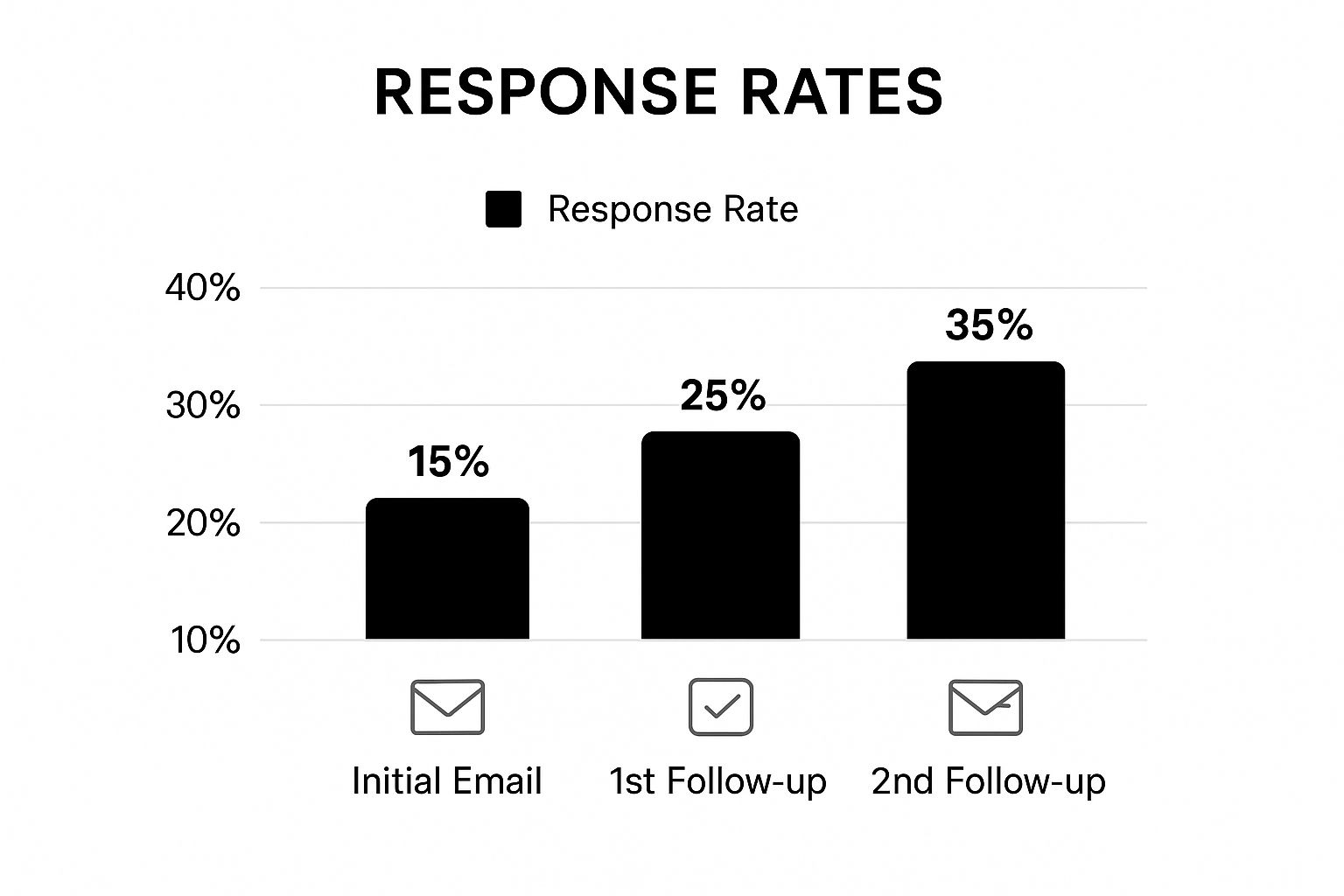
As you can see, your first email is just the opening act. A smart follow-up sequence can easily double your chances of getting that coveted reply.
A word of advice: only test one thing at a time. If you change the subject line and the CTA in the same test, you’ll have no idea which change was responsible for the results. By isolating one variable, you can confidently say, “This is what worked,” and build upon that knowledge.
Clearing Up Common Cold Email Questions
Even the most seasoned pros run into questions when they’re deep in the weeds of a cold email campaign. It’s natural. Getting these sticking points sorted out is what separates a stalled campaign from one that really takes off.
Let’s tackle some of the most common questions I hear from people just like you.
What’s the Absolute Best Day and Time to Send a Cold Email?
This is the million-dollar question, isn’t it? The honest-to-goodness answer is, it depends. You’ll see dozens of studies pointing to a “golden window,” usually somewhere mid-week between 9 AM and 11 AM. But treating that as a hard and fast rule is a mistake.
Think about who you’re trying to reach. A startup founder’s schedule is worlds apart from a restaurant owner’s. The founder might be plowing through their inbox first thing Monday morning, while the restaurant owner is slammed during lunch and dinner. For them, a late-night or very early morning email might actually get noticed.
My advice? Use the conventional wisdom as your starting point, not your destination. Send your first few batches during those popular times, sure. But then, you have to start experimenting. Try a Monday afternoon. See what happens on a Friday morning. The only data that truly matters is your own. Watch your open and reply rates like a hawk and let them tell you when your audience is paying attention.
How Many Follow-Ups Is Too Many?
You’re walking a fine line here between being persistent and just being annoying. I’ve found that a sequence of 2 to 4 follow-up emails hits the sweet spot for most campaigns. A massive number of replies come from these follow-ups, so if you’re not sending them, you’re just leaving opportunity on the table.
A simple, respectful cadence that works well looks something like this:
- Day 1: The initial email.
- Day 4: First follow-up.
- Day 8: Second follow-up.
- Day 15: A final, gentle nudge.
The golden rule is to add value every single time. Don’t just send a lazy “just checking in” email. Each message needs to offer something new—a different resource, a fresh insight, another angle on how you can help. If you’ve sent three or four genuinely helpful messages and still hear crickets, it’s time to respectfully bow out. Pushing past that point is where you risk getting marked as spam and hurting your reputation.
An unanswered email isn’t always a hard “no.” More often than not, it’s a “not right now.” A great follow-up simply makes it easy for them to reply when the timing finally clicks.
Should I Use AI to Write My Cold Emails?
Yes, absolutely—but with one major rule. Think of AI as your co-pilot, not the pilot. AI tools are brilliant for getting you off the ground. They can spitball dozens of subject lines, whip up a first draft, fix your grammar, or rephrase a clunky sentence in seconds.
What AI can’t do is replicate genuine human connection. It can’t have an “aha!” moment reading a company’s annual report or spot a subtle, interesting detail in a prospect’s LinkedIn post. That last 20% of deep, human personalization is what gets you a reply.
A 100% AI-generated email feels… off. It’s hollow, and trust me, busy people can spot them a mile away. Let AI do the heavy lifting—the 80% of drafting and structuring—but always, always save the final, crucial touches for yourself. Your personal insight is the one thing that can’t be automated.
Ready to make sure every email you craft actually lands in the inbox? Stop guessing and start validating. Truelist offers pay-as-you-go credits that never expire, plus unlimited plans for high-volume senders, to help you clean your lists, slash your bounce rates, and protect your sender reputation. Try Truelist for free and see the difference.