 Claude
  Perplexity
8 Smart Ways to Increase Email Open Rate in 2025
Discover actionable strategies to increase email open rate and boost engagement in 2025. Learn subject line optimization, list segmentation, and more!
TL;DR: Discover actionable strategies to increase email open rate and boost engagement in 2025. Learn subject line optimization, list segmentation, and more!
Unlocking the Secrets to Higher Email Open Rates
Want to increase email open rates and boost your email marketing ROI? This listicle delivers eight actionable strategies to help you achieve just that. A high open rate is crucial for conversions, whether you’re a sales representative, marketer, developer, or small business owner. Learn how to optimize subject lines, sender information, email design, and more to grab your audience’s attention and drive engagement. From list segmentation to re-engagement campaigns, these tips will transform your email performance.
1. Subject Line Optimization
Subject line optimization is the practice of crafting compelling, personalized, and curiosity-driven subject lines that entice recipients to open emails. This is the most critical factor in increasing email open rates as it’s the first thing recipients see and serves as the gateway to your email content. It’s the equivalent of a storefront window display – a poorly designed one will likely be passed over, while an enticing one draws customers in. In the digital realm of email marketing, your subject line is that window display, and optimizing it is crucial to attracting attention and ultimately, driving conversions.
Several features contribute to a successful subject line. Character limit optimization is essential, especially for mobile devices where subject lines are often truncated. Aim for 30-50 characters to ensure your core message is visible. Personalization, using the recipient’s name or company, can significantly increase engagement. Incorporating elements of urgency and scarcity, when appropriate, can encourage prompt action. Curiosity gaps and questions pique interest and encourage recipients to click. Finally, using emojis can add visual appeal and help your email stand out in a crowded inbox. A/B testing capabilities within your email marketing platform allow you to experiment with different subject lines and refine your approach over time.
There are undeniable advantages to focusing on subject line optimization. It’s arguably the most impactful factor on open rates and, thankfully, it’s also easy to implement and test. You can see results immediately, and the cost to optimize is minimal. However, there are some potential drawbacks. Overdoing any of the tactics mentioned above can make your emails appear spammy. Cultural and audience sensitivity are crucial – what works for one audience may not resonate with another. Constant testing and refinement are needed for continued optimization. And finally, there’s the temptation to write misleading clickbait-y subject lines, which can damage your sender reputation and erode trust over time.
Successful examples of subject line optimization abound. Spotify’s personalized “Your 2023 Wrapped is here” campaigns leverage the power of personalized data to generate excitement. Airbnb’s location-specific subject lines like “Paris is calling your name” tap into wanderlust and personalized recommendations. BuzzFeed’s curiosity-driven subjects like “You won’t believe what happened next” create a powerful sense of intrigue. These examples demonstrate the versatility and effectiveness of different subject line strategies.
A compelling subject line is the first step to getting your emails opened. For more proven strategies on boosting your open rates, check out this helpful resource: improve email open rates “Improve Email Open Rates: 7 Proven Strategies for 2025” from OKZest offers a comprehensive guide to optimizing your email campaigns.
Here are some practical tips to help you increase email open rate through effective subject line optimization: test different subject line lengths and styles, use numbers and specific details when relevant, avoid spam trigger words like “Free,” “Urgent,” and “Act Now” (unless genuinely applicable), create urgency without being pushy, and always ensure your subject line accurately reflects the email content to build trust.
The following infographic visualizes three key data points for subject line optimization: optimal character length, average open rate lift from optimization, and the recommended number of A/B tests to run.
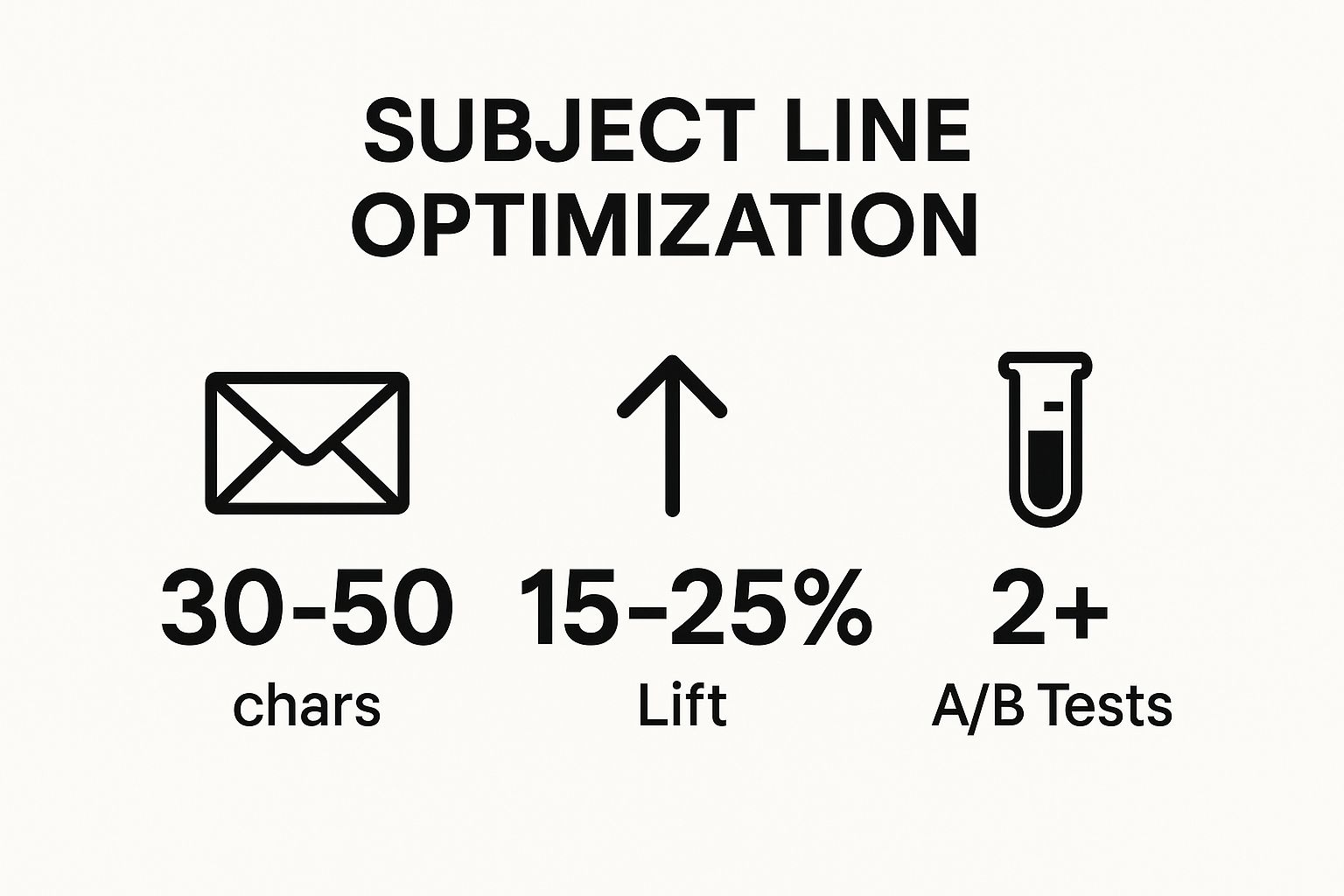
As the infographic illustrates, keeping your subject lines within the 30-50 character range, aiming for a 15-25% lift in open rates through optimization efforts, and consistently A/B testing at least two subject line variations are critical for successful email campaigns. These statistics highlight the importance of carefully crafting concise, impactful subject lines and the value of ongoing testing and refinement.
Pioneers in advertising and marketing like David Ogilvy recognized the importance of headlines, a principle that translates directly to email subject lines. Digital marketing experts like Neil Patel consistently emphasize the role of subject line optimization in driving email engagement. Research by organizations such as Campaign Monitor further validates the impact of well-crafted subject lines on open rates and overall campaign success. Whether you’re a sales representative conducting cold email outreach, a small business owner managing a high-volume email list, or an e-commerce company optimizing transactional emails, subject line optimization is a crucial element in achieving your email marketing goals.
2. Sender Name and Email Address Optimization
One of the most impactful, yet often overlooked, aspects of increasing your email open rates lies in optimizing your sender name and email address. This strategic approach focuses on establishing a clear and recognizable sender identity, leveraging consistent branding and trustworthy email addresses to build familiarity and trust with your recipients. When subscribers recognize and trust who an email is coming from, they’re significantly more likely to open it. This simple tweak can be the difference between your message landing in the inbox or being ignored.
This method works by capitalizing on the human tendency to prioritize communication from known and trusted sources. Think about your own inbox – are you more likely to open an email from a recognizable name or a generic, impersonal address? By consistently using a recognizable sender name and professional email address, you build a sense of familiarity and credibility with your audience. This fosters trust, which directly translates into higher open rates and improved engagement.
Several key features contribute to successful sender identity optimization:
- Human Name + Company Format: Using a format like “Sarah from Shopify” or “Austin from Morning Brew” adds a personal touch while still maintaining brand association. This format works particularly well for building rapport with audiences.
- Consistent Sender Identity Across Campaigns: Maintaining the same sender name across all your email campaigns reinforces brand recognition and avoids confusion. Consistency is key to building familiarity.
- Brand Recognition Elements: Incorporating your brand name within the sender name or email address reinforces brand awareness and helps recipients quickly identify your emails.
- Reply-Enabled Email Addresses: Using a reply-enabled email address encourages interaction and fosters a two-way communication channel with your subscribers. This builds a stronger connection and demonstrates accessibility.
- Domain Authentication and Reputation Management: Implementing proper authentication protocols like SPF, DKIM, and DMARC not only improves deliverability but also signals trustworthiness to email providers and recipients, reducing the chances of your emails being flagged as spam.
The advantages of optimizing your sender name and email address are numerous:
- Builds Long-Term Subscriber Trust: Consistent positive interactions associated with a recognizable sender build trust over time, leading to higher engagement.
- Improves Deliverability Rates: Proper authentication and a good sender reputation contribute to better inbox placement.
- Creates Personal Connection with Audience: Humanized sender names foster a sense of personal connection, making your emails feel less like mass marketing and more like a one-on-one conversation.
- Reduces Unsubscribe Rates: When subscribers recognize and trust the sender, they are less likely to unsubscribe.
However, there are also some potential drawbacks to consider:
- Takes Time to Build Recognition: Establishing a recognizable sender identity takes time and consistent effort. Results are not immediate.
- Requires Consistent Brand Management: Maintaining consistency across all communication channels is essential for maximizing impact.
- May Not Work for All Business Types: Highly formal industries or businesses with established impersonal branding might find this approach less effective.
- Can Create Dependency on Specific Individuals: If your entire sender identity is built around a single individual, their departure can disrupt brand recognition.
Examples of successful implementation of this strategy include HubSpot’s “Dharmesh from HubSpot,” Warby Parker’s consistent use of “The Warby Parker Team,” and Morning Brew’s personable “Austin from Morning Brew.” These brands demonstrate the effectiveness of different approaches tailored to their specific audiences.
Here are some actionable tips to optimize your sender name and email address:
- Use a consistent sender name across all emails.
- Include your company name for brand recognition.
- Test personal vs. company sender names to see what resonates best with your audience.
- Ensure your sender email address is professional and reflects your brand.
- Set up proper authentication (SPF, DKIM, DMARC) to improve deliverability and build trust.
This approach is particularly valuable for sales development representatives conducting cold email outreach, cost-conscious email marketing professionals looking for impactful yet inexpensive strategies, developers and API integrators seeking automated validation solutions, small businesses and startups managing high-volume email lists, and e-commerce and SaaS companies optimizing transactional email deliverability. By optimizing your sender name and email address, you make a small change that yields significant returns in terms of increased open rates and overall email marketing effectiveness, making it a crucial element in any email marketing strategy.
3. List Segmentation and Targeting
One of the most effective strategies to increase email open rates is list segmentation and targeting. This practice involves dividing your email subscribers into smaller, more focused groups based on shared characteristics, such as demographics, behavior, preferences, or engagement history. By tailoring your email content to resonate with these specific audience segments, you dramatically increase the chances of your emails being opened and engaged with. Instead of blasting a generic message to your entire list, you’re delivering personalized content that speaks directly to the individual recipient’s needs and interests. This targeted approach makes your emails more relevant and valuable, fostering stronger connections with your audience and ultimately boosting your open rates.

List segmentation offers a range of possibilities. You can segment based on demographics like age, location, and job title, allowing you to craft messages that resonate with specific demographics. Behavioral segmentation, based on past purchases, website activity, or content interactions, allows you to send highly targeted product recommendations or follow-up emails. Engagement-based segmentation helps you identify and re-engage inactive subscribers while nurturing your most active users with exclusive content. Preference-based segmentation allows subscribers to choose the type of content they receive and how often, leading to higher satisfaction and lower unsubscribe rates. Finally, lifecycle stage segmentation allows you to tailor messaging based on where a subscriber is in their journey with your brand, from new subscriber to loyal customer to brand advocate.
Examples of successful list segmentation and targeting abound. Netflix uses viewing history to recommend personalized movie and show suggestions, while Amazon leverages purchase behavior to trigger targeted product recommendations. Sephora segments its campaigns based on beauty profiles, sending personalized product recommendations and beauty tips. Spotify curates and delivers segmented playlist emails based on individual music tastes. These companies understand the power of personalization and use segmentation to deliver highly relevant content that drives engagement.
Here are some actionable tips to implement effective list segmentation and targeting:
- Start simple: Begin with basic demographic or behavioral segments and gradually add more complex layers as you gather data.
- Collect data at signup: Use signup forms to gather essential segmentation data, such as interests, industry, or company size.
- Monitor and adjust: Continuously track the performance of your segmented campaigns and adjust your strategy based on open rates, click-through rates, and conversions.
- Dynamic content: Leverage dynamic content to personalize email elements for different segments within a single campaign.
- Regular list cleaning: Remove inactive subscribers and update outdated information to maintain a healthy and engaged email list. Re-segment your list periodically to ensure your segments remain relevant and effective.
While list segmentation offers significant benefits, it’s important to be aware of the potential drawbacks. Managing multiple segments requires more time and resources. You’ll need to collect and analyze data effectively, and there’s a risk of over-segmentation, leading to tiny audiences that make it difficult to see statistically significant results. However, the advantages far outweigh the disadvantages. List segmentation leads to significantly higher open and click-through rates, improves customer experience and satisfaction, and contributes to better deliverability due to higher engagement. It also allows for a more efficient use of your email marketing budget by targeting only the most receptive audiences.
This approach is especially beneficial for sales development representatives using cold email outreach, cost-conscious email marketing professionals, developers and API integrators seeking automated validation, small businesses and startups managing high-volume email lists, and e-commerce and SaaS companies optimizing transactional email deliverability. Learn more about List Segmentation and Targeting and discover how it can revolutionize your email marketing efforts. By delivering the right message to the right person at the right time, you’ll maximize your impact and drive meaningful results.
4. Send Time Optimization
One of the most impactful yet often overlooked aspects of increasing email open rates is send time optimization. This strategy focuses on delivering your emails precisely when your target audience is most likely to engage with their inbox. By strategically aligning your send times with subscriber behavior, you significantly boost the chances of your message being seen, read, and acted upon. For sales development representatives, email marketers, and anyone managing email campaigns, understanding and implementing send time optimization is crucial for maximizing ROI.
Send time optimization isn’t simply guessing the best time to send. It involves a data-driven approach that considers several factors, including:
- Time Zone-Based Sending: A fundamental aspect, especially for global audiences. Sending an email at 9 AM in your time zone might be 3 AM for a subscriber elsewhere. Time zone segmentation ensures your message arrives during business hours or peak engagement periods, regardless of location.
- Day-of-Week Optimization: Certain days consistently perform better for email engagement. While Tuesdays, Wednesdays, and Thursdays are generally considered optimal for B2B communication, e-commerce businesses might find success with weekend sends when consumers have more leisure time.
- Industry-Specific Timing Considerations: Industry norms and audience behavior play a role. For example, newsletter publishers often find success with Thursday morning sends, capitalizing on the end-of-week news cycle.
- Individual Subscriber Behavior Analysis: Advanced email marketing platforms allow for analyzing individual subscriber engagement patterns. This data can reveal optimal send times based on when specific users historically open and interact with emails.
- A/B Testing of Different Send Times: Experimentation is key. A/B testing different send times allows you to compare open rates and identify the most effective windows for your specific audience.
- Automated Send Time Optimization Tools: Many email marketing platforms offer automated tools that leverage machine learning to dynamically adjust send times based on individual subscriber behavior and overall campaign performance.
The benefits of effective send time optimization are substantial:
- Increased Visibility: Emails sent at optimal times are more likely to be at the top of the inbox when subscribers check their email, increasing visibility and the chances of being opened.
- Improved Engagement Rates: Higher open rates often translate to increased click-through rates and conversions, as emails are reaching subscribers when they are most receptive.
- Maximized Campaign ROI: By optimizing engagement, send time optimization can lead to a higher return on investment for your email marketing efforts.
- Automated Efficiency: Automated tools streamline the process, freeing up your time for other important tasks.
However, send time optimization also presents some challenges:
- Audience Variability: Optimal times can vary drastically depending on your target audience’s demographics, location, and behavior. What works for one audience might not work for another.
- Data Dependence: Effective optimization relies on data collection and analysis. This requires tracking open rates and experimenting with different send times to identify patterns.
- Urgency Conflicts: Time-sensitive campaigns might not always align with optimal send times. You may need to prioritize timely delivery over maximizing open rates in certain situations.
- Global Campaign Complexity: Managing time zones for international audiences can be complex, requiring careful segmentation and scheduling.
Successful implementation of send time optimization can be seen across various industries. B2B companies often find that sending emails between 10 AM and noon on Tuesdays, Wednesdays, and Thursdays yields the best results. E-commerce brands, on the other hand, sometimes see higher open and click-through rates with weekend evening sends when consumers are more likely to be browsing online. Newsletter publishers frequently utilize Thursday mornings to capitalize on the end-of-week news cycle. Mailchimp’s Send Time Optimization feature provides a good example of how data analysis can be leveraged to determine the best send times for your audience. Similarly, studies by Constant Contact and GetResponse have contributed significantly to our understanding of email timing best practices. Learn more about Send Time Optimization
To effectively implement send time optimization, consider these actionable tips:
- Systematic Testing: Test different send times and days of the week methodically to identify optimal windows.
- Audience Awareness: Consider your audience’s lifestyle, work schedule, and typical email checking habits.
- Consistent Monitoring: Continuously monitor open rates by send time to identify trends and adjust your strategy accordingly.
- Time Zone Segmentation: Implement time zone-based sending for global email lists to ensure timely delivery.
- Seasonal Adjustments: Be mindful of seasonal patterns and adjust your send times based on holidays, events, or changes in audience behavior.
By understanding the nuances of send time optimization and employing these strategies, you can significantly increase your email open rates, improve engagement, and maximize the impact of your email marketing campaigns. This is especially critical for sales development representatives engaged in cold outreach, cost-conscious marketing professionals, and businesses striving to enhance their email deliverability.
5. Mobile-First Email Design
In today’s mobile-driven world, ignoring mobile users is akin to ignoring a significant portion of your potential audience. With over 60% of emails being opened on smartphones and tablets, optimizing your emails for mobile devices is no longer optional—it’s essential for increasing your email open rates and overall campaign success. Mobile-first email design prioritizes the mobile user experience, ensuring your emails render beautifully and function flawlessly across a range of devices. This approach focuses on responsive design, fast loading speeds, and touch-friendly interfaces, making it easier for recipients to engage with your content on the go. By embracing mobile-first design, you’re catering to the majority of your audience and setting the stage for higher open rates, improved click-through rates, and ultimately, better conversion rates. This is why mobile-first email design deserves its place as a key strategy for increasing email open rates.
Mobile-first email design involves crafting emails specifically for mobile devices first, and then adapting them for larger screens like desktops. This method ensures that the core experience is optimized for the smaller screen, preventing the frustration of zoomed-in text, tiny buttons, and distorted layouts that often plague desktop-first designs on mobile. This approach leverages responsive email templates that automatically adjust to different screen sizes. These templates use fluid layouts and media queries to dynamically resize images, text, and other elements, ensuring optimal display on any device.
Several key features are crucial for effective mobile-first email design. These include using single-column layouts for easy mobile reading, incorporating large, touch-friendly buttons (minimum 44px for easy tapping), optimizing image sizes for fast loading times on mobile networks, employing readable font sizes (minimum 14px), and creating a simplified navigation structure with a clear visual hierarchy. These elements work together to provide a seamless and enjoyable mobile email experience, encouraging recipients to engage with your content.
Numerous successful companies demonstrate the power of mobile-first email design. Starbucks, for example, utilizes simple, image-heavy emails that are visually appealing and easy to navigate on mobile devices. Uber employs a clean, button-focused mobile design, making it effortless for users to access ride information or contact support. Pinterest’s visual, Pinterest-board-style mobile layouts seamlessly translate the platform’s core experience to email. Grubhub’s location-based mobile-optimized restaurant emails make ordering food on the go quick and convenient. These examples showcase how different brands can tailor mobile-first design to their specific needs and branding, while consistently prioritizing the mobile user experience.
To implement mobile-first design effectively, consider the following tips: Use single-column layouts for better mobile display. Keep subject lines concise, ideally under 30 characters, to ensure they display fully in mobile previews. Always test your emails on actual mobile devices, not just desktop previews, to catch any rendering issues. Use larger fonts and buttons for easy tapping on touchscreens. Optimize images for faster mobile loading by compressing them and using appropriate file formats.
While mobile-first email design offers numerous advantages, it’s important to be aware of the potential drawbacks. Redesigning existing templates might be necessary, and complex designs can be more challenging to implement within the constraints of mobile screens. Thorough testing across multiple devices is essential to ensure consistent rendering. Additionally, optimizing for mobile might require some compromise in desktop optimization, although responsive design minimizes this trade-off.
The benefits of mobile-first design, however, significantly outweigh the challenges. By capturing the majority of email opens—those originating from mobile users—you improve the overall user experience, reduce delete rates stemming from formatting issues, and future-proof your email campaigns against the continuing rise of mobile usage. This approach is particularly beneficial for sales development representatives using cold email outreach, cost-conscious email marketing professionals, developers and API integrators handling transactional emails, small businesses and startups managing high-volume email lists, and e-commerce and SaaS companies optimizing for conversions. Mobile-first design empowers these users to connect with their audience effectively, regardless of the device they’re using, ultimately leading to increased engagement and a better return on investment. Tools and resources like Litmus mobile email testing tools, Email on Acid’s responsive design advocacy, and Really Good Emails’ mobile showcase can further assist in mastering this essential strategy.
6. Preheader Text Optimization: The Secret Weapon to Increase Email Open Rate
Preheader text, that often-overlooked snippet of preview text displayed after the subject line in most email clients, holds surprising power to increase email open rate. It’s the second impression, the hook that pulls recipients in after your subject line catches their eye. Think of it as valuable real estate for extending your message and enticing clicks. While a compelling subject line grabs attention, a well-crafted preheader text provides context and adds value, significantly influencing a recipient’s decision to open your email. For cost-conscious email marketers, small businesses, and startups, optimizing this element is a low-cost, high-impact strategy for boosting engagement.
How does it work? When an email lands in an inbox, the preheader text appears alongside the subject line, offering a preview of the email’s content. This sneak peek allows subscribers to quickly gauge the relevance and value of your email before deciding to open it. This is particularly important in a world inundated with emails; it helps your message stand out from the noise and compete for attention.
Why Preheader Text Optimization Deserves Its Spot on the List:
The benefits of preheader text optimization are multifold, directly impacting your ability to increase email open rate. It provides:
- Additional Messaging Real Estate: Expand on your subject line and provide further context without cramming everything into the subject line itself.
- Clarification and Expansion: Explain a cryptic or concise subject line, offering more detail about the email’s content.
- Improved Preview Appeal: An engaging preheader transforms a bland preview into a compelling invitation.
- Easy Implementation, Big Impact: Implementing preheader text is technically simple but yields significant improvements in open rates.
However, it’s essential to acknowledge the challenges:
- Often Overlooked: Many marketers either forget or underestimate the power of the preheader.
- Character Limitations: The available space is limited, usually between 50-90 characters, demanding concise and impactful writing.
- Inconsistent Display: Not all email clients display preheader text uniformly.
- Coordination Required: Subject line and preheader text must work together harmoniously to maximize impact.
Examples of Effective Preheader Text:
Several brands leverage preheader text effectively to increase email open rate. Consider these examples:
- Product-Focused: Everlane uses preheaders like “New sustainable basics inside” to instantly communicate the email’s value proposition. This is highly effective for e-commerce companies optimizing transactional emails.
- Summary Style: TheSkimm provides a brief summary of their newsletter content in the preheader, allowing readers to preview the key topics covered.
- Benefit-Driven: Glossier uses preheaders like “Get that dewy glow” to highlight the benefits of their products and entice recipients to learn more. This approach resonates well with SaaS companies looking to showcase their product’s value.
- Contextualized Preview: Headspace uses mindfulness-focused preview text to set the tone and appeal to their target audience.
Actionable Tips for Preheader Text Optimization:
Here’s how you can optimize your preheader text to increase email open rate:
- Complement, Don’t Repeat: Your preheader should add to the subject line, not simply reiterate it.
- Highlight Value: Clearly state the benefit of opening the email. What’s in it for the recipient?
- Mind the Length: Aim for under 90 characters to ensure optimal display across different email clients, especially on mobile devices.
- A/B Test: Experiment with different approaches, such as posing questions versus making statements, to identify what resonates best with your audience.
- Hidden Spacer Text: Use hidden spacer text (a string of non-breaking spaces) to control which content appears as the preheader and prevent unwanted text from being pulled in. This is particularly important for developers and API integrators managing automated email campaigns.
Popularized By Industry Leaders:
The importance of preheader text optimization has been highlighted by industry leaders like Campaign Monitor through their preheader studies, Litmus with their email testing recommendations, and Really Good Emails’ best practice analysis.
By leveraging preheader text effectively, sales development representatives using cold email outreach, email marketing professionals, and even developers managing transactional emails can significantly increase email open rate and drive higher engagement. It’s a small change with a big impact, well worth the effort for anyone seeking to maximize the effectiveness of their email campaigns.
7. Email Authentication and Deliverability
Want to increase email open rates? One of the most crucial, yet often overlooked, aspects is email authentication and deliverability. It’s the backbone of successful email marketing, ensuring your meticulously crafted messages actually land in your subscribers’ inboxes instead of being relegated to the spam folder. Think of it as your email’s passport and visa – without the proper stamps, it won’t be allowed entry. This is particularly critical for sales development representatives, cost-conscious email marketers, developers handling API integrations, startups managing growing email lists, and e-commerce/SaaS companies relying on transactional emails.
Email authentication and deliverability involve implementing technical protocols and best practices to verify your identity as a legitimate sender. This builds trust with email providers like Gmail, Yahoo, and Outlook, significantly increasing the chances of your emails reaching the intended recipients. Without these measures in place, your open rates will suffer, impacting your overall campaign effectiveness.
This process primarily revolves around three key email authentication protocols: SPF, DKIM, and DMARC. SPF (Sender Policy Framework) specifies which mail servers are allowed to send emails on behalf of your domain. Think of it as authorizing specific post offices to handle your mail. DKIM (DomainKeys Identified Mail) adds a digital signature to your emails, verifying their authenticity and preventing tampering. This is like adding a tamper-proof seal to your letters. Finally, DMARC (Domain-based Message Authentication, Reporting & Conformance) ties SPF and DKIM together, telling email providers what to do with emails that fail authentication checks – whether to quarantine them, reject them, or deliver them to the spam folder. This is like giving specific instructions on how to handle suspicious mail.
Beyond these core protocols, maintaining a good sender reputation is vital. This involves consistent list hygiene practices, such as regularly removing inactive subscribers and managing bounced emails. Just like a clean driving record keeps your insurance premiums down, a clean email list keeps your sender reputation high. Spam filter testing and optimization also play a crucial role. By testing your emails against common spam filters, you can identify and avoid trigger words and formatting issues that could land your emails in spam.
The benefits of proper email authentication and deliverability are substantial. It dramatically improves inbox placement rates, leading to increased open rates and ultimately, higher conversion rates. It builds long-term sender reputation, establishing trust with email providers and subscribers alike. Moreover, it reduces the number of emails marked as spam, preventing your domain from being blacklisted.
While the advantages are clear, there are some challenges to consider. Implementing these protocols requires technical expertise and can be time-consuming to set up correctly. Ongoing monitoring and maintenance are also necessary to ensure optimal performance. It’s important to understand that results may take time to show improvement, as building a strong sender reputation is an ongoing process.
Several successful companies demonstrate the power of robust email authentication and deliverability practices. Salesforce, for instance, has a comprehensive email authentication setup that ensures its marketing and transactional emails consistently reach their target audience. Shopify provides detailed deliverability best practices for its merchants, empowering them to maximize their email marketing efforts. Mailchimp simplifies the process for its users by offering automated authentication, while HubSpot provides powerful deliverability monitoring tools to track sender reputation and identify potential issues.
To optimize your own email authentication and deliverability, consider these actionable tips: Implement all three authentication protocols (SPF, DKIM, and DMARC). Regularly clean your email lists of inactive subscribers. Monitor your sender reputation scores consistently. Use double opt-in for new subscribers to ensure they actively want to receive your emails. Avoid spam trigger words and excessive punctuation. Managing a dedicated IP address can also improve deliverability, particularly for high-volume senders.
Learn more about Email Authentication and Deliverability
While setting up email authentication and deliverability might require an initial investment of time and resources, the long-term benefits for increasing email open rates and overall campaign effectiveness are undeniable. By prioritizing these practices, you can ensure your emails reach their intended audience, maximizing your return on investment and fostering stronger relationships with your subscribers. Remember, getting your email delivered is the first step towards getting it opened. If you’re serious about improving your email marketing performance, email authentication and deliverability are not optional – they are essential.
8. Re-engagement and Win-back Campaigns
One often-overlooked tactic to increase email open rates is focusing on the subscribers you already have. Instead of solely pursuing new sign-ups, consider re-engaging inactive subscribers through targeted win-back campaigns. This strategy can significantly improve your overall list engagement and, consequently, your email open rates. Why? Because a highly engaged list signals to email providers that your content is valuable, increasing your sender reputation and the likelihood of your emails landing in the inbox.
Re-engagement and win-back campaigns are specifically designed to reconnect with subscribers who have become inactive. This inactivity might manifest as a lack of opens, clicks, or purchases over a defined period. These campaigns aim to reignite interest and encourage these dormant subscribers to re-engage with your brand before they are removed from your list entirely. They achieve this through a combination of personalized messaging, enticing offers, and providing subscribers with more control over their email preferences. This approach helps clean up your email list, leading to a higher percentage of engaged users and ultimately, an increase email open rate.
Several features make these campaigns effective. First, they are often automated, triggered by a set period of inactivity (e.g., 60-90 days). This automation saves you time and ensures consistent outreach. Second, these campaigns utilize personalized messaging that acknowledges the subscriber’s absence, making the communication feel more genuine. For instance, a simple “We miss you” can go a long way. Third, they often include special offers or incentives, such as discounts or exclusive content, to entice subscribers to return. Finally, a crucial component is the inclusion of a preference center, allowing subscribers to adjust their email frequency or the type of content they receive. This empowers subscribers and reduces the likelihood of them simply unsubscribing altogether.
There are several compelling reasons to implement re-engagement campaigns. They improve overall list engagement rates by reactivating dormant subscribers, essentially breathing new life into your email list. This, in turn, enhances your sender reputation by demonstrating to email providers that your list is active and engaged, leading to better deliverability and increased email open rates. These campaigns also offer valuable insights into subscriber preferences. By analyzing how subscribers respond to different offers or content options, you can refine your overall email marketing strategy and tailor your messages more effectively.
Successful examples of re-engagement campaigns abound. Spotify’s “We miss you” campaigns, featuring personalized playlists based on past listening history, are a great example of leveraging user data to create a compelling reason to return. Grammarly effectively re-engages inactive users by showcasing new features and improvements they might have missed. Evernote offers a productivity tip series to remind dormant account holders of the platform’s value, while Coursera sends course recommendations to inactive learners, prompting them to continue their educational journey.
While the benefits are significant, there are some potential downsides. In the short term, re-engagement campaigns might lead to a slight increase in unsubscribes as some recipients decide they are genuinely no longer interested. Developing these campaigns also requires additional effort and planning. Furthermore, the success rates of re-engagement campaigns are typically lower than regular campaigns targeting active subscribers. Finally, if not executed thoughtfully, these campaigns can be perceived as pushy or intrusive.
To maximize the effectiveness of your re-engagement campaigns and increase email open rate, consider these tips:
- Wait 60-90 days of inactivity: This allows sufficient time for subscribers to genuinely become disengaged without bombarding them prematurely.
- Use compelling subject lines: Subject lines like “We miss you” or “Come back” create a sense of personalization and intrigue.
- Offer exclusive content or discounts: Provide a tangible incentive for subscribers to re-engage with your brand.
- Provide easy preference management options: Empower subscribers to choose the content and frequency they prefer.
- Remove consistently unengaged subscribers after the campaign: Maintaining a clean list is crucial for sender reputation and deliverability.
Popular email marketing platforms like Klaviyo, Mailchimp, and Campaign Monitor offer tools and templates to simplify the creation and automation of re-engagement campaigns. Their automated workflows and pre-built templates can streamline the process and help you get started quickly. By implementing these strategies and utilizing the available resources, you can effectively revive inactive subscribers, boost engagement, and ultimately, increase email open rate.
Email Open Rate Strategies Comparison
| Strategy | 🔄 Implementation Complexity | ⚡ Resource Requirements | 📊 Expected Outcomes | 💡 Ideal Use Cases | ⭐ Key Advantages |
|---|---|---|---|---|---|
| Subject Line Optimization | Low | Low | 15-25% increase in open rates | Increasing email open rates | Most impactful on opens, easy & low cost |
| Sender Name and Email Address Optimization | Low to Medium | Low to Medium | Builds long-term trust; 73% millennials prefer recognizable senders | Building trust and brand recognition | Improves deliverability, reduces unsubscribes |
| List Segmentation and Targeting | Medium to High | Medium to High | 14.3% higher open rates with segmentation | Personalized content for diverse audiences | Higher engagement, better budget efficiency |
| Send Time Optimization | Medium | Medium | Up to 23% improvement in open rates | Timing emails for max engagement | Increases email visibility, can be automated |
| Mobile-First Email Design | Medium | Medium | 15% higher click-through rates | Majority mobile users | Enhances UX, reduces deletes, future-proofs emails |
| Preheader Text Optimization | Low | Low | Up to 30% improvement in open rates | Complementing subject lines | Adds preview real estate, easy to implement |
| Email Authentication and Deliverability | High | High | 10-20% better inbox placement; up to 30% higher opens | Ensuring inbox delivery and reducing spam | Builds sender reputation, reduces spam markings |
| Re-engagement and Win-back Campaigns | Medium | Medium | Recovers 5-15% inactive subscribers | Reactivating dormant subscribers | Improves list health, recovers lost engagements |
Supercharge Your Email Open Rates Now
Increasing your email open rate is crucial for any successful email marketing strategy. We’ve covered eight key strategies in this article, from optimizing your subject lines and preheader text to ensuring your emails are mobile-friendly and authenticated. Remember, list segmentation and targeting, along with choosing the right send time, allows you to personalize the experience and reach the right people at the right moment. Mastering these elements isn’t just about boosting a single metric; it’s about fostering stronger relationships with your audience, driving engagement, and ultimately achieving a higher return on your email marketing investment. By focusing on delivering value and respecting your subscribers’ time, you can transform your emails from overlooked messages into anticipated communications.
Implementing even a few of these tactics can significantly increase email open rate. But to truly maximize your impact, you need a clean, verified email list. Truelist helps you achieve just that, ensuring your messages reach the inbox and contribute to improved open rates and a stronger ROI. Take advantage of our free validation offer at Truelist and start seeing the difference a clean list can make today.