 Claude
  Perplexity
Your Guide to Using a Spam Trap Checker
Learn how a spam trap checker protects your sender reputation. Our guide explains how to find and remove email traps to improve your email deliverability.
TL;DR: Learn how a spam trap checker protects your sender reputation. Our guide explains how to find and remove email traps to improve your email deliverability.
A spam trap checker is your first line of defense in email marketing. Think of it as a specialized scanner designed to find and flag dangerous “trap” email addresses hiding in your contact list. These traps are a fast track to getting blacklisted by internet service providers, which can torpedo your sender reputation and destroy your campaign results.
Protecting Your Sender Reputation From Hidden Threats

Getting emails delivered to the inbox is the name of the game. Yet, even the most diligent marketers can accidentally let spam traps slip onto their lists, causing silent but serious damage to every single campaign they send.
Picture your email list as a high-performance engine. A spam trap checker is the expert diagnostic tool that finds the critical flaws before they lead to a total breakdown. Without it, you’re unknowingly sending emails to addresses specifically created to catch spammers, and the penalties can be severe.
Why List Hygiene Is No Longer Optional
Email providers have become incredibly strict because they’re fighting a constant flood of unwanted messages. The problem is massive. In the first half of 2023, the United States alone was hit with 78 billion spam texts. This number shows just how aggressive providers need to be, and spam traps are one of their best weapons.
Maintaining a clean list isn’t just about bulk campaigns, either. It’s also vital for effective sales email follow-up strategies. If your entire domain gets flagged for hitting spam traps, even your critical one-on-one sales emails could start landing in the junk folder, or worse, not get delivered at all.
Using a spam trap checker isn’t just about cleaning a list—it’s about protecting your brand’s credibility and ensuring your message has a chance to be heard. Hitting a single pristine trap can undo months of hard work building a positive sender score.
The Immediate Need For a Checker
At its core, a spam trap checker proactively finds these dangerous email addresses before you hit “send.” Throughout this guide, we’ll break down exactly what these traps are, the damage they can do, and how you can use a checker to keep your email program healthy and effective.
To give you a quick overview, here’s a summary of what a spam trap checker brings to the table.
Spam Trap Checker Quick Summary
| Core Function | Primary Benefit | Who Needs It |
|---|---|---|
| Scans email lists for known trap addresses. | Prevents Blacklisting: Avoids the primary trigger for IP and domain blacklisting by ISPs. | Any business or individual sending bulk or automated emails. |
| Identifies pristine, recycled, and typo traps. | Improves Deliverability: A clean list dramatically increases inbox placement rates. | Email marketers, sales teams, and marketing agencies. |
| Provides a list hygiene report. | Protects Sender Reputation: Maintains a positive sender score, ensuring long-term email success. | Anyone focused on growing their business through email. |
Ultimately, this simple tool helps you accomplish a few crucial things.
A regular scan with a spam trap checker helps you:
- Identify Hidden Risks: It spots addresses that look completely valid but are actually traps laid by ISPs and anti-spam services.
- Prevent Blacklisting: By removing these traps, you eliminate one of the biggest reasons IPs and domains get blacklisted.
- Boost Deliverability: With a cleaner list, your emails have a much better shot at landing in the primary inbox instead of the junk folder.
Making a spam trap checker a regular part of your process is a foundational step for any serious email marketer. It’s how you achieve consistent results and protect your sender reputation for the long haul.
Understanding How Spam Traps Work
Spam traps are the hidden reefs of email marketing. They look harmless on the surface but can absolutely wreck your sender reputation before you even know what hit you. It’s a huge misconception that traps are only triggered by sketchy content or “spammy” subject lines. The truth is, they have nothing to do with what you write and everything to do with who you’re sending to.
Think of them as digital tripwires laid by Internet Service Providers (ISPs) and anti-spam groups. Their only job is to catch senders who aren’t following email list best practices. Hitting one signals to these providers that you might be a spammer, even if your intentions are good. This is where a spam trap checker comes in—it’s the specialized tool you need to spot these tripwires before you stumble over them.
At their core, these traps are just email addresses. But they’re special ones, created and monitored by ISPs to identify senders with poor email list hygiene. Getting familiar with the different types is the first step to keeping your lists clean and your reputation safe.
Pristine Spam Traps: The Digital Honeypots
First up are pristine traps, and they are by far the most dangerous. Picture an email address that was created for one reason and one reason only: to be a trap. It has never belonged to a real person, never signed up for anything, and never opted into a single email.
These addresses are planted in places where list scrapers and sellers will find them—hidden in a website’s code, posted on forums, or buried inside purchased email lists. They are pure bait. When a marketer scrapes a site for emails or buys a shady list, they scoop up these honeypots without a clue.
Hitting a single pristine spam trap is a massive red flag for ISPs. It’s seen as concrete proof of irresponsible list gathering, which can lead to an immediate block of your IP address or sending domain.
Sending an email to a pristine trap tells providers one thing: you did not get permission. There’s no gray area or excuse. It’s the email equivalent of being caught with your hand in the cookie jar, and the consequences are just as swift.
Recycled Spam Traps: The Ghost Addresses
The other main category is the recycled spam trap. These are much more common and can find their way onto even well-managed lists if you aren’t paying close attention.
Think of these like old, disconnected phone numbers. A recycled trap was once a legitimate email address used by a real person—maybe an employee who left their company or someone who just abandoned an old Hotmail account. After a while, the provider deactivates the account and any emails sent to it will “hard bounce,” which is a clear signal that the address is dead.
Here’s the catch. After another long dormant period, the provider might reactivate that same address. Only this time, it’s not for a user; it’s a trap. Any sender still emailing this address is showing they have poor list hygiene. Why? Because they’ve been ignoring the hard bounces and failing to clean out inactive contacts. Hitting a recycled trap tells ISPs you aren’t maintaining your lists. The penalty might not be as instant as with a pristine trap, but hitting them repeatedly will kill your sender reputation and send your deliverability rates into a nosedive.
Ultimately, both pristine and recycled traps expose weaknesses in how a list is managed. The only real defense is a commitment to strong list hygiene and using a spam trap checker regularly to root out these threats. If you need some concrete steps, our guide on how to avoid spam traps can help you build a much more resilient sending strategy.
The Real Business Cost of Ignoring Spam Traps

It’s easy to think of a few bounced emails as a minor annoyance, but hitting a spam trap is a different beast entirely. This is where a technical deliverability hiccup snowballs into a serious business problem with very real financial consequences. Ignoring these hidden threats on your list is like ignoring a crack in a dam—the pressure builds quietly until the whole thing gives way.
Hitting just one pristine spam trap can get your sending domain or IP address blacklisted instantly. From there, it’s a devastating chain reaction. Your email deliverability craters, your open rates plummet, and the ROI you expect from your email campaigns vanishes almost overnight.
From Healthy Campaign to Grinding Halt
Let’s picture a successful e-commerce brand. Their weekly newsletter is a workhorse, reliably driving sales and keeping customers connected. But over time, their list has been quietly contaminated by a few recycled traps from long-inactive accounts and one pristine trap they unknowingly acquired from an old partner list.
Suddenly, their open rates drop from a healthy 25% to a worrying 15%. The next week, they’re at 8%. The marketing team is in a panic, testing new subject lines and tweaking send times, but nothing moves the needle. Revenue from their email channel has all but disappeared, and engagement has fallen off a cliff. The culprit? Spam traps that destroyed their sender reputation with major providers like Gmail and Outlook.
Spam traps are a direct threat to your bottom line. They don’t just sink one campaign; they poison the well for all future emails, eroding customer trust and damaging your brand’s reputation with every message that fails to deliver.
This isn’t just a scary story. Poor list hygiene directly attacks your business’s health, turning what should be a powerful marketing channel into a liability. A spam trap checker is the diagnostic tool you need to spot this kind of disaster before it happens.
The Financial Domino Effect of Poor Deliverability
The link between deliverability and revenue is crystal clear. For many marketers, simply getting past spam filters is a huge hurdle. Research highlights this, showing that nearly 60.3% of businesses say spam filters get in the way of their campaigns. The impact is staggering, with 64.6% of companies admitting that deliverability issues have directly cost them revenue or customers. You can dig deeper into these findings on the impact of email deliverability.
This data paints a very clear picture: when your emails don’t hit the inbox, you lose money. Every single email that lands in a spam folder is a missed chance to connect with, convert, and keep a customer.
The total cost of ignoring spam traps is steep and includes:
- Lost Revenue: The most direct hit, coming from failed campaigns and missed sales.
- Wasted Marketing Spend: All the money, time, and creative energy poured into campaigns that no one ever sees is just gone.
- Damaged Brand Reputation: When customers suddenly stop getting your emails, they might think your business is unreliable or, even worse, that you’re a real spammer.
- Reduced Customer Lifetime Value: Broken communication channels make it impossible to build the long-term relationships that lead to repeat business.
Why You Can’t Afford to Guess
At the end of the day, managing spam traps isn’t just a best practice for detail-oriented marketers; it’s a fundamental business requirement. The cost of a good spam trap checker is a drop in the bucket compared to the potential revenue loss and brand damage from a trashed sender reputation.
By proactively scanning your lists, you aren’t just cleaning up data—you’re protecting a vital revenue stream. You’re making sure your message actually gets to the people who want to see it, safeguarding your marketing ROI and preserving the trust you’ve worked so hard to build. Ignoring spam traps is a gamble no business can afford to make.
How a Spam Trap Checker Reveals List Vulnerabilities
So, how exactly does a spam trap checker sniff out these hidden dangers in your email list? Think of it less like a simple filter and more like a forensic investigation. It methodically scans every single contact, using data and pattern recognition to spot the invisible threats that could sink your deliverability.
These tools are designed to see what we can’t. They run your list against enormous, constantly updated databases of known traps and high-risk signals. It’s a bit like running a background check on every email address before you send a single campaign.
It’s All About the Data
A good spam trap checker doesn’t operate on guesswork. It’s plugged into a global intelligence network, analyzing billions of data points to identify risky addresses with surgical precision. It’s looking for very specific red flags that signal an email is likely a trap.
Here are the main clues a checker hunts for:
- Known Trap Signatures: The tool’s most powerful feature is its direct access to a database of confirmed pristine and recycled spam traps. Any match here is a five-alarm fire.
- Zero Engagement History: Some advanced checkers can identify addresses that have never opened or clicked an email from any sender, anywhere. This is a massive indicator of a potential trap.
- High-Risk Domain Patterns: The analysis flags emails coming from domains notorious for hosting traps or associated with widespread email abuse.
- Typo Traps: It catches common misspellings of popular domains (think “gnail.com” instead of “gmail.com”), which are often repurposed by providers to catch sloppy data practices.
The real magic of a spam trap checker is its ability to connect the dots. It blends historical data, behavioral patterns, and known threat intelligence to give you a clear, accurate picture of your list’s health.
This process is a critical piece of the larger puzzle of maintaining a healthy sender reputation.
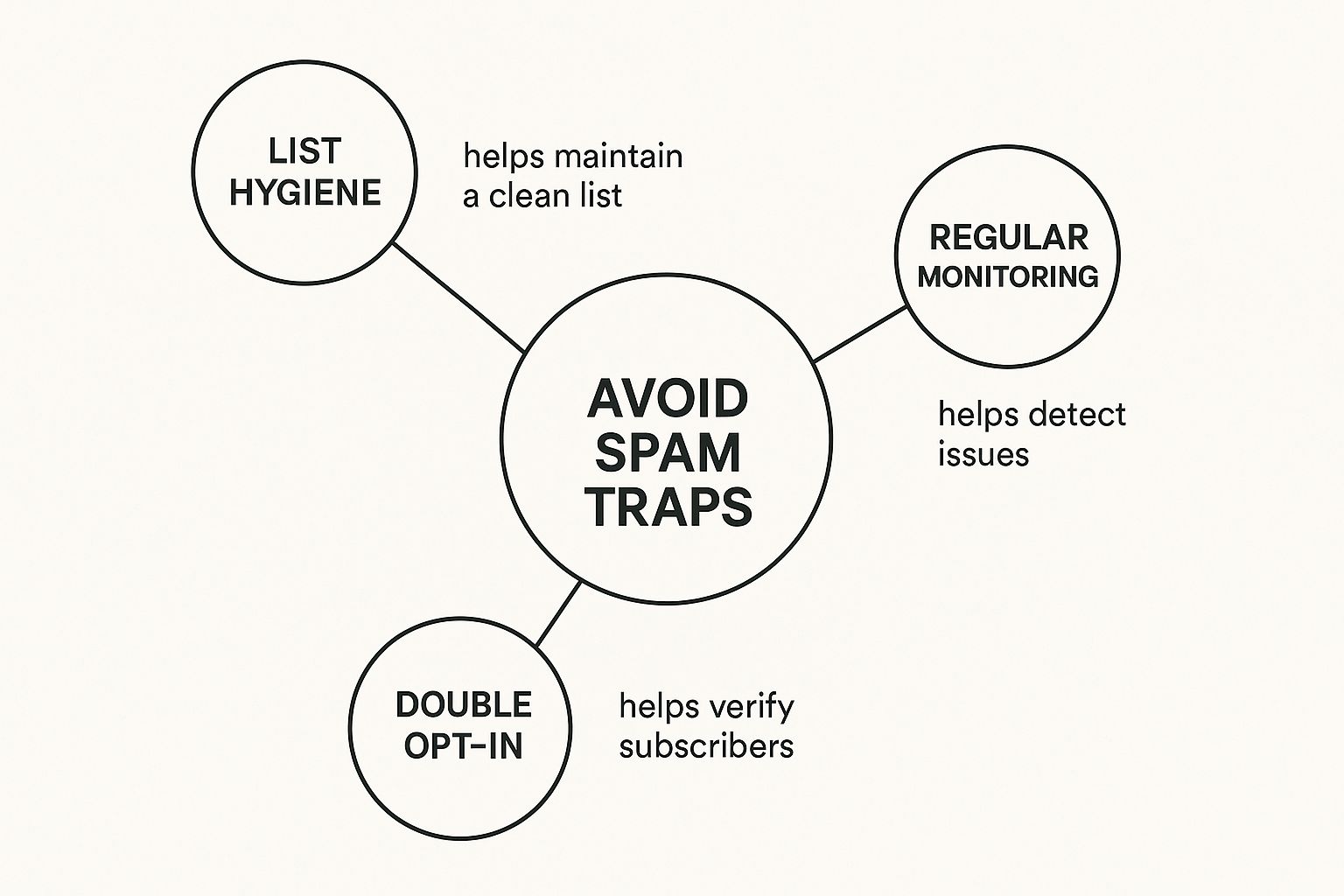
As you can see, using a checker isn’t a one-and-done fix. It’s a vital part of a comprehensive strategy that includes regular list cleaning and solid opt-in practices.
Demystifying the Detection Process
Let’s make this real. Imagine you upload your list of 10,000 contacts to a spam trap checker. The system immediately gets to work, running each address through its multi-layered verification process.
In just a few minutes, the results start coming in. The tool might find three emails that are direct matches for pristine spam traps. These are the most toxic addresses on your list and need to be removed immediately.
Next, it could flag another 50 contacts as probable recycled traps. These were once legitimate addresses that have been dormant for years and are now being monitored by ISPs to catch senders mailing to old, unengaged lists.
Finally, it might identify 200 more emails with no engagement history across its entire network. While not confirmed traps, these are high-risk “ghost” contacts that are almost certainly dragging down your deliverability. The tool gives you a clear, actionable report so you can clean your list with confidence, not guesswork. It’s not magic—it’s just smart data analysis.
Spam Trap Checker Features Breakdown
Not all spam trap checkers are created equal. The tools on the market range from basic scanners to sophisticated platforms offering deep-dive analytics. Here’s a look at what separates the standard features from the more advanced ones.
| Feature | What It Does | Why It’s Important |
|---|---|---|
| Known Trap Detection | Scans your list against a database of confirmed spam trap email addresses. | This is the core function. Directly removes the most damaging types of traps from your list. |
| Recycled Trap ID | Identifies emails that were once valid but are now dormant and repurposed. | Helps you avoid sending to inactive lists, a major red flag for mailbox providers. |
| Typo Trap Detection | Catches common misspellings of major domains (e.g., “gmal.com”). | Prevents you from hitting traps set up to catch poor data collection practices. |
| Accept-All Detection | Flags domains that report every email as valid, even nonexistent ones. | These are often sources of spam traps and can lead to high bounce rates over time. |
| Behavioral Analysis | Analyzes engagement data across a network to find “undisclosed” traps. | An advanced feature that identifies risky emails that have never interacted with any mail. |
| Reputation Alerts | Monitors for your IPs or domains appearing on major blocklists. | Gives you an early warning that your sender reputation is already taking a hit. |
Choosing a tool often comes down to balancing your budget with the level of risk protection you need. For anyone serious about email marketing, a checker with both standard and advanced features provides the most comprehensive defense for your sender reputation.
Proven Methods for Maintaining a Clean Email List
The best way to deal with spam traps isn’t waiting to clean up the mess after you’ve hit one. It’s about being proactive and stopping them from getting on your list in the first place. Shifting your mindset from reactive to proactive is what separates struggling email programs from successful ones. It all comes down to building a solid foundation of practices that ensure every single contact is valid, engaged, and actually wants to hear from you.
Think of it like tending a garden. A proactive approach means you’re carefully choosing the seeds you plant (your subscribers), giving them the right amount of water (engagement), and consistently pulling out the weeds (inactive contacts) before they can choke out the healthy plants. This ongoing care is what helps your garden—and your email list—truly flourish.
Implement a Strict Double Opt-In Process
If there’s one silver bullet for preventing spam traps, it’s making double opt-in mandatory for every new subscriber. This simple, two-step process is a nearly foolproof shield against bad email addresses.
Here’s the breakdown:
- Initial Sign-Up: Someone pops their email into your sign-up form.
- Confirmation Email: Your system immediately sends a confirmation email to that address. Critically, they are not added to your main list yet.
- Final Confirmation: The user has to open that email and click the confirmation link. Only after they take that action are they officially on your list.
This simple workflow is brilliant because it instantly stops typo-based spam traps (like ”user@gnail.com”) cold—the confirmation email just won’t arrive. More importantly, it provides undeniable proof that a real person owns that address and wants your emails, which is your best defense if you’re ever questioned about pristine traps.
Create a Sunset Policy for Unengaged Contacts
Let’s be real: not every subscriber will love you forever. People change jobs, get new email addresses, or just lose interest. Clinging to these inactive contacts is a huge risk because their old, abandoned addresses can easily be converted into recycled spam traps. A sunset policy is your automated system for pruning them from your list before they cause problems.
A sunset policy isn’t about punishing inactive subscribers; it’s about protecting your sender reputation. It ensures you are only communicating with an audience that is actively listening, which is a powerful positive signal to mailbox providers.
Start by identifying subscribers who haven’t opened or clicked an email in a set period, like 90 days. You can then send them a final re-engagement campaign asking if they’d like to stick around. If they don’t respond, it’s time to say goodbye and remove them. It might feel strange to shrink your list intentionally, but a smaller, highly engaged audience is infinitely more valuable than a massive, silent one. These email verification best practices dive deeper into maintaining this kind of list quality.
Never Buy or Rent an Email List
This is the golden rule of email marketing. It’s completely non-negotiable. Purchased or rented lists are the single biggest source of pristine spam traps, period. These lists are almost always built by scraping websites, a practice that intentionally scoops up the honeypot addresses planted by anti-spam organizations.
Sending an email to a list you bought is like trying to cross a minefield with a blindfold on. You have zero relationship with these people, they never gave you permission to contact them, and hitting just one trap can get you blacklisted almost instantly. The cheap price tag of a purchased list is never worth the catastrophic cost of a torched sender reputation. Organic list growth is the only sustainable way to build a healthy program. While a spam trap checker is a great tool, remember that effective email marketing for lead generation depends on a holistic, permission-based strategy.
Use a Spam Trap Checker Periodically
Finally, even if you follow all the best practices, a regular check-up is just smart policy. Get into the habit of running your entire email list through a reputable spam trap checker at least once or twice a year. And don’t just scan new leads—recycled traps can pop up from contacts that were once perfectly valid. A full scan acts as a crucial health report for your list, catching any threats that might have slipped through and giving you the confidence that your list is clean, safe, and ready to deliver real results.
Choosing the Right Spam Trap Checker for Your Business
Picking a spam trap checker isn’t just another software purchase; it’s a critical decision that will directly shape the health and future of your entire email program. Not all tools are created equal, and choosing the right one is like hiring a security guard for your sender reputation.
Think about it this way: you wouldn’t install a flimsy lock on a bank vault. A basic checker might catch the most obvious spam traps, but your business needs something more robust to defend against the full range of threats that can tank your deliverability. This is your guide to making a smart investment.
Evaluate Accuracy and Detection Methods
The absolute most important thing to look at is the tool’s accuracy. A checker that gives you false positives—telling you a great lead is a trap—is actively harmful. Even worse, one that misses real traps gives you a false sense of security while you email your way onto a blocklist.
So, how do you judge accuracy? Start by asking potential providers about their detection network. A top-tier spam trap checker doesn’t just check against some static, outdated list. It relies on a massive, constantly evolving database of known traps, including both pristine and recycled ones. The best services also use sophisticated behavioral analysis to spot suspicious activity, helping to identify those tricky “undisclosed” traps that other tools miss.
Prioritize Seamless Integration and Speed
The best tool in the world is useless if it’s a pain to use. Your spam trap checker needs to slide right into your existing workflow without causing headaches. Look for services that offer simple, one-click integrations with your CRM, ESP, and other marketing tools. This automates the cleaning process, so you’re not constantly exporting and re-uploading CSV files.
A key consideration is processing speed. When you’re validating a large list right before a major campaign launch, you can’t afford to wait hours for the results. A good spam trap checker should be able to process tens of thousands of contacts in minutes.
Scrutinize Pricing Models and Support
Pricing can be tricky. Some providers use credits that expire if you don’t burn through them fast enough. Truelist offers pay-as-you-go credits that never expire, plus unlimited plans for high-volume senders — so you can match the model to your list size and get predictable costs either way.
Finally, don’t overlook the support and reporting. A good tool won’t just tell you an email is bad; it will give you a clear, actionable report explaining why. And when you have a question, you need access to responsive, expert support. You’re not just buying software—you’re looking for a partner in your deliverability success.
Common Questions About Spam Trap Checkers
As you dive deeper into keeping your email lists clean, a few questions always pop up. Getting a handle on what a spam trap checker does and how it fits into your marketing efforts is crucial for building a strong sender reputation you can trust. Let’s tackle some of the most common ones.
How Often Should I Scan My Email List?
The right answer really depends on how fast your list is growing and how often you’re sending campaigns. If you’re adding new subscribers daily or sending emails multiple times a week, running a scan every quarter is a solid move.
For everyone else, a deep clean of your entire list at least once or twice a year should be non-negotiable.
Think of it like a regular car tune-up. You put gas in it and check the tire pressure all the time (your day-to-day list management), but you still need a mechanic to look under the hood for hidden issues. A spam trap checker does just that, spotting those old, recycled traps that sneak onto your list over time.
Validator vs. Spam Trap Checker: What’s the Difference?
This is a really important distinction. A basic email validator just checks the technical stuff—is the email address formatted correctly? Does the domain exist and can it receive mail? It’s a decent first line of defense, but it doesn’t see the whole picture.
A spam trap checker, on the other hand, goes much, much deeper. It compares your list against huge, private databases of known spam traps. These are addresses that a simple validator would happily pass as “valid.” It’s the difference between seeing if a house has a front door and knowing that behind that door is a security system waiting to flag you.
An email validator checks for technical health. A spam trap checker sniffs out reputational risk. You absolutely need both for total protection.
Can a Checker Automatically Remove Traps?
No, and that’s actually a good thing. A good spam trap checker will pinpoint and flag the risky email addresses, but it won’t just delete them from your list. This deliberate design puts you in the driver’s seat.
The service gives you a detailed report, usually breaking down the risks by how severe they are (like “confirmed trap” versus “high-risk”). It’s then your job to take that report and use it to remove or suppress those contacts in your email platform or CRM. This ensures you always have the final say over your own data.
Can I Recover My Sender Reputation After Hitting a Trap?
Yes, you can, but it’s not a quick fix. It takes patience and a solid plan. The very first step is to stop sending to the list you suspect is contaminated. Then, run a thorough scan with a powerful spam trap checker to clean it from top to bottom.
Once you’ve removed all the identified threats, you can start the slow-and-steady process of warming up your sending domain again, beginning with only your most engaged subscribers.
For a complete picture of your list’s quality beyond just traps, it’s smart to run a full email health check. Recovery is definitely achievable, but avoiding the hit in the first place is always the better strategy.
Ready to protect your sender reputation with the most straightforward and powerful email validation available? Truelist offers pay-as-you-go credits that never expire, plus unlimited plans for high-volume senders, ensuring you never have to guess about your list’s health again. Start cleaning your list for free today.