
 Claude
  Perplexity
Test Email Address for Validity: Your Complete Guide
Master how to test email address for validity with proven techniques. Discover insider strategies from email pros that boost deliverability & ROI.
TL;DR: Master how to test email address for validity with proven techniques. Discover insider strategies from email pros that boost deliverability & ROI.
Why Testing Email Addresses Actually Saves Your Business
Let’s be real, those bounced email notifications aren’t just a minor annoyance. They’re a real drain on your resources and impact your bottom line. I’ve seen it firsthand – from small startups to established companies – overlooking email validation is like throwing money away. And it’s not just about the wasted sends; the damage runs much deeper.
Every bounce dings your sender reputation. Internet Service Providers (ISPs) keep an eye on these things, and a high bounce rate is a one-way ticket to the spam folder. That means your carefully crafted emails just aren’t reaching your audience. Lost opportunities, lost revenue – it’s a frustrating cycle.
Invalid emails also mess with your metrics. You might see a decent open rate and think you’re doing great, but if a chunk of your list is bogus, your real engagement numbers are way off. This can lead to bad decisions based on flawed data and even more wasted marketing budget.
Savvy businesses recognize that email verification isn’t a cost; it’s an investment. It’s a way to safeguard their brand reputation and get the most bang for their marketing buck. And with email usage still on the rise, this is more crucial than ever. Think about it – by 2025, there will be an estimated 4.6 billion email users globally. This highlights the absolute necessity of robust email verification systems. In fact, the email verification software market is projected to hit $0.72 billion in 2025, a jump of 10.8% from 2024. Discover more insights about email verification market growth
Beyond the hard numbers, consider the impact on customer trust. Consistently bounced emails make your brand look unprofessional. Customers might think you’re disorganized or just don’t care. This erodes trust and makes it harder to build those all-important customer relationships. I’ve personally witnessed how proper email validation can transform struggling campaigns into success stories. By making sure your messages land in the inboxes of real, engaged people, you’re not only boosting deliverability, you’re building trust and fostering stronger customer connections.
At the end of the day, testing email addresses isn’t just about reducing bounces. It’s about protecting your business, getting the most out of your marketing efforts, and creating better relationships with your customers. It’s a non-negotiable for any business that relies on email.
Decoding Email Validation Methods That Actually Work
Not all email validation methods are created equal. Knowing the difference between a quick syntax check and something more robust like real-time validation can save you a lot of hassle (and budget) later on. Let’s walk through what each method actually does.
A syntax check simply looks at the structure of an email address. Does it have a username, an ”@” symbol, and a domain name? This catches obvious typos, sure, but it misses the deeper problems. For example, john.doe@gmail.com passes a syntax check. But what if John Doe abandoned that account years ago? Your email bounces. That’s where real-time validation comes in handy.
Real-time validation digs a little deeper. It actually verifies that the email address exists and is active. It checks the domain, the mailbox, and can even pick out those pesky disposable email addresses from providers like Mailinator. This helps prevent bounces before they happen.
Some platforms, like Truelist, also offer batch validation. This is a lifesaver when you need to clean up a huge email list. You simply upload your list and get a detailed report showing you which addresses are invalid or risky.
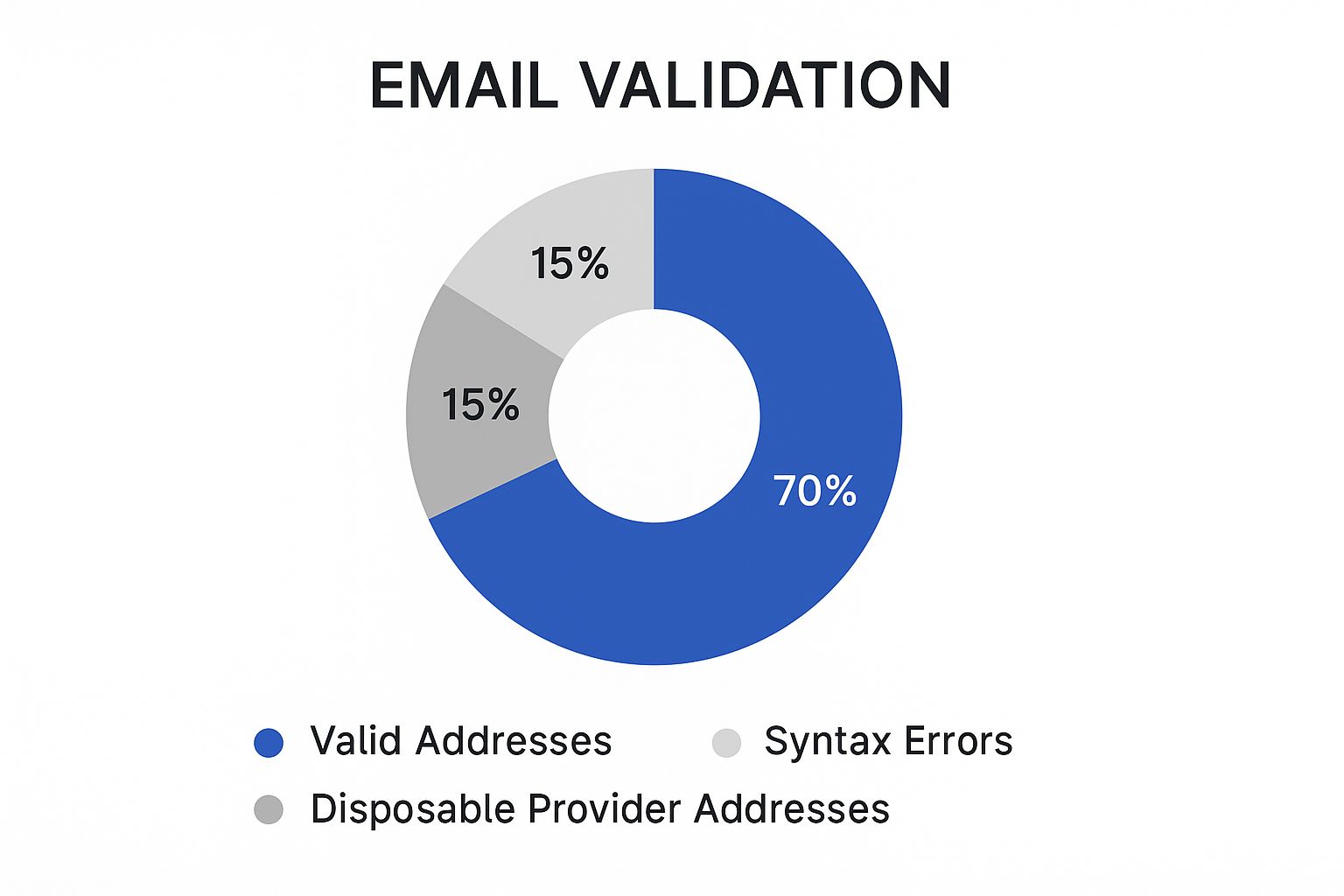
This pie chart shows a typical breakdown of email addresses after they’ve been validated. Notice how 70% are valid, but a significant chunk (15%) have syntax errors, and another 15% are disposable. This really highlights why it’s so important to go beyond a simple syntax check if you want to improve your email deliverability. Integrating email validation into your email and SMS marketing strategy is important. For a deeper dive into that, check out this resource on Email SMS Marketing.
For more information specifically on email validation best practices, you can also take a look at this helpful blog post on email validation. From my experience, the best approach is a combination of syntax checks, real-time validation, and batch validation for those larger list cleanups. It’s like having a multi-layered security system for your email list, ensuring only real, active addresses make it through.
Email Validation Methods Comparison
To help you understand the different options available, I’ve put together this comparison table:
| Validation Method | Accuracy Level | Processing Time | Best Use Case | Cost Range |
|---|---|---|---|---|
| Syntax Check | Low | Very Fast | Identifying obvious typos | Free - Low |
| Real-time Validation | High | Fast | Verifying individual addresses during signup | Low - Medium |
| Batch Validation | High | Medium - Slow (depends on list size) | Cleaning large email lists | Medium - High |
| Disposable Email Detection | Medium - High | Fast | Preventing sign-ups with temporary emails | Low - Medium |
This table gives you a quick overview of the pros and cons of each method. Syntax checks are great for catching quick typos, but real-time and batch validation offer much better accuracy. Disposable email detection is also crucial for maintaining a clean list.
In a nutshell, choosing the right email validation method depends on your needs and budget. But trust me, investing in robust validation is worth it. It saves you time, money, and the frustration of bounced emails.
Finding Email Validation Tools That Deliver Results
The email validation tool market is overflowing with options. Everyone promises the moon, but how do you separate the wheat from the chaff? Honestly, I’ve chatted with so many businesses about their experiences with different email validation tools, and it’s a real mixed bag. Some free tools are surprisingly effective, while some enterprise-level platforms handling massive volumes struggle. Finding the right tool for your needs can feel like navigating a minefield.
So, what should you be looking for? Accuracy is king. A simple syntax check won’t cut it. You need a tool that can weed out inactive addresses, disposable emails, and even those pesky spam traps. Look for providers who are upfront about their validation methods and accuracy stats. Don’t be shy about asking for case studies or testimonials. Seeing how the tool has performed for similar businesses is invaluable.
Another key factor is integration. How smoothly does the tool slide into your existing workflow? Can it connect with your CRM, your email marketing platform, or other essential tools? Seamless integration can save you a mountain of time and hassle. Look for one-click integrations and powerful APIs.
Pricing, of course, is always a consideration. Credit-based models can be a real headache, leading to unexpected costs. I’ve seen businesses get stung by hidden fees and confusing pricing tiers. Aim for transparent, straightforward pricing that fits your budget and how much you’ll actually use the tool. And don’t be afraid to negotiate! Many providers are flexible, especially for high-volume users.
Then there’s support. What happens when you hit a snag? Is there helpful documentation? Can you easily get in touch with a real person? Trust me, solid support is a lifesaver, especially when you’re in the middle of a time-sensitive email campaign.
The email verification market is constantly evolving, thanks to things like increasingly strict spam filters and growing data privacy regulations. It’s predicted to be a $6 billion market by 2033, with a 15% CAGR from 2025 onward. The increasing reliance on email marketing and the need for clean, accurate data are driving this growth. Discover more insights on the email validation market.

Finally, look to the future. AI-powered solutions are really shaking things up in the email validation world. These tools leverage machine learning to spot patterns and predict deliverability with remarkable accuracy. If you’re serious about maximizing your email ROI, exploring AI-powered options is definitely worth your while. By carefully weighing these factors, you can find an email validation tool that actually delivers and helps you reach your goals. Don’t settle for empty promises; demand results.
Making Validation Work Within Your Current Systems
So, we’ve covered why validating emails is so important and looked at different ways to do it. Now for the practical bit: how do you actually weave email validation into your existing systems without everything falling apart?
Seamless Integration for Smooth Operations
Lots of companies put off email validation because they’re worried about disrupting their workflow. I get it – change can be a hassle. But honestly, it doesn’t have to be a nightmare. Successful companies build validation into key areas like signup forms, CRM imports, and even their lead generation tools. This catches bad data early, before it can mess up your email marketing.
For signup forms, real-time validation is the gold standard. Someone types in their email, and boom – the validation tool checks the formatting and makes sure the mailbox actually exists. This instant feedback stops bad data from getting into your system in the first place. For your existing lists and CRM imports, batch validation is the answer. Upload your list, let the tool work its magic, and you’ll get a report showing which addresses are good and which need a closer look.
Here’s a snapshot from the Truelist homepage:
Truelist makes its main selling point clear: easy, unlimited email validation. The clean website design and focus on key features suggest it’s simple to use and get quick results.
Automating the Process for Efficiency
When it comes to scaling your email validation, automation is king. Think about it: automatically verifying every new lead that goes into your CRM. No more manual checks, no more messy spreadsheets – just clean, validated data flowing smoothly into your system. This is where integrations and APIs come in handy. Lots of validation tools connect directly with popular CRMs, marketing automation platforms (HubSpot, Marketo, etc.), and other essential tools.
Let’s say you use Zapier to connect your lead generation form to your email validation tool, and then to your CRM. Someone fills out a form, their email address is automatically checked, and if it’s valid, the lead goes straight into your CRM. If it’s not valid, you can set up a notification or put them on a separate list to follow up later.
Handling the Edge Cases
Let’s be real, no system is foolproof. There will always be those odd situations that pop up. What happens if a valid email address bounces? Or if your validation system briefly goes down? Having backup plans is essential. You might want to use a double opt-in process to confirm email addresses or set up a manual review for any addresses flagged as potentially problematic. For creating those confirmation email links quickly, tools like the Email Mailto Link Generator are helpful. Need a refresher on validating email formats? Check out our guide on validating email format. By thinking ahead and having solutions ready, you can minimize interruptions and keep your email program running smoothly. It’s all about being proactive and having a Plan B (and maybe even a Plan C!). Regularly testing your validation system is also critical to make sure everything’s working as it should.
Advanced Validation Techniques for Email Pros
So, you’re ready to step up your email validation game? Most folks just stick with the basic checks, but trust me, there’s a whole other level of techniques that can seriously boost your results. Let me share some strategies that real email pros use – the kind of stuff that can make a real difference.
Beyond the Basics: Sophisticated Validation Methods
First off, think about role-based email detection. If you’re trying to reach specific roles within companies, you don’t want to be stuck sending emails to generic addresses like info@ or sales@. Good validation tools can help you identify these generic addresses and prioritize the contacts with specific, named mailboxes. It’s all about making sure you’re talking to the right decision-makers.
Then there’s disposable email identification. Services like Mailinator and Guerrilla Mail let people create temporary email addresses. Catching these early is key. You don’t want them clogging your list and messing up your metrics.
Another thing to consider is deliverability scoring. This goes way beyond a simple valid/invalid check. Some tools give each email address a score based on things like domain reputation, mailbox activity, and whether it’s a spam trap. This helps you focus your energy on the addresses that are actually going to engage.
International Emails and Provider Quirks
International emails can be a real headache. Different countries have different formatting rules, and sometimes even character encoding can throw things off. Make absolutely sure your validation tool can handle those nuances.
Also, remember that each email provider has its own quirks. Some are much stricter than others about format and validation. Knowing these differences can help you tailor your strategy and avoid unnecessary bounces.
Adapting to the Evolving Email Landscape
The world of email is always changing. New providers appear, old ones vanish, and best practices are constantly evolving. You can’t just set up a validation strategy and forget about it. You need a flexible approach that can adapt. This means using a tool that keeps up with the latest changes and lets you customize your rules as needed.
For instance, you might want to set up custom rules based on your specific industry or the audience you’re targeting. Maybe you need to verify particular domain extensions or check for common typos in your field. A good validation tool will give you that kind of control. The demand for sophisticated email validation is booming, especially in areas where digital adoption is accelerating. A lot of this is driven by increased digital marketing, especially in the Asia-Pacific region. By 2025, almost 4.5 billion people globally will be using email, so having a solid validation system is essential. Discover more insights on regional email validation growth.
Let’s talk a little about the regional differences in email validation. Here’s a table summarizing key considerations:
Regional Email Validation Considerations | Region | Common Email Formats | Validation Challenges | Best Practices | Compliance Requirements | |—|—|—|—|—| | North America | firstname.lastname@domain.com | Disposable emails, role-based addresses | Real-time validation, deliverability checks | CAN-SPAM Act | | Europe | firstname.lastname@domain.com, firstnamelastname@domain.com | GDPR compliance, language variations | Double opt-in, localized validation messages | GDPR | | Asia-Pacific | Varied formats, character encoding | Mobile email usage, disposable emails | Real-time validation, language support | Varies by country | | Latin America | firstname.lastname@domain.com | Disposable emails, varying internet access | Real-time validation, deliverability checks | Varies by country |
As you can see, adapting your email validation strategies based on region is vital for maximizing deliverability and engagement.
Mastering False Positives and Advanced Techniques
Even the best tools can sometimes make mistakes – flagging a valid address as invalid (a false positive). It’s crucial to handle these carefully. You might set up a manual review process for flagged addresses or use a double opt-in to confirm.

Finally, exploring advanced techniques like email age verification, domain reputation checking, and even behavioral pattern analysis can truly elevate your validation efforts. These methods help you pinpoint high-quality addresses and steer clear of those likely to bounce or cause deliverability problems. By combining these advanced techniques, you can build a robust email validation strategy that gives you a real competitive edge.
Tracking What Actually Matters in Email Validation
Let’s be honest, a lot of businesses get hung up on the wrong numbers when they’re looking at email validation. They chase vanity metrics that don’t actually tell them anything useful about their business growth. So let’s cut through the noise and talk about the metrics that really move the needle – the ones that show if your validation efforts are actually paying off.
Key Performance Indicators Beyond Validity Rates
A high validity rate is a nice starting point, sure. But it’s like judging a book by its cover. What you really want to know is, are your emails actually reaching people? Are they landing in inboxes, or are they languishing in spam folders, never to be seen?
That’s why tracking your inbox placement rate is so important. Are more of your emails hitting the primary inbox now compared to before you started validating? That’s a clear sign you’re doing something right.
Another critical metric is your bounce rate. Lowering your bounce rate doesn’t just improve your sender reputation (although that’s a big one!). It also tells you that your email list is cleaner, healthier, and more engaged.
And of course, never underestimate the power of open and click-through rates. These are the real indicators of campaign success. If your validation strategy is working, you should see a noticeable improvement in both. More people are getting your emails, and they’re actually clicking on your content – and that’s what ultimately leads to conversions and revenue.
Measuring the ROI of Validation
So, how do you put a dollar value on email validation? Think of it this way: a lower bounce rate means fewer wasted emails, which directly translates to cost savings. Improved deliverability means higher open and click-through rates, boosting your conversion rate and driving revenue. You can even calculate the cost per valid email by dividing your validation costs by the number of valid addresses. This helps you see the tangible value you’re getting.
You might be interested in: Email Verification Best Practices
Setting Up Monitoring and Reporting Systems
Like any successful endeavor, effective email marketing needs constant monitoring. Set up a system to track your key metrics regularly. Daily or weekly works, depending on your sending volume. Visualize your progress with dashboards to help you spot trends quickly. Are bounce rates creeping up? Open rates slipping? These early warning signs can help you address validation issues before they become major problems.
For example, a sudden spike in bounces might mean there’s an issue with your validation tool, or a new source of bad addresses has slipped into your list. Catching these issues early lets you address them quickly and keep your email program on track.
Regular reporting is just as important. Focus your reports on the metrics that tie directly to business outcomes, like conversions and revenue. This shows the value of validation and justifies your investment. By consistently analyzing your data and tweaking your approach, you can really maximize your ROI. Remember, effective email validation isn’t a one-and-done thing, it’s an ongoing process.
Your Complete Email Validation Action Plan
So, we’ve talked about checking email addresses – now let’s get down to brass tacks. This action plan breaks email validation into bite-sized pieces, giving you clear priorities and ways to see how you’re doing. Whether you’re just starting or want to up your game, this will help you figure out where to begin, which tools to grab first, and how to grow your validation efforts as your business takes off.
Phase 1: Assess and Plan (Week 1)
Take Stock: Are you starting from zero? Do you have a small list, or a massive one that looks like a phone book? Knowing your starting point is crucial.
Set Achievable Goals: Rome wasn’t built in a day, and neither is a perfect email list. Start with realistic goals, like lowering your bounce rate by a specific percentage. Maybe you’re aiming for 5%, maybe 1%. Small wins add up.
Find Your Perfect Tool: Based on your needs and budget, pick a tool that fits the bill. Need real-time validation for signup forms? Batch validation for those huge lists? A service like Truelist offers both, which is pretty handy.
Data is King: To really know if your email validation is working, you need to track your email analytics. This data will show you how your validation strategy impacts your campaign performance. It’s like having a behind-the-scenes look at what’s really going on.
Phase 2: Implement and Test (Weeks 2-4)
Connect the Dots: Integrate your chosen validation tool with your existing systems, like your CRM or email marketing platform. Automation is your best friend here – let the machines do the heavy lifting.
Test Drive and Fine-Tune: Run some test validations and see what happens. Any snags? Need to adjust some settings? This is your chance to smooth out any wrinkles before things go live.
Get Everyone on Board: Make sure your team knows why email validation is important and how to use the new tools. Having everyone on the same page is essential for success.
Phase 3: Monitor and Optimize (Ongoing)
Keep an Eye on the Numbers: Watch your key metrics like a hawk – bounce rate, deliverability, open rates, and click-through rates. These tell you what’s working and what needs some love.
Adapt and Conquer: Based on the data you’re seeing, tweak your validation approach. Maybe you need some extra validation steps or some rule adjustments. It’s all about continuous improvement.
Grow Smart: As your email list grows (and it will!), make sure your validation system can keep up. Can your current tool scale, or will you need something more robust down the line?
This action plan gives you a solid foundation for email validation. It’s not a one-and-done deal, but an ongoing process. By following these steps and being flexible, you’ll ensure your emails hit real inboxes, build stronger relationships with your customers, and get the most bang for your marketing buck.
Ready to give your email marketing a boost? Try Truelist for free today!