
 Claude
  Perplexity
The Best Time to Send Cold Emails for Maximum Engagement
Unlock higher open rates with our data-backed guide. Discover the best time to send cold emails and learn how to test and find your perfect sending window.
TL;DR: Unlock higher open rates with our data-backed guide. Discover the best time to send cold emails and learn how to test and find your perfect sending window.
If you’ve ever wondered about the best time to send cold emails, the data doesn’t mince words: aim for early weekday mornings. Countless studies have pointed to the time slot between 6 AM and 10 AM, Tuesday through Thursday, as the sweet spot for getting the highest open and reply rates.
The Best Time to Send Cold Emails: A Data-Backed Answer
Sending a brilliantly crafted cold email at the wrong time is like delivering the perfect sales pitch to an empty room—your message, no matter how good, simply gets lost. Timing isn’t just a minor detail; it’s the gateway to getting your email seen, opened, and considered. Think of it as catching your prospect right as they sit down with a fresh cup of coffee, ready to tackle a clear inbox before the day’s chaos truly begins.
Hitting their inbox during these early morning slots means you’re capitalizing on peak attention. Most professionals kick off their day by triaging emails, which creates a prime opportunity for a well-crafted message to stand out from the noise.
The Power of Early Mornings
So, why does this early window work so consistently? It all comes down to basic human behavior. We tend to clear out our inboxes first thing to get organized and set the tone for the day. An email that lands at 6 AM is sitting right at the top of the pile, while one sent at 2 PM is likely to get buried under an avalanche of internal pings and meeting alerts.
Imagine launching your campaign at the crack of dawn, say between 4 AM and 8 AM PST, and watching your open rates soar to 42.7%. An analysis from Salesmate found this to be the prime window for engagement. This timing gives you a serious advantage, putting your message in front of recipients when they’re most focused and receptive.
This chart drives the point home, visualizing exactly why early mornings on weekdays are so effective.
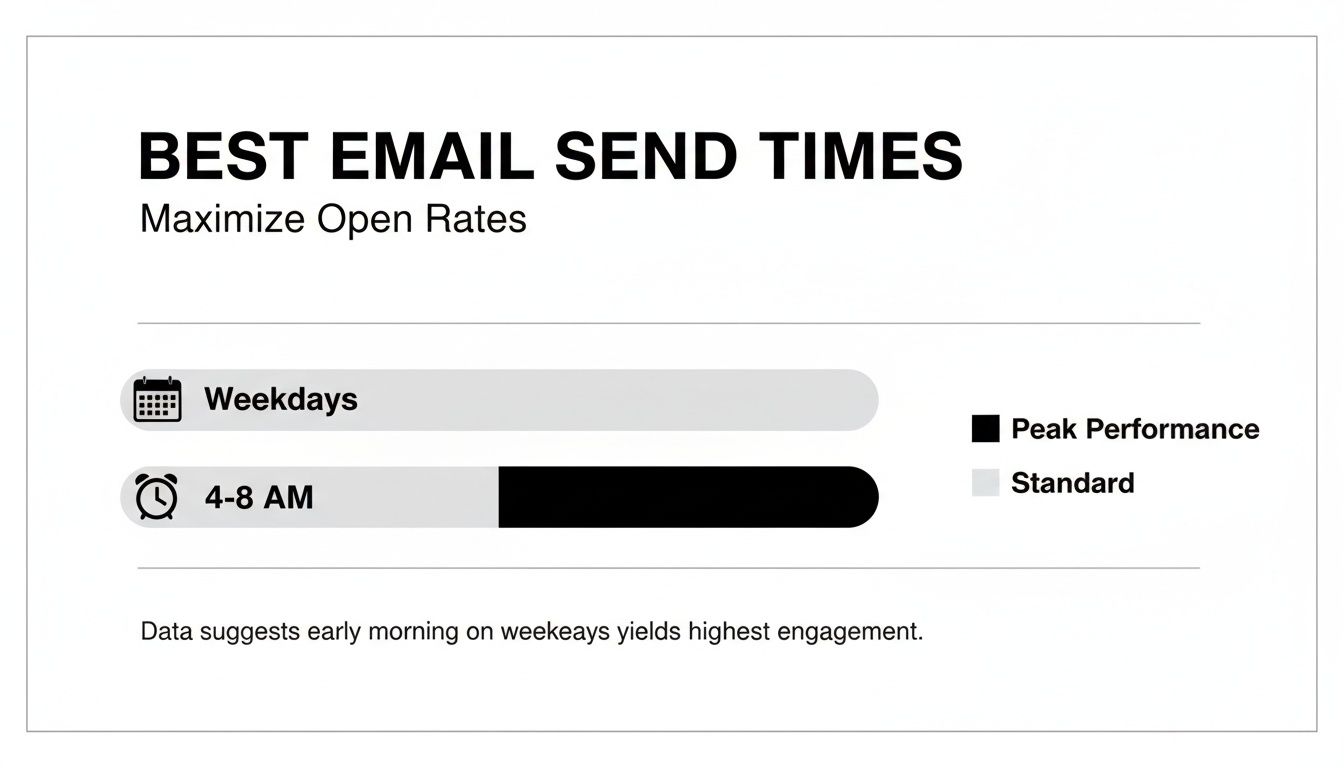
The data makes it crystal clear: syncing your send schedule with your prospect’s morning routine can make a world of difference in your campaign’s performance.
A Quick Guide to Optimal Sending Windows
While early mornings are an excellent starting point, let’s look at a quick-reference guide to help you plan your outreach with more precision.
Optimal Cold Email Sending Windows At a Glance
The table below breaks down the highest-performing windows based on aggregated data, giving you a solid baseline for your own testing and optimization.
| Day of the Week | Optimal Time Window (Local Time) | Key Performance Insight | Best For |
|---|---|---|---|
| Tuesday | 6 AM - 10 AM | Highest overall open and reply rates. Prospects are settled into the work week but not yet overwhelmed. | Critical outreach, initial touches, and important follow-ups. |
| Wednesday | 8 AM - 10 AM | Strong engagement continues. Mid-week focus is high, making it another peak performance day. | Nurturing leads and sending valuable content. |
| Thursday | 9 AM - 11 AM | Very high open rates, as people are often planning ahead for Friday and tying up loose ends. | Scheduling demos, final follow-ups before the weekend. |
| Monday | 10 AM - 12 PM | Avoid the early morning rush. Sending late morning allows prospects to clear their weekend backlog first. | Softer touches, re-engagement campaigns. |
| Mid-Afternoon | 2 PM - 4 PM | A secondary sweet spot. Catches people during a post-lunch lull or between meetings. | Less critical follow-ups or A/B testing alternative time slots. |
These timeframes are your launchpad, not the final word. The best strategy always involves testing what resonates with your specific audience.
The goal is to avoid the “Monday morning scramble” when inboxes are overflowing from the weekend and the “Friday afternoon checkout” when focus has already shifted to personal plans.
Of course, timing is only one piece of the puzzle. It’s crucial to pair a smart send schedule with a deep understanding of what drives your cold email open rates in the first place. Think of it this way: great timing gets you in the door, but a great message is what keeps you there.
Why Timing Is Your Secret Weapon in Cold Outreach
Ever sent a perfectly crafted cold email only to hear crickets? It’s like telling a killer joke to an empty room. The joke is great, but if no one’s there to hear it, it falls flat. That’s exactly what happens when you ignore timing in your outreach. It’s not just some minor detail; it’s the element that decides whether you’re the first thing a prospect reads with their morning coffee or just another email in a sea of 50 they mass-delete.
Think about it. You wouldn’t call a CEO to pitch them during their kid’s soccer game, right? The same logic applies to their inbox. Your email is an uninvited guest, and its arrival time has a huge say in the kind of welcome it gets.

From Writing to Delivering
Too many salespeople obsess over what they write—the killer subject line, the irresistible value prop, the slick call-to-action. And yes, that stuff is crucial. But it’s all for nothing if the email lands at the bottom of an overflowing inbox. The real goal is to hit the top of their screen right when they’re most likely to be paying attention.
This is where you shift from just writing a message to orchestrating its delivery. It’s about moving past the “spray and pray” approach and getting intentional. When your email arrives matters just as much as what it says.
How Timing Directly Impacts Your Results
Let’s get specific. Nailing the best time to send cold emails isn’t just about getting seen—it’s about moving the needle on the metrics that actually matter.
- Higher Open Rates: An email that arrives while a prospect is clearing out their inbox first thing in the morning is far more likely to get a click than one that shows up during a chaotic, meeting-packed afternoon.
- Increased Reply Rates: Catch someone when their mind is clear and distractions are low, and you’ve got a much better shot at a thoughtful reply. An email received during a busy period just gets flagged for “later,” which usually means never.
- Better Sender Reputation: When people actually open and engage with your emails, it signals to providers like Google and Outlook that you’re not a spammer. Good timing leads to better engagement, which protects your sender score and keeps you out of the junk folder.
Timing is the art of aligning your message with your prospect’s daily rhythm. It’s about finding that sweet spot where their availability and attention span overlap, ensuring your outreach doesn’t just get delivered—it gets noticed.
At the end of the day, all the effort you put into writing a great email deserves a fighting chance. By mastering the when of your outreach, you make sure your message lands with the impact it was designed for. This single piece of strategy can be the difference between getting ignored and starting a real conversation.
Decoding the Data to Find Your Golden Hours
General advice is a great starting point, but the real magic happens when you understand the why behind the numbers. This is what separates a decent outreach campaign from a great one. The rhythm of a typical workweek is surprisingly predictable, and once you decode it, you can see exactly why certain days and times consistently deliver better results. It’s about moving from guesswork to making strategic, informed decisions.
Think of the workweek in terms of mental energy. Mid-week days—Tuesday, Wednesday, and Thursday—are the peak productivity zone. People have dealt with Monday’s fires, settled into their workflow, and are focused on getting things done. An email that lands in their inbox during this window feels like a potential opportunity, not just another distraction.
Monday and Friday, on the other hand, are bookends with their own unique challenges for outreach.
Navigating the Workweek Mindset
Getting inside your prospect’s head on any given day is the key to finding the best time to send a cold email. Each day of the week presents a different landscape for your message to navigate.
The Monday Morning Scramble: Mondays are for triage. Inboxes are overflowing from the weekend, and the first few hours are a blur of catching up, planning the week, and sitting in kickoff meetings. A cold email sent into that storm has a high chance of getting deleted without a second glance.
The Friday Afternoon Checkout: By Friday afternoon, attention spans are shrinking fast. People are wrapping up their final tasks, making weekend plans, and mentally checking out. Your email will most likely sit unopened until Monday, where it’ll be buried under a fresh pile of new messages.
This is precisely why the middle of the week works so well. Your email arrives when your prospect is in a focused, professional mindset—but they aren’t totally overwhelmed by the start-of-week chaos or distracted by the upcoming weekend.
The Three High-Leverage Time Slots
Beyond just picking the right day, zeroing in on specific time slots can dramatically boost your chances of getting a response. These “golden hours” align with the moments people are most likely to be actively clearing out their inboxes.
The goal isn’t just to land in the inbox; it’s to arrive at the precise moment your prospect is most receptive. This requires understanding the psychology behind their daily routine.
Let’s break down the three main windows where your cold email has the best shot.
1. The 6 AM Early Bird Window
This pre-work slot is incredibly powerful. Many executives and decision-makers start their day early to get ahead before the constant stream of meetings and interruptions begins. At this hour, their inboxes are relatively clean, and their minds are fresh. An email that lands at this time is often one of the very first things they see.
The data backs this up. While the typical cold email reply rate hovers between a slim 1-5%, some studies show that Monday mornings between 5-8 AM can bump that figure up to 2.3%. Hitting this window gives you a clear statistical edge right at the start of the week.
2. The 10 AM Post-Meeting Catch-Up
By mid-morning, the first round of meetings is usually over. People are finally sitting down at their desks to dig into their to-do lists, and that almost always starts with checking their email.
They’re in work mode and actively looking for tasks to tackle. Your email, arriving just after they’ve cleared those initial morning hurdles, has a high probability of being opened and actually considered. This is a fantastic time to send messages that might require a little more thought. To see how timing impacts engagement across the board, you can explore our detailed guide on email open rate benchmarks.
3. The 2 PM After-Lunch Focus Period
We all know about the post-lunch slump. But what often follows is a renewed period of focus as people push to finish their tasks before heading home. This 2 PM to 4 PM window can be surprisingly effective.
Many people use this time to catch up on emails they missed during a busy morning. Sending your message during this slot can capture their attention when other senders have already called it a day. This principle of strategic timing isn’t unique to email; it’s the same logic used to find the best time to post on Instagram for maximum engagement.
By understanding these daily rhythms, you can time your emails to arrive for maximum impact, making sure your message doesn’t just get delivered—it gets noticed.
Moving Beyond Generic Send Times

While the data gives us some great starting points, like the classic “Tuesday morning,” the idea that there’s one magical time to email everyone is a complete myth. Relying on that advice alone is like trying to navigate London with a map of New York—you’re in the right country, but you’re going to miss every important turn.
Real success in cold outreach happens when you stop obsessing over the clock and start considering the human on the other end of that email. Your prospect isn’t just a row in a spreadsheet; they’re a person with a daily rhythm shaped by their industry, their specific job, and where they live. This is where you level up from generic blasts to a smart, context-aware strategy that actually connects.
Think Like Your Prospect
The secret to finding the real best time to send an email is to forget your own schedule and put yourself in theirs. Think about it: a tech CEO in the middle of a product launch has a radically different day than a restaurant manager prepping for the dinner rush. Sending them both an email at 10 AM on a Wednesday ignores that basic reality.
So, how do you fix this? Build a simple picture of who you’re emailing. This doesn’t have to be some massive marketing project. Just ask yourself a few questions:
- What industry are they in? A construction foreman is probably on-site and far from a computer all morning. An accountant, on the other hand, is likely glued to their screen.
- What’s their role? C-suite executives often start their day at the crack of dawn to get ahead of the chaos. A customer service rep’s schedule is probably locked into standard business hours.
- When are they least distracted? That restaurant manager might finally have a moment to breathe mid-afternoon, between the lunch and dinner services. The software developer might be most open to a new message right after their daily stand-up meeting is over.
When you sketch out a quick “day in the life” for your target audience, you’ll start to spot unique sending windows your competitors are completely missing because they’re all stuck on that 10 AM send time.
Stop asking, “When is the best time to send an email?” and start asking, “When is my prospect most likely to actually welcome one?” This simple change in mindset is the foundation of a smarter outreach plan.
Accounting for Geography and Mobile Habits
In today’s market, your prospects are everywhere. Sending an email at 9 AM your time might hit someone’s inbox at 6 AM on the West Coast or smack in the middle of the afternoon for a contact in Europe. Luckily, you don’t need a world clock and a calculator to figure this out.
Nearly every modern sales tool has a “send in prospect’s time zone” feature. Turn it on. Always. This simple checkbox ensures your careful timing actually works, no matter where your recipient is.
On top of that, smartphones have totally blurred the lines of the 9-to-5 workday. People check email first thing in the morning, on their commute, and even late at night. This opens up some new opportunities.
- Commute Times (7-9 AM): People are often scrolling through their inbox on a train or bus. A short, easy-to-read, mobile-friendly email can cut through the noise during this downtime.
- Evening Wind-Down (7-9 PM): Many professionals do one last email check before unplugging. This can be a quiet, less-crowded time to reach them, but your call-to-action should be low-pressure.
By layering these contextual factors—industry, role, time zone, and mobile use—over the general data, you create a much sharper, more effective sending strategy. This is a huge piece of learning how to write cold emails that don’t just get delivered but actually start conversations. Your goal is to stop broadcasting a message and start intelligently delivering it at the moment it’s most likely to be well-received.
How to Find Your Unique Sending Sweet Spot
Industry benchmarks are a great starting point, but that’s all they are. Relying on them completely is like using a generic map for a treasure hunt—it gets you into the right area, but the real prize is found by exploring the terrain yourself. The secret to killer cold email performance isn’t guessing; it’s testing.
By running a few simple, structured experiments, you can scientifically discover the perfect sending times for your specific audience. This is how you turn outreach from a shot in the dark into a reliable system for getting replies. And don’t worry, you don’t need a data science degree. It’s all about being methodical and letting your own data be the guide.
Building Your Testing Framework
Think of this like a simple science experiment. Your mission is to isolate one variable—the sending time—and see how changing it affects your results. To do that, you need a repeatable game plan.
Here’s a simple, four-step process to start pinpointing your own best time to send cold emails.
Formulate a Hypothesis: Start with an educated guess. For instance: “Sending emails at 7 AM will get a higher open rate than sending at 2 PM because our target audience of tech executives checks their inboxes before their workday officially begins.”
Segment Your List: This is crucial. Never test on your entire list at once. Split a small portion of your list into two equal, random groups (let’s call them Group A and Group B). This ensures the only major difference between the two is when you hit “send,” which makes your results trustworthy.
Run the A/B Test: Send the exact same email—same subject line, same body copy, same call-to-action—to both groups, but at the different times from your hypothesis. Group A gets the email at 7 AM, and Group B gets it at 2 PM.
Analyze the Results: Give it some time. Wait at least 48-72 hours for people to open, read, and reply. After that, pull up the numbers and compare the performance.
This basic A/B test is the foundation of data-driven outreach. It takes the guesswork out of the equation and replaces it with cold, hard facts about what actually works for your prospects.
The goal of testing isn’t to find one single “perfect” time that works forever. It’s to build a habit of optimization, constantly refining your approach based on real-world feedback from your audience’s behavior.
Choosing the Right Metrics to Track
When you look at the results, it’s easy to get lost in a sea of data. To keep things simple and effective, just focus on the three metrics that tell you everything you need to know about your timing.
- Open Rate: This is your first clue. A high open rate means you landed at the top of their inbox at the exact moment they were ready to see what’s new. It’s a direct signal that your timing was on point.
- Click-Through Rate (CTR): This tells you if you caught them with enough time to spare. If people are not only opening but also clicking your link, it’s a great sign they were engaged and had a moment to actually consider your message.
- Reply Rate: This is the ultimate prize. A solid reply rate proves your email arrived when the prospect was not only available but also in the right frame of mind to hit “reply” and start a conversation.
Tracking these three key performance indicators will give you a crystal-clear picture of which sending windows are generating real, valuable engagement.
A Continuous Cycle of Improvement
Your first test is just the beginning. People’s habits change, markets shift, and what worked like a charm last quarter might fall flat today. The most successful outreach pros don’t see testing as a one-and-done task; they treat it as an ongoing process.
Once you find a winning time, try to beat it. Pit your new champion time slot (say, 7 AM on Tuesday) against a new challenger (maybe 4 PM on Thursday). Over time, you’ll build an incredibly detailed map of your audience’s daily and weekly rhythms. This is how you stay sharp, adapt, and ensure your outreach always hits the mark.
Your Actionable Cold Email Timing Checklist
Alright, let’s put all this theory into practice. Knowing the data is one thing, but getting results comes from smart execution. This is your go-to checklist for launching cold email campaigns that actually get noticed.
Think of it as your pre-flight check before you hit “send.” Each step is designed to make sure your message doesn’t just get delivered, but that it lands at the exact moment it’s most likely to be read.

Step 1: Start with a Clean Foundation
Before you obsess over send times, you need to make sure your emails can even get through. Blasting out messages to a messy list is the fastest way to wreck your sender reputation, which makes all this timing strategy completely pointless.
- Validate your list first. This is non-negotiable. Use a trusted email validation service to scrub your list of bounces, spam traps, and dead-end addresses. A clean list is the bedrock of any successful campaign.
Step 2: Set Your Baseline with Data
Don’t guess. Use the mountain of available data as your launchpad to find the most promising send windows right from the start.
Target the “Golden Hours.” For your first campaigns, schedule them to go out mid-week, specifically Tuesday through Thursday between 8 AM and 11 AM in your prospect’s local time. The data consistently points to this window as a peak engagement time.
Explore secondary windows. Don’t forget about the “early bird” slot around 6 AM or that post-lunch focus block around 2 PM. These are often less crowded times that can be surprisingly effective for catching decision-makers.
The goal isn’t to follow data blindly. It’s about using it to make an educated first move. These proven time slots give you a solid foundation to test, learn, and fine-tune your own strategy.
Step 3: Segment and Personalize Your Timing
This is where you move from generic best practices to truly expert-level outreach. A one-size-fits-all approach just doesn’t cut it.
Analyze by Role: A CEO’s daily routine looks nothing like a marketing manager’s. Think about their day and adjust. Try early mornings for senior leaders and mid-mornings for individual contributors who need time to settle in.
Consider Industry Norms: You wouldn’t email a restaurant owner during the lunch rush, right? Try them in the mid-afternoon lull. A tech developer might be more receptive after their morning stand-up meeting is done.
Always Use Local Time Zones: This is a simple but critical detail. Make sure your outreach tool has the “send in recipient’s time zone” feature enabled. Otherwise, your perfectly planned 10 AM email could land in their inbox at midnight. To ensure your cold emails are not only well-timed but also well-executed, consider these top tips for sending bulk emails.
Step 4: Plan Your Cadence and Commit to Testing
A single email is almost never enough. The real magic happens in the follow-up and your commitment to constant improvement.
Strategize Your Follow-Ups: Never send a follow-up on the same day or at the same time as the first email. Give it 2-3 days, then space out later messages by 3-5 days. By sending at different times of the day, you dramatically increase your chances of catching someone at the right moment.
Embrace Continuous Testing: Always be A/B testing. Once you find a time that works well, pit it against a new challenger. This ongoing process of refinement is what keeps your strategy sharp and ensures you stay ahead of the curve.
Frequently Asked Questions
Does the Best Send Time Vary by Industry?
Absolutely. There’s no one-size-fits-all answer here. Think about your prospect’s day-to-day reality. A software developer might finally catch up on emails in the late afternoon, after they’ve finished their deep coding work. A retail manager, on the other hand, is completely swamped during peak store hours.
You wouldn’t try to get a chef’s attention during the dinner rush, and the same principle applies to cold email. Always do a little homework on your target industry’s daily rhythm. Use the general data we’ve discussed as your baseline, but let specific context fine-tune your strategy. A bit of empathy for their schedule can make all the difference.
How Should I Time My Follow-Up Emails?
Your first email is just the beginning. A solid cold email cadence almost always involves 2-4 follow-ups, and timing them right is crucial to avoid being a pest.
A good rule of thumb is to wait 2-3 days after your initial email before sending the first follow-up. For any messages after that, stretch the gap to 3-5 days. Most importantly, vary your send times and days. This simple change dramatically increases your odds of catching someone at a good time instead of repeatedly hitting the same busy slot in their calendar.
Timing your follow-ups is just as important as timing your initial outreach. A varied schedule respects the prospect’s time and boosts your odds of finally connecting.
How Does Email List Validation Affect Timing?
It’s the foundation of everything. Sending an email at the perfect moment means nothing if it bounces or gets flagged as spam.
Think of it this way: timing is the key, but your email list is the door. If the door is locked (a bad email address), the key is useless. A high bounce rate wrecks your sender reputation, which sabotages all your future campaigns. Cleaning your list with a validation service like Truelist ensures your perfectly timed messages actually get delivered. It’s the step that makes all your other efforts count.
Should I Ever Send Cold Emails on the Weekend?
For most B2B outreach, it’s best to stick to weekdays. The majority of professionals disconnect from their work inboxes over the weekend, and your email will just get lost in the Monday morning flood.
But there are always exceptions to the rule. People in certain roles—like real estate agents, startup founders, or event planners—often work unconventional hours that bleed into the weekend. If you’re targeting an audience like this, it might be worth a shot. Just be sure to test it on a small segment of your list first and watch the results closely.
Don’t let bounces and bad data undermine your perfectly timed outreach. Truelist.io ensures every email you send has the best chance of landing in the inbox. Start cleaning your lists today for free and see the difference a validated list makes. Visit https://truelist.io to get started.