
 Claude
  Perplexity
Email Open Rate Benchmarks A Guide to Boosting Your Campaigns
Explore current email open rate benchmarks across industries. Learn data-driven strategies to improve your open rates and drive meaningful engagement.
TL;DR: Explore current email open rate benchmarks across industries. Learn data-driven strategies to improve your open rates and drive meaningful engagement.
Email open rate benchmarks are basically the average open rates for a specific industry. Think of them as a yardstick to see how your own campaigns stack up. While the global average email open rate is around 43%, that number can swing wildly depending on whether you’re in e-commerce, running a nonprofit, or selling B2B services.
What Are Email Open Rate Benchmarks and Why They Matter
Imagine your email open rate is the foot traffic for a brick-and-mortar store. It’s the very first sign that people are interested in what you have to offer. It’s easy to look at it as just a number, but it tells you a whole lot about the health of your email marketing.
These benchmarks aren’t just for show; they’re your compass. They give you much-needed context to answer that nagging question: “Are my results any good?” Without knowing the industry average, you’re just guessing. A 25% open rate could be a huge win in one industry but a major red flag in another.
Your Email Strategy Health Checkup
I like to think of email open rate benchmarks as a quick health check for your strategy. A high open rate is a strong pulse—it means the core parts of your plan are working just as they should.
On the other hand, a low open rate is a worrying symptom. It’s a clear signal that something needs a closer look. It tells you right away that for some reason, your message isn’t connecting with your audience from the get-go.
An email open rate is the first and most direct feedback you get from your audience. It tells you if your subject line landed, if your sender name is trusted, and if your timing was right. Everything else in your campaign depends on getting that first click.
More Than Just a Number
When your open rate is strong, it’s a direct reflection of several key marketing fundamentals all working together beautifully. It’s solid proof that:
- Your Subject Lines Resonate: You’ve managed to pique curiosity and show value in a seriously crowded inbox.
- Your List Quality is High: You’re sending emails to real, interested people who actually want to hear from you.
- Your Sender Trust is Solid: Your audience recognizes your brand and feels your emails are worth their time.
Knowing how you measure up against your industry’s average is the first real step toward building a smarter email program. It helps you set goals that make sense, spot areas for improvement, and know when to celebrate your wins.
From here, you can start digging into other numbers that give you the full story of your campaign’s success. To go deeper, you can learn more about the key email campaign performance metrics that matter most. Nailing your open rates lays the groundwork for making every other interaction with your audience even better.
What Are Good Email Open Rate Benchmarks in 2024?
One of the first questions every email marketer asks is, “What’s a good open rate?” The honest answer? It depends. There’s no magic number that applies to everyone.
Performance swings wildly from one industry to the next, shaped by everything from audience expectations to the kind of content you’re sending. Think about it: an email from a nonprofit you passionately support is going to feel very different from a weekly promotional blast from a clothing store. One is about a shared mission, the other is about a transaction. Their benchmarks for success live in completely different worlds.
A Look at the Industry-Wide Numbers
Let’s dig into some data. While some studies suggest a broad average open rate across all industries hovers around 21.5%, that number can be misleading. To get a real sense of performance, you have to look at specific sectors.
For example, industries built on trust and shared values, like government agencies and religious organizations, often see the highest engagement. At the other end, sectors like retail can struggle to cut through the noise of a crowded inbox.
These numbers aren’t just stats on a page; they tell a story about what different audiences care about. Knowing where your industry stands is the first step to setting goals that make sense for your business.
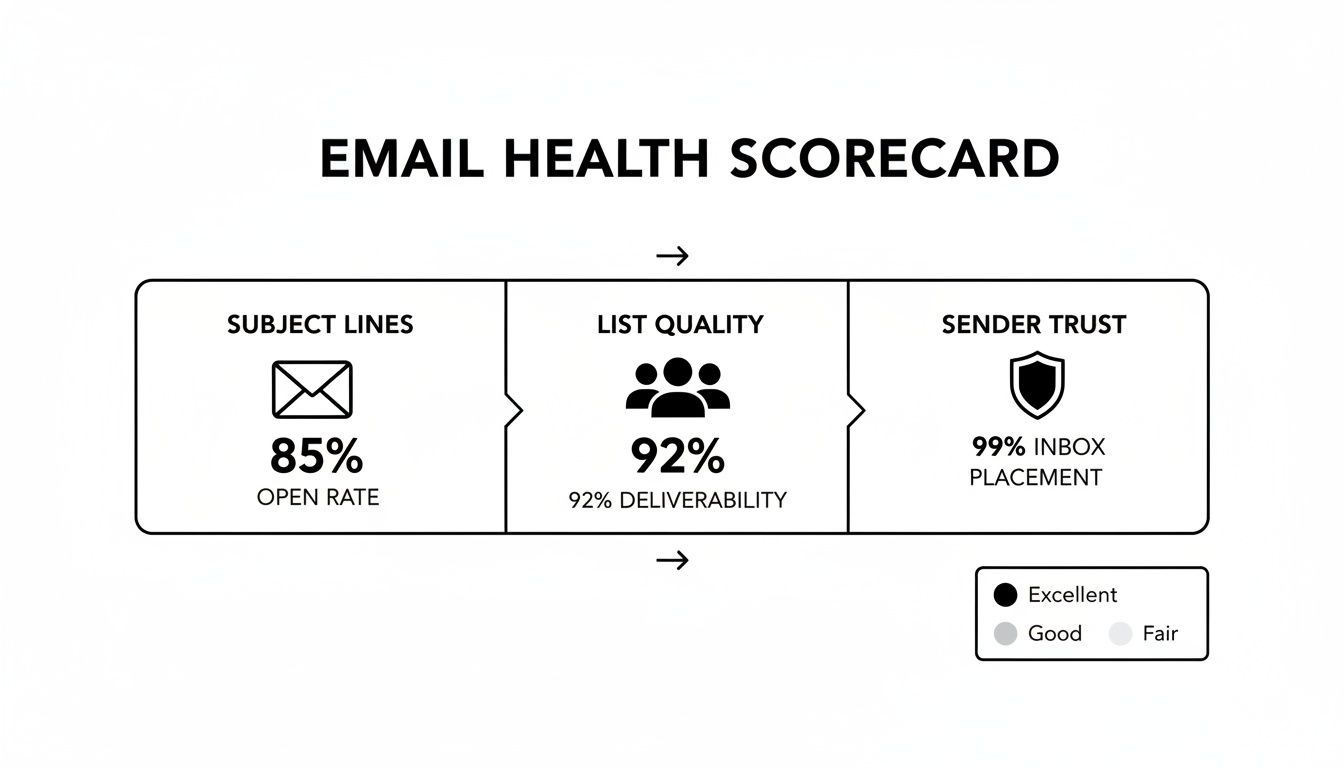
As this scorecard shows, a high open rate isn’t a fluke. It’s the result of a healthy, well-managed email program where deliverability, inbox placement, and subscriber engagement all work together.
Average Email Open Rates by Industry
To give you a clearer starting point, we’ve compiled data from leading sources to show you what average open rates look like across key business sectors. Use this table not as a strict rule, but as a guide to see how you stack up against your peers.
| Industry | Average Open Rate (%) | Source/Notes |
|---|---|---|
| Government & Politics | 26.58% | High trust and essential communications drive engagement. |
| Religious Organizations | 26.04% | Mission-driven content resonates deeply with a dedicated audience. |
| Financial Services | 24.63% | Subscribers rely on these emails for important account information. |
| Education & Training | 24.13% | Content is often highly relevant to subscribers’ personal or professional goals. |
| Nonprofits | 24.01% | Supporters are invested in the cause, leading to strong open rates. |
| B2B & Professional Services | 22.84% | Content is often seen as a valuable professional resource. |
| Health & Wellness | 22.56% | Personal interest in well-being keeps subscribers opening emails. |
| Media & Publishing | 21.57% | Delivers timely and sought-after information, from news to entertainment. |
| Retail & E-commerce | 17.58% | High volume and frequent promotions can sometimes lead to lower engagement. |
Remember, these are just averages. Your own rates will be influenced by the quality of your list, the power of your subject lines, and the overall strength of your brand.
Why B2B Open Rates Tell a Different Story
You’ll often hear that Business-to-Business (B2B) emails get higher open rates than their Business-to-Consumer (B2C) counterparts. There’s a good reason for that. A B2B email usually isn’t just another ad—it’s a piece of information tied directly to someone’s job. It could be an update on a tool they use every day or an insight that helps their company succeed.
In the B2B world, an email is less of an interruption and more of a resource. When you provide genuine value—insights, data, or solutions to a problem—your audience is not only willing to open your emails, they look forward to them.
This changes the entire dynamic. A single, highly relevant email sent to a carefully chosen list of professionals can easily outperform a dozen generic B2C email blasts. It’s all about understanding the business context and delivering content that solves a real problem. For a deeper dive, it’s always a good idea to review some core B2B email marketing best practices.
This is why B2B marketers have to be so precise. Every email they send needs to answer the recipient’s silent question: “Why should I care about this right now?”
By getting a handle on these industry differences, you can stop chasing generic metrics and start making smart, data-driven decisions for your own campaigns.
How Email Engagement Changes Around the World
It’s not just your industry that matters—it’s where your subscribers live. A subject line that crushes it in North America might completely fall flat in Asia-Pacific. Why? Because things like cultural norms, mobile usage habits, and even data privacy laws create huge differences in how people treat their inboxes.
If you have an international audience, you can’t afford to ignore these geographic nuances. Think of it this way: you wouldn’t talk the same way in a formal business meeting as you would with your friends. Your email strategy needs that same adaptability, respecting the “local rules” of each region to genuinely connect with subscribers.
A Quick Tour of Global Email Performance
When you zoom out to a global view, you start to see clear patterns. Each continent tells its own story, shaped by things like how quickly new technology is adopted, how people shop and behave, and what the legal rules are. All of these factors directly impact email open rate benchmarks.
Take Europe, for example. The General Data Protection Regulation (GDPR) has had a fascinating side effect. While it demands explicit consent from subscribers, this has actually resulted in cleaner, more engaged email lists. People in Europe have actively chosen to hear from you, which often pushes open rates higher than in places with looser opt-in regulations.
Sending the same email everywhere is like trying to use one key to open a dozen different locks. You need to cut a specific key for each one. A tailored, region-aware approach is what unlocks real engagement and delivers better results.
A Head-to-Head Look at Key Regions
The data paints a pretty clear picture of how much engagement can vary from one place to another. If you’re a marketer or salesperson targeting different markets, these numbers are your guide to setting realistic goals and crafting an approach that works.
- North America: This is often the region people look to as a baseline. It shows strong open rates, typically hovering between 31-40%. It’s a mature market where email marketing consistently delivers a high return on investment.
- Europe: Thanks largely to GDPR, engagement here is fantastic, with open rates often falling between 30% and an impressive 46% or more. Deliverability for B2C campaigns is also top-notch, reaching 99.2%.
- Oceania: This region, especially Australia, is a real star. It leads the world with an average open rate of 46.34%, showing just how receptive the audience is to email.
- Asia-Pacific: Things get a bit more complex here. The average open rate is 19.14%. This is a mobile-first market, so your messaging has to be incredibly sharp and concise to grab attention on small screens.
- Latin America: As a growing market, it shows solid potential with an average open rate of 30.67%. There’s a huge opportunity here for businesses that can figure out how to connect with this audience.
These stats prove that a one-size-fits-all email strategy just doesn’t work. The most successful global campaigns are the ones that are flexible enough to adapt to what makes each market unique. You can dive deeper into these trends and discover more insights from The Frank Agency.
By paying attention to these global and regional email engagement trends, you can stop relying on generic benchmarks. Instead, you can set smarter, geographically-informed goals that give your campaigns the best possible shot at success, no matter where your audience opens their email.
The Levers You Can Pull to Influence Your Email Open Rates
Knowing the average email open rate is one thing, but understanding what actually makes someone open your email is where the real magic happens. Think of the industry benchmark as a destination on a map. Several key factors are your vehicle, your fuel, and the road conditions—all of them determine whether you’ll even reach that destination.
Getting these core elements right is the difference between shouting into the void and starting a real conversation. They all work together, building a powerful case for why your email is worth a subscriber’s precious time. Let’s break down the most important levers you can pull.

Protect Your Sender Reputation
Your sender reputation is basically a credit score for your email domain. Internet Service Providers (ISPs) like Gmail and Outlook are always watching. They track signals from your sending address to decide if your emails should land in the primary inbox, the promotions tab, or the dreaded spam folder. A high reputation tells them you’re a sender to be trusted.
So, how do you build a good score?
- Keep Your Sending Volume Steady: Avoid sudden, massive email blasts out of nowhere. ISPs see that as a huge red flag.
- Keep Complaint Rates Low: If too many people mark your emails as spam, your reputation takes a serious nosedive.
- Minimize Bounces: Sending emails to addresses that don’t exist is a clear sign of a poorly managed list.
A pristine sender reputation is the absolute foundation of good deliverability. Without it, even the most perfectly written email will never get seen.
Master the First Impression with Subject Lines and Preheaders
Your subject line and preheader text are the dynamic duo of the inbox. They’re your five-second pitch, working together to give someone an irresistible reason to click. The subject line has to grab their attention, and the preheader needs to provide that extra bit of context or a compelling hook.
A great subject line sparks curiosity without feeling like cheap clickbait. It might pose a question, hint at a valuable solution, or create a little bit of urgency. The preheader then chimes in, offering a sneak peek of what’s inside. Get this combination wrong, and you’re ignored. Get it right, and opening the email feels like the obvious next step.
Your subject line makes a promise. Your preheader adds intrigue. Your email content must deliver on both. This chain of trust begins the moment a subscriber sees your name in their inbox and is the key to consistently high open rates.
Prioritize Your List Quality and Hygiene
Honestly, this might be the most important factor of all. You could have the world’s greatest email content, but if you’re sending it to a list clogged with invalid, old, or uninterested contacts, your open rates are going to be dismal. A high-quality list is built on one thing: real, engaged subscribers who actually asked to hear from you.
Cleaning your email list regularly isn’t just a nice-to-have; it’s non-negotiable. This means you have to remove hard bounces, inactive subscribers, and spam traps. Sending to a clean, validated list is the single most powerful thing you can do to protect your sender reputation and make sure your messages actually arrive.
The global average open rate sits around 24%, but that number hides a ton of variation. For B2B emails, which are critical for SDRs cleaning lists with tools like Truelist, the average can jump to nearly 40%. Decision-makers often value relevant follow-ups—48% say they appreciate them. Yet, a whopping 71% ignore cold emails that aren’t relevant, which just hammers home why validating lists to remove bad addresses is so vital for deliverability and opens. You can explore more of these important email marketing statistics on inboxally.com.
Use Smart Segmentation and Personalization
Sending the exact same message to everyone on your list is a fast track to low engagement. Segmentation is simply the practice of dividing your audience into smaller, more focused groups based on shared traits, like:
- Their purchase history
- Where they’re located
- How often they engage with your emails
- Their behavior on your website
Once you have these segments, you can personalize your messaging to make each subscriber feel like you’re talking directly to them. This goes way beyond just sticking their first name in the subject line. It’s about delivering content that speaks to their specific needs and interests. This targeted approach is a huge driver for higher open rates because your subscribers quickly learn that your emails are consistently worth opening.
Actionable Strategies to Improve Your Email Open Rates
Knowing your industry’s email open rate benchmarks gives you the map; now it’s time to start driving. Turning those insights into real, measurable improvements requires a playbook of proven tactics. Think of these strategies as your step-by-step guide to not just boosting your open rates, but building a healthier email program from the ground up.
Each of these actions works together to build trust with your subscribers, prove your relevance, and make sure your message actually lands in front of an engaged audience. It all starts not with what you send, but who you send it to.

Master Your List Hygiene with Email Validation
Honestly, the single most impactful thing you can do for your open rates is to make sure you’re sending to a clean list. Blasting emails to invalid, risky, or dormant contacts is like trying to deliver mail to abandoned houses—it’s a waste of resources and, worse, it wrecks your sender reputation.
Email validation is just the process of cleaning your list to weed out these problem addresses. It’s the foundational first step that directly protects your ability to land in the inbox.
Think of a clean email list as the foundation of a skyscraper. Without that solid, verified base, everything else you build on top—clever subject lines, beautiful design, compelling content—is at risk of collapsing.
Making list hygiene a regular habit is non-negotiable. When you remove undeliverable addresses, you instantly lower your bounce rate. This sends a huge, positive signal to Internet Service Providers (ISPs) like Gmail and Outlook that you’re a responsible sender, which helps your future emails land in the primary inbox instead of the spam folder.
Craft Irresistible Subject Lines
In a crowded inbox, your subject line is the gatekeeper. It has just a few seconds to spark enough curiosity to earn a click. A great subject line makes a clear promise of value without ever feeling like spammy clickbait.
To write more effective subject lines, you really just need to focus on three things: clarity, curiosity, and relevance.
- Be Specific and Clear: Instead of a vague “Big News,” try something like, “Our Summer Collection Just Dropped.” Your subscribers should know exactly what to expect.
- Create Urgency (Sparingly): Phrases like “24 hours left” or “Last chance” can work wonders, but they lose their punch if you use them in every email.
- Ask Engaging Questions: A question like, “Are you making this marketing mistake?” practically begs the reader to open the email to find the answer.
- Personalize When Possible: Simply including a subscriber’s name or referencing a past purchase can make your email feel like a personal note, not a mass broadcast.
For a deeper dive, it’s worth exploring some proven email subject line best practices that can give you an immediate lift.
Implement Smart Segmentation
Sending the exact same email to every single person on your list is a recipe for low engagement. Segmentation is the simple practice of dividing your audience into smaller groups based on shared traits, which lets you send much more relevant content.
Imagine you run an online bookstore. Instead of sending a generic “New Books This Week” email to everyone, you could segment your list:
- Recent Buyers: Send them a thank-you email with recommendations based on what they just bought.
- Genre Fans: Let the sci-fi lovers know when a new fantasy trilogy is released.
- Inactive Subscribers: Send a special “we miss you” offer to try and win them back.
This targeted approach shows your subscribers that you get them, making them far more likely to open your emails. It transforms your messaging from a megaphone shouting at a crowd into a one-on-one conversation.
Optimize for a Mobile-First World
The reality is, most emails are now opened on a phone. If your email is a jumbled mess or hard to read on a small screen, it’s going to be deleted in seconds. Mobile optimization isn’t a “nice-to-have” anymore; it’s absolutely essential.
Here are the key things to get right for mobile:
- Short Subject Lines: Long subject lines get cut off on mobile. Aim for around 20-40 characters to make sure the whole thing is visible at a glance.
- Readable Font Size: Use a clear font that’s big enough to be read comfortably without any pinching and zooming.
- Single-Column Layout: A simple, top-to-bottom design is the easiest for people to scroll through on their phones.
- Clickable Buttons: Make sure your calls-to-action (CTAs) are big, tappable buttons, not tiny text links that are impossible to hit with a thumb.
By putting these strategies into practice, you can systematically improve your performance. To implement them effectively and streamline your communication, exploring specialized email marketing automation tools can be a game-changer. This helps you turn insights from benchmarks into tangible results, building a more engaged audience and a far more successful email program.
Common Questions About Email Open Rate Benchmarks
Once you start digging into email analytics, a few questions always seem to surface. It’s totally normal. Email marketing isn’t a set-it-and-forget-it channel; it’s constantly evolving as new tech and user habits change the game.
To help you get your bearings, we’ve put together some straight-talking answers to the most common questions we hear about email open rate benchmarks. Let’s clear up the confusion so you can feel confident making smarter, data-driven decisions for your campaigns.
What Is a Good Email Open Rate to Aim For?
Ah, the million-dollar question. The honest answer? It depends. A “good” open rate isn’t some universal number floating out there. It’s a moving target that shifts based on your specific industry, audience, and even the type of email you’re sending.
For example, a nonprofit might regularly see open rates over 45% because their audience is highly engaged with their cause. Meanwhile, a retail brand might be thrilled to hit 20% on a promotional send.
The best way to set a meaningful goal is to ground it in reality. Start with your industry’s average benchmark as your baseline. Your first goal is simply to meet it. Once you’re consistently there, the real work begins: aim to consistently beat your own past performance. If your average has been sitting at 22%, pushing it to 25% is a huge win.
Focus on a pattern of steady, incremental growth driven by better list quality and more relevant content. Chasing a universal “good” number is a distraction; beating your own best is a strategy.
At the end of the day, progress is the best benchmark. It’s proof that all your hard work on segmentation, subject lines, and list hygiene is actually paying off.
How Does Apple’s Mail Privacy Protection Affect Open Rate Tracking?
Apple’s Mail Privacy Protection (MPP), rolled out in 2021, really shook things up for email marketers. In a nutshell, MPP pre-fetches email content—including the tiny tracking pixel used to record an open—for users of the Apple Mail app. This happens in the background, whether the person actually opens the email or not.
The result is that your open rate data can get artificially inflated. An email might get marked as “opened” just because it landed in an Apple Mail inbox, not because a real person read it. This has made the open rate a much less reliable metric for gauging genuine reader interest.
Because of this, experienced marketers have started shifting their focus. Open rates are still useful for a quick check on your overall deliverability health (a sudden drop is still a red flag), but they’re no longer the star of the show. Instead, we’re putting more weight on metrics that MPP can’t touch:
- Click-Through Rate (CTR): This tracks how many people clicked a link in your email. It’s a clear, undeniable sign of engagement.
- Click-to-Open Rate (CTOR): This shows you the percentage of openers who also clicked, giving you a better sense of how compelling your content was.
- Conversion Rate: This is the ultimate measure—it tracks how many people took the desired action, whether that’s making a purchase or downloading a guide.
These metrics paint a much more accurate and actionable picture of how your audience is really interacting with your emails.
How Often Should I Clean My Email List?
Think of list cleaning like regular maintenance for your car—it’s essential for keeping your email program running smoothly. As a general rule, you should do a deep clean of your entire list at least every 3 to 6 months. This means clearing out contacts that are invalid, have gone dormant, or have just stopped engaging.
However, the ideal frequency really depends on how fast your list is growing. If you’re adding hundreds or thousands of new subscribers every month, you need to be more proactive. The best practice here is to validate new emails in real-time, right at the point of collection. This stops bad data from ever making it onto your list in the first place.
Consistent list hygiene is the single most effective way to protect your sender reputation and ensure your emails land in the inbox, not the spam folder.
Can Email Validation Alone Guarantee High Open Rates?
Email validation is a crucial first step, but it’s not a magic bullet. Its job is to make sure your email has the best possible chance of being delivered to a real, valid inbox. Think of it as a gatekeeper that filters out all the undeliverable addresses, clearing the path for your message to arrive.
But just because a letter makes it to the right mailbox doesn’t mean the person will open it. Getting that open depends entirely on other factors. A great open rate is the result of several things working together:
- A subject line that sparks curiosity and promises value.
- A sender name that your audience recognizes and trusts.
- Content that is genuinely relevant and personalized.
- Sending it at the right time for your specific audience.
Validation gets you to the front door. Your content and strategy are what get you invited inside. It lays the critical foundation that makes all your other efforts worthwhile.
Ready to build that solid foundation? A clean email list is your first and most important step toward better deliverability and higher open rates. Truelist offers unlimited email validations with a simple monthly subscription, helping you remove invalid and risky addresses effortlessly. Protect your sender reputation and ensure your great content reaches the right people. Start validating for free today and see the difference a clean list can make.