
 Claude
  Perplexity
How to Build Email Lists That Actually Grow Your Business
Learn how to build email lists with proven strategies for creating irresistible lead magnets, high-converting forms, and maintaining an engaged audience.
TL;DR: Learn how to build email lists with proven strategies for creating irresistible lead magnets, high-converting forms, and maintaining an engaged audience.
At its core, building an email list is a straightforward value exchange. You offer something genuinely useful, and in return, people give you their email address to get it. This could be anything from a deep-dive guide or a special discount to a sneak peek at a new product. The real magic happens when you consistently make great offers and make it incredibly simple for people to sign up.
Why Your Email List Is a Core Business Asset

Let’s get straight to the point: your email list is the only audience you will ever truly own. Think about it. Your social media following exists at the mercy of algorithms and sudden platform changes. Your email list, on the other hand, is a direct, stable line to the people who care most about what you do.
This is the classic “owned” vs. “rented” media debate. Social media platforms are rented land. You can build a huge following there, but the landlord (the platform) can change the rules—or the rent—at any time. When an algorithm shifts, your reach can tank overnight, and all that effort you put in feels wasted.
Your email list is different. It’s an asset you own and control, built one subscriber at a time on a foundation of direct consent. That makes the connection far more personal and powerful.
The Power of First-Party Data
With third-party cookies on their way out, first-party data has become the new gold rush. And what is first-party data? It’s information you collect directly from your audience, with their full permission. An email address is a perfect example.
This data is incredibly valuable. It’s what allows you to move beyond generic marketing and start personalizing your messages. When you know what your subscribers are interested in, you can send them content and offers that actually resonate, which naturally leads to better conversion rates.
Your email list isn’t just a collection of contacts; it’s a direct-access pass to your most loyal customers and prospects, free from algorithmic gatekeepers. This makes it one of the most stable and high-ROI marketing channels available.
This direct relationship is what gives email its stability and impressive return on investment. While other channels are great for getting discovered, your email list is where you turn casual interest into lasting customer relationships that fuel real, long-term growth.
A Channel Built for Engagement
The data backs this up, too. With a projected 4.6 billion global email users by 2025, email isn’t going anywhere. It remains one of the most universal communication tools we have.
Better yet, when you get strategic, the results are fantastic. Segmented email campaigns—where you tailor messages to specific groups—can lead to up to 30% more opens and 50% more click-throughs. You can get a closer look at these and other email marketing statistics to see the full picture.
This is exactly why smart businesses see list building as a foundational part of their growth strategy, not just another task on the to-do list. Every new subscriber is a potential relationship. By focusing on an asset you truly own, you build a more resilient and profitable business—setting the stage perfectly for the practical strategies we’ll dive into next.
Creating Lead Magnets People Genuinely Want
Let’s be honest, the days of a simple “sign up for our newsletter” button working are long over. People guard their inboxes like a fortress these days. To get an invitation, you have to offer something truly valuable in return. That’s where a killer lead magnet comes in—it’s the engine of any serious list-building effort.
A great lead magnet isn’t just a freebie; it’s a targeted solution. It hones in on a specific, urgent problem your ideal customer is wrestling with and gives them a quick, satisfying win. The goal is to create something so compelling that trading an email address for it feels like an absolute steal.
First, Figure Out Your Customer’s Core Problem
Before you even think about creating a PDF or a video, you have to get inside your audience’s head. What’s keeping them up at night? What’s that one nagging issue you could solve for them right now? If your lead magnet misses the mark on this, it’s dead in the water, no matter how slick it looks.
For example, imagine you’re a business coach for new entrepreneurs. You notice they all stumble when it comes to pricing. A generic “10 Business Tips” PDF is forgettable. But a “Service Pricing Calculator” spreadsheet? Or a “5-Step Guide to Confidently Price Your Services”? Now you’re talking. You’re solving a precise, immediate problem.
This visual breaks down that exact process—it’s a simple but powerful framework for making sure your lead magnet actually connects.
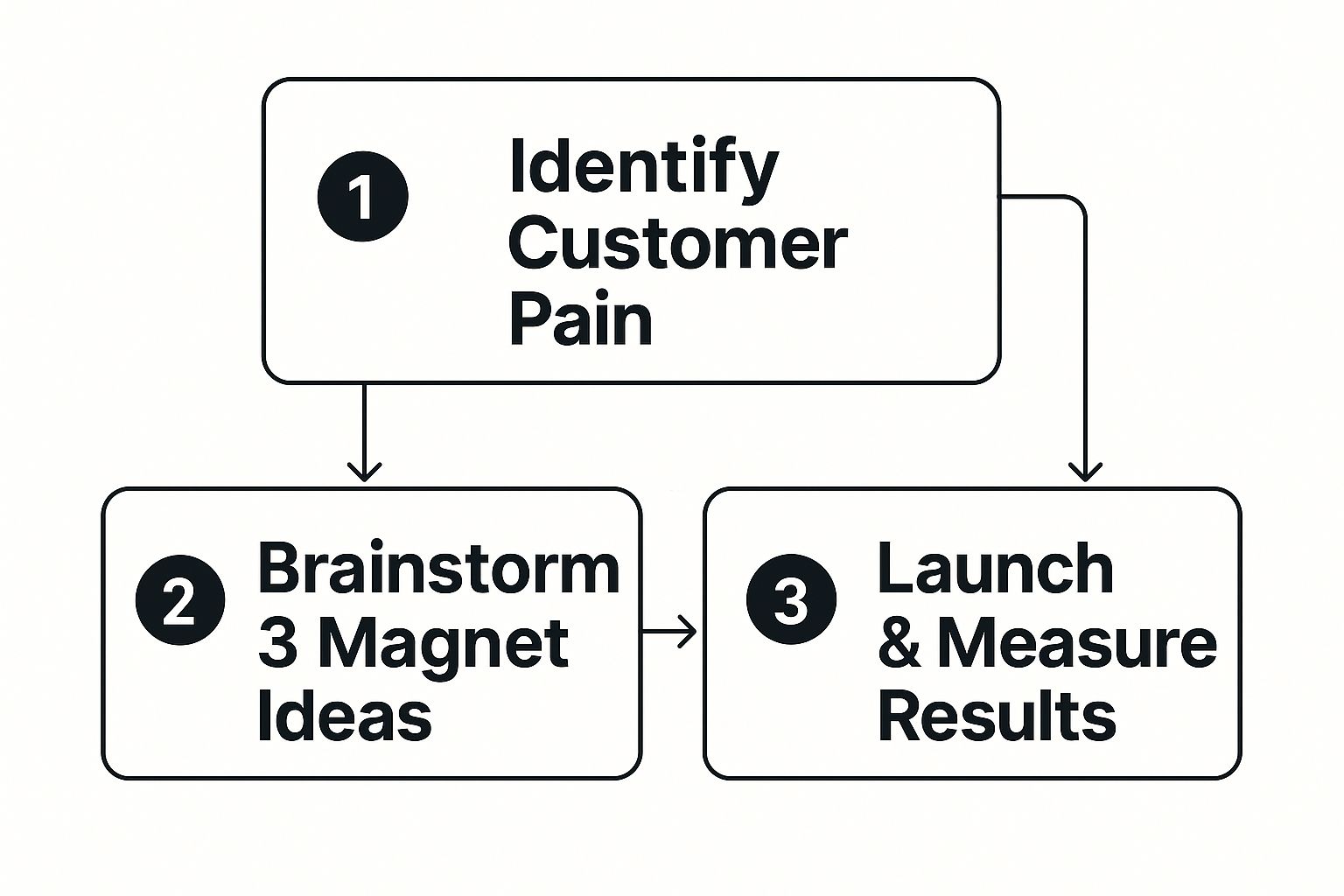
Following this ensures your effort is always aimed at solving a real-world problem, which is the secret to an offer people can’t ignore.
Next, Pick the Right Format for Your Offer
Once you’ve nailed down the problem, you need to decide on the best way to deliver the solution. The format really depends on your audience and what you’re teaching. I’ve seen too many fluffy, low-effort PDFs that just don’t cut it anymore.
Here are a few modern lead magnet ideas that deliver genuine value:
- Interactive Quizzes: A marketing agency could build a “What’s Your Marketing Blind Spot?” quiz. The user gets personalized results and actionable tips, and the agency gets a highly qualified lead.
- Video Workshops or Mini-Courses: A SaaS company could offer a free 3-part video series on “Mastering a Key Feature.” This not only captures an email but also starts onboarding a potential customer by showing them the product’s real power.
- Templates & Tools: A freelance designer I know offers a ”Canva Template Pack for Stunning Social Media Graphics.” It’s an instant win for their audience, saving them time and effort right away.
- Case Study Breakdowns: A consulting firm can take a great client result and create an in-depth PDF breaking down exactly how they did it. This showcases expertise and gives readers a proven roadmap.
The best lead magnets promise a quick, specific transformation. Don’t offer “A Guide to Better Health.” Offer “A 7-Day Meal Plan to Boost Your Energy.” Specificity is everything.
Remember, the perceived value has to be high. Your lead magnet should feel like a premium resource, something you could almost charge money for. That’s what pushes someone over the edge from “maybe later” to “I need this now.”
Finally, Launch and Promote Your Lead Magnet
Creating a fantastic offer is only half the job. Now you have to get it in front of the right eyeballs. Your lead magnet shouldn’t be an afterthought buried in your website’s footer; it should be a star player in your content strategy.
Weave your offer into everything you do:
- On Your Website: A dedicated landing page is a must. But also think about smart pop-ups on relevant blog posts or a sticky call-to-action bar at the top of your site.
- Within Your Content: Writing a blog post on pricing strategies? It’s the perfect place to embed a call-out for your pricing calculator. Contextual promotion works incredibly well.
- On Social Media: Pin a post about your lead magnet to the top of your profiles. Run targeted ad campaigns that send traffic directly to your landing page.
When you start by solving a real problem and package it in a high-value, easy-to-use format, you change the entire dynamic. You’re no longer begging for emails—you’re offering a valuable exchange. That’s the foundation for an email list full of people who are actually excited to hear from you.
Designing Email Capture Forms That Convert
A fantastic lead magnet is a great start, but it’s only half the battle. If your signup form is clunky, confusing, or hidden away, all that work goes right out the window. How you design and where you place your email capture forms is what ultimately turns a casual visitor into a subscriber.
Think of your form as the final handshake. It needs to be clear, inviting, and make the user feel smart for signing up. A poorly designed one creates friction and doubt, while a great one makes saying “yes” feel like the most natural next step.
Choosing the Right Form Type
Not all signup forms are built the same, and using the right one in the right context is crucial. Picking the best type for the situation will boost your conversion rates without annoying your visitors.
Here’s a quick rundown of the most common types I’ve seen work wonders:
- Embedded Forms: These are your bread and butter. You place them directly within your content, like in the middle of a blog post or on a resources page. They feel like a natural part of the experience, which is perfect for capturing readers who are already highly engaged with what you have to say.
- Pop-Up Forms: I know, I know—pop-ups can be annoying. But when done right, they’re incredibly effective. The key is timing. An exit-intent pop-up, for example, only shows up when someone is about to leave your site. It’s your last chance to make an offer, and it often works surprisingly well.
- Welcome Mats: This is the bold approach—a full-screen overlay that greets a visitor the moment they land. It’s definitely aggressive, but for a high-value, site-wide offer, it’s a powerful way to make sure your message is seen immediately.
- Sticky Bars: These are the slim banners that “stick” to the top or bottom of the screen as someone scrolls. They’re persistent but don’t block the content, keeping your offer in sight without getting in the way.
The goal isn’t just to get an email; it’s to start a relationship. Your form design should be welcoming, not demanding. Make it so easy and compelling that signing up feels like the next logical step.
Crafting Forms for Maximum Conversion
Once you’ve picked your form type, the small details are what separate a form that converts from one that gets ignored. Simplicity is your absolute best friend here. Every single element should be focused on one thing: getting that signup.
First, nail the copy. Your headline should be a direct extension of your lead magnet’s promise. Forget generic pleas like “Subscribe Now.” Instead, try something that screams value, like “Get Your Free Pricing Calculator” or “Unlock the 5-Day Video Course.” This immediately reminds them why they should sign up.
Next, be ruthless about your form fields. Study after study shows that the fewer fields you have, the higher your conversion rate. For most lead magnets, an email address is all you really need to get started. You can always ask for a first name later in your welcome sequence. Asking for too much information upfront is the fastest way to kill momentum.
Placement is just as critical. Look at your analytics and find your highest-traffic pages—that’s your prime real estate. Put embedded forms in your most popular blog posts. Use a sticky bar on your homepage. Go where your most engaged visitors are already spending their time.
Optimizing Your Forms with A/B Testing
Building a high-converting form isn’t a one-and-done job. The only way to know what truly works for your audience is to test, test, and test again. A/B testing, where you pit two versions of a form against each other, is how you find the real winners.
You can start with simple but powerful tests:
- Button Color: Does a bright green button get more clicks than a subtle blue one? You’d be surprised how much these small visual tweaks matter.
- Headline Copy: Try a benefit-driven headline versus a question.
- Call-to-Action Text: Which pulls better: “Download Now” or “Get My Free Guide”?
- Image vs. No Image: See if adding a visual of your lead magnet actually boosts sign-ups.
Even small wins here compound over time, steadily increasing your list growth. For a deeper dive into creating signup experiences that work, check out this guide on mastering lead capture forms that convert. By treating your forms as a living, breathing part of your marketing, you ensure they’re always working as hard as possible to build your email list.
Driving Targeted Traffic to Your Offers
https://www.youtube.com/embed/KE9hRQljEYo
Alright, you’ve built an incredible lead magnet and a sharp-looking signup form. That’s a huge win. But here’s the hard truth: they can’t do their job if no one ever sees them.
Just sticking a form on your website and hoping people find it is a surefire way to get frustrated with slow growth. We need to shift from a passive “wait and see” approach to actively getting your offers in front of the right people.
A great list doesn’t just happen. It’s built by intentionally driving targeted traffic to your best resources. This means adopting a multi-channel plan to create a steady, reliable stream of potential subscribers who are already looking for what you have to offer.
Start With Your Owned Content Channels
Your own platforms—your blog, your social media—are the lowest-hanging fruit and the most cost-effective places to start. Think of your blog as a lead-generation engine. Every single article is an opportunity.
Let’s say you wrote a post on “Common Bookkeeping Mistakes for Freelancers.” It’s the perfect spot to embed a signup form for your “Ultimate Freelancer Tax Checklist.” See how that works? You’re offering a practical solution right when the reader is most engaged with the problem. This turns all your hard work on SEO into a direct pipeline for new subscribers.
And don’t forget about your social media profiles. Your bio is valuable real estate. Instead of a generic link to your homepage, send people directly to a landing page for your best lead magnet. Create posts, stories, and videos that hint at the value inside and tell people exactly how to get it.
Tap Into New Audiences Through Collaboration
Once you’ve got your own channels firing on all cylinders, it’s time to expand your reach. How? By tapping into audiences that other people have already built.
Guest posting on respected industry blogs is a classic for a reason—it works. You get to borrow the trust and authority of an established site and get in front of a brand-new, highly relevant audience. The trick is to deliver genuine value in the post itself and then include a compelling call-to-action to your lead magnet in your author bio.
Another powerful move is to team up with complementary brands. Look for businesses that serve the same type of customer but aren’t direct competitors. You could co-host a webinar, create a joint resource, or do a simple cross-promotion. It’s a win-win that delivers value to both audiences and drives new subscribers for everyone involved. For B2B companies, this kind of outreach is crucial; our guide on B2B lead generation strategies dives much deeper into these tactics.
Use Paid Traffic as an Accelerator
Organic methods are the foundation, but when you’re ready to really step on the gas, paid advertising is your friend. Platforms like Facebook, Instagram, and Google Ads let you get laser-focused with your targeting based on interests, demographics, and online behavior.
Paid traffic isn’t about buying subscribers. It’s about paying for hyper-targeted visibility. When your offer is strong, a small ad spend can produce a significant return in high-quality leads.
You don’t need a massive budget to get started. Begin with a small, controlled test to dial in your ad copy, visuals, and landing page. To really make this work, learning the ins and outs of Google Ads lead generation best practices is key to attracting the right people. The goal is to find a predictable formula where you can turn advertising dollars into valuable, long-term email subscribers.
Keeping Your Email List Healthy and Engaged

Getting a new subscriber feels great, and it should. But the real work—and where the real value lies—kicks in the moment they hit that “subscribe” button. A huge list of unengaged people is nothing more than a vanity metric. What you’re really after is a healthy, responsive email list, and that’s an asset that needs constant care.
Think of it as shifting gears from acquisition to relationship building. This means welcoming new folks properly, sending them stuff they actually want to read, and, yes, having the courage to prune the list when needed. Skipping this is like buying all the best gardening gear and then never watering the plants.
Crafting a Compelling Welcome Series
Your very first email is, without a doubt, the most important one you’ll ever send. Welcome emails can see open rates of over 80%, making this your one shot at a killer first impression. This is not the time for a generic, “Thanks for joining.”
A solid welcome email needs to do three key things:
- Deliver the Goods: Get that lead magnet they signed up for into their hands immediately.
- Confirm Their Decision: Gently remind them why they subscribed and reaffirm the value you offer.
- Tell Them What’s Next: Set expectations. Let them know how often they’ll hear from you and what kind of content is coming their way.
But why stop at one? A well-crafted welcome series—maybe three to five emails over a week—can onboard new subscribers beautifully. Use the follow-ups to share your best resources, tell your brand’s story, or even ask a simple question to get a reply. That small interaction can do wonders for your long-term deliverability.
The Power of Smart Segmentation
As your list grows, the one-size-fits-all email becomes a recipe for mediocre results. Someone who downloaded a beginner’s guide has totally different needs than an expert who attended your advanced webinar. This is where segmentation becomes your secret weapon.
Simply put, segmentation is just breaking your list into smaller, more focused groups based on what you know about them. This lets you send hyper-relevant content that speaks directly to each group’s interests, making them far more likely to open, read, and click.
An email list isn’t just a broadcast channel; it’s a collection of individual relationships. Segmentation is how you honor those individual connections at scale, turning a monologue into a conversation.
You can slice and dice your audience in countless ways:
- Behavior: Group people by the lead magnet they downloaded, the links they’ve clicked in past emails, or their purchase history.
- Interests: Let subscribers tell you what they like. You can do this with a preferences page or by tracking which topic-specific links they click on.
- Demographics: Depending on your business, segmenting by location, industry, or job title can be incredibly powerful.
The Importance of Regular List Hygiene
This might sound backward, but one of the best ways to increase the value of your list is to regularly remove people from it. List hygiene is just the process of clearing out inactive or invalid email addresses. It’s a non-negotiable part of keeping your sender reputation in good standing.
Email providers like Gmail and Outlook watch how subscribers engage with your emails. If a huge chunk of your list never even opens your messages, it sends a signal that your content might be unwanted. This can hammer your deliverability, meaning even your most loyal fans might stop seeing your emails.
To keep your list in top shape, a consistent routine is key. Think of it like regular maintenance for a high-performance engine.
Essential List Hygiene Practices
| Practice | Description | Key Benefit | Frequency |
|---|---|---|---|
| Inactive Pruning | Removing subscribers who haven’t engaged (opened or clicked) in a set period, like 90 days. | Improves sender reputation and engagement metrics. | Quarterly |
| Re-engagement Campaign | A targeted email sequence sent to inactive subscribers to try and win them back before removal. | Recaptures a portion of your “at-risk” audience. | Before each quarterly prune |
| Email Validation | Using a service to check for typos, invalid domains, and spam traps at the point of signup or on your existing list. | Reduces bounce rates and protects deliverability. | Continuously (at signup) and annually for the full list |
| Preference Center | Giving subscribers an easy way to update their contact info and choose the content they want to receive. | Increases relevance and reduces unsubscribes. | Always available |
A clean list is an effective list.
It can feel painful to remove someone who hasn’t opened an email in 90 days, but it’s essential. Before you do, you can always run a “re-engagement campaign” to give them one last chance to stick around. For a deeper dive into this process, check out our comprehensive guide on effective email list cleaning. This simple practice keeps your engagement rates high, your sender score strong, and your active subscribers happy.
Common Questions About Building Your Email List
Even the most seasoned marketers have questions when it comes to list building. It’s a constantly evolving game, and getting clear answers can be the difference between hitting a growth spurt and getting stuck on a plateau.
Let’s tackle some of the most common questions I hear from people just like you. Think of this as a quick-reference guide for those moments you need a straight answer.
What’s a Realistic Growth Rate for My Email List?
This is the big one, and the honest answer is… it really depends. There’s no magic number. Your industry, how much traffic your site gets, and how prominent your sign-up forms are all play a huge role. But we can definitely look at some solid benchmarks.
For a website that already has a steady stream of visitors, aiming to convert 1-5% of them into subscribers is a great goal. So, for every 100 people who visit, you’re adding one to five new contacts. If you’re just starting out and traffic is low, don’t get hung up on percentages. Focus on hitting milestones, like getting your first 100 dedicated subscribers.
It’s easy to get discouraged when you start at zero. Everyone does. The key is to consistently offer real value and make your sign-up opportunities impossible to miss. Momentum will follow.
Instead of chasing an industry-wide average, focus on improving your own numbers. If your pop-up is converting at 1%, what happens if you test a new headline? Getting that to just 1.5% can make a massive difference over time.
What Are the Best Email Marketing Tools for Someone New to This?
The sheer number of options out there can be paralyzing. The trick is to find a platform that’s easy to start with but won’t hold you back as your list (and your ambitions) grow.
Here are a few that consistently get high marks for being beginner-friendly without skimping on power:
- Mailchimp: This is where most people start, and for good reason. Its drag-and-drop editor is incredibly intuitive, and the free plan is generous enough to let you get your feet wet without spending a dime.
- ConvertKit: Built for creators like bloggers, podcasters, and course builders, it’s fantastic for organizing subscribers with tags and building automated email sequences. Their visual builder makes mapping out a welcome series surprisingly simple.
- MailerLite: This one hits a sweet spot between features and price. Even on the free plan, you get tools to build landing pages and pop-ups, making it a great all-in-one choice if you’re on a budget.
Think about your specific goals. If you’re a writer, ConvertKit’s focus on creators might be the perfect fit. If you’re a small business watching every penny, the free tiers from MailerLite or Mailchimp are excellent places to begin your journey.
How Can I Wake Up My Inactive Subscribers?
It happens to every list—some people just stop opening your emails. Before you scrub them from your list for good (which you should do regularly!), it’s worth trying to win them back with a re-engagement campaign.
This is usually a short series of just two or three emails aimed at getting their attention one last time.
Try a punchy subject line like “Are we breaking up?” or “Still want to hear from us?“. Inside the email, remind them what they’re missing and simply ask if they want to stay. A big, clear button that says “YES, KEEP ME SUBSCRIBED!” works wonders. You could even sweeten the deal with a small discount or a free resource.
If they still don’t bite after that, you can remove them with a clear conscience. You’ve done your part, and now you can focus on the subscribers who are genuinely engaged.
Ready to make sure every new subscriber is a quality contact? At Truelist, we make email validation easy and affordable. Our platform cleans your list, slashes your bounce rates, and protects your sender reputation so your messages land in the inbox. Start validating for free and build a healthier, more valuable email list today.