 Claude
  Perplexity
B2B Lead Generation Strategies for 2026: A Practical Guide
Modern B2B lead generation playbook for 2026. ICP-driven outbound, intent data, AI SDR tools, ABM, and the list-hygiene foundation that keeps it all working.
TL;DR: The 2026 B2B lead generation playbook looks very different from 2022's spray-and-pray outbound. Narrow ICP definition, intent data, AI-assisted research, and ruthless list hygiene now matter more than volume. This guide covers ten core strategies — content, LinkedIn social selling, email automation, ABM, webinars, cold email, paid ads, referrals, events, and SEO — plus the foundational practices (clean data, ICP discipline, multi-channel sequencing) that make any of them work. If your bounce rate is above 5%, no strategy below will save you; fix that first with an email list cleaning service.
In the competitive B2B landscape, a steady stream of high-quality leads isn’t just a goal; it’s the engine of sustainable growth. But with crowded inboxes and discerning buyers, conventional tactics are falling short. To build a robust pipeline, sales development representatives and marketing professionals need a multi-faceted approach that combines proven methodologies with modern, data-driven execution.
This guide cuts through the noise to deliver 10 powerful b2b lead generation strategies you can implement today. We’ll move beyond the basics, offering actionable insights, real-world examples, and specific tips for each tactic. You will learn how to build long-term authority with content marketing, execute high-precision Account-Based Marketing (ABM) campaigns, and optimize your cold outreach for maximum impact. We’ll explore everything from leveraging LinkedIn for social selling to scaling successful referral and partner programs.
This comprehensive list provides a blueprint for building a resilient and predictable lead generation machine. For a deeper dive into modern approaches, consider these 9 Lead Generation Best Practices for 2025, providing a comprehensive guide to navigating today’s competitive market. Whether you’re a startup managing high-volume email lists or an established SaaS company aiming to refine your webinar strategy, the following tactics will equip you with the tools needed to attract, engage, and convert your ideal customers. Let’s explore the strategies that will define B2B growth.
The 2026 Reality: What Changed in B2B Lead Generation
Before getting into specific strategies, it’s worth naming what’s different about generating B2B leads in 2026. A lot of advice still floating around was written for a world that no longer exists.
- Spray-and-pray outbound is dead. Inbox providers have tightened bulk-sender enforcement, LinkedIn caps connection requests aggressively, and prospects’ tolerance for irrelevant messages is near zero. Sending 10,000 generic emails to an unverified list now mostly produces spam complaints, blacklisting, and silence. Narrower, better-researched outreach beats volume.
- AI SDR tools are mainstream. Apollo, Outreach, Clay, Lemlist, and newer agents handle prospect research, snippet personalization, and sequence drafting. The teams winning with these tools aren’t generating more emails — they’re using AI to enrich, segment, and qualify with much higher precision.
- Intent data is table stakes for enterprise outbound. 6sense, Bombora, and ZoomInfo Intent surface accounts actively researching your category before they fill out a form. Targeting shifts from “anyone matching the ICP filters” to “ICP-matched accounts with active buying signals right now.”
- Cookieless tracking is reshaping paid. Third-party cookies are functionally dead, so 2022-era retargeting funnels leak badly today. First-party data, server-side tracking, and email-based identity are the durable substrate now.
- MQL-to-SQL handoff is being rebuilt. B2B teams are moving past raw MQL counts toward signal-based qualification: multi-stakeholder engagement, high-intent page hits, actual meetings booked. RevOps is rewriting these definitions.
- Deliverability is a competitive moat. Gmail and Yahoo enforce strict sender requirements (DMARC alignment, low complaint rates, authenticated domains). A dirty list isn’t just wasted spend — it gets your primary domain blacklisted. See why emails bounce back and how to prevent emails from going to spam.
Most strategies in this guide aren’t new ideas. What’s new is the level of precision they require to work in 2026.
The Foundation: ICP Discipline and List Hygiene
Skip this section and the rest of the playbook collapses. Two things determine whether any strategy below produces pipeline or just produces activity: how narrowly you’ve defined your ICP, and how clean your data is.
Define a Painfully Narrow ICP
The modern best practice is narrower than most teams are comfortable with. Instead of “B2B SaaS companies with 50–500 employees in North America,” a useful ICP for 2026 looks more like: “Series A and B vertical SaaS companies with 80–250 employees, headquartered in the US, with a VP of Marketing hired in the last 18 months, using HubSpot, and showing measurable GTM hiring growth.”
That specificity does three things: it makes prospect research tractable for AI tools, it makes personalization easy because buying context is similar across accounts, and it forces honest conversations about who’s actually a fit. If you can describe the prospect’s problem better than they can, you have ICP discipline. If you can’t, go talk to ten of your best customers and find the pattern before doing anything else.
Validate Every List Before You Touch It
A dirty list is the fastest way to torch a sending domain. Inbox providers route mail based on engagement signals — sending to invalid addresses produces hard bounces, which signal “this sender is list-blasting,” which suppresses inbox placement for every legitimate prospect.
The rule of thumb: keep bounce rates under 2%, and never exceed 5%. Above 5% on a campaign, you’re likely to land on a blacklist and have to do significant work to recover.
Practical hygiene steps before any cold outbound or large campaign:
- Verify syntax and format — catch obvious typos and malformed addresses (format of an email address).
- Check the domain’s MX records — if there’s no mail server behind the domain, the address can’t receive mail. An MX record lookup confirms it.
- Verify the mailbox exists — use an email address existence checker or free email validation for small batches.
- Scrub spam traps and role accounts — catch-all domains, info@ and sales@ aliases, and known spam traps belong in a suppression file.
- Monitor sender reputation — periodic checks on sender reputation score and spam flags catch erosion before blacklisting.
Truelist exists for this layer — a verification API and bulk flow built for B2B outbound teams. The point isn’t the tool; it’s that no strategy in this guide will outperform a clean list and a tight ICP.
1. Content Marketing and SEO: Building Your Inbound Engine
Content marketing is a strategic approach focused on creating and distributing valuable, relevant, and consistent content to attract and retain a clearly defined audience. When combined with Search Engine Optimization (SEO), it becomes a powerful inbound engine that draws potential B2B customers to you by answering their most pressing questions. This method positions your company as a trusted authority, building credibility long before a sales conversation begins.
Instead of interrupting prospects with ads, you provide solutions. By developing high-quality blog posts, in-depth whitepapers, data-driven reports, and insightful case studies, you address specific pain points your ideal customers face. This is a cornerstone of modern B2B lead generation strategies, turning your website into a 24/7 resource that generates qualified leads organically.

How to Implement This Strategy
This approach works best for companies with complex sales cycles where education and trust are paramount. It’s ideal for building a long-term, sustainable pipeline rather than seeking immediate, short-term wins. A prime example is HubSpot, whose extensive blog and resource library practically wrote the book on inbound marketing. Similarly, Salesforce’s Trailhead platform offers free educational content that not only generates leads but also creates a skilled user base for its products.
Actionable Tips for Success
To effectively build your inbound engine, focus on execution and strategic alignment. Move beyond generic advice by implementing these specific tactics:
- Create Topic Clusters: Build your content around core “pillar” pages that cover broad topics comprehensively. Then, create multiple “cluster” content pieces that delve into specific sub-topics and link back to the pillar page. This structure signals your expertise to search engines and improves rankings.
- Focus on Problem-Solving Keywords: Instead of just targeting high-volume keywords, identify long-tail keywords that reflect specific problems your audience is trying to solve. Use tools like Ahrefs or Semrush to find questions people are asking.
- Leverage Original Research: Conduct your own surveys, analyze internal data, or compile industry statistics to create a unique, linkable asset. This “linkbait” content attracts backlinks from other authoritative sites, significantly boosting your SEO.
- Repurpose Winning Content: Don’t let a great blog post die. Turn it into a webinar, a series of social media posts, an infographic, or a video. This maximizes the ROI of your initial content creation efforts and reaches audiences on different platforms.
2. LinkedIn Outreach and Social Selling
LinkedIn outreach and social selling transform the world’s largest professional network into a powerful lead generation channel. This B2B lead generation strategy moves beyond cold, transactional messages, focusing instead on building genuine relationships through strategic engagement. It involves identifying ideal prospects, interacting with their content, and providing value long before a direct sales pitch is ever made, positioning you as a helpful resource rather than just another vendor.
This approach humanizes the sales process by leveraging personal profiles and shared connections. By consistently sharing insightful content, commenting thoughtfully on others’ posts, and sending personalized connection requests, you build familiarity and trust. This method allows you to warm up cold leads, turning your professional network into a dynamic and responsive pipeline of potential customers who are already familiar with your expertise.

How to Implement This Strategy
This strategy is highly effective for businesses selling high-ticket services or complex products where trust and credibility are crucial. It’s ideal for sales teams aiming to connect with specific decision-makers in target accounts, bypassing traditional gatekeepers. A great example is Drift, which uses a conversational marketing approach on LinkedIn, with its executives and sales reps actively engaging in industry discussions to generate inbound interest. Similarly, Okta’s executives have established themselves as thought leaders, using their platforms to share security insights that naturally attract C-level prospects.
Actionable Tips for Success
To master social selling, your approach must be authentic, consistent, and value-driven. Avoid generic automation and focus on genuine human connection with these tactics:
- Personalize Every Connection Request: Never use the default “I’d like to connect” message. Reference a mutual connection, a piece of content they shared, or a recent company achievement to show you’ve done your research.
- Engage Before You Connect: Spend at least a week “liking” and, more importantly, leaving thoughtful comments on your prospect’s posts. This builds name recognition, so your connection request is no longer from a complete stranger.
- Share Value, Not Promotions: Your content feed should be 80% educational, insightful, or entertaining industry content and only 20% promotional. Position yourself as a go-to expert, not a walking advertisement.
- Leverage Video Messages: After connecting, send a short, personalized video message using LinkedIn’s mobile app. This high-touch, personal approach has a significantly higher response rate than standard text messages and helps you stand out.
3. Email Marketing and Automation
Email marketing is the cornerstone of B2B communication, providing a direct line to your prospects. When enhanced with automation, it transforms into a powerful system for nurturing leads at scale. This strategy involves sending targeted, personalized messages triggered by specific user actions or timelines, ensuring you deliver relevant information at the moment it’s most impactful. This systematic approach guides potential customers through the sales funnel, building trust and maintaining engagement without manual intervention.
Instead of generic email blasts, automation allows for sophisticated nurturing sequences that respond to a lead’s behavior. A prospect who downloads a whitepaper receives a different set of emails than one who attended a webinar. This level of personalization is crucial for effective B2B lead generation strategies, as it demonstrates that you understand the prospect’s needs and can provide tailored solutions, moving them from initial interest to sales-readiness.
How to Implement This Strategy
This approach is highly effective for businesses with a defined sales funnel and a need to nurture leads over time. It’s ideal for converting inbound leads from content marketing or for re-engaging a cold list. A great example is Marketo, whose platform enables complex, behavior-driven lead nurturing campaigns that score and segment leads automatically. Similarly, ActiveCampaign allows businesses to create dynamic automation workflows that personalize the customer journey based on site visits, email engagement, and other actions.
Actionable Tips for Success
To move beyond basic newsletters and create a high-performing lead nurturing machine, focus on strategic segmentation and personalization. Implement these specific tactics:
- Segment Lists by Persona and Stage: Don’t send the same message to everyone. Divide your audience based on their job role, industry, and where they are in the buyer’s journey. Before you can segment, you must first build a quality list. Learn more about how to build an email list on truelist.io.
- Use Dynamic Content: Personalize emails beyond the
[First Name]tag. Use dynamic content blocks to show different offers, case studies, or calls-to-action based on a subscriber’s segment, ensuring maximum relevance. - Test Send Times and Frequency: Optimal engagement varies by industry and audience. A/B test different send days and times to discover when your audience is most responsive. Also, test the frequency of your emails to avoid fatigue while staying top-of-mind.
- Monitor Sender Reputation: Your deliverability is critical. Use tools to monitor your sender score, manage bounce rates, and ensure your emails are landing in the inbox, not the spam folder. A clean, engaged list is your best asset.
4. Account-Based Marketing (ABM)
Account-Based Marketing (ABM) flips the traditional lead generation funnel on its head. Instead of casting a wide net to capture as many leads as possible, ABM is a highly focused B2B strategy that treats individual high-value accounts as markets of one. This approach creates personalized campaigns designed to engage specific target companies and the key decision-makers within them.
The core principle of ABM is the tight alignment between marketing and sales teams. Together, they identify a list of best-fit, high-value accounts and coordinate every effort to deliver a consistent, customized experience. This method is one of the most effective B2B lead generation strategies for businesses with long sales cycles and high-value deals, as it builds deep relationships with the accounts most likely to drive significant revenue.
The following diagram illustrates the different tiers of ABM, showing the relationship between personalization and scale.
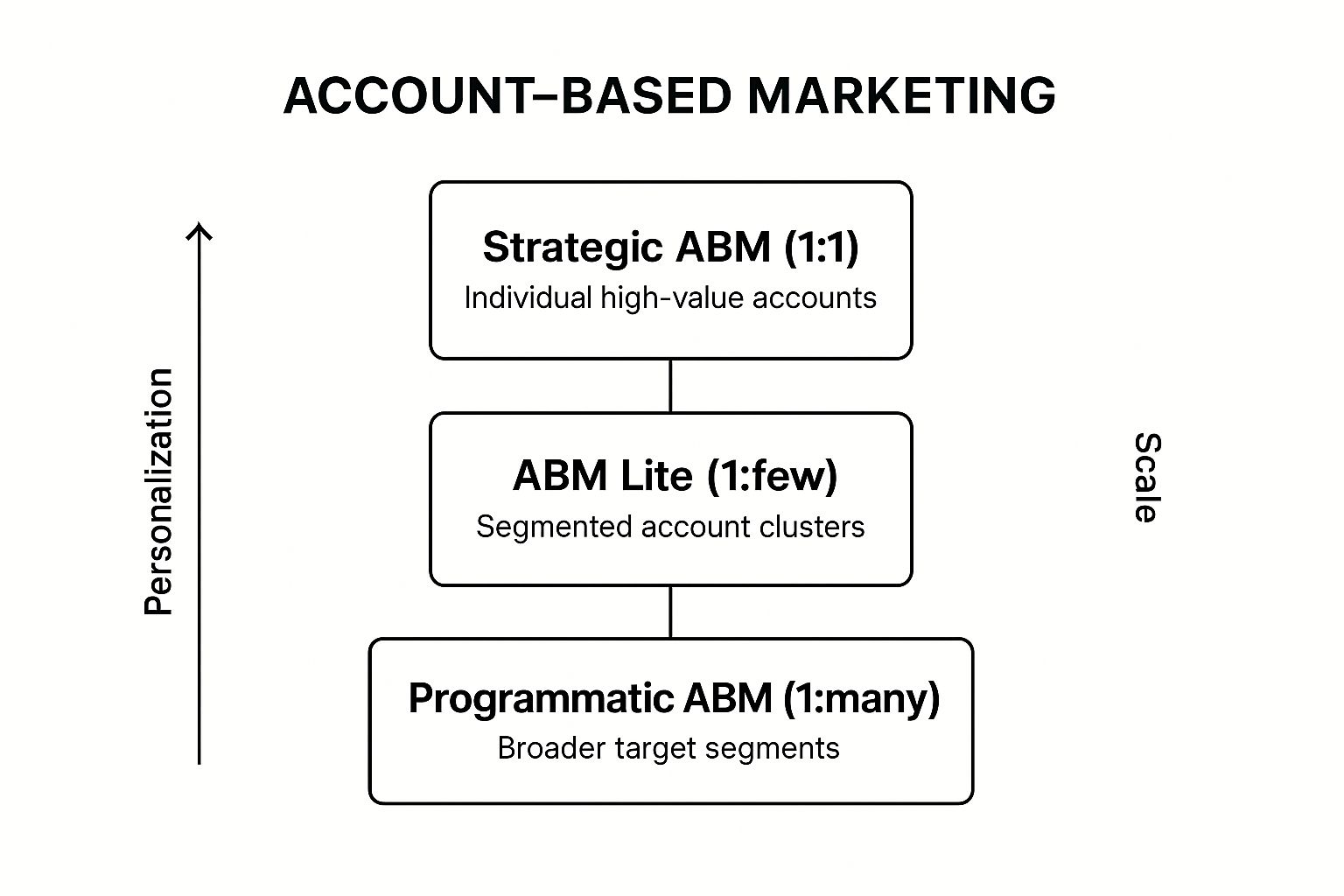
As the hierarchy shows, Strategic ABM offers the highest level of personalization for a few key accounts, while Programmatic ABM allows for broader reach with less customization.
How to Implement This Strategy
This strategy is ideal for companies targeting enterprise-level clients or a small, well-defined market segment where a handful of accounts can make or break a revenue target. For example, Snowflake runs sophisticated enterprise ABM programs targeting Fortune 500 companies with tailored messaging. Similarly, Demandbase uses its own technology to deliver personalized website experiences that change dynamically based on the visitor’s company. Accurate account data is crucial for this approach to work. To ensure your efforts are based on reliable information, consider investing in data quality management software.
Actionable Tips for Success
To move from theory to execution, your ABM program needs a clear framework and tactical precision. Focus on these specific steps for a successful rollout:
- Start with a Tiered Target Account List: Begin by identifying a small number of high-value “Tier 1” accounts for your most personalized efforts. Create “Tier 2” and “Tier 3” lists for lighter-touch and programmatic campaigns, respectively.
- Develop Detailed Account Personas: Go beyond standard buyer personas. Map out the entire buying committee, understand their individual roles and pain points, and build detailed organizational charts to guide your outreach.
- Create Account-Specific Value Propositions: Craft messaging that speaks directly to the target account’s unique challenges, strategic goals, and industry landscape. Reference their annual reports, press releases, or key initiatives in your content.
- Use Multi-Channel, Coordinated Touchpoints: Orchestrate your outreach across multiple channels like email, LinkedIn, targeted ads, and direct mail. Ensure sales and marketing are sending a consistent message at every stage.
- Measure Account Engagement, Not Just Leads: Shift your metrics from MQLs to account-level engagement. Track how many contacts within a target account are interacting with your content, visiting your website, or responding to outreach.
5. Webinars and Virtual Events
Webinars and virtual events are powerful B2B lead generation strategies that engage prospects in a live, interactive format. By hosting educational presentations, panel discussions, or product demos, you can attract a highly relevant audience, demonstrate your expertise, and capture detailed lead information through the registration process. This approach builds authority and creates a direct channel for communication with potential customers who have actively shown interest in your subject matter.
This method transforms a one-way marketing message into a two-way conversation. It provides immense value to attendees by addressing their specific challenges and questions in real-time, which accelerates trust and shortens the sales cycle. The data collected, from registration details to poll responses and Q&A participation, offers invaluable insights for sales teams to conduct personalized, high-impact follow-ups.
How to Implement This Strategy
This strategy is ideal for B2B companies that need to explain complex products, showcase software in action, or establish thought leadership in a niche industry. It works exceptionally well for generating mid-funnel leads who are past initial awareness and actively evaluating solutions. For example, ON24 provides an interactive platform for businesses to create engaging webinar experiences, while companies like Zoom use their own technology to host product demonstration webinars that convert attendees into users.
Actionable Tips for Success
To maximize your lead generation efforts, your virtual events must be executed flawlessly. Focus on delivering value and creating a seamless attendee experience with these specific tips:
- Focus on Education, Not a Sales Pitch: Structure 80% of your content around solving a key problem for your audience and reserve only 20% for mentioning your solution. This builds credibility and keeps attendees engaged.
- Use Compelling, Benefit-Driven Titles: Instead of a generic title like “Product Demo,” use a title that promises a specific outcome, such as “How to Cut Reporting Time by 50% with Automation.”
- Incorporate Interactive Elements: Use live polls, Q&A sessions, and chat features throughout the event to maintain engagement. This interaction provides valuable data on attendee pain points and interests.
- Segment Your Follow-Up: Create different follow-up sequences for attendees versus no-shows. Send the recording and a summary to everyone, but send a more direct call-to-action to those who attended and showed high engagement.
6. Cold Email Outreach
Cold email outreach is a proactive B2B lead generation strategy that involves sending targeted, personalized emails to prospects who have not previously engaged with your company. Unlike spam, this method relies on deep research and value-driven messaging to initiate meaningful conversations with key decision-makers. It’s a direct and scalable way to connect with high-value accounts when executed with precision and personalization.
This strategy moves beyond generic templates by focusing on the recipient’s specific challenges, goals, and recent activities. A well-crafted cold email feels less like an interruption and more like a helpful, timely introduction. By providing immediate value, you earn the right to ask for a few minutes of their time, effectively turning a cold contact into a warm lead.
How to Implement This Strategy
This approach is highly effective for B2B companies with a clearly defined Ideal Customer Profile (ICP), especially those in SaaS, professional services, and high-ticket sales. It excels at opening doors in specific target accounts where inbound methods might be too slow. Outreach.io and Lemlist have popularized this strategy by providing platforms that enable hyper-personalized, multi-step sequences. Aaron Ross’s “Predictable Revenue” methodology also provides a foundational framework for segmenting and targeting prospects effectively. For drafting templates that actually get replies in 2026, see our deep-dive on cold email templates for sales.
Actionable Tips for Success
To transform cold outreach from a numbers game into a strategic asset, focus on quality over quantity. Implement these specific tactics to break through the noise and generate responses:
- Research and Personalize: Before hitting send, research your prospect on LinkedIn. Reference a recent post, a company announcement, or a shared connection. This shows you’ve done your homework and aren’t just blasting a generic message.
- Craft Compelling Subject Lines: Your subject line is the gatekeeper. Keep it short, intriguing, and specific. Avoid spammy words like “free” or “offer.” Questions like “Quick question about [Company Name]” often perform well. To learn more, explore these best practices for cold email open rates.
- Focus on One Clear Ask: Don’t overwhelm your prospect with multiple questions or links. Your initial email should have a single, low-friction call-to-action, such as asking if they are the right person to speak with or gauging interest in a specific idea.
- Follow Up Persistently and Respectfully: Most responses come from follow-up emails, not the initial one. Create a sequence of 3-5 emails with varied messaging. Reference your previous email, add new value, and always provide an easy way for them to opt out.
7. Paid Advertising (PPC and Social)
Paid advertising encompasses the strategic use of Pay-Per-Click (PPC) and social media ads to gain immediate visibility and drive targeted traffic. Unlike organic methods that take time to build momentum, paid campaigns on platforms like Google Ads and LinkedIn Ads can place your message directly in front of high-intent B2B audiences, generating leads quickly and predictably. This strategy allows you to target prospects based on specific firmographics, job titles, and online behaviors.
The core principle is to drive this highly qualified traffic to dedicated landing pages optimized for conversion. By creating compelling offers such as a free demo, a detailed guide, or a webinar registration, you can capture contact information and fill your sales pipeline. This makes paid advertising one of the most scalable B2B lead generation strategies for businesses needing measurable, near-term results.
How to Implement This Strategy
This approach is ideal for businesses that have a clear understanding of their ideal customer profile and a proven offer that converts. It works exceptionally well for launching new products, promoting time-sensitive offers, or supplementing a slower inbound marketing pipeline. For example, Salesforce leverages a massive, multi-platform advertising ecosystem to capture search intent and engage prospects on social media, ensuring they dominate digital ad spaces. Similarly, Slack uses targeted LinkedIn advertising to reach key decision-makers within enterprise-level companies.
Actionable Tips for Success
To maximize your return on ad spend, move beyond simply launching campaigns and focus on rigorous optimization and targeting. Implement these specific tactics to enhance your B2B lead generation strategies:
- Focus on High-Intent Keywords: For search campaigns, target long-tail keywords that signal a user is close to making a purchase decision, such as “best CRM for small businesses” or “Salesforce implementation partner.”
- Create Dedicated Landing Pages: Never send paid traffic to your homepage. Build a unique landing page for each campaign with a single, clear call-to-action that matches the ad’s message, ensuring a seamless user experience.
- Use Negative Keywords Aggressively: Actively build a list of negative keywords to prevent your ads from showing for irrelevant searches. This filters out unqualified clicks, protects your budget, and improves lead quality.
- Leverage Retargeting Campaigns: Re-engage website visitors who didn’t convert by showing them tailored ads across different platforms. Remind them of your value proposition and present a new or more compelling offer to bring them back.
8. Referral and Partner Programs: Amplifying Reach Through Trust
Referral and partner programs are a systematic approach to leveraging existing customers, partners, and industry relationships to generate qualified leads. Instead of relying solely on direct outreach, this strategy creates a network of advocates who recommend your solutions. It operates on the powerful principle of social proof, where a lead generated from a trusted peer is often more qualified and easier to convert than a cold one.
This method formalizes word-of-mouth marketing by creating mutually beneficial relationships. By offering structured incentives, you can turn satisfied customers into a proactive sales force and build alliances with non-competing businesses that serve a similar audience. These programs are a core component of scalable B2B lead generation strategies, expanding your reach and credibility through third-party endorsements.
How to Implement This Strategy
This strategy is exceptionally effective for companies with a strong existing customer base or those operating in a well-defined ecosystem with complementary service providers. It works best when trust and reputation are critical factors in the buying decision. For example, HubSpot’s partner program provides agencies with resources and revenue sharing, turning them into a massive lead generation channel. Similarly, Salesforce’s extensive partner network of developers and consultants drives significant new business and platform adoption.
Actionable Tips for Success
To build a program that generates consistent results, focus on making it simple, rewarding, and mutually beneficial. Avoid generic approaches and implement these specific tactics:
- Make Referrals Effortless: Create a simple, dedicated portal or a unique referral link for partners. The process should be so easy that it takes less than a minute for someone to submit a lead. Complicated forms or processes will kill participation.
- Provide a Partner “Sales Kit”: Don’t expect partners to create their own marketing materials. Equip them with co-branded case studies, email templates, presentation decks, and product one-pagers to ensure they represent your brand accurately and effectively.
- Implement a Tiered Reward System: Motivate your top performers by creating exclusive benefits. This could include higher commission rates, early access to new features, co-marketing opportunities, or dedicated support, encouraging a deeper partnership.
- Track and Reward Every Step: Acknowledge more than just closed deals. Consider offering small rewards for qualified lead submissions, even if they don’t convert. This keeps partners engaged and motivated to continue sending opportunities your way.
9. Trade Shows and Industry Events
Trade shows and industry events are one of the most powerful B2B lead generation strategies for engaging prospects directly. This approach involves participating in conferences and exhibitions specific to your industry, allowing for face-to-face interactions, product demonstrations, and high-value networking. In a digital world, the power of personal connection can significantly accelerate the sales cycle and build lasting business relationships.
By establishing a physical presence, you can engage a highly concentrated audience of potential buyers who are actively seeking solutions. This method combines brand building with direct lead capture, offering an unparalleled opportunity to qualify prospects in real-time. A well-executed event strategy positions your company as a serious player and allows you to gather competitive intelligence and market feedback simultaneously.
How to Implement This Strategy
This strategy is most effective for companies with a tangible product to demonstrate or a complex service that benefits from in-person explanation. It’s ideal for businesses targeting niche industries where key decision-makers gather. For example, Salesforce’s Dreamforce conference is a masterclass in event marketing, creating an ecosystem that generates massive leads and deepens customer loyalty. Similarly, Microsoft and IBM maintain a strong presence at major technology and industry-specific conferences to showcase thought leadership and capture enterprise-level leads.
Actionable Tips for Success
To maximize your return on investment from events, you need a plan that extends beyond just showing up. Implement these specific tactics to turn event attendance into a lead-generation machine:
- Pre-Schedule Meetings: Don’t leave networking to chance. Research attendee lists or use the event’s app to identify high-value prospects and schedule meetings in advance. This ensures you connect with the right people.
- Create an Engaging Booth Experience: Move beyond a simple table and banner. Use interactive demos, live presentations, or a contest to draw people in. The goal is to create a memorable experience that sparks conversation.
- Use Modern Lead Capture Tools: Ditch the fishbowl for business cards. Use badge scanners or mobile apps like CamCard to instantly digitize contact information, add notes, and sync with your CRM.
- Implement a Rapid Follow-Up Sequence: The most critical window is the 48 hours following the event. Send a personalized follow-up email referencing your conversation to stay top of mind while the experience is still fresh.
- Measure ROI Beyond Lead Count: Track metrics like lead quality, meetings booked, pipeline influence, and closed deals attributed to the event. This gives a far more accurate picture of success than simply counting scanned badges.
10. Search Engine Optimization (SEO): Capturing Active Buyer Intent
Search Engine Optimization (SEO) is a fundamental digital marketing discipline focused on improving your website’s visibility in organic search engine results. For B2B lead generation, it means capturing high-intent prospects at the exact moment they are actively searching for solutions, information, or vendors related to your industry. By optimizing your site’s content, technical performance, and authority, you position your brand as the answer they are looking for.
Unlike outbound methods that interrupt potential customers, SEO pulls them in. It transforms your website into a powerful, automated lead generation tool that works around the clock. By ranking for keywords that signal commercial intent, you attract qualified visitors who are much further along in the buying journey, making it one of the most effective long-term b2b lead generation strategies.
How to Implement This Strategy
This strategy is indispensable for B2B companies with a considered purchase process where buyers conduct extensive online research. It’s ideal for building a sustainable, scalable pipeline of inbound leads. A standout example is Ahrefs, which dominates search rankings for countless SEO-related terms by creating comprehensive, data-rich content that perfectly matches user intent, driving millions of organic visitors and product sign-ups.
Actionable Tips for Success
To turn your website into a lead generation powerhouse, move beyond basic keyword stuffing and focus on a sophisticated, user-centric SEO approach.
- Focus on Long-Tail Keywords with Buyer Intent: Target specific, multi-word phrases that indicate a user is close to making a purchase decision (e.g., “best crm for manufacturing companies” instead of just “crm”). These keywords have lower competition and higher conversion rates.
- Create Comprehensive “10x” Content: Develop content that is significantly better and more thorough than anything ranking on the first page. Answer every potential question a user might have on a topic to establish your authority and satisfy search engine algorithms.
- Optimize for Featured Snippets: Structure your content with clear headings, lists, and tables to capture “position zero” in Google’s search results. Use Q&A formats to directly answer common questions.
- Build High-Quality Backlinks: Earn links from reputable industry publications, partner websites, and resource pages. A strong backlink profile is a critical signal to search engines that your content is trustworthy and authoritative.
The Modern B2B Prospecting Stack: AI, Intent Data, and Multi-Channel
Once the ten strategies above are in motion, the next layer of maturity is building a coordinated prospecting stack rather than treating each tactic as a standalone channel. Three categories of tooling now define what “good” looks like in 2026.
Data and enrichment. ZoomInfo, Apollo, Cognism, and Lusha provide broad B2B contact and company data. Clearbit and Clay handle enrichment APIs that hydrate your CRM with current titles, company size, funding, and technographics. 6sense, Bombora, ZoomInfo Intent, and Demandbase surface which accounts are actively researching your category right now. Layering intent data on top of contact data shifts the question from “who matches my ICP?” to “which ICP-matched accounts are in-market this week?” — and in-market outreach converts at multiples of cold ICP outreach.
AI SDR and sequencing. Outreach, Salesloft, Lemlist, Smartlead, and Instantly send multi-step cadences with built-in personalization and reply detection. Apollo, Clay, and Outreach AI act as research agents — generating personalized snippets at scale and drafting first-pass outreach. Common Room, UserGems, and Champify flag signal events: job changes, former champions joining new companies, PLG signals from your user base. A practical 2026 outbound stack: Clay or Apollo for enrichment → AI personalization → Smartlead or Instantly for sending → Truelist for validating every contact before it enters the sequence. The deliverability layer matters more than ever; sending unvalidated mail through any of these platforms is how teams burn domains.
Multi-channel sequencing. Single-channel outbound underperforms multi-channel sequencing by a wide margin. A typical 2026 sequence weaves LinkedIn touches (profile view, connection request, message), email touches (short signal-based opener, value-add follow-up, close-the-loop), and retargeting ads on LinkedIn and Google for anyone who engaged. Each touch should reinforce the previous one, not introduce a new pitch. For LinkedIn specifically, the highest-leverage 2026 tactics are Sales Navigator filtered by recent activity, Sponsored InMail message ads, thought-leader ads promoting an employee’s organic post, and CSV-upload matched audiences for ABM-style ad targeting against your verified account list.
Top 10 B2B Lead Gen Strategies Comparison
| Strategy | Implementation Complexity 🔄 | Resource Requirements ⚡ | Expected Outcomes 📊 | Ideal Use Cases 💡 | Key Advantages ⭐ |
|---|---|---|---|---|---|
| Content Marketing and SEO | High – consistent creation & SEO expertise required | Moderate – content creators, SEO tools, time investment | Long-term brand authority, organic traffic growth | Brands aiming for thought leadership and inbound lead generation | Builds trust, cost-effective, reusable assets |
| LinkedIn Outreach and Social Selling | Moderate to high – personalized outreach & monitoring | Moderate – LinkedIn Sales Navigator, time for engagement | Direct access to decision-makers, relationship building | B2B sales teams targeting specific professionals | Direct prospect access, credibility via connections |
| Email Marketing and Automation | Moderate to high – automation setup and list management | Moderate – email platforms, CRM integration | Scalable, personalized lead nurturing and measurable ROI | Nurturing leads through automated sequences | Personalization at scale, detailed analytics |
| Account-Based Marketing (ABM) | High – requires sales & marketing alignment and orchestration | High – account intelligence, multi-channel resources | Higher ROI, shorter sales cycles, focused campaigns | Enterprise B2B targeting high-value accounts | Strong personalization, better resource allocation |
| Webinars and Virtual Events | Moderate to high – planning, production, and engagement | Moderate to high – platforms, presenters, content creation | High-quality leads, real-time interaction, thought leadership | Educative outreach and product demonstrations | Engaged audiences, reusable content |
| Cold Email Outreach | Moderate – research intensive, careful personalization | Low to moderate – email tools, prospect data | Immediate outreach with measurable ROI | Direct prospect targeting with personalized value offers | Scalable, cost-effective, direct access |
| Paid Advertising (PPC and Social) | Moderate – campaign setup with ongoing optimization | High – paid budgets, ad expertise | Immediate visibility and lead generation | Quick lead generation and brand awareness campaigns | Precise targeting, measurable ROI |
| Referral and Partner Programs | Moderate – requires relationship building and tracking | Moderate – program management and incentives | High-quality leads from trusted sources | Leveraging existing networks and partners | Lower acquisition cost, built-in trust |
| Trade Shows and Industry Events | High – significant planning and resource allocation | High – booth costs, travel, materials | Face-to-face relationships, high brand visibility | Industry networking and product demonstration | Direct engagement, concentrated target audience |
| Search Engine Optimization (SEO) | High – ongoing technical and content efforts | Moderate – SEO specialists, tools, content | Long-term sustainable organic traffic and authority | Companies seeking sustainable inbound leads | Cost-effective over time, builds credibility |
Common B2B Lead Generation Pitfalls (And How to Avoid Them)
Most failed B2B lead gen programs don’t fail because of bad strategy choice — they fail on execution mistakes that compound over time. The patterns repeat.
- Buying a lead list without validating it. Tempting because the upfront math looks great: 10,000 contacts for a few hundred dollars. Then half the addresses bounce, your sending domain gets blacklisted, and your real prospects stop seeing your mail. Always run purchased lists through a bulk email verifier before sending.
- No ICP definition (or one that’s too broad). “We sell to mid-market companies” is not an ICP. Without specificity, your messaging is generic, your targeting is wide, and conversion rates suffer everywhere. Spend a week interviewing your ten best customers; the ICP will fall out of the conversation.
- Treating MQL-to-SQL handoff casually. Define the handoff criteria with sales explicitly: how many engagement touches, how recent, which buying-committee roles are represented, and what the SDR should say when they reach out. A bad handoff destroys both pipeline and the marketing-sales relationship.
- Skipping deliverability fundamentals. SPF, DKIM, DMARC, sender warm-up, separate sending domains for cold outbound — none of this is optional anymore. Read up on SMTP authentication before you launch a cold campaign, and if your primary domain is already damaged, see email blacklist removal for the recovery path.
- Sending high volume from your primary domain. Cold outbound from your main domain will tank deliverability for your real marketing mail. Use a separate domain with its own warm-up and reputation.
- Optimizing for opens instead of replies. Open rates became unreliable after Apple’s Mail Privacy Protection inflated them artificially. The metrics that matter are reply rate, positive reply rate, and meetings booked.
- Generic subject lines. A 4-7 word subject line referencing a specific signal beats a clever subject line every time. Review email subject line best practices and write subject lines that look like internal communication, not marketing.
- Ignoring bounce rates until they cause damage. A bounce rate creeping from 2% to 4% to 6% is a slow-motion blacklist event. Set up an email bounce checker cadence to monitor the trend, not just the absolute number.
- Confusing activity with progress. A team can send 50,000 emails in a quarter and book zero meetings. If activity is high and output is flat, something upstream — usually ICP, list, or messaging — is broken.
Building Your Integrated Lead Generation Engine
Navigating the landscape of B2B lead generation can feel like assembling a complex machine without a manual. You have all the parts-Content Marketing, LinkedIn Outreach, ABM, and Paid Advertising-but the real power isn’t in any single component. The true path to sustainable growth lies in understanding how these pieces connect to build a high-performance, integrated lead generation engine. We’ve explored a comprehensive suite of B2B lead generation strategies, from the foundational power of SEO to the targeted precision of cold email, and the common thread is clear: synergy is non-negotiable.
Your content marketing efforts shouldn’t exist in a vacuum; they must serve as the fuel for your email nurturing sequences and provide valuable assets for your social selling on LinkedIn. Likewise, the data gathered from a successful webinar can inform and refine the targeting for your next paid advertising campaign, creating a virtuous cycle of insight and optimization. This interconnected approach transforms disparate activities into a cohesive, multi-channel system where each strategy amplifies the others, creating a result far greater than the sum of its parts.
From Strategy to Execution: Your Actionable Roadmap
The key takeaway is to move from a “random acts of marketing” mindset to a strategic, holistic framework. A powerful lead generation system is built on a foundation of clean, verified data, ensuring that every message-whether it’s an automated email or a personalized ABM touchpoint-reaches its intended recipient and has the maximum chance of converting. Without this, even the most brilliantly crafted campaigns will fail to deliver.
Here is a practical, step-by-step plan to begin building your integrated engine:
- Conduct a Strategy Audit: Start by evaluating your current efforts against the strategies discussed. Which channels are you already using? Where are the biggest gaps? Identify one or two high-potential strategies that align closely with your Ideal Customer Profile (ICP) and available resources. For example, a company with a strong subject matter expert might prioritize webinars and content marketing first.
- Prioritize Data Hygiene: Before launching any new outreach, commit to data integrity. Implement a process for cleaning your existing contact lists and verifying all new leads. This single step will dramatically improve your deliverability, engagement rates, and overall campaign ROI across all channels.
- Create Cross-Channel Connections: Intentionally link your strategies. Promote your latest blog post (Content/SEO) through a targeted LinkedIn ad (Paid Social). Use the attendee list from an industry event to launch a hyper-personalized ABM campaign. Repurpose webinar content into smaller video clips for social media. These connections create a seamless and consistent experience for your prospects.
- Establish a Test-and-Measure Cadence: Marketing is a science. For each strategy you implement, define key performance indicators (KPIs) and track them relentlessly. A/B test your email subject lines, experiment with different ad creatives, and analyze your LinkedIn connection request messaging. Use the data, not assumptions, to guide your optimizations and double down on what works.
Even physical marketing materials play a crucial role in an integrated strategy. High-quality brochures at a trade show, direct mailers for an ABM campaign, or branded leave-behinds for sales meetings can bridge the digital and physical divide. For a comprehensive range of physical materials that support various lead generation activities, explore our Lead Generation solutions. By thoughtfully combining these tactics, you move beyond just generating leads and start building a predictable, scalable system that consistently fills your sales pipeline with high-quality opportunities, paving the way for sustained business growth.
Ready to ensure every email you send has the best chance of landing in the inbox? The foundation of all successful B2B lead generation strategies is clean, verified data. Start building your outreach on a rock-solid foundation with Truelist’s powerful email verification and list-cleaning services at Truelist.