
 Claude
  Perplexity
Top Data Quality Management Software to Boost Business Accuracy
Learn how data quality management software can improve your data accuracy and drive growth. Find the best solutions today.
TL;DR: Learn how data quality management software can improve your data accuracy and drive growth. Find the best solutions today.
At its core, data quality management software is a specialized tool built to find, fix, and ultimately prevent errors from creeping into your company’s data. Think of it as an automated, highly intelligent filtration system, making sure the information you use for mission-critical decisions is accurate, consistent, and complete.
Why Your Business Is Losing Money on Bad Data

Picture your business as a high-performance engine. Now imagine fueling it with dirty, contaminated gasoline. It’s going to sputter, stall, and never reach its full potential. That’s exactly what bad data does to your operations—it quietly sabotages performance from the inside.
Every flawed customer record, duplicate entry, or incomplete product detail adds friction. These aren’t just minor annoyances; they are tiny cracks in your foundation that compound over time, leading to significant financial and operational drains that often go unnoticed until it’s too late.
The Hidden Costs of Inaccurate Information
The fallout from poor data quality isn’t contained to one department; it ripples across the entire organization. Marketing campaigns miss the mark, wasting budget on the wrong audience. Sales teams chase dead-end leads. Financial forecasts become unreliable, leading to misguided strategic bets.
According to Gartner, organizations lose an average of $15 million per year because of poor data quality.
This isn’t just an IT issue—it’s a core business problem. A crucial first step is mastering CRM data hygiene, because clean, reliable data is the bedrock of sustainable growth.
Putting a Number on the Damage
The financial toll of bad data is genuinely staggering. Research shows that companies can lose between 15% and 25% of their revenue annually due to the ripple effects of inaccurate reporting and flawed analytics. Turning this data chaos into clarity isn’t just a good idea; it’s a fundamental survival strategy.
Investing in data quality isn’t just another line-item expense. It’s a direct investment in operational excellence, customer trust, and, ultimately, your bottom line.
Understanding Data Quality Management Software

So, what exactly is this software? Instead of a textbook definition, picture it as a tireless editor for all your company’s data. It works around the clock to find and fix errors, standardize messy formatting, and weed out the duplicate entries that inevitably clog up your systems.
Think about it like building a skyscraper. You wouldn’t dream of starting construction on a cracked, uneven foundation; the whole project would be a disaster waiting to happen. Data quality management software acts as that solid, reliable foundation for everything you build on top of it, from your CRM and strategic plans to sophisticated AI models.
Simply put, this software is the engine that cleanses your data, making sure the information you rely on for critical decisions is accurate, consistent, and ready for action. Without it, you’re just guessing.
The Core Dimensions of Data Quality
To really get a feel for how these tools operate, you need to understand the key characteristics—or “dimensions”—they’re designed to protect. These are the pillars of what makes data trustworthy. You can almost think of them as a report card for your information.
- Accuracy: Is the data actually correct? An inaccurate customer address means your expensive marketing mailer ends up in a dead-letter office.
- Completeness: Are there any missing pieces? A customer record without a phone number makes a sales follow-up impossible.
- Consistency: Does the data look the same everywhere? If one system has “ABC Corp.” and another has “ABC, Inc.”, you’ve just created confusion and a potential duplicate.
- Timeliness: Is the information still relevant? Using last quarter’s sales data to plan this month’s inventory is a recipe for empty shelves or a bloated warehouse.
- Uniqueness: Are there duplicate records floating around? Seeing five different entries for the same customer shatters your single view of their history and true value.
- Validity: Does the data follow the right rules? A phone number field containing “N/A” instead of actual digits is invalid data that your systems can’t use.
A good data quality platform is constantly on guard, monitoring and enforcing these dimensions to protect your most valuable asset. The goal is to ensure every byte of data ticks all these boxes.
From Manual Effort to Automated Intelligence
Not too long ago, data cleanup was a soul-crushing manual job. Teams would spend endless hours staring at spreadsheets, trying to spot errors by hand. It was slow, tedious, and—let’s be honest—incredibly prone to human error.
Modern data quality management software completely flips that script by automating the heavy lifting.
Many of today’s sophisticated tools use artificial intelligence (AI) and machine learning (ML) to spot and fix poor-quality data. These platforms can chew through and correct thousands of records in the time it takes you to grab a coffee.
This shift to automation is huge. It frees up your people to focus on analyzing the data, not just scrubbing it clean. AI-powered systems can now spot subtle patterns, catch duplicate records with slight misspellings, and even predict data problems before they escalate. It’s a proactive approach that turns a constant headache into a real competitive edge.
If you’re ready to see what’s out there, you’ll find a whole ecosystem of powerful data quality management tools that can automate these vital processes.
What to Look for in a Data Quality Management Tool
So, we’ve talked about the “why.” Now, let’s get into the “what.” When you’re actually looking at data quality management software, what features really matter? It’s one thing to understand the concept, but it’s another to know what a good tool actually does.
Think of it like shopping for a car. You know you need something to get you from A to B, but the specific features—engine size, safety ratings, cargo space—determine if it’s the right car for your life. The same goes for data quality software. The best platforms share a core set of functions designed to systematically find, fix, and maintain your data’s health.
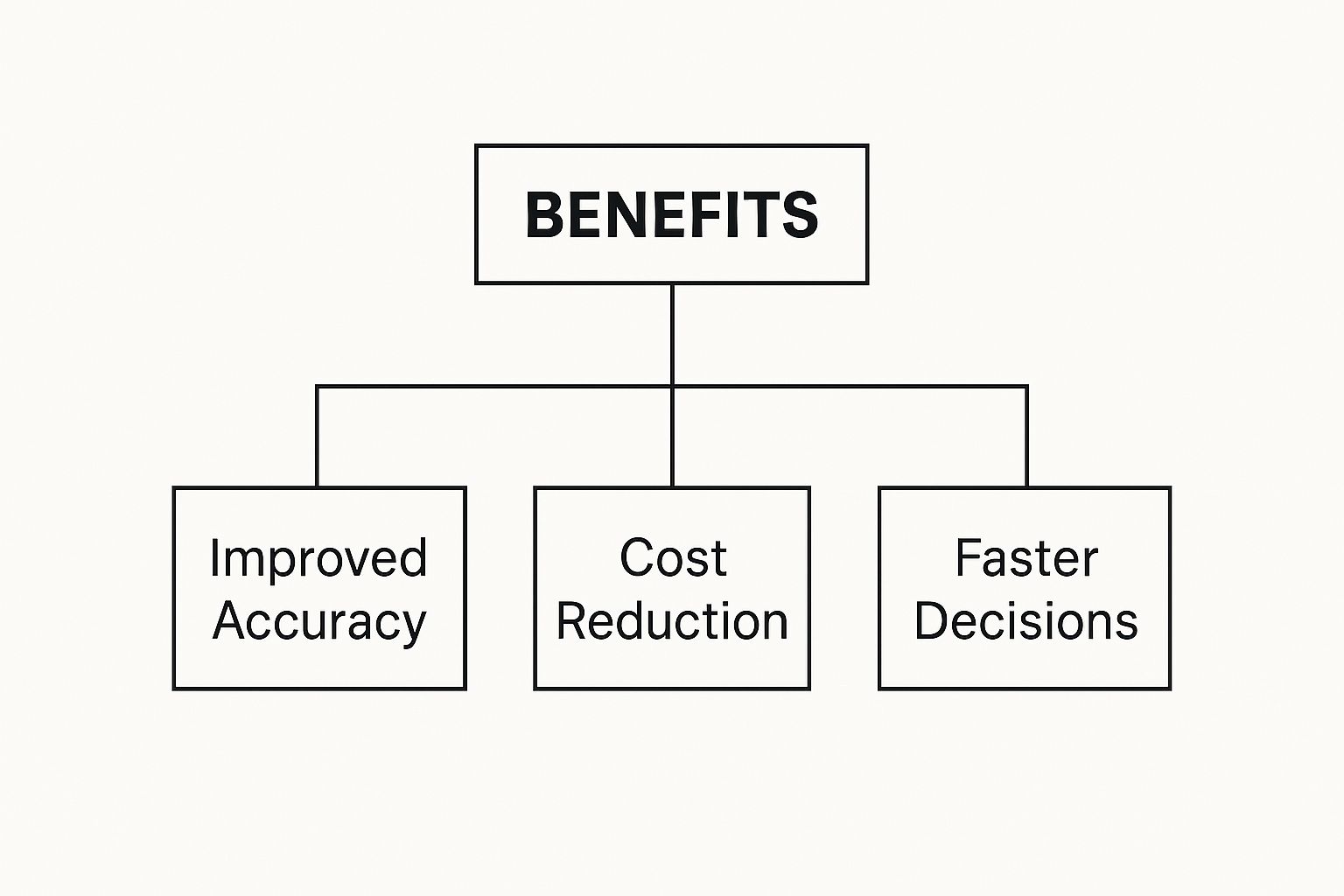
The capabilities we’re about to cover aren’t just technical bells and whistles. They are the engine that drives real business results, turning messy data into a reliable asset that leads to better decisions and a healthier bottom line.
Data Profiling and Discovery
You can’t fix a problem you don’t understand. Data profiling is the crucial first step—it’s like running a full diagnostic scan on your entire database to see what’s really going on under the hood. The software sifts through your data, identifying its structure, content, and overall health.
This process uncovers hidden patterns, flags outliers, and measures your data against key quality metrics. For instance, a profiling tool might instantly tell you that 25% of your customer records are missing a phone number or that the “State” field contains a messy mix of “CA,” “Calif.,” and “California.” This initial assessment gives you a clear, actionable roadmap for all the cleanup work that follows.
The Six Pillars of High-Quality Data
To really grasp what these tools are looking for, it helps to understand the core dimensions of data quality. These six pillars are the universal benchmarks that define whether your data is trustworthy or not.
| Quality Dimension | What It Means | Business Impact Example |
|---|---|---|
| Accuracy | Is the information correct and true? | An inaccurate address leads to a failed delivery, costing you shipping fees and a frustrated customer. |
| Completeness | Are there any gaps? Is all the necessary data present? | Missing phone numbers in a sales lead list make it impossible for your team to follow up on promising prospects. |
| Consistency | Does the same data stored in different places match? | One system lists a customer as “Active” while another has them as “Inactive,” causing confusion in billing and support. |
| Timeliness | Is the data up-to-date and available when needed? | Using last quarter’s sales data to make inventory decisions for this month can lead to stockouts or overstock. |
| Uniqueness | Is this a one-of-a-kind record, or is it a duplicate? | Multiple records for the same customer result in sending them the same marketing email three times, which looks unprofessional. |
| Validity | Does the data conform to the required format or rules? | A “Date of Birth” field containing “N/A” is invalid and will break any age-based analysis or personalization. |
Ultimately, a good data quality tool is built to automatically measure, monitor, and enforce these six dimensions across all your systems.
These six pillars map directly to the dimensions defined in the DAMA-DMBOK (Data Management Body of Knowledge), the framework maintained by the Data Management Association International. Most enterprise tools benchmark themselves against it, which makes it a useful shared vocabulary when comparing vendors. For the tactical side, see our guide to data cleansing techniques; for the broader governance picture, data management best practices.
Cleansing and Standardization
Once profiling has identified the mess, cleansing and standardization tools roll up their sleeves and get to work. This is the “scrubbing” phase, where the software automatically corrects errors, fills in gaps, and enforces a single, consistent format across millions of records.
A classic example is address standardization. The software can take all the different ways people enter their addresses and reformat them to a clean, official standard.
- Before:
123 main st, apt 4, new york city - After:
123 Main St Apt 4, New York, NY 10001
This isn’t just about tidiness. It’s about making your data usable and reliable for everything from shipping products accurately to running effective marketing campaigns.
Matching and Deduplication
Duplicate records are a silent killer of efficiency and customer trust. The matching and deduplication feature is designed to hunt down and merge these redundant entries. This is much more sophisticated than just finding exact matches. Modern tools use smart algorithms to spot “fuzzy” matches where key details are slightly different.
A powerful system can recognize that “John Smith,” “J. Smith,” and “John Smyth” at the same address are almost certainly the same person. It can then intelligently merge these records into a single, definitive “golden record.”
This capability is essential for creating a true single customer view, preventing embarrassing mistakes and ensuring you know exactly who you’re talking to.
Data Enrichment
Sometimes, good data isn’t just about being correct—it’s about being complete. Data enrichment is the process of taking your existing data and making it better by adding valuable information from trusted external sources. It’s about filling in the blanks to create a much richer, more useful profile.
For example, say you have a basic list of customers with just names and emails. An enrichment tool could append:
- Demographic Data: Add age, income level, or marital status for more precise marketing segmentation.
- Firmographic Data: For B2B, you can add company size, industry, or annual revenue to better qualify leads.
- Geographic Data: Append location details to fine-tune regional sales strategies or local event planning.
By turning a skeleton record into a full-bodied profile, enrichment transforms your raw data from a simple list into a powerful strategic asset. Each of these capabilities builds on the others, working together to create a robust system for turning messy data into a reliable source of truth.
The Categories of Data Quality Tools (and Where Vendors Actually Fit)
Every vendor claims to do everything. In reality, the market sorts into a few distinct categories, each optimized for a different slice of the problem.
- Enterprise data quality and MDM suites: Informatica, Talend (now part of Qlik), IBM InfoSphere, and SAP Data Services. End-to-end profiling, cleansing, matching, and master data management—powerful, but heavy to implement and priced for the Fortune 500.
- Cloud-native validation frameworks: Great Expectations, Soda Core, and dbt tests treat data quality as code—assertions written alongside your pipelines. Lightweight, open source, beloved by engineering teams on Snowflake, BigQuery, or Databricks.
- Data observability platforms: Monte Carlo, Bigeye, Anomalo, Acceldata, and Datafold. Instead of writing rules, these tools learn what “normal” looks like and alert when freshness, volume, schema, or distribution drift. Think Datadog for your data.
- Specialized point solutions: Truelist for email validation, Melissa or SmartyStreets for address verification, Dun & Bradstreet for B2B firmographic enrichment. Narrow scope, but they consistently outperform generalists in their lane.
- Cloud provider native tools: AWS Glue DataBrew, Azure Purview, and Google Cloud Dataplex bundle quality checks into the broader cloud platform. Convenient if you’re already in one ecosystem, less mature than dedicated specialists.
Most teams combine categories—an observability tool watching the warehouse, a validation framework gating the pipelines, and a point solution like Truelist scrubbing contacts before they reach the CRM.
The 2026 Shift: Observability and LLM-Assisted Quality
Two trends have reshaped this space and are worth understanding before you sign a multi-year contract.
The first is data observability. Traditional tools ask “is this record valid?” Observability platforms ask “did anything weird just happen to my data?” They monitor metadata—row counts, null rates, schema changes, freshness lag—and surface anomalies in real time. That’s enormously useful for modern warehouses where pipelines change daily and writing rules for every edge case is impossible.
The second is LLM-assisted data quality. Vendors are embedding language models into matching, profiling, and rule generation. An LLM can normalize messy free-text product descriptions, resolve “NYC”, “New York City”, and “N.Y.C.” to the same entity without a regex, and even draft quality rules from a plain-English description. Treat these features as accelerators, not replacements—the fundamentals still matter most.
Buy vs. Build: When a Dedicated Platform Actually Makes Sense
Plenty of teams ask the obvious question: do we even need a commercial data quality platform, or can we get there with Great Expectations and a few dbt tests? The honest answer depends on three factors.
| Factor | Lean toward buying | Lean toward building |
|---|---|---|
| Data volume and complexity | Hundreds of sources, dozens of integration patterns | A handful of pipelines, mostly inside one warehouse |
| Team makeup | Mixed business and technical users need to write rules | Strong data engineering team comfortable with code |
| Compliance burden | Regulated industry, formal audit trails required | Internal analytics, low regulatory pressure |
| Time horizon | Need value in weeks, not quarters | Can invest 6–12 months in tooling before payoff |
For a small data team on a modern stack, dbt tests plus Great Expectations plus a focused tool like Truelist for contact data often beats a sprawling enterprise platform at a fraction of the cost. For a multinational with hundreds of source systems, the calculus flips. The strongest programs blend purchased platforms for breadth with custom tests for depth, and they revisit the boundary as the data stack evolves.
The Strategic Payoff of Investing in Data Quality
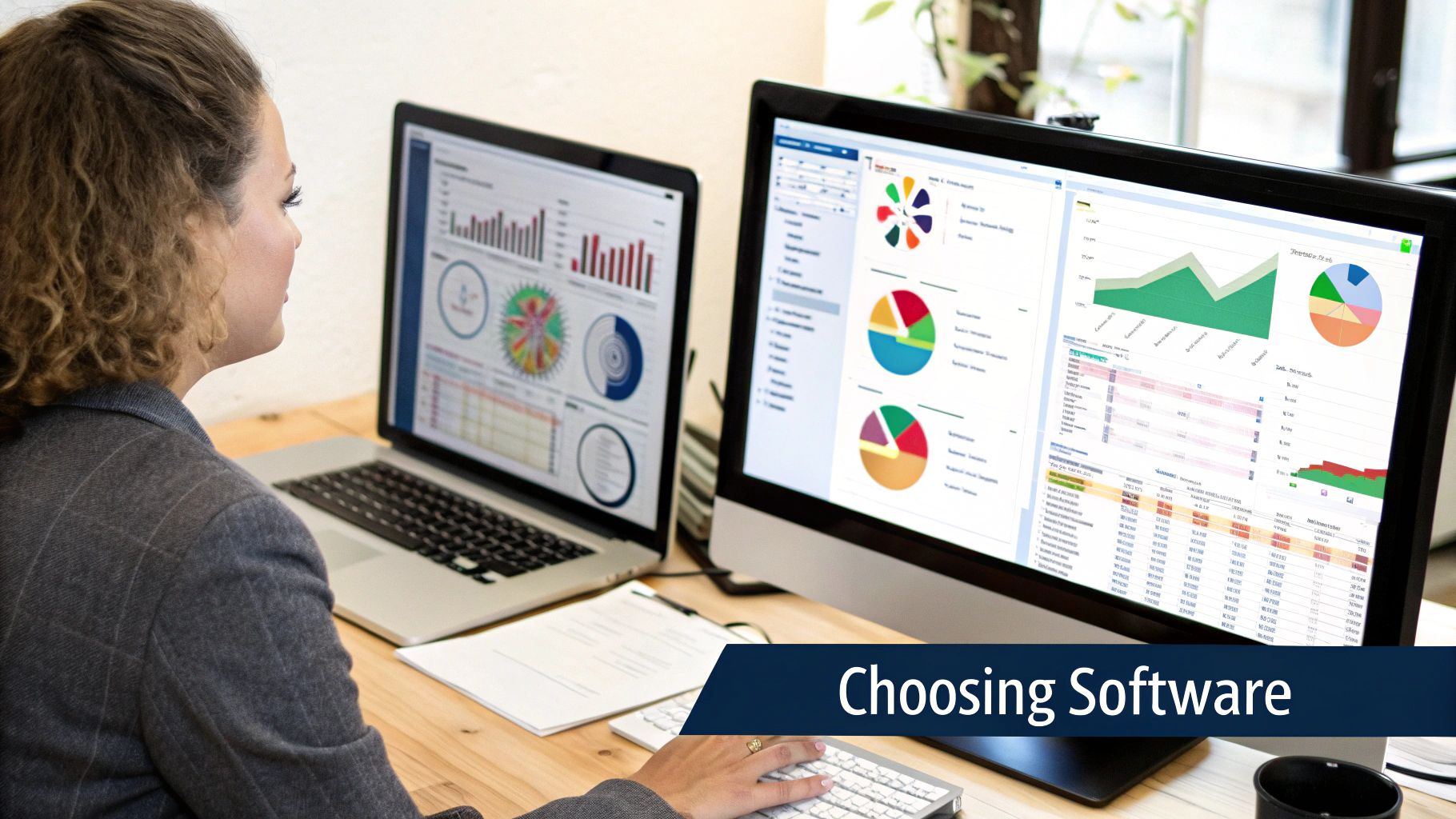
It’s one thing to know what data quality software does, but it’s another thing entirely to see how those features translate into real-world business wins. Let’s be clear: investing in data quality isn’t just a technical clean-up project. It’s a core strategic move that pays for itself over and over again, turning your data from a liability into your sharpest competitive edge.
When your data is solid, decision-making stops being a game of guesswork. Leaders can finally stop hedging their bets on questionable reports and start acting with confidence, knowing their strategies are built on a bedrock of truth.
That confidence ripples through the entire company, making everyone’s work smarter and more effective.
Fueling Smarter Decision Making
Trustworthy data gives leaders the clarity to steer the ship with precision. Think about a retail business trying to manage its inventory. With clean, accurate sales data, they can forecast demand with incredible accuracy, preventing costly stockouts of popular items and avoiding overstocking things nobody wants.
Without that reliable data, they’re flying blind, risking millions in lost sales or dead inventory. High-quality data cuts through the noise, showing you exactly what’s happening in your business and what your customers are telling you. This isn’t just about having numbers; it’s about having the right numbers.
This strategic advantage is why the quality management software market is exploding. Currently valued at USD 11.69 billion, it’s on track to hit USD 22.12 billion in just five years. You can discover more about this market’s growth to see just how seriously businesses are taking this.
Enhancing the Customer Experience
Nothing kills customer trust faster than a simple data mistake. Ever get an email promoting a product you just bought? Or an order shipped to an old address? These little blunders scream incompetence and make your company look disorganized.
Data quality management tools are designed to stop these embarrassing mix-ups cold. By consolidating customer information into a single, accurate “golden record,” you ensure every touchpoint—from marketing emails to support calls—is personal, relevant, and correct.
A major e-commerce brand, for instance, used deduplication tools to merge thousands of scattered customer profiles. The result? A 15% jump in repeat purchases, all because their personalized recommendations finally hit the mark. They stopped annoying customers and started building loyalty.
Driving Operational Efficiency
Think about the hidden costs of bad data for a moment. All those hours your team wastes chasing down the right information, manually correcting spreadsheets, or re-running reports because the first attempt was wrong. That’s time and money down the drain.
Clean data greases the wheels of your entire operation. Your sales team spends more time selling because the CRM data is actually correct. Your finance department closes the books faster because the numbers add up the first time. The whole organization just runs smoother, with less friction and more productivity.
Strengthening Compliance and Analytics
In today’s world of strict data privacy laws like GDPR, having accurate, well-managed data isn’t just a good idea—it’s the law. Data quality software gives you the audit trails and controls you need to prove compliance and avoid massive fines. It helps you answer the crucial questions: What data do we have? Where is it? And are we handling it correctly?
Beyond just staying out of trouble, clean data is the essential fuel for any serious analytics or AI initiative. Predictive models and machine learning algorithms are completely useless if they’re fed garbage data. By ensuring your information is clean, complete, and consistent, you’re paving the way for the kind of powerful insights that truly set you apart from the competition.
How to Choose the Right Data Quality Software
Picking the right data quality software can feel overwhelming, but it doesn’t have to be. With a clear, structured approach, you can cut through the noise and find a solution that genuinely fits your needs. The trick is to stop getting dazzled by flashy feature lists and start focusing on what your business actually needs to fix.
Think of it like this: you wouldn’t hire a world-class chef to fix your leaky faucet. You need the right specialist for the job.
The very first step happens before you even look at a single vendor. You need to do a quick internal audit to figure out where the real pain is. Are duplicate customer records making your sales team’s life a nightmare? Is incomplete product data holding up your e-commerce launches? Nailing down these core issues gives you a lens to evaluate every potential tool. Without that clarity, every platform will look shiny and appealing, and you’ll risk buying software that solves problems you don’t even have.
This initial diagnostic is crucial. It sets the stage for every decision that follows. If duplicates are your main enemy, you’ll want a tool with powerful, smart matching algorithms. But if your problem is missing information, you’ll need to prioritize software with strong data enrichment features.
Defining Your Core Evaluation Criteria
Once you know your problems, you can start building a scorecard to compare vendors. This isn’t just about ticking boxes on a feature list; it’s about finding a true partner, not just a product. Your criteria should be grounded in the reality of how your business, your team, and your technology operate today.
Here are the big-ticket items you absolutely need to consider:
- Deployment Model (Cloud vs. On-Premise): Do you want the flexibility and lower startup cost of a cloud-based tool, or do your security and compliance rules require an on-premise system that you control from top to bottom?
- Scalability and Performance: Your data isn’t shrinking. The software you choose today has to keep up with your data volumes five years from now without grinding to a halt.
- Ease of Use: A powerful tool is useless if only one data scientist on your team knows how to use it. Look for an intuitive interface that lets business users get involved, while still offering the deep-down controls your technical team needs.
- Integration Capabilities: Your data is scattered across CRMs, ERPs, marketing automation tools, and more. The right software needs to play nice with your existing tech stack, either through pre-built connectors or a flexible API.
Getting this right ensures the new platform will slide into your existing workflows instead of creating frustrating new bottlenecks.
Balancing User Needs and Technical Power
One of the biggest hurdles is finding a tool that makes both business users and your IT team happy. Your sales and marketing folks need simple, visual dashboards to see the health of their data at a glance. They want to create rules without writing a line of code.
Your technical staff, on the other hand, needs the heavy-duty machinery. They need advanced features for complex data transformations, the ability to build custom scripts, and deep diagnostic tools to find the root cause of problems.
The ideal data quality management software acts as a bridge between these two worlds. It provides a user-friendly layer for daily tasks while keeping powerful, granular controls accessible for a technical audience.
This balance is the secret to getting everyone on board. If a tool is too complex, your business teams will just ignore it. If it’s too basic, your IT department won’t be able to solve the deep-seated data issues plaguing the company.
The growing demand for these balanced, user-friendly solutions is fueling massive growth in the market. The global Data Quality Management Software market is expected to jump from USD 2.23 billion to USD 6.89 billion in just ten years, which is a powerful compound annual growth rate of 13.35%. You can explore these data quality market trends to get a better sense of where the industry is heading.
To help you get organized, here’s a simple checklist you can use to compare different vendors side-by-side.
Software Evaluation Checklist
This checklist is a great starting point for comparing your top contenders. Don’t just look for “yes” or “no” answers; dig into how each vendor meets the criteria and whether their approach aligns with your team’s skills and your company’s goals.
| Evaluation Criterion | Vendor A | Vendor B | Vendor C |
|---|---|---|---|
| Meets Core Needs? (e.g., deduplication) | |||
| Deployment Model (Cloud/On-Premise) | |||
| Scalability (Handles projected growth) | |||
| Ease of Use (For business users) | |||
| Technical Depth (For IT/data teams) | |||
| Key Integrations (e.g., Salesforce, Marketo) | |||
| Pricing Model (Subscription, usage-based) | |||
| Customer Support (Availability, quality) |
After filling this out, you’ll have a much clearer picture of which solution is the front-runner for your specific situation.
Putting It All Together for the Right Choice
Finally, don’t make a decision without a test drive. A vendor demo is a good start, but a proof-of-concept (POC) using your own messy data is non-negotiable. This is where the rubber meets the road. You get to see how the software handles your unique data challenges, not just a polished and perfect demo set.
During the POC, focus on solving one of the high-impact problems you identified in your initial audit.
For instance, if bad customer emails are killing your campaign ROI, run a validation test. See how well the tool actually finds and fixes invalid formats, disposable addresses, and other common errors. Knowing how to see if an email address is valid can give you a great benchmark for this test. A successful POC not only builds confidence but also gives you a rock-solid business case to justify the investment, making that final decision a whole lot easier.
Turning Your New Tool into a Business Asset
https://www.youtube.com/embed/OiktKgzZzTQ
Buying a data quality management tool is a great first step, but it’s just that—a first step. The real magic happens when that software becomes part of a company-wide commitment to great data. A tool is just a tool; it’s your people and your processes that actually turn that investment into a powerful business asset.
Lasting success comes from weaving data quality into the very fabric of your company culture. This means you have to move past thinking of data cleanup as a one-time project and start treating it as a continuous, everyday practice. Without that mindset shift, even the most sophisticated software will just put a temporary bandage on the problem as old habits creep back in and pollute your systems all over again.
Building a Culture of Data Ownership
The best way to make data quality stick is to establish clear data governance. Don’t let the term intimidate you—it’s simpler than it sounds. It all starts by appointing data stewards.
These are specific people or teams who are officially responsible for certain data sets, like customer contact info or product details.
Data stewards become the go-to experts and advocates for clean data in their corner of the business. They typically handle a few key things:
- Defining Standards: They establish what “good” data actually looks like for their specific domain.
- Monitoring Health: They use the software’s dashboards to track data quality metrics and spot problems early.
- Driving Resolution: When an issue pops up, they’re the ones who take charge and get it fixed.
This model creates a powerful web of accountability. It ensures that data quality is never “someone else’s problem.”
Start Small and Prove the Value
Trying to fix every single data issue across the entire organization at once is a classic mistake, and it almost never works. A far better approach is to start with a small, high-impact pilot project.
Find one critical business problem that’s being caused by bad data—maybe it’s unreliable sales leads or incomplete customer profiles—and focus all your energy there first.
By tackling a specific, visible issue, you can demonstrate a tangible return on investment very quickly. A successful pilot creates momentum, quiets the doubters, and turns key team members into advocates for a wider rollout.
This methodical approach proves the software’s value and builds a rock-solid business case for future investment. It shows everyone that data quality isn’t just some abstract IT goal, but a real-world commitment that pays dividends for years to come.
Common Data Quality Pitfalls (and How to Avoid Them)
Even with great software, plenty of data quality programs stall out. The same handful of mistakes show up again and again.
- Tool-first thinking. Buying a platform before you’ve defined which data matters, who owns it, and what “good” looks like. The tool ends up underused while the mess stays put.
- No clear data owners. When data quality is everyone’s job, it’s nobody’s job. Without named stewards accountable for specific domains, the dashboards get ignored.
- Treating it as a one-time project. Data decays—customers move, companies rebrand, integrations break. A six-week cleansing sprint without ongoing monitoring is a vacation from the problem, not a fix.
- Ignoring the inbound side. Most teams pour effort into cleansing data already in their systems but skip validation at the point of entry. Validate at the form, the API, and the integration layer—not just at the warehouse.
- Optimizing for the wrong dimension. Don’t chase uniqueness if your real problem is validity. Map your dimensions to your actual business pain.
- Underestimating change management. New rules will reject records that used to slip through. Plan the rollout and communicate the why.
The teams that get this right treat data quality the same way they treat security or finance: a continuous discipline with named owners and a budget line that doesn’t disappear after launch.
Where Email Validation Fits in the Bigger Data Quality Picture
Email data is a subset of customer data, which is itself a subset of overall enterprise data quality. The DAMA-DMBOK dimensions all apply—an email address can be valid (formatted correctly), accurate (belongs to the person), complete, and unique.
What makes email different is that it’s one of the few data points you can verify externally in near real time. You can’t ping a service to confirm someone’s job title, but you can confirm an inbox accepts mail. That’s the gap Truelist fills—a specific dimension (validity and deliverability for email) handled better than any general-purpose suite, because it’s the entire surface area we optimize for.
Most teams pair a dedicated email validation tool with their broader stack:
- Use a validate email API at the signup form to reject typos and disposable addresses.
- Run periodic batch verification with a bulk email verifier to flag stale inboxes.
- Use email list cleaning services before major sends to protect sender reputation.
- Pair validation with bounce monitoring—see why emails bounce back and email bounce checker.
Developers can plug in via JavaScript, Python, or PHP. The MX record lookup and format of email address guides round out the contact-data picture.
Ready to transform your email data into a reliable asset? Truelist offers accurate, real-time validation to ensure your messages always reach the right inbox. Start validating for free today and see the difference clean data makes.