 Claude
  Perplexity
Best Email List Cleaning Services for 2025 | Top Picks
Discover the top email list cleaning services for 2025 to optimize your email campaigns. Enhance deliverability and engagement today!
TL;DR: Discover the top email list cleaning services for 2025 to optimize your email campaigns. Enhance deliverability and engagement today!
Your email list is one of your most valuable assets, but only if it’s healthy. Sending campaigns to invalid, outdated, or risky email addresses doesn’t just waste your budget; it actively harms your sender reputation, decreases deliverability rates, and ensures your carefully crafted messages never reach your intended audience. This is where dedicated email list cleaning services become essential tools for anyone serious about email marketing, from sales development reps running cold outreach to e-commerce stores optimizing transactional email delivery.
This guide cuts directly to the chase, providing a comprehensive, no-fluff comparison of the top 12 email verification and list scrubbing platforms available today. We’ve done the heavy lifting to analyze each service’s core features, pricing structures, integration capabilities, and unique strengths and weaknesses. Forget generic marketing copy; here, you’ll find an honest assessment based on real-world use cases. We dig into the specifics, like the accuracy of their catch-all server detection, the flexibility of their API for developers, and their overall value for cost-conscious marketers.
Each review is structured for quick scanning and includes screenshots and direct links to help you evaluate the platforms efficiently. Our goal is to equip you with the detailed information needed to select the best service for your specific needs, whether you’re a small business managing your first high-volume list or a developer seeking robust, automated validation. As you embark on your journey to optimize email campaigns, remembering that data quality is paramount. For more comprehensive guidance, consider these effective email marketing tips. Let’s find the right tool to protect your sender score and maximize your ROI.
1. Truelist
Best For: Flexible Pay-As-You-Go Validation and API Integration
Truelist stands out as a premier choice among email list cleaning services, offering a powerful and refreshingly simple approach to email verification. Its core value proposition is flexible pricing that fits any workflow: pay-as-you-go credits that never expire, plus unlimited plans for high-volume senders. This makes it an ideal solution for high-volume users like sales development teams, marketers, and SaaS companies who require consistent, large-scale list cleaning with predictable costs.
The platform, founded by former ConvertKit engineering head Grant Ammons, is engineered for performance and reliability. It provides deep, real-time validation that goes beyond basic syntax checks to ensure comprehensive list hygiene. The user-friendly interface simplifies the process of uploading and managing lists, while its powerful REST API and direct integrations with tools like Zapier, Mailchimp, and Clay.com enable seamless, automated workflows for developers and tech-savvy marketers.
Standout Features & Analysis
Truelist excels with a focused set of high-impact features designed for maximum deliverability.
- Flexible Pricing Model: Pay-as-you-go credits that never expire, plus unlimited plans for high-volume senders, is a significant differentiator. It provides cost certainty and encourages proactive list cleaning, with credits that carry over instead of expiring. This is particularly beneficial for startups and small businesses managing tight budgets.
- Comprehensive Verification Suite: The service performs multi-layered checks, including:
- Syntax & Format Validation: Ensures emails are correctly structured.
- Domain & MX Record Check: Confirms the domain is valid and configured to receive mail.
- Mailbox Existence Check: Pings the server to verify if a specific mailbox is active.
- Spam Trap & Disposable Email Detection: Protects your sender reputation by identifying and flagging harmful addresses.
- Developer-First API & Integrations: The robust REST API is well-documented, allowing for custom integrations into any application or workflow. Pre-built connections to major platforms facilitate effortless automation, making it a strong choice for embedding validation directly into sign-up forms or data enrichment processes.
Our Take: Flexible pricing — credits that never expire plus unlimited plans for high-volume senders — combined with a powerful API makes Truelist a uniquely valuable tool. It gives businesses predictable costs at any scale, empowering them to maintain pristine email lists and focus on what matters: engagement and growth.
Use Case Spotlight
A sales development representative (SDR) can integrate Truelist via Clay.com or Zapier to automatically verify prospect lists before initiating a cold outreach sequence. This drastically reduces bounce rates, protects the company’s domain reputation, and ensures that campaign metrics accurately reflect engagement rather than deliverability issues. To dive deeper into the underlying mechanics, see our walkthrough of how to check if an email address is valid and the impact on email sender reputation.
Key Details
| Feature | Details |
|---|---|
| Pricing Model | Pay-as-you-go credits that never expire, plus unlimited plans for high-volume senders. |
| Core Function | Real-time and bulk email list verification. |
| Integrations | Zapier, Mailchimp, ConvertKit, Clay.com, and a powerful REST API. |
| Compliance | GDPR-compliant data handling practices. |
| User Experience | Clean, intuitive interface with straightforward list upload and export functionality. |
| Support | Expert support from an industry-experienced team. |
Pros:
- Flexible pricing: credits that never expire, plus unlimited plans for high-volume senders.
- Advanced real-time checks for format, domain, mailbox activity, and spam-trap detection.
- Seamless integrations and powerful REST API for automated workflows.
- Backed by GDPR-compliant data handling and deep industry expertise.
Cons:
- No tiered pricing information is publicly available, which may require direct contact for budget planning.
- Limited details on multi-user or enterprise-level features on the website.
2. ZeroBounce
ZeroBounce has earned its reputation as a heavyweight among email list cleaning services by offering a comprehensive suite of deliverability tools alongside its core verification engine. It strikes an excellent balance between accuracy, speed, and value-added features, making it a go-to for marketers who see list hygiene as part of a larger deliverability strategy. The platform is particularly user-friendly, with a clean dashboard that makes uploading lists and interpreting results straightforward.
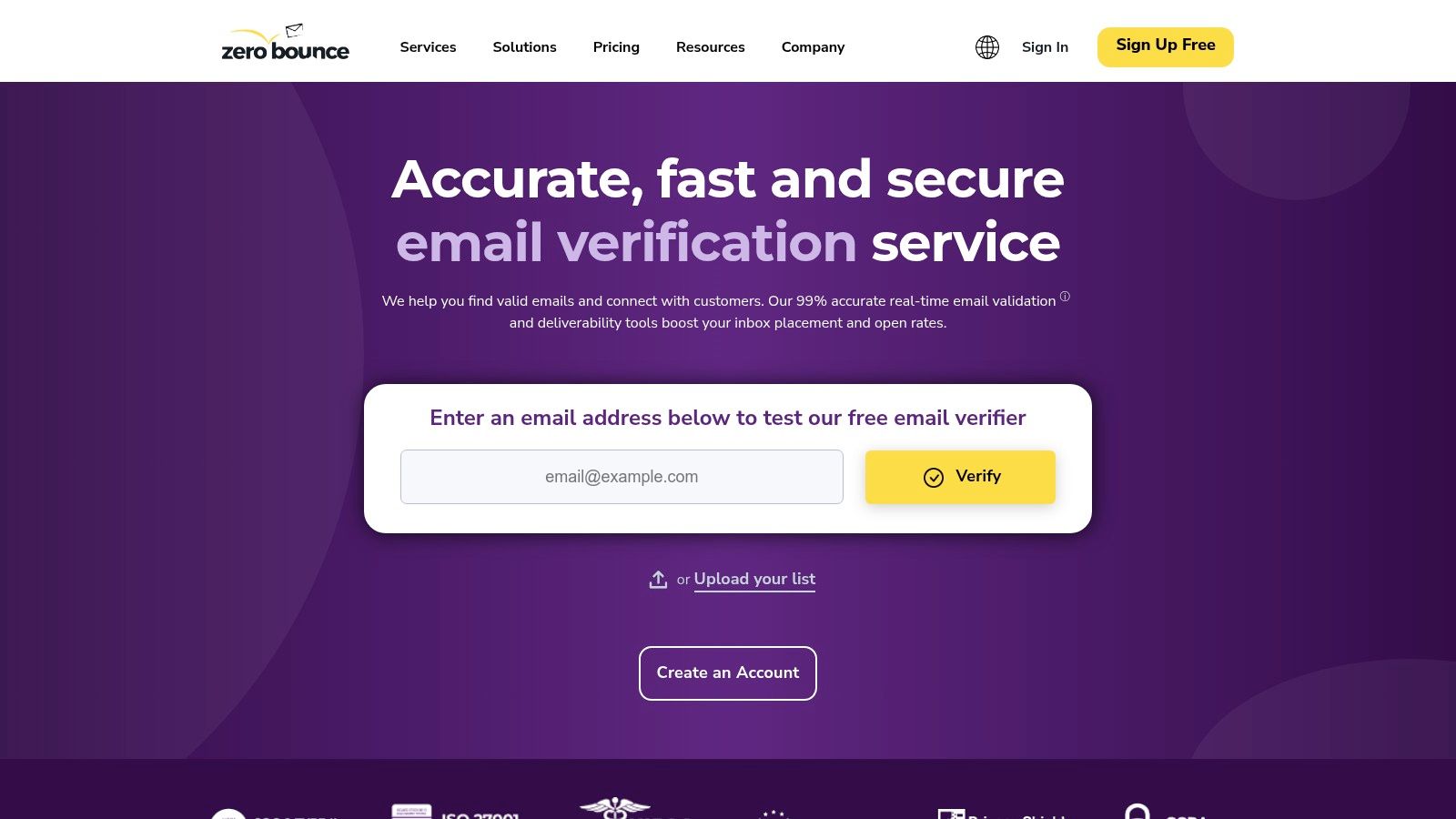
What sets ZeroBounce apart is its ecosystem of tools. Beyond standard list cleaning, it offers inbox placement testing to see if your emails are hitting the inbox or spam folder, blacklist monitoring, and even an email server tester. This makes it ideal for teams who need to diagnose and fix deliverability issues, not just clean a list.
Key Considerations
- Pricing Model: ZeroBounce uses a pay-as-you-go credit system where 1 credit equals 1 email verification. A significant advantage is that credits never expire, which is perfect for businesses with inconsistent cleaning needs. Pricing becomes more cost-effective at higher volumes.
- Unique Features: Users get 100 free verification credits every month, and you are not charged for emails that return an “unknown” status. Free duplicate email removal is also included with every cleaning.
- Ideal Use Case: A great fit for a SaaS company or e-commerce store that relies heavily on both marketing and transactional emails. They can use the API for real-time sign-up verification and the full deliverability toolkit to ensure critical messages (like password resets or purchase receipts) consistently reach the inbox.
Pros:
- Credits never expire, providing flexibility.
- Includes a robust toolkit beyond basic validation.
- Provides 100 free monthly credits.
Cons:
- The minimum purchase is 2,000 credits, which may be a high entry point for very small lists.
- Advanced deliverability tools require a separate, subscription-based plan.
Website: https://www.zerobounce.net
3. NeverBounce (by ZoomInfo)
NeverBounce, now part of ZoomInfo, has established itself as a reliable and versatile player in the email list cleaning services space. It effectively serves two distinct user needs: one-time bulk cleaning for occasional list hygiene and automated, continuous cleaning for businesses with dynamic, ever-growing lists. Its platform is straightforward, focusing on core validation accuracy and making it easy for users to get started with either bulk uploads or API integration.
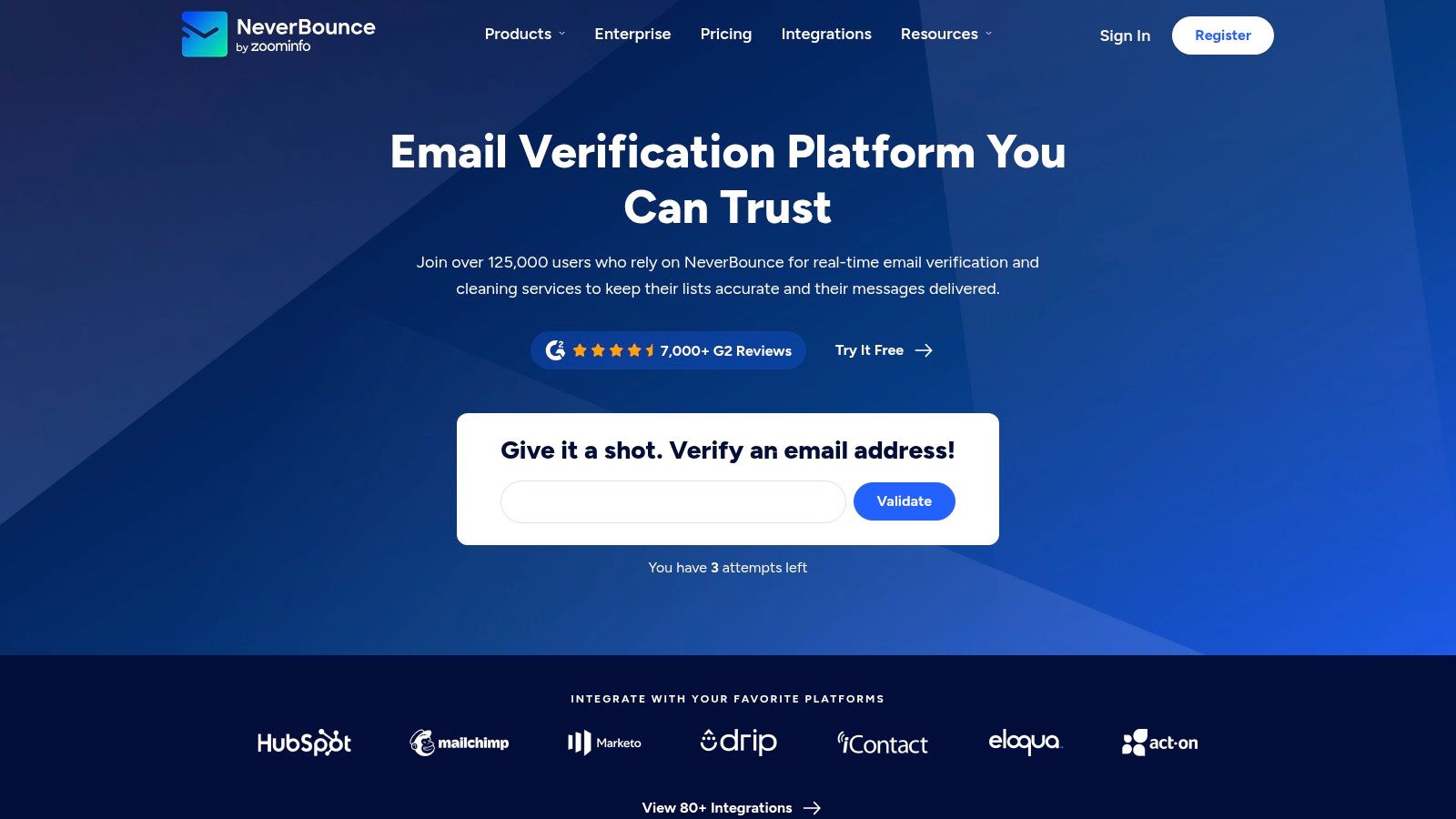
What differentiates NeverBounce is its clear separation between ad-hoc and subscription-based models. Users can choose the path that best fits their workflow without getting locked into a system that doesn’t match their needs. This flexibility makes it a strong contender for both marketers who need a quick cleanup before a campaign and developers who require a set-it-and-forget-it solution for maintaining list health.
Key Considerations
- Pricing Model: NeverBounce offers two primary models. You can buy pay-as-you-go credits for bulk or API verification, with significant volume discounts. Alternatively, you can subscribe to “Sync,” an automated daily cleaning service that connects directly to your Email Service Provider (ESP).
- Unique Features: The “Sync” feature is a key differentiator, offering automated daily list hygiene without manual uploads. Its API is also well-documented, making it a favorite for developers looking to integrate real-time verification into their applications or sign-up forms.
- Ideal Use Case: Perfect for a growing startup that initially needs to clean a purchased or old list using pay-as-you-go credits. As they mature and build a consistent lead flow through their website, they can transition to the Sync subscription model to automatically maintain the hygiene of their primary marketing list in Mailchimp or HubSpot.
Pros:
- Clear choice between one-time credits and automated Sync subscriptions.
- Straightforward, well-documented API for easy integration.
- Connects directly to major ESPs for automated cleaning.
Cons:
- Detailed pricing tables are sometimes located in help documentation, not on the main pricing page.
- Lacks the broader deliverability toolkit (inbox placement, blacklist monitoring) offered by some competitors.
Website: https://www.neverbounce.com
4. Kickbox (by Validity)
Kickbox, now part of the Validity suite of products, is one of the most developer-friendly and accessible email list cleaning services on the market. It excels by providing a straightforward, no-fuss approach to verification, focusing on a powerful API and a simple pay-as-you-go model that appeals to startups, developers, and small businesses alike. The platform is known for its reliability and ease of integration, making it a popular choice for embedding real-time verification directly into sign-up forms and applications.
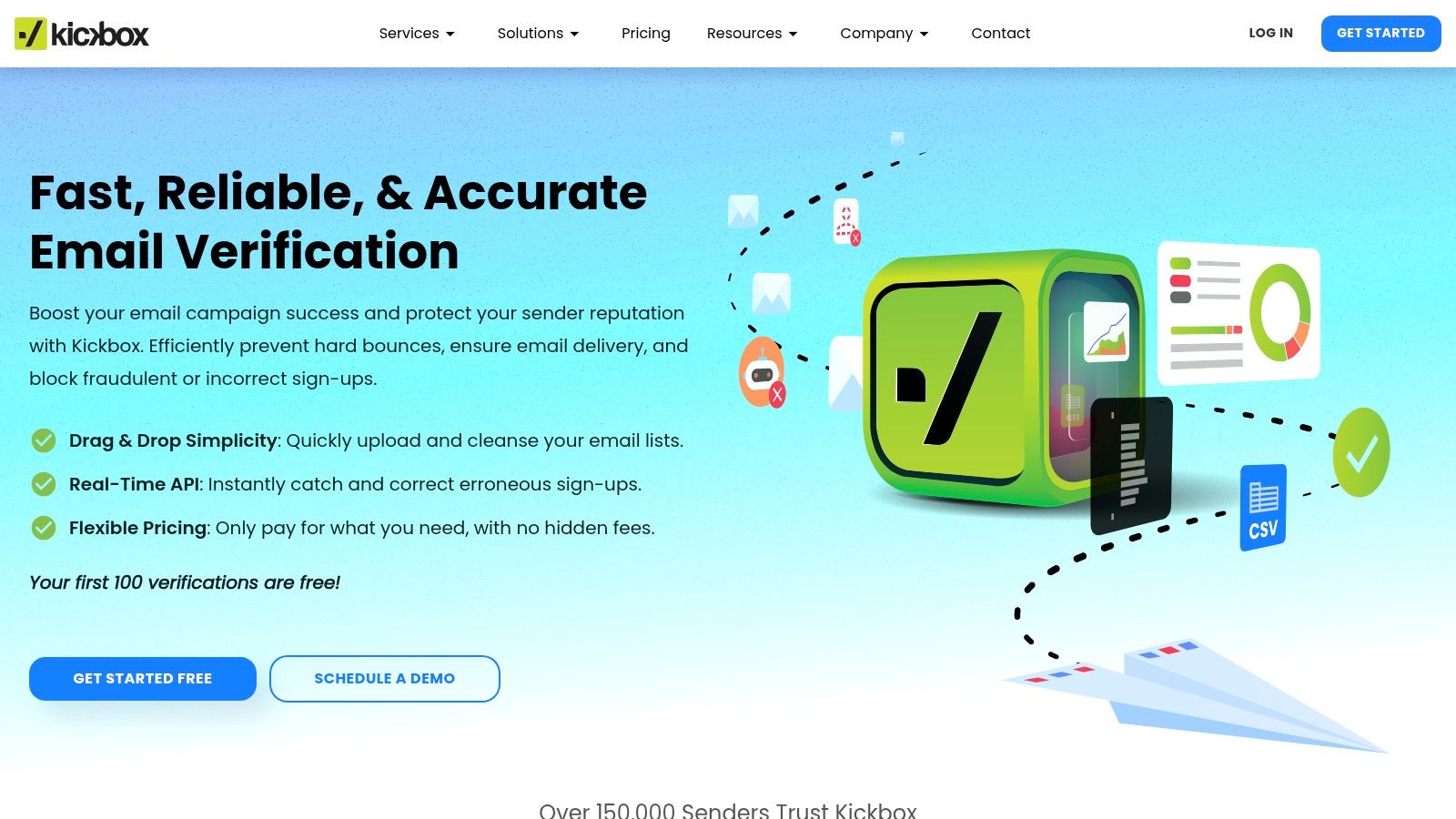
What makes Kickbox a strong contender is its broad adoption and well-documented API, which simplifies the process for developers to automate list hygiene. While it operates as a standalone tool, its connection to Validity’s larger deliverability ecosystem provides a clear growth path for companies that may eventually need more advanced tools. To get the most out of services like Kickbox, pair them with a solid email validation API workflow and a clear understanding of why emails bounce back in the first place.
Key Considerations
- Pricing Model: Kickbox uses a clear pay-as-you-go structure where you purchase verification credits. Pricing tiers start with very small packs (as low as 500 verifications), making it highly accessible for users with minimal needs or those wanting to run a small test.
- Unique Features: The service offers 100 free verifications for all new users to trial the platform. Its core strength lies in its real-time API, which can instantly validate an email address as it’s entered into a form, preventing bad data from ever entering your system.
- Ideal Use Case: Perfect for a developer or small business that needs a reliable, easy-to-implement real-time API for their website or app. It’s also great for marketers who need to clean small to medium-sized lists periodically without committing to a monthly subscription.
Pros:
- Very easy to start with a free trial and small credit packs.
- Excellent documentation and developer-focused API workflow.
- Broad market adoption and a reputation for reliability.
Cons:
- Pricing for very large volumes can be less competitive than some rivals.
- Purchased credits may have an expiration date, requiring users to plan their usage.
Website: https://kickbox.com
5. Bouncer
Bouncer carves out its space among email list cleaning services by combining high accuracy with a simple, no-nonsense approach to pricing and features. It is designed for users who want a reliable validator without the complexity or long-term commitment of some larger platforms. Its clean interface and straightforward process make it easy to upload a list, get fast results, and improve your sender reputation with minimal friction.
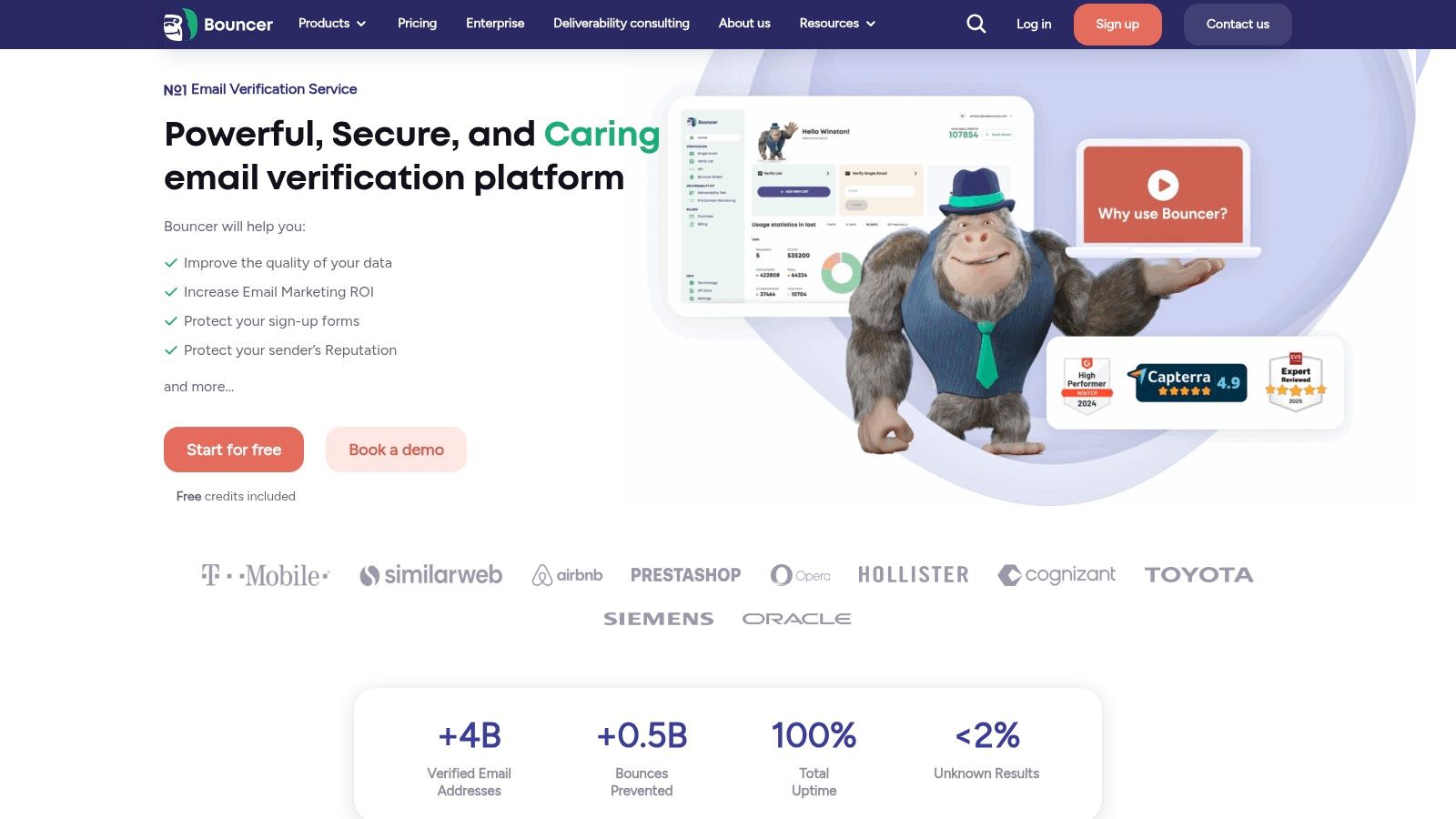
What makes Bouncer particularly appealing is its developer-friendly API and transparent model. Beyond its core verification engine, it offers a Deliverability Kit add-on for inbox placement testing and blocklist monitoring. This provides a clear upgrade path for teams who start with basic list cleaning but later need more advanced diagnostics, all within the same ecosystem.
Key Considerations
- Pricing Model: Bouncer uses a pay-as-you-go credit system where credits never expire, offering great flexibility. Pricing is very transparent, with clear per-email rates that decrease significantly at higher volumes. There’s no charge for duplicate emails or “unknown” results.
- Unique Features: The platform offers a “Bouncer Shield” feature for real-time form protection, preventing bad emails from entering your list in the first place. It also provides free toxicity checks to identify emails associated with data breaches.
- Ideal Use Case: Excellent for developers or small marketing teams who need a reliable API for real-time verification at sign-up. It’s also a great fit for cost-conscious businesses that need to clean lists periodically and value the fact that their purchased credits will always be available for use.
Pros:
- Credits never expire, which is ideal for sporadic cleaning schedules.
- Transparent, volume-based pricing is easy to understand.
- Good developer documentation and strong API performance.
Cons:
- The Deliverability Kit for ongoing monitoring requires a separate subscription.
- Fewer native integrations compared to some larger competitors.
Website: https://www.usebouncer.com
6. MillionVerifier
MillionVerifier carves out its space in the market by focusing on high-volume verification at an exceptionally aggressive price point. As one of the most cost-effective email list cleaning services available, it appeals to businesses that need to process massive lists without a proportional increase in cost. The platform is built for speed and scale, offering a straightforward service that prioritizes accurate, bulk cleaning above all else. Its bold 100% money-back guarantee on accuracy aims to build trust with users wary of low-cost providers.
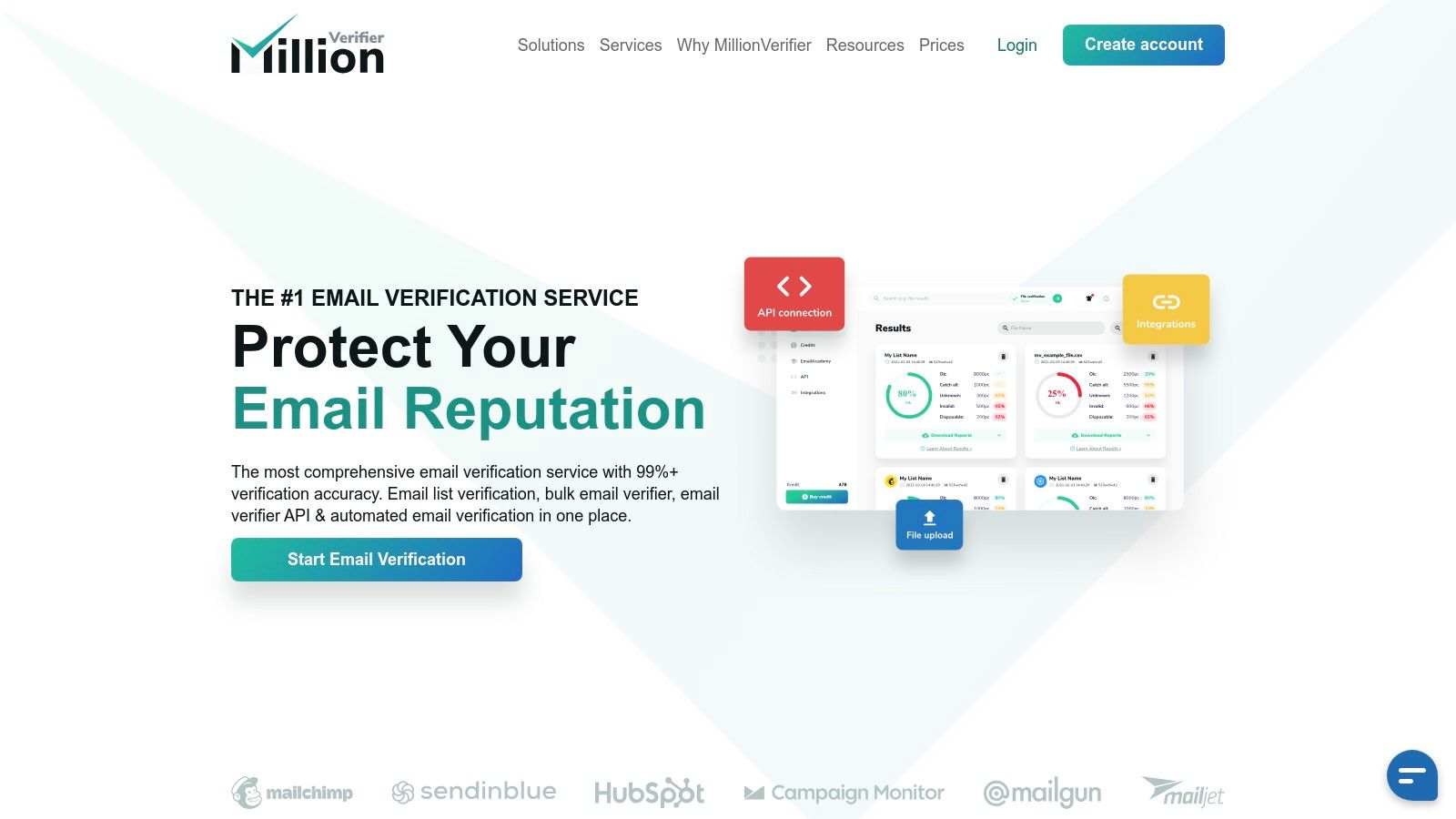
What makes MillionVerifier stand out is its “EverClean” feature, an automated subscription service that monitors and re-verifies your email list daily or weekly. This set-and-forget approach prevents list decay over time, making it ideal for organizations with constantly growing contact databases from various sources. The service integrates directly with major email service providers, automatically cleaning the list without manual uploads.
Key Considerations
- Pricing Model: MillionVerifier uses a pay-as-you-go model that becomes drastically cheaper at higher volumes, reaching fractions of a cent per email. It also offers the EverClean automated service on a separate monthly subscription basis, priced by the number of emails being monitored.
- Unique Features: The standout feature is EverClean for automated, ongoing list hygiene. The 100% money-back guarantee if bounce rates exceed 4% after cleaning is a significant and confident value proposition.
- Ideal Use Case: This platform is perfect for a cost-conscious e-commerce business or a lead generation agency managing millions of contacts. They can perform an initial bulk cleaning for a low cost and then subscribe to EverClean to maintain database health automatically, saving significant time and resources.
Pros:
- Extremely competitive pricing, especially for very large lists.
- “EverClean” feature offers powerful, automated list maintenance.
- Strong 100% money-back accuracy guarantee.
Cons:
- Lacks the comprehensive deliverability toolkits (like inbox placement tests) found in other premium services.
- The website’s marketing can feel overly promotional, which may require users to look closer at the service details.
Website: https://www.millionverifier.com
7. EmailListVerify
EmailListVerify positions itself as a powerful, budget-friendly solution among email list cleaning services, catering to users who need reliable bulk validation without the premium price tag. It provides a straightforward, no-frills experience focused on core accuracy and speed, making it an excellent choice for businesses prioritizing cost-efficiency. The platform is designed for simplicity, allowing users to quickly upload lists, get clear results, and improve their deliverability with minimal complexity.
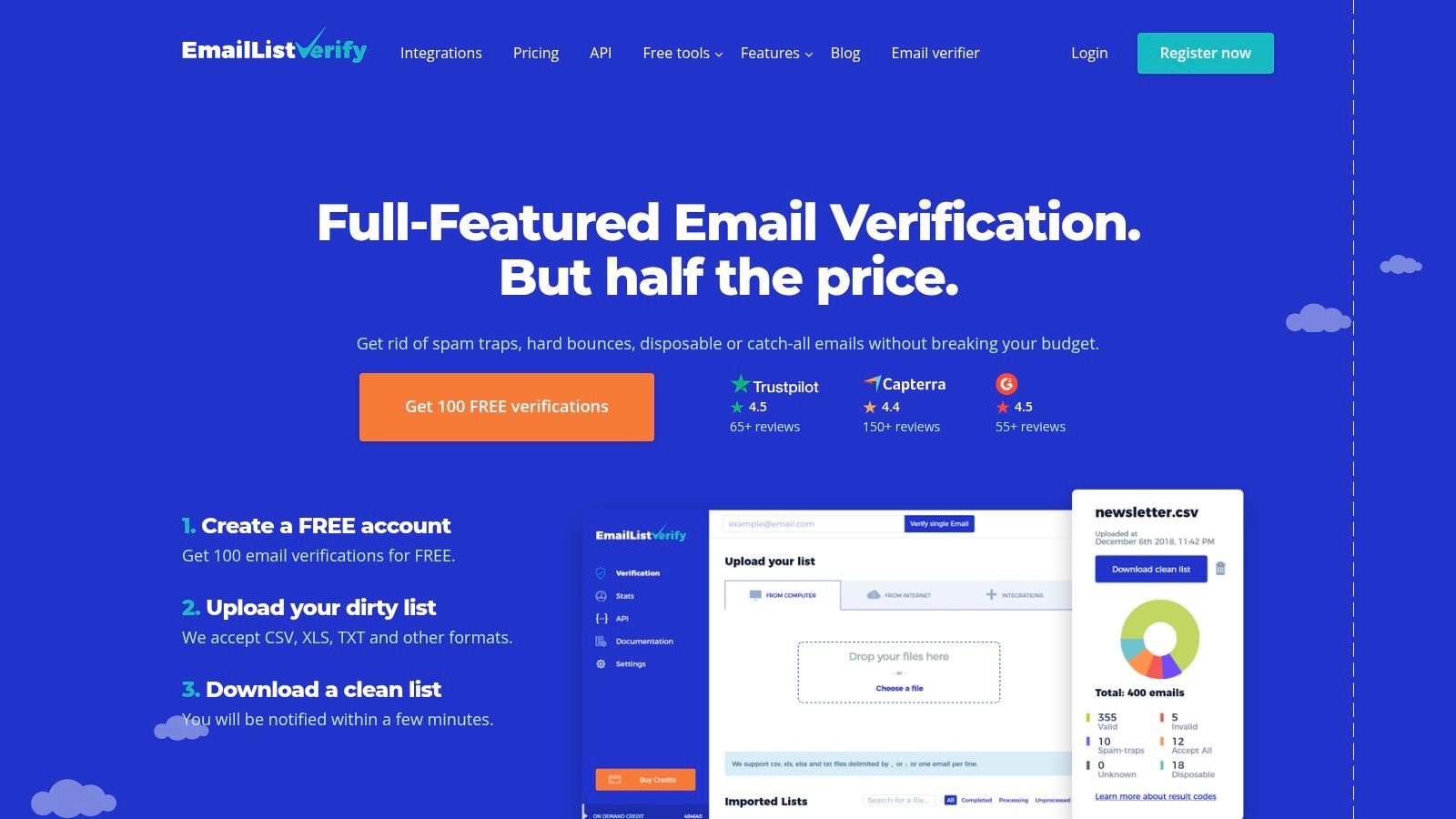
What makes EmailListVerify stand out is its aggressive pricing, especially on monthly subscriptions, which offers significant value for high-volume users. It processes lists rapidly, claiming to handle over 100,000 emails per hour for each customer. This speed, combined with a simple API for real-time verification at signup forms, makes it a practical tool for maintaining list hygiene without a steep learning curve. For a deeper dive into the underlying checks, see our explainer on how to see if an email address is valid and our guide to free email validation tools.
Key Considerations
- Pricing Model: Offers both pay-as-you-go credits and monthly subscriptions. With pay-as-you-go, credits never expire and users are not charged for “unknown” results, providing great flexibility. Subscriptions offer a lower per-email cost for those with consistent cleaning needs.
- Unique Features: The platform includes free duplicate email removal and syntax verification. Credits can be used for both its email validator and its email finder tool, adding a layer of versatility to the service.
- Ideal Use Case: Perfect for a small business, startup, or a cost-conscious marketing team that needs to clean large lists regularly. Its simple interface and fast processing are ideal for users who want to upload a list, get results, and move on without needing complex deliverability diagnostics.
Pros:
- Highly competitive pricing, especially for subscription plans.
- Simple, user-friendly interface for easy list uploads and analysis.
- Pay-as-you-go credits do not expire.
Cons:
- Lacks advanced deliverability tools like inbox placement or blacklist monitoring.
- The feature set is more focused on core verification than a comprehensive suite.
Website: https://emaillistverify.com
8. DeBounce
DeBounce has carved out a niche as one of the most cost-effective and straightforward email list cleaning services available. It’s built for users who prioritize accuracy and affordability over an extensive suite of deliverability tools. The platform is incredibly fast, processing large lists quickly, and its simple interface ensures users can get started without a steep learning curve, making it perfect for budget-conscious marketers.
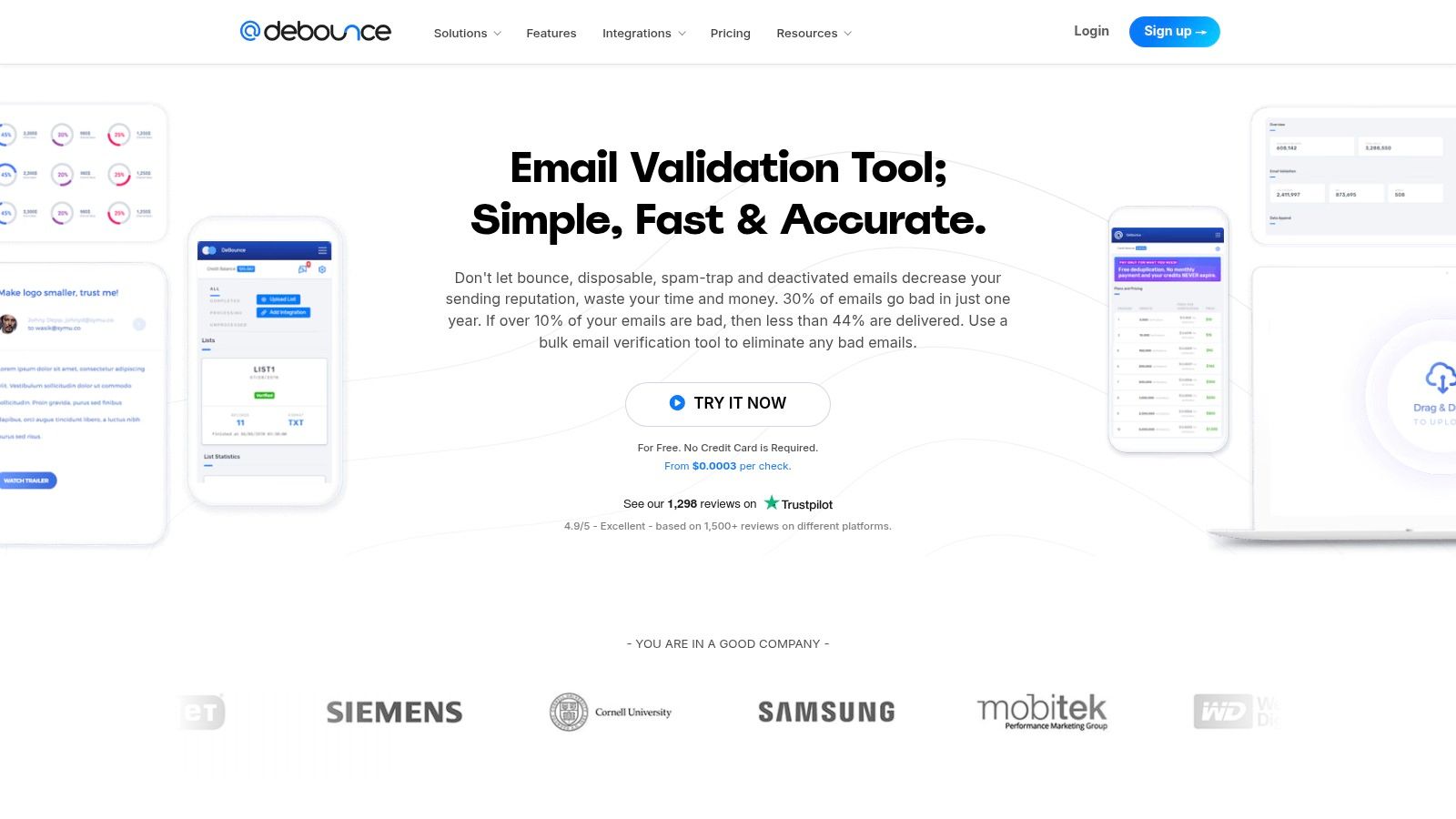
What makes DeBounce particularly attractive is its transparent and user-friendly pricing policy. The promise that you never pay for “unknown” results or duplicate emails removes a common point of frustration found with other services. This focus on core validation, combined with lifetime credits, provides exceptional value for businesses that need to perform bulk cleaning operations without breaking the bank.
Key Considerations
- Pricing Model: DeBounce operates on a simple pay-as-you-go credit system where credits never expire, offering maximum flexibility. Pricing is highly competitive and becomes even more affordable with larger volume purchases, positioning it as a top choice for bulk verification.
- Unique Features: A key benefit is that all plans include access to their verification API at no extra cost. Free removal of duplicates and no charges for unknown statuses are standard. They also offer an optional data enrichment service to append names and photos to emails.
- Ideal Use Case: Excellent for startups, small businesses, or marketing agencies that manage large email lists and need a reliable, no-frills cleaning solution. Its API makes it a great fit for developers wanting to integrate real-time validation into sign-up forms or applications without committing to a monthly subscription.
Pros:
- Extremely competitive pricing, especially for large lists.
- Credits have a lifetime validity.
- No charges for unknown email statuses or duplicates.
Cons:
- Lacks advanced deliverability tools like inbox placement or blacklist monitoring.
- The user interface is functional but less polished than some premium competitors.
Website: https://debounce.io
9. Verifalia
Verifalia is an established, European-based email list cleaning service that gives users exceptional control over the verification process. Its standout feature is the ability to choose between different validation levels, allowing a trade-off between speed, accuracy, and cost. This granular control, combined with a strong developer focus and transparent privacy policies, makes it a unique and reliable choice for technically-minded marketers and businesses with specific compliance or performance needs.
What sets Verifalia apart is its tiered validation quality: Standard, High, and Extreme. Standard is fast and great for general list cleaning. High adds more checks for temporary unavailability, and Extreme performs the deepest analysis, including syntax verification and temporary email detection. This flexibility is ideal for tailoring the service to the specific value of an email list, from a low-risk marketing newsletter to a high-stakes transactional email list.
Key Considerations
- Pricing Model: Verifalia uses a credit-based system, but with a twist. The number of credits consumed per email depends on the chosen validation level. Paid plans also come with a generous daily allotment of free credits, which encourages regular, small-batch cleaning.
- Unique Features: The adjustable validation depth is its core differentiator. Verifalia also provides robust, open-source SDKs for various programming languages, making its real-time API integration straightforward for developers.
- Ideal Use Case: Perfect for a developer or a technically savvy marketing team that needs to integrate real-time verification into a web application. The ability to select “Extreme” validation for high-value sign-ups (like a paid service) while using “Standard” for a general newsletter list provides powerful cost-optimization.
Pros:
- Flexible validation levels to balance cost and accuracy.
- Daily free credits on paid plans incentivize routine hygiene.
- Strong developer tools and open-source SDKs.
Cons:
- The credit consumption for higher validation levels can become costly at a large scale.
- The interface is more technical and may be less intuitive for non-developers compared to other platforms.
Website: https://verifalia.com
10. Emailable
Emailable positions itself as a fast, developer-friendly, and highly accurate solution among email list cleaning services. It focuses on delivering core verification with impressive speed and reliability, enhanced by a generous free tier and flexible credit policy. The platform is designed for ease of use, whether you’re a marketer needing to clean a bulk list or a developer integrating real-time validation into an application. Its user-friendly interface simplifies the process of uploading lists and understanding the results.

What makes Emailable a strong contender is its combination of performance and user-centric features like team accounts and unlimited API keys. While it offers a separate Deliverability module for inbox placement and blacklist monitoring, its primary strength lies in its precise and efficient verification engine. This makes it an excellent choice for teams that prioritize accuracy and seamless integration over an all-in-one deliverability suite.
Key Considerations
- Pricing Model: Emailable operates on a pay-as-you-go credit system. A major benefit is that credits never expire, and you are not charged for duplicate or “unknown” results, which provides excellent value. Pricing is competitive and scales for larger volumes.
- Unique Features: The service offers a generous starting bonus of 250 free credits for new users. Its 50+ integrations and team account features make it easy to manage verification across multiple users or departments within a company.
- Ideal Use Case: Perfect for a startup or a development team needing to quickly implement real-time email verification on sign-up forms. The API is robust, and the free credits allow for thorough testing before committing. The non-expiring credits also suit businesses with sporadic list-cleaning needs.
Pros:
- Starts with 250 free credits for new users.
- Credits do not expire, offering maximum flexibility.
- Free verification for unknown and duplicate emails.
Cons:
- Advanced deliverability tools are sold as a separate product.
- Pricing details can vary, so it’s best to confirm the final cost at checkout.
Website: https://emailable.com
11. mailfloss
mailfloss positions itself as the “set-and-forget” solution among email list cleaning services, focusing heavily on automation. Instead of requiring manual uploads for every cleanup, it integrates directly with a wide range of popular Email Service Providers (ESPs) to perform daily, automatic list hygiene. This approach is designed for marketers who want to continuously prevent list decay rather than just reactively cleaning their lists a few times a year.
The platform’s core strength is its direct ESP integration. Once connected, mailfloss automatically detects and removes invalid emails from your lists every single day, fixing common typos and unsubscribing bad contacts without any manual intervention. This continuous, background process helps maintain high deliverability and sender reputation over the long term.
Key Considerations
- Pricing Model: mailfloss uses a subscription-based model tied to the number of emails you want to scan monthly. It also offers prepaid credits for one-off bulk cleaning jobs, which is useful for lists held outside a supported ESP. The overage pricing for exceeding your plan’s monthly cap is transparent.
- Unique Features: The primary differentiator is the daily automated cleaning via direct ESP connections. It also offers a real-time API, webhook support for developers, and automatic typo correction for common domain misspellings (e.g., “gnail.com” to “gmail.com”).
- Ideal Use Case: This service is perfect for an agency managing multiple client accounts on platforms like Mailchimp or Klaviyo. They can connect each account to mailfloss to ensure all client lists are continuously maintained, protecting both the client’s sender score and the agency’s reputation without adding significant manual work.
Pros:
- True “set-and-forget” automation with wide ESP coverage.
- Daily cleaning helps proactively manage list health.
- Transparent overage pricing prevents unexpected high bills.
Cons:
- The subscription model is best suited for those using a supported ESP.
- One-time cleanups for unsupported ESPs require purchasing separate prepaid credits.
Website: https://mailfloss.com
12. Clearout
Clearout positions itself as more than just an email verifier, integrating powerful prospecting and email-finding tools into its core offering. This dual functionality makes it a strong contender among email list cleaning services for sales and marketing teams who need to both clean existing lists and find new leads. The platform’s approach focuses on flexibility and value, with user-friendly billing and a straightforward interface for managing bulk uploads and real-time verification.
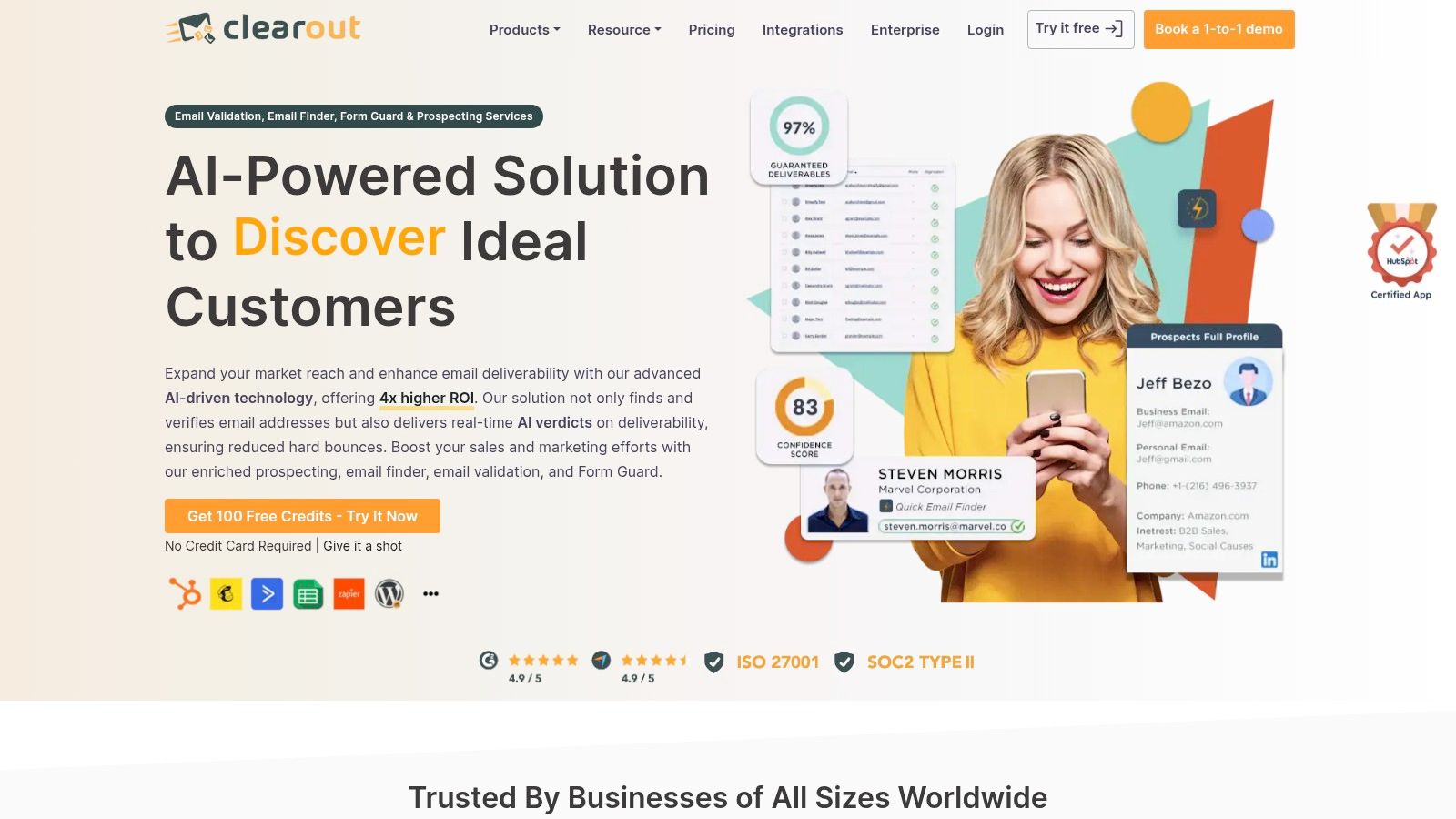
What makes Clearout stand out is its commitment to not charging for inconclusive results. This, combined with its flexible credit system and a generous number of integrations, provides a low-risk, high-value proposition. It offers multiple ways to implement verification, including a JavaScript widget for inline capture forms and a dedicated WordPress plugin, catering to both technical and non-technical users.
Key Considerations
- Pricing Model: Clearout offers both pay-as-you-go credits and monthly or yearly subscriptions. A key benefit is that credits never expire, and you are not charged for emails with an “unknown” status or for any duplicates found in your list. This policy ensures you only pay for definitive results.
- Unique Features: The service provides 100 free credits upon signup for new users to test the platform. Its email finder tool is a significant differentiator, allowing users to discover professional email addresses based on a name and company domain, blending list cleaning with lead generation.
- Ideal Use Case: Excellent for a sales development team or a B2B marketer who needs a unified solution for cleaning outbound campaign lists and prospecting for new contacts. The API and integrations also make it a solid choice for e-commerce platforms wanting to validate customer emails at the point of registration to reduce bounce rates on transactional emails.
Pros:
- Billing excludes unknown and duplicate emails.
- Flexible plans include pay-as-you-go, monthly, and yearly options.
- Integrates email finding and prospecting tools.
Cons:
- Pricing for different tiers can vary based on active promotions; users should confirm the final rate at checkout.
- While integrations are plentiful, some advanced options may be tied to higher-tier plans.
Website: https://clearout.io
Email List Cleaning Services: Feature & Pricing Comparison
| Platform | Core Features/Validation | User Experience & Quality ★★★★☆ | Value Proposition & Pricing 💰 | Target Audience 👥 | Unique Selling Points ✨ |
|---|---|---|---|---|---|
| 🏆 Truelist | Real-time checks; bulk + inline validation | Intuitive UI; robust export; GDPR-compliant | Credits that never expire + unlimited plans; no hidden fees | SDRs, marketers, developers, SMBs | Flexible pricing; seamless REST API & 1-click integration |
| ZeroBounce | Bulk + real-time API; blacklist & inbox tests | Reliable; credits don’t expire | Credit-based; min. 2,000 credits | Teams focused on deliverability | Deliverability toolkit; free monthly credits |
| NeverBounce | Bulk, single check, Sync subscriptions | Clear purchasing; good for sporadic & ongoing | Volume discounts on bulk credits | Businesses needing flexible cleaning | Automated Sync for list hygiene |
| Kickbox | Bulk + real-time API; compliance tools | Easy start with free trial; good dev docs | Pay-as-you-go; small packs; expirations possible | Small to mid volume users | Free trial; broad market adoption |
| Bouncer | Bulk/API; add-ons for deliverability | Transparent pricing; solid docs | Pay-as-you-go; credits never expire | Teams needing basic deliverability | Deliverability Kit; real-time form protection |
| MillionVerifier | Bulk, API; automated EverClean subscription | Fast processing; strong value at scale | Aggressive per-email cost; money-back guarantee | Large volume users | EverClean ongoing verification |
| EmailListVerify | Bulk, real-time API, email finder | Simple UX; fast processing | Budget-friendly; subscription & pay-as-you-go | Budget-conscious marketers | Credits for email finder; unknowns not charged |
| DeBounce | Pay-as-you-go; unknowns & duplicates free | Competitive pricing; all features included | Lifetime credits; low cost | Budget bulk cleaners | No charges for unknowns; API on all plans |
| Verifalia | Multi-level validation depth; open-source SDKs | Flexible validation depth | Higher cost at deeper validation levels | Developers, privacy-focused users | Custom validation depth; European GDPR focus |
| Emailable | Bulk, API; deliverability module separate | Good integrations; team accounts | Credits never expire; deliverability tools extra | Teams needing fast validation | 250 free credits; 50+ integrations |
| mailfloss | Daily automated cleaning of ESPs | Automation-first; wide ESP coverage | Subscription tied to ESP support | Marketers seeking automation | True “set-and-forget” daily cleans |
| Clearout | Bulk and API; real-time JS widget | Flexible plans; billing excludes unknowns | Credits never expire; pay-as-you-go & subscriptions | Prospecting & validation users | Inline real-time capture; WordPress plugin |
The 5 Layers of Email Cleaning
When vendors talk about “verification,” they’re doing some combination of five checks. A cheap tool that only does syntax and MX misses most of the real risk.
- Syntax validation. RFC 5321 / 5322 conformance. Catches typos but won’t confirm the mailbox exists. See the format of a valid email address.
- Domain and MX record check. Does the domain publish MX records that accept inbound mail? No MX, no email. Catches parked and expired domains. Our MX record lookup guide covers what the query returns.
- SMTP mailbox ping. The verifier opens an SMTP conversation, issues
HELO,MAIL FROM,RCPT TO, reads the response.250accepts;550rejects. Where the real signal lives — but catch-all domains return ambiguous results since they accept everything. - Disposable detection. Throwaway providers (Mailinator, Guerrilla Mail, 10MinuteMail) plus rotating burner domains. Almost always a low-intent signup or trial-gamer.
- Role-based and catch-all classification. Addresses like
info@,sales@,support@are usually distribution lists — high bounce risk, low engagement. Catch-all domains need separate treatment: you can’t confirm the mailbox exists, only that the domain won’t bounce.
A complete pass returns valid, invalid, risky, or unknown. Most reputable services don’t charge credits for unknown — if yours does, that’s a yellow flag. For the underlying mechanics, see how to see if an email address is valid.
Flat-Rate vs Per-Credit Pricing
The pricing model has a bigger impact on behavior than most teams realize.
Per-credit (ZeroBounce, NeverBounce, Kickbox, Bouncer, MillionVerifier, DeBounce, Verifalia, Emailable, Clearout). Buy a balance, burn it down. Pricing scales with volume — typically $0.007 to $0.001 per email. Credits often don’t expire. Best for sporadic, one-off cleaning.
Unlimited plans (Truelist, mailfloss). Fixed monthly fee, validate as much as you need. Best when verification is woven into daily workflow — every signup, every form, every cold-outreach push — and per-credit math would punish you for being thorough. Truelist also offers pay-as-you-go credits that never expire, so lower-volume senders aren’t locked into a subscription.
The hidden cost of per-credit is behavioral: teams ration credits and skip optional checks. They validate quarterly instead of continuously, or skip real-time signup verification to save credits. Above ~50,000 emails/month or when validation is embedded at every capture point, flat-rate usually wins. Below that, per-credit can be cheaper.
One nuance: per-credit services define “unknown” differently. Some count catch-all addresses as paid; others refund them. For a list with 30% catch-all domains, this single policy can swing your effective cost by 2x.
When DIY Cleaning Beats Paying for a Service
For most teams, a paid service is the right answer — SMTP infrastructure, IP rotation, and disposable-domain lists are hard to maintain in-house. But three situations favor building it yourself.
You already run a data warehouse with analytics engineers. Encode syntax and domain checks as dbt tests in the pipeline. A regex match plus a join against a disposable-domain seed table catches the easy cases without an external call. Great Expectations wraps the same checks in a more formal framework.
Your cleaning rules are deeply custom. Blocking specific employer domains, enforcing a partner allowlist, normalizing Gmail dot-and-plus aliasing — those belong in your code, not a third-party API.
You’re already paying for enrichment that includes validation. Clay, Apollo, ZoomInfo validate as part of enrichment. A second verifier is duplicate spend.
Where DIY breaks: SMTP probing — managing IPs, handling greylisting, parsing provider-specific error codes, avoiding probe-IP blocks. Outsource this. Pragmatic hybrid: syntax, domain, and disposable detection in your pipeline; SMTP and catch-all via a paid API. See our data cleansing techniques overview.
Where Cleaning Fits in the Email Lifecycle
List hygiene is checks distributed across four moments:
- Signup time (real-time API). A call on form submit blocks typos and disposables before they hit your database.
- Import time (batch). Purchased list, badge scan, partner drop — run batch validation before merging.
- Pre-send (campaign-level). For high-stakes campaigns, re-validate right before send. Lists decay at 2–3% per month. This is the catch for why emails bounce back on a list you thought was clean.
- Post-bounce (suppression). Confirm whether each bounce was transient or permanent. Our email bounce checker walkthrough digs into bounce codes.
Stack all four for continuous hygiene. Skip one and bad addresses leak through.
Ongoing Hygiene Cadence
- Stable opt-in newsletters: Quarterly. Decay is slow when subscribers chose to be there.
- Active cold outbound (SDRs, prospecting): Monthly minimum, often before every send. A stale prospect list tanks reply rates and domain reputation simultaneously.
- High-stakes sends (announcements, fundraising): Re-validate within 24 hours of send.
- Continuous via ESP sync: Daily or weekly automated cleaning catches decay before it shows up as a bounce.
Skip cleaning for six months, then send to a list now 8% bad, and you’re rebuilding reputation from scratch. See how to prevent emails from going to spam.
What’s Changing in 2026: AI-Driven Hygiene
SMTP-ping mechanics haven’t changed in twenty years, but the layers around them are getting smarter.
Predictive disposable detection. Static blocklists can’t keep up with burner providers using legitimate-looking domains. Newer detectors combine behavioral signals — newly registered domains, generic MX, missing SPF/DMARC, sequential username patterns — into a confidence score. ML models now beat static lists on the long tail.
AI-driven engagement segmentation. Beyond valid vs invalid, the next layer is engaged vs decayed. A valid address that hasn’t engaged in 18 months is technically clean but functionally dead.
Authentication-aware verification. Verification services increasingly bundle sender-side checks — does your domain have valid SPF, DKIM, DMARC — alongside list-side checks. See SMTP authentication for the mechanics.
Risk scoring instead of binary verdicts. Each address gets a 0–100 risk score; tune thresholds per use case (90 may be fine for a newsletter, 99 required for transactional onboarding).
Don’t pick a vendor on 2025 criteria alone. Ask about predictive detection, engagement scoring, and authentication on their roadmap.
Final Thoughts
Navigating the crowded market of email list cleaning services can feel overwhelming, but making an informed decision is the cornerstone of a successful email marketing strategy. Throughout this comprehensive guide, we’ve dissected twelve of the industry’s leading platforms, moving beyond surface-level features to uncover the specific use cases, integration capabilities, and practical limitations that define each one. The core takeaway is clear: not all validation tools are created equal, and the “best” service is entirely dependent on your unique operational needs, technical stack, and budget.
From the developer-centric power of NeverBounce’s extensive API to the set-it-and-forget-it automation of mailfloss, the right tool exists to solve your specific deliverability challenge. Your choice ultimately hinges on a strategic evaluation of your priorities.
Making Your Final Decision: A Strategic Checklist
Before you commit to a service, step back and assess your requirements through a structured lens. A rushed decision can lead to wasted budget and suboptimal results. Use this checklist to guide your selection process and ensure you choose one of the email list cleaning services that truly aligns with your goals.
- Accuracy vs. Speed: Do you need near-instantaneous results for a point-of-capture form, or is meticulous, high-accuracy bulk cleaning for a quarterly campaign scrub more critical? Services like ZeroBounce and Kickbox are renowned for accuracy, while others may prioritize faster processing for high-volume, real-time needs.
- Integration Ecosystem: How will this tool fit into your existing workflow? If you’re a heavy Salesforce or HubSpot user, a service with deep, native integrations like NeverBounce or Clearout is essential. For developers building custom solutions, a robust and well-documented API, like that offered by Verifalia or Emailable, should be your top priority.
- Pricing Model and Scalability: Your list size and cleaning frequency dictate the most cost-effective model. Pay-as-you-go plans are ideal for sporadic, one-off cleaning projects. In contrast, monthly subscriptions offered by services like Bouncer or mailfloss provide better value for businesses that require continuous, automated list monitoring. Always calculate the cost-per-verification for your typical usage volume.
- Feature Set Beyond Basic Validation: Do you need more than just deliverability checks? Consider tools that offer advanced diagnostics. For instance, the toxicity checks from ZeroBounce, the email-to-social profile data from Clearout, or the comprehensive deliverability toolkits from Kickbox add significant value beyond a simple “valid” or “invalid” status.
Implementation and Long-Term Strategy
Once you’ve selected your tool, implementation is the next critical phase. Don’t just clean your list once and consider the job done. Effective list hygiene is an ongoing process, not a one-time task.
For maximum impact, integrate your chosen service at every email acquisition point. This includes your website registration forms, newsletter sign-ups, and landing pages. Using a real-time API prevents bad data from ever entering your ecosystem, saving you significant time and resources down the line. For your existing database, schedule regular bulk cleaning, perhaps quarterly or bi-annually, to remove decayed contacts and maintain a high sender reputation.
Ultimately, investing in one of these top-tier email list cleaning services is a direct investment in your ROI. It protects your sender score, boosts open rates, and ensures your carefully crafted messages actually reach the inbox. By choosing wisely and implementing strategically, you transform email from a potential liability into your most powerful and reliable communication channel.
Frequently Asked Questions
How accurate are email list cleaning services? Reputable services land in 95–99% on normal lists. Accuracy drops with high catch-all proportions, where no service can confirm a mailbox without sending real mail. Vendors claiming 100% are marketing; MillionVerifier’s 4% bounce-rate guarantee is a more honest version of the same promise.
Will cleaning improve deliverability immediately? It stops the bleeding but doesn’t heal existing reputation issues. If your domain is already on blocklists or has a damaged sender reputation score, recovery takes time and good sending behavior. See our email blacklist removal guide.
Can I just use a free tool? For small lists and one-off checks, free email validation tools are fine. The pain shows up at scale — free tools rate-limit aggressively, skip SMTP and catch-all layers, and rarely offer a meaningful API.
How long does cleaning take? 50,000–200,000 addresses per hour depending on catch-all and timeout distribution. A 100,000-address list finishes in 30–90 minutes. Real-time API calls return in 1–5 seconds — fast enough for signup forms, slow enough that you shouldn’t call them synchronously on every page load.
Do I need to clean if I only send to opt-ins? Yes. Opt-in lists decay at 2–3% per month — people change jobs, abandon mailboxes, forget passwords. Cadence can be longer (quarterly usually works), but the work doesn’t go away.
What’s the difference between validation and verification? Used interchangeably by most vendors — both refer to the same five-layer check. Ask what specific checks a vendor runs rather than relying on the label.
Stop validating once and hoping for the best. Truelist’s recurring validation automatically re-checks your lists on a schedule — catching new bounces, dead mailboxes, and risky addresses before they damage your sender reputation. Pay-as-you-go credits that never expire, plus unlimited plans for high-volume senders.