 Claude
  Perplexity
Transactional vs Marketing Emails An Essential Guide
Struggling with transactional vs marketing emails? Learn the key differences in purpose, triggers, and strategy to boost deliverability and engagement for both.
TL;DR: Struggling with transactional vs marketing emails? Learn the key differences in purpose, triggers, and strategy to boost deliverability and engagement for both.
At its core, the difference between transactional and marketing emails is a matter of reaction versus action. A transactional email is an automated reaction to something a user just did, like making a purchase or requesting a password reset. A marketing email, on the other hand, is a proactive action you take to communicate with a group of subscribers, like sending a weekly newsletter or announcing a holiday sale.
Breaking Down the Core Differences
Both email types are absolutely essential for a solid communication strategy, but they play by different rules and serve very different purposes. Think of transactional emails as the functional backbone of the user experience; they deliver vital information that people are actively expecting. Marketing emails are your engine for growth, designed to build relationships and drive revenue.
What’s wild is that they share a critical, invisible link: your sender reputation. Internet Service Providers (ISPs) like Gmail and Outlook don’t really care about the type of email you’re sending when they judge your domain’s health. If your transactional emails have a high bounce rate because of poor list management, it can absolutely tank the deliverability of your marketing campaigns, sending them straight to the spam folder.
This graphic really helps visualize the fundamental split between the two.
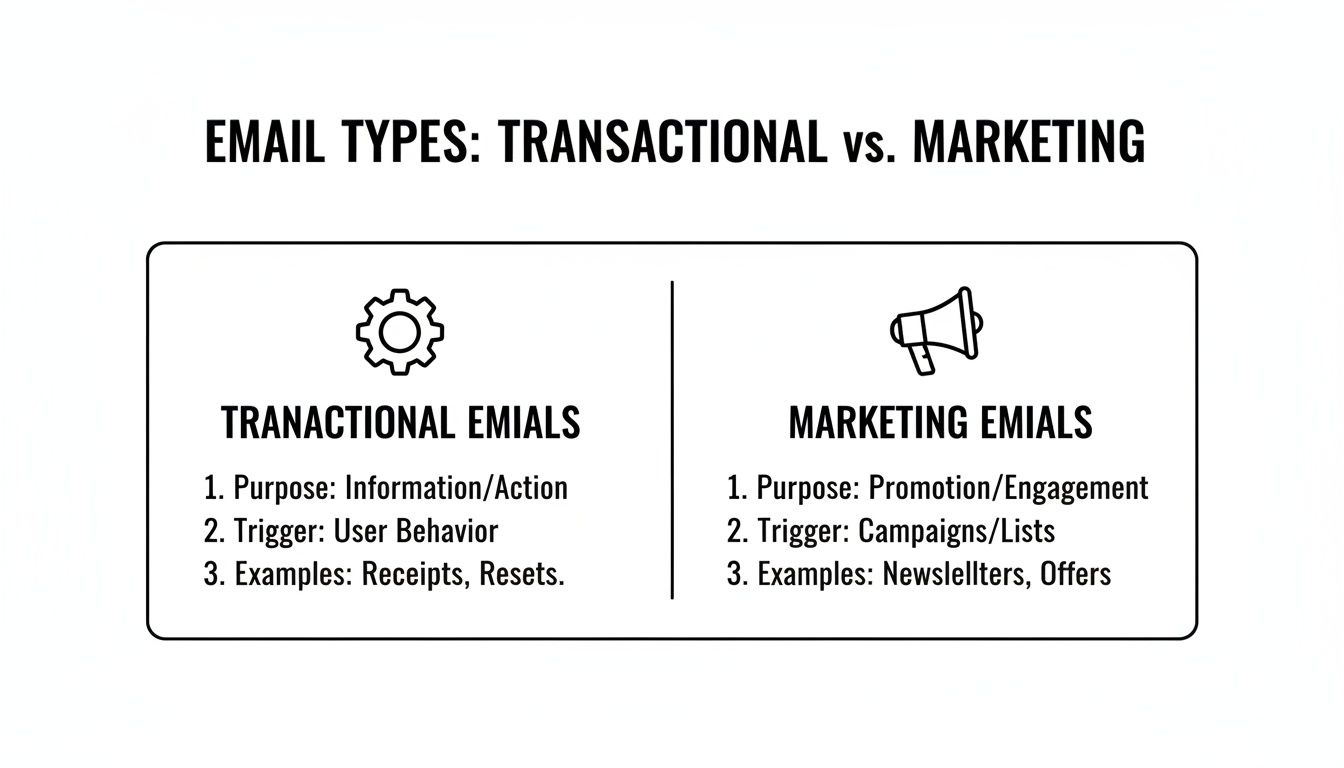
As you can see, transactional emails are all about function, triggered one-by-one based on what a user does. Marketing emails are promotional and are sent out from the business to many people at once.
Transactional vs Marketing Emails At a Glance
Getting a firm grasp on these differences is the first step to building an email program that actually works. Each email has a specific job to do, and a common mistake is treating them the same, which can lead to bad engagement, legal headaches, and a trashed sender score.
Here’s a quick summary table to lay out the key distinctions before we get into the nitty-gritty of each.
| Attribute | Transactional Emails | Marketing Emails |
|---|---|---|
| Primary Purpose | To inform or confirm a process the user started. | To promote, persuade, or build a relationship to drive sales. |
| Trigger | A specific user action (e.g., a purchase, sign-up, or password request). | A business-defined schedule or segment (e.g., weekly newsletter, flash sale). |
| Recipient Expectation | High. The user is actively waiting for this email to arrive. | Varies. The user opted in but isn’t expecting every single message. |
| Legal Basis (CAN-SPAM) | Mostly informational, so it’s exempt from many marketing rules. | Requires explicit consent (opt-in) and an obvious unsubscribe link. |
This foundational knowledge is what lets you build a strategy where both email types support each other. When they work in harmony, they create a customer journey that feels seamless, helpful, and effective.
Purpose and Triggers: What Kicks Off Each Email?
The real difference between transactional and marketing emails comes down to a simple question: who started the conversation? One type of email is a direct reply to something your user just did, while the other is you reaching out to start a new conversation. Getting this distinction right is the foundation of an email strategy that feels helpful instead of intrusive.
Transactional emails are purely reactive. Think of them as automated, one-to-one messages sent because a user took a specific action. Their job is functional—to deliver information or confirm a process the user is actively waiting for.
Transactional Email Triggers: The User Is in Control
These emails are the nuts and bolts of your operation, making sure the user experience is seamless and clear. Because the user’s own action triggers them, these messages are highly anticipated and immediately relevant.
Common triggers for transactional emails include:
- Account Management: A user signs up, asks for a password reset, or gets a security alert about a login from a new device.
- E-commerce Actions: A customer completes a purchase, their order ships, or they get an electronic receipt.
- User Requests: Someone downloads their data, requests a magic login link, or confirms a booking they just made.
The goal here is pure utility. A person waiting for a password reset email isn’t just hoping it arrives; they need it to move forward. This sense of necessity is why these emails have such high open rates.
These messages are critical for building trust. They reliably deliver essential information at the exact moment it’s needed. For a deeper dive into making these messages work for you, check out our guide on https://truelist.io/blog/transactional-email-best-practices.
Marketing Email Triggers: The Business Makes the First Move
Marketing emails, on the other hand, are proactive. Their purpose is to drive growth by nurturing leads, promoting products, and keeping your brand top-of-mind. The triggers aren’t based on a single user’s immediate need but on a broader business strategy. To really dial in this approach, it’s worth exploring different email follow-up automation strategies.
Essentially, marketing emails are sent from a one-to-many perspective, targeting segments of your audience with content designed to persuade or inform.
Marketing email triggers are usually based on:
- Timed Campaigns: Your weekly newsletter, a Black Friday sale, or an announcement about a new feature.
- Behavioral Segments: A user who hasn’t purchased in 90 days gets a “we miss you” offer, or a subscriber who browsed a specific product category gets an email with related items.
- Business Goals: A company-wide push to promote a new service or drive registrations for an upcoming webinar.
While transactional emails fulfill a user’s request, marketing emails work to create one. They keep your brand relevant and gently guide subscribers toward an action you want them to take, whether that’s making a purchase or reading your latest blog post.
This is where you build long-term relationships and customer value. It’s a different game entirely, but a crucial one. A 2023 analysis from Attentive shows that while transactional emails get more engagement per message, it’s the marketing list—which makes up over 80% of most brands’ subscribers—that fuels sustained growth and repeat business.
The distinction couldn’t be clearer. Transactional emails are a direct consequence of user behavior, serving a functional purpose. Marketing emails are a deliberate business action, serving a strategic one. You need both, but mastering their unique triggers is what separates a good email program from a great one.
How to Measure Performance and Set Realistic Expectations
When it comes to your email program, you can’t measure everything by the same yardstick. Transactional and marketing emails have completely different jobs, so their performance metrics tell very different stories. Trying to compare them directly is like judging a sprinter and a marathon runner on the same criteria—both are running, but their goals and what defines a “good” performance are worlds apart.
Setting the right expectations for each type of email is the first step to understanding what’s really working.
Gauging the Success of Transactional Emails
Transactional emails are all about utility. Your customers are waiting for them—think password resets, order confirmations, or shipping notifications. Because of this, their engagement metrics should be through the roof. Success here isn’t about persuasion; it’s about pure reliability and speed.
Low performance for a transactional email almost always points to a technical glitch, not a content problem. A slow or failed delivery could mean you have a server issue or, worse, a damaged sender reputation.
Here’s what you should be watching:
- Open Rate: These should be exceptionally high, often hitting 40-60% or more. If your password reset email has a low open rate, you’ve got a serious deliverability problem on your hands.
- Click-Through Rate (CTR): When there’s a button to click—like “Track Your Package”—the CTR will naturally be high. The user has a genuine need to take that action.
- Delivery Speed: This is non-negotiable. An email with a two-factor authentication code needs to land in the inbox in seconds, not minutes. Anything less is a failure.
Think of it this way: The consistently high engagement on your transactional emails sends a powerful message to ISPs like Gmail and Outlook. It tells them you’re a trustworthy sender. This positive reputation gives a direct boost to your marketing email deliverability, making transactional performance the foundation of your entire email strategy.
What Success Looks Like for Marketing Emails
Marketing emails, on the other hand, are judged by a much broader set of business goals. The aim is to build relationships, drive sales, and grow your audience over time. You’re not just looking for opens and clicks; you need to see a real impact on your bottom line.
The story of a marketing email’s performance is told through a different lens:
- Conversion Rate: This is the big one. Did the email actually lead to a purchase, a download, or a sign-up?
- List Growth Rate: Are you bringing in more new subscribers than you’re losing? A healthy list growth rate is a clear sign that your content is hitting the mark.
- Unsubscribe Rate: Some people will always leave, and that’s okay. But if you see a sudden spike in unsubscribes after a campaign, it’s a warning that something is off with your content, frequency, or targeting.
- Revenue Per Email (RPE): For any e-commerce business, this metric is gold. Tracking how much revenue each email generates gives you undeniable proof of your ROI.
When you look at the raw numbers, transactional emails will always seem to perform better. For example, their click-through rates often top 5%, while a good marketing campaign might hover somewhere between 2-5%. This gap isn’t a sign of failure; it’s a reflection of user intent. One is a critical tool, the other is a welcome conversation. You can always explore more benchmarks to see how your own campaigns measure up.
Expected Performance Benchmarks by Email Type
Because their purposes are so distinct, you can’t hold both email types to the same standard. A 25% open rate would be fantastic for a weekly newsletter but a total disaster for an order confirmation. The context is everything.
To help you set some realistic goals, here’s a look at what you can generally expect from each type of email.
| Metric | Transactional Email Benchmark | Marketing Email Benchmark |
|---|---|---|
| Open Rate | 40% – 80%+ | 15% – 25% |
| Click-Through Rate | 5% – 20% | 2% – 5% |
| Conversion Rate | Not a primary metric | 1% – 5% |
| Unsubscribe Rate | less than 0.1% | less than 0.5% |
These numbers are a starting point. The key is to ask the right questions. For transactional emails, the question is: “Did my user get what they needed, instantly and without friction?” For marketing emails, it’s: “Did this campaign move the subscriber closer to our business goals?” Answering these two questions separately is how you build a powerful and truly effective email program.
Why Your Sender Reputation Is Your Most Important Asset
You might think of transactional and marketing emails as two separate worlds, but to Internet Service Providers (ISPs) like Gmail and Outlook, they all come from one place: your domain. Every single email, whether it’s a password reset or a flash sale announcement, is tied to that domain. This means they’re all judged together, building a single, unified sender reputation that decides if you land in the inbox or get lost in the spam folder.
Think of it like a credit score for your email program. When your eagerly awaited transactional emails get high open rates, your score goes up. But when you send emails to invalid addresses and they bounce, your score takes a serious hit. This connection is probably the most overlooked part of the transactional vs. marketing email relationship, and it’s where a lot of businesses accidentally shoot themselves in the foot.
The “Transactional Contamination” Problem
So, where does it all go wrong? It usually starts at the very beginning—the moment a user signs up. Someone creates an account or buys something, triggering a transactional email. But what if they mistype their address (user@gmial.com) or just make one up? That crucial first email bounces, sending an immediate negative signal to ISPs.
When this happens over and over, ISPs start to see your domain as a source of sloppy, low-quality mail.
Your sender reputation is indivisible. A high bounce rate on your transactional emails directly poisons the well for your marketing campaigns. ISPs don’t care about the type of email; they just see a domain sending unwanted messages and start filtering everything from you more aggressively.
This sets off a devastating domino effect. All the trust and high engagement you build with legitimate transactional emails gets completely wiped out by bounces from the bad ones. As a result, your beautifully crafted marketing campaigns, sent from the exact same domain, have a much higher chance of being flagged as spam before anyone even has a chance to see them.
How Bounces Quietly Destroy Your Email Strategy
Every hard bounce is a big red flag for email providers. It screams, “This sender doesn’t keep a clean, permission-based list!” This is especially bad for transactional sends because they’re often the first email you ever send to a user and they happen in huge volumes. A leaky signup form can quickly flood your system with bad data, creating a steady stream of bounces that slowly chips away at your domain’s credibility.
Fragmented systems often make this problem even worse. High bounce rates from invalid emails in your transactional system can tank your marketing campaigns because of that shared domain reputation. We’ve seen poor hygiene cause 20-30% drops in deliverability across the board. The experts at Mailjet point out that when transactional platforms repeatedly send to dead addresses without proper list cleaning, they can get the entire domain blacklisted. Your marketing masterpieces end up going straight to spam. You can dig deeper into how fragmented systems amplify this issue and see additional insights from Mailjet’s analysis.
This all points to one critical truth: you can’t have a healthy marketing email strategy without a healthy transactional email system. They’re two sides of the same coin, held together by your domain’s reputation.
The Simple Fix: Validate Everything Upfront
The only real way to defend your reputation is to stop bad email addresses from ever getting into your system in the first place. This is where proactive email validation becomes non-negotiable.
By putting real-time validation on your signup forms, checkout pages, and anywhere else you collect an email, you create an instant shield for your sender reputation.
- For Transactional Emails: This ensures critical messages like receipts and password resets actually get delivered. No bounces mean a stronger reputation with every single send.
- For Marketing Emails: This protects their path to the inbox. A high sender score means your promotional campaigns reach real, engaged subscribers, which is what drives ROI.
Validating every email at the point of entry is like treating the cause instead of the symptom. It’s a single action that reinforces the shared foundation of your entire email program, allowing both your transactional and marketing emails to do their jobs effectively. You stop trying to patch a leaky bucket and start building a fortified, reliable communication channel.
Navigating Legal Compliance Under GDPR and CAN-SPAM
Understanding the legal landscape isn’t just a box to check—it’s foundational to any good email strategy. The rules for transactional and marketing emails are worlds apart, and for good reason. Regulations like the CAN-SPAM Act in the U.S. and Europe’s GDPR were created to protect people from getting spammed, and getting this wrong can cost you. We’re not just talking about hefty fines; we’re talking about eroding the customer trust you’ve worked so hard to build.

From a legal standpoint, the entire distinction boils down to a single, powerful word: consent. Marketing emails are proactive, promotional messages that absolutely require explicit, provable consent before you hit send. Transactional emails, on the other hand, are seen as a direct and necessary part of a service the user has already initiated.
Marketing Emails: The Demand for Strict Opt-Ins
When it comes to your marketing messages, the user must always be in the driver’s seat. Laws like GDPR are especially strict here, requiring consent to be freely given, specific, informed, and unambiguous. That means you can forget about pre-checked boxes or burying consent language deep within your terms of service.
Here are the non-negotiables for marketing emails:
- Explicit Consent: Your user must actively agree—opt-in—to get promotional content. This is the heart of permission-based marketing.
- Clear Unsubscribe Link: Every single marketing email needs a prominent and simple way for users to opt-out. You have to honor these requests quickly, too.
- Accurate Sender Information: The “From” name and the physical address of your business must be clearly stated in the email.
Dropping the ball on this isn’t a small mistake. Under GDPR, penalties can climb as high as 4% of a company’s global annual revenue. If you need a deeper dive, we cover the specifics of GDPR email compliance in our dedicated article.
Transactional Emails: Implied Consent and Primary Purpose
Transactional emails get to play by a different set of rules because their primary purpose is informational, not commercial. When someone buys something from your site, they have a reasonable expectation of getting a receipt and shipping updates. Their action—the purchase—implies consent for you to send communications directly related to that transaction.
Because of this, transactional emails are largely exempt from the strict opt-in requirements that govern marketing. But this exemption comes with a huge string attached.
The primary purpose of the message must be transactional. If the email’s main goal shifts to advertising or promoting a product, it legally morphs into a marketing email and has to follow all the corresponding rules—including prior consent and an unsubscribe link.
This creates a bit of a gray area for anyone looking to add a little promotional flair to their transactional sends.
The 80/20 Rule for Hybrid Emails
So, can you pop a coupon into an order confirmation? The short answer is yes, but you have to be smart about it. The go-to industry practice is to stick to the 80/20 rule: at least 80% of the email’s content should be the core transactional information, leaving no more than 20% for anything promotional.
Think about an order confirmation. The order summary, shipping details, and tracking link are the transactional heart of the email. Adding a small banner at the bottom with “You might also like…” or a discount on a future order is usually fine. But the moment that promotional content starts to overshadow the order details, you’re wandering into dangerous territory and risk violating anti-spam laws. The email’s subject line and overall focus must scream “transactional” to keep you compliant and, just as importantly, to keep your customer’s trust.
Integrating Email Validation for Flawless Operations
Protecting your sender reputation isn’t just a defensive tactic; it’s the bedrock of a healthy email program. A solid validation process is what allows both your transactional and marketing emails to hit their mark, every single time. The real secret is knowing when and where to apply the right kind of validation along the customer journey.
This means shifting your mindset from one-off list cleanups to a continuous, automated hygiene practice. For marketing teams, this discipline directly translates to better ROI. For developers, it means automating a critical part of list maintenance and preventing deliverability problems before they can even start.
Real-Time Validation for Transactional Integrity
The single most important time to check an email address is the moment someone gives it to you. By plugging a real-time validation API directly into your signup forms, checkout pages, or account creation fields, you build a frontline defense against bad data.
When a user types in their email, the API gives it an instant checkup—looking for typos, syntax mistakes, or fake domains—before it ever touches your database. This is non-negotiable for transactional sends. It ensures your most critical messages, like order confirmations, password resets, and shipping updates, actually land in a real inbox. This simple step stops the hard bounces that can tank your sender score.
Bulk Validation for Marketing Campaign Success
For the marketing lists you’ve already built, bulk validation is your go-to tool for maintenance and pre-flight checks. Before you hit “send” on a big promotion or your next newsletter, running that list through a bulk validation service is a must-do.
This process acts like a deep clean for your database, finding and flagging all the hidden problems:
- Invalid or inactive addresses that are guaranteed to cause a hard bounce.
- Disposable email addresses that offer no long-term engagement value.
- Spam-trap addresses that ISPs use to identify and blacklist senders.
Cleaning out these toxic contacts is the fastest way to boost your campaign’s deliverability and make sure your carefully crafted message actually reaches people who want to see it. For a deeper look at this process, you can read our guide on how to validate an email list correctly.
Email validation isn’t just about cleaning lists. It’s about giving every single email—whether it’s a critical receipt or a new promotion—the absolute best chance of reaching its destination and doing its job. This unified approach protects your reputation and powers your results.
Of course, keeping your lists clean is only half the battle; staying on the right side of email regulations like GDPR and CAN-SPAM is just as important. Having access to the right information is key. Using the best legal research tools can help you grasp the details of these laws, ensuring your sending practices are always compliant. A proactive stance on both list hygiene and legal compliance is what separates the amateurs from the pros.
Frequently Asked Questions

Even after you’ve got a handle on the differences between transactional and marketing emails, some practical questions always seem to pop up. Let’s tackle a few of the most common ones so you can put these ideas into practice.
Can I Put Marketing Content in a Transactional Email?
Technically, yes, but you have to walk a very fine line. The email’s main job must be transactional. An order confirmation, for instance, has to focus squarely on confirming the order details first.
Once that’s covered, you can sprinkle in secondary marketing content, like a small section with related product recommendations or a discount code for their next purchase. A good rule of thumb is the 80/20 rule: keep at least 80% of the email focused on the transaction, leaving no more than 20% for anything promotional. If the marketing message starts to take over, you risk violating laws like the CAN-SPAM Act and, just as importantly, eroding customer trust.
The key is subtlety and relevance. The moment a promotional offer overshadows the core transactional information, you’ve crossed a line that can harm both your compliance and your customer relationships.
Do I Need Separate Services for Each Email Type?
It’s a smart move and a common industry practice. Many companies use a specialized service like Postmark for transactional emails because of its speed and reliability, alongside a marketing platform like Mailchimp for building campaigns and automations. This approach helps ensure your most critical messages get delivered instantly without delay.
What really matters, though, is that both services send from the same authenticated domain. This way, the high engagement from your transactional emails helps build a strong sender reputation that gives your marketing emails a boost. No matter your setup, the non-negotiable step is validating every single email address before it enters either system to protect that shared reputation.
How Does Email Validation Help Both Email Types?
Think of email validation as the foundation that supports your entire email program. It protects both your transactional and marketing efforts at the same time.
For Transactional Emails: Real-time validation at signup or checkout is a game-changer. It ensures critical messages like receipts and password resets can actually be delivered, which dramatically cuts down on the bounce rates that tank your sender reputation.
For Marketing Emails: Regularly scrubbing your marketing lists with a bulk validation tool gets rid of invalid, risky, and dormant addresses. This one action directly improves deliverability, pumps up your engagement metrics, and drives a better ROI on every campaign.
Since both email streams flow from the same sender reputation, keeping your transactional sends pristine directly protects and improves the performance of your marketing strategy.
A clean, validated email list is the bedrock of any successful email strategy. Truelist.io offers accurate email validation to ensure your transactional and marketing emails always reach their target. Protect your sender reputation and maximize your ROI by signing up at https://truelist.io today.