 Claude
 Perplexity

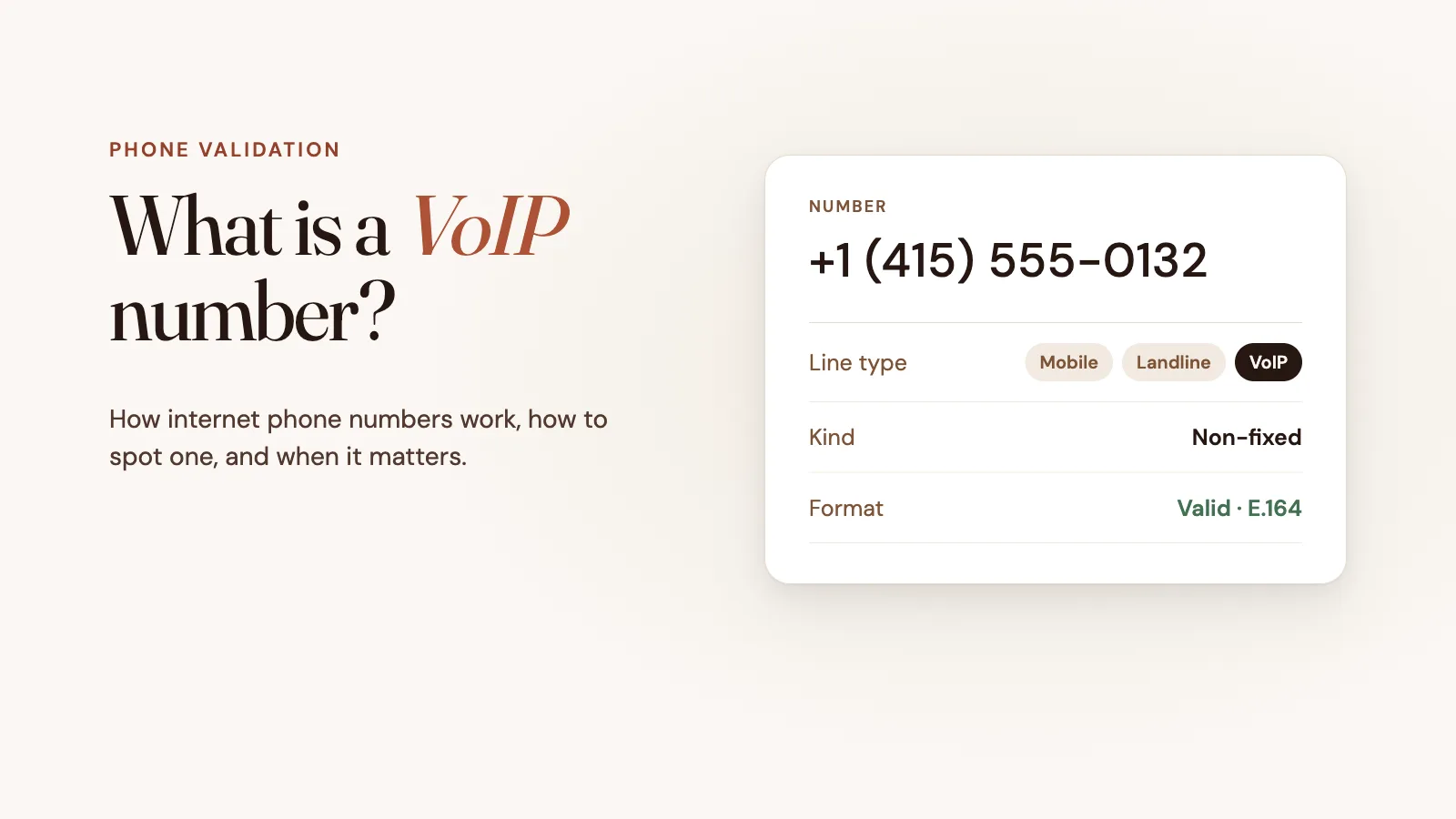
What Is a VoIP Number? How It Works and How to Spot One
A VoIP number runs over the internet instead of a phone line. Learn fixed vs non-fixed VoIP, why you can't spot one from the digits, and how to look one up.
TL;DR: A VoIP number is a phone number that runs over the internet instead of a copper line or a cell tower. Fixed VoIP numbers are tied to a street address. Non-fixed ones (cloud phone systems, Google Voice, TextNow and similar apps) aren't, and some can be created in minutes. You can't tell them apart by looking at the digits. You need a carrier lookup.
A VoIP number is a regular-looking phone number that is delivered over the internet. VoIP stands for Voice over Internet Protocol: instead of travelling over a copper landline or a mobile network, the call is turned into data packets and sent across the internet to an app, a desk phone or a softphone.
From the outside, a VoIP number looks like any other number. In the US and Canada it has the same 10 digits (area code plus seven) as a mobile or landline number. That’s what makes VoIP numbers easy to use and hard to spot.
How a VoIP number works
Every phone number is assigned to a carrier. With a landline or mobile number, that carrier also owns the physical line or the radio network that reaches your phone. With a VoIP number, the carrier only routes the number. The last step happens over whatever internet connection you have.
When someone calls a VoIP number:
- The call is routed through the phone network to the carrier that holds the number, like any other call.
- A gateway on that network converts the call into internet data (usually SIP and RTP packets).
- The packets travel over the internet to the device or app signed in to that number.
- Your reply goes back the same way and becomes a normal call again on the other side.
Because nothing ties the number to a building or a SIM card, one VoIP number can ring a mobile app, a browser and an office desk phone at the same time, in different cities.
Fixed vs non-fixed VoIP numbers
Not all VoIP numbers are the same. The distinction that matters most is whether the number is tied to a physical address.
| Fixed VoIP | Non-fixed VoIP | |
|---|---|---|
| Tied to an address | Yes, a registered service address | No |
| How you get one | A home or business phone plan from a provider such as a cable company | An app or online account, often in minutes |
| Typical users | Households and offices replacing landlines | Cloud phone systems, second-line apps and throwaway numbers |
| Risk signal | Low, behaves much like a landline | Mixed: anything from a sales rep’s line to a burner |
Fixed VoIP behaves like a landline: one number, one registered location.
Non-fixed VoIP covers a wide range. Many cloud business phone systems (the softphones sales and support teams use) show up as non-fixed, because their numbers aren’t tied to one building. So do consumer apps like Google Voice and TextNow. Google Voice asks you to verify an existing US phone number first, but other second-number and “burner” apps ask for much less. That makes non-fixed VoIP the cheapest way to get many numbers, which is why it shows up so often in fake sign-ups and promo abuse.
Can you tell if a number is VoIP just by looking at it?
Mostly, no. In the US and Canada, VoIP numbers use the same area codes and number ranges as landlines and mobiles. Numbers can also be ported: someone can move a mobile number to a VoIP provider and keep every digit. A number that started life on a cell network in 2012 may be a VoIP line today.
A few countries set aside special ranges for VoIP. In the UK, Ofcom allocated numbers starting with 056 to “location independent” services, and format libraries such as Google’s libphonenumber flag that range as VoIP. In practice, though, 056 numbers are rare: UK VoIP providers almost always hand out ordinary 01, 02 or 03 numbers. An offline format check can only spot VoIP in a dedicated range like that, so for most numbers in most countries the digits tell you nothing.
You can check the format, country and the line type implied by a number's range with the free Truelist phone validator. For US and Canadian numbers, the range alone can't separate VoIP from mobile, so treat that result as a first pass.
How to check if a number is VoIP (VoIP number lookup)
To find out whether a number is VoIP today, you need to ask the phone network, not the digits. That’s what a carrier lookup does. It queries number portability and carrier databases and returns:
- The current carrier: the company the number is assigned to right now, after any porting. Often that’s a wholesale carrier rather than the app brand: a Google Voice number, for example, typically comes back as the network operator behind it, not “Google”.
- The line type: mobile, landline, fixed VoIP, non-fixed VoIP or toll-free.
- Ported status: whether the number has moved between carriers (available for US and Canadian numbers).
For one number, a free carrier lookup site is enough. For a signup form, a CRM or a call list, you want the same check through an API or a bulk upload so it runs automatically. Truelist’s phone validation is built for that: you send a number and get back whether it’s valid, its standard E.164 format, its line type and its carrier.
Why VoIP numbers matter
A VoIP number isn’t bad on its own. What matters is what you’re using the number for.
Sign-up fraud and promo abuse
If you give away free trials, credits or discounts per account, non-fixed VoIP numbers are the cheapest way for one person to look like twenty. Phone verification only stops abuse if the number is hard to get. A number made in an app in two minutes isn’t.
What to do: treat non-fixed VoIP as a risk signal, not an automatic block. Add friction (a second check, a card on file, manual review) when the account unlocks something of value, and combine it with other signals such as a disposable email address. Blocking it outright will also turn away real buyers on cloud phone systems.
SMS delivery and two-factor codes
Many VoIP numbers can receive normal person-to-person texts, but some can’t receive messages from short codes, the 5–6 digit numbers many companies use for one-time passcodes. On top of that, many verification services and banks look up the line type themselves and refuse to send codes to VoIP numbers at all. Either way, a user on a VoIP number may never get the code and will blame your product.
What to do: know each number’s line type before you rely on it for SMS, and offer email or an authenticator app as a fallback.
Sales and outbound calling
For sales teams, line type tells you how to reach someone. A mobile number is usually a person. A fixed VoIP number is often a company switchboard or a desk line that rings a cloud phone system. A non-fixed VoIP number on a “decision maker” record is a sign that the contact data may be stale or made up.
Calling rules also depend on line type. In the US, the TCPA treats calls and texts to mobile numbers differently from landlines, and how VoIP numbers are classified depends on the service. Check your use case with counsel rather than assuming.
Data quality
If you buy or enrich lead lists, the share of non-fixed VoIP numbers is a quick quality check. A list where a large slice of “direct dials” turn out to be app numbers wasn’t built from real records.
VoIP vs landline vs mobile
| Landline | Mobile | VoIP | |
|---|---|---|---|
| How the call travels | Copper or fibre line to a building | Cell towers to a SIM | The internet to an app or device |
| Tied to | An address | A SIM card and a person | An account (and, for fixed VoIP, an address) |
| Can it move? | No | Moves with the person | Moves with the login |
| Short-code SMS | No (most can’t receive texts at all) | Yes | Often not |
| Emergency calls | Location known | Location estimated by the network | Registered address for fixed VoIP. Many free apps don’t support 911 at all |
Common questions about VoIP numbers
Is a VoIP number a real phone number?
Yes. A VoIP number is a real, dialable number in the public phone network. Anyone can call or text it from a normal phone. The difference is only in how the last part of the connection is delivered.
Is Google Voice a VoIP number?
Yes. Google Voice numbers are non-fixed VoIP numbers. They’re tied to a Google account rather than an address or a SIM card, and setting one up requires verifying an existing US phone number.
Can VoIP numbers receive texts?
Usually yes for messages from ordinary phone numbers. Many can’t receive texts from short codes, so verification codes sent that way may not arrive.
Should I block VoIP numbers at signup?
Usually not. Blocking every VoIP number, or even every non-fixed one, shuts out real businesses on cloud phone systems. A better rule is to add friction for non-fixed VoIP numbers when the account gets something worth abusing (free credits, a trial, a coupon), and to weigh it alongside other signals.
Is Wi-Fi calling the same as VoIP?
Not quite. Wi-Fi calling on your phone is your mobile carrier’s own service carried over Wi-Fi: it still uses your SIM and your mobile number, which stays a mobile number. A VoIP number is a separate number delivered by an internet phone service.
What’s the difference between a VoIP number and a virtual number?
The terms overlap. “Virtual number” usually means a number that forwards to another phone or app, which in practice almost always runs on VoIP. Not every VoIP number is virtual, though: a business desk phone on a cloud phone system is VoIP too.
How do I check if a number is VoIP?
Run a carrier lookup. It returns the number’s current carrier and line type, including whether it’s fixed or non-fixed VoIP. Checking the format alone isn’t enough, because VoIP numbers use the same ranges as other numbers and numbers can be ported.
The short version
A VoIP number is a phone number that lives on the internet instead of a wire or a SIM. Fixed VoIP behaves like a landline. Non-fixed VoIP covers everything from a sales team’s cloud phones to throwaway app numbers, which makes it a signal worth checking rather than a reason to block. You can’t spot either from the digits, so if line type matters to your signup flow, your SMS or your sales list, look it up.
Start with the free phone validator for format and country, and see Truelist phone validation for line type and carrier checks at scale.