 Claude
  Perplexity
The 12 Best Marketing Automation Software Platforms for 2026
Discover the best marketing automation software for 2026. A detailed review of 12 top platforms with pros, cons, pricing, and use cases to grow your business.
TL;DR: Discover the best marketing automation software for 2026. A detailed review of 12 top platforms with pros, cons, pricing, and use cases to grow your business.
Marketing automation is the engine that powers modern marketing strategies. From nurturing leads to engaging customers and proving ROI, the right platform can transform your business. But with hundreds of options, how do you find the best marketing automation software for your specific needs? This guide cuts through the noise. We have analyzed the top platforms, evaluating their core features, ideal use cases, and practical limitations.
This isn’t just a list of names; it’s a comprehensive resource designed for sales development representatives, cost-conscious marketers, and developers alike. We focus on the practical details that matter: implementation challenges, scalability potential, and honest assessments of where each tool shines or falls short. Before diving into specific platforms, it’s beneficial to understand the overarching benefits these tools offer, as detailed in this guide on the 8 Key Advantages of Marketing Automation for SMBs.
Whether you’re a startup managing high-volume email lists or an e-commerce brand optimizing transactional emails, this article will help you make a confident, strategic choice. We will explore platforms ranging from industry giants like HubSpot and Salesforce Marketing Cloud to specialized tools like Klaviyo and Customer.io.
Inside this detailed roundup, you’ll find:
- In-depth reviews of 12 top-tier marketing automation platforms.
- Use-case analysis to help you match software to your business goals.
- Pros and cons for a balanced perspective on each option.
- Direct links and screenshots for a clear look at each platform.
We also cover crucial evaluation criteria, such as integrations with email validation services like Truelist.io to protect your sender reputation and ensure high deliverability. Let’s find the software that will scale with your growth.
1. HubSpot Marketing Hub
HubSpot Marketing Hub is a comprehensive, all-in-one platform renowned for integrating powerful marketing automation with a native, user-friendly CRM. It stands out by offering a seamless experience, consolidating tools for email marketing, landing pages, ad management, social media, and analytics into a single interface. This makes it an ideal choice for teams seeking to unify their marketing and sales data without juggling multiple disconnected systems.
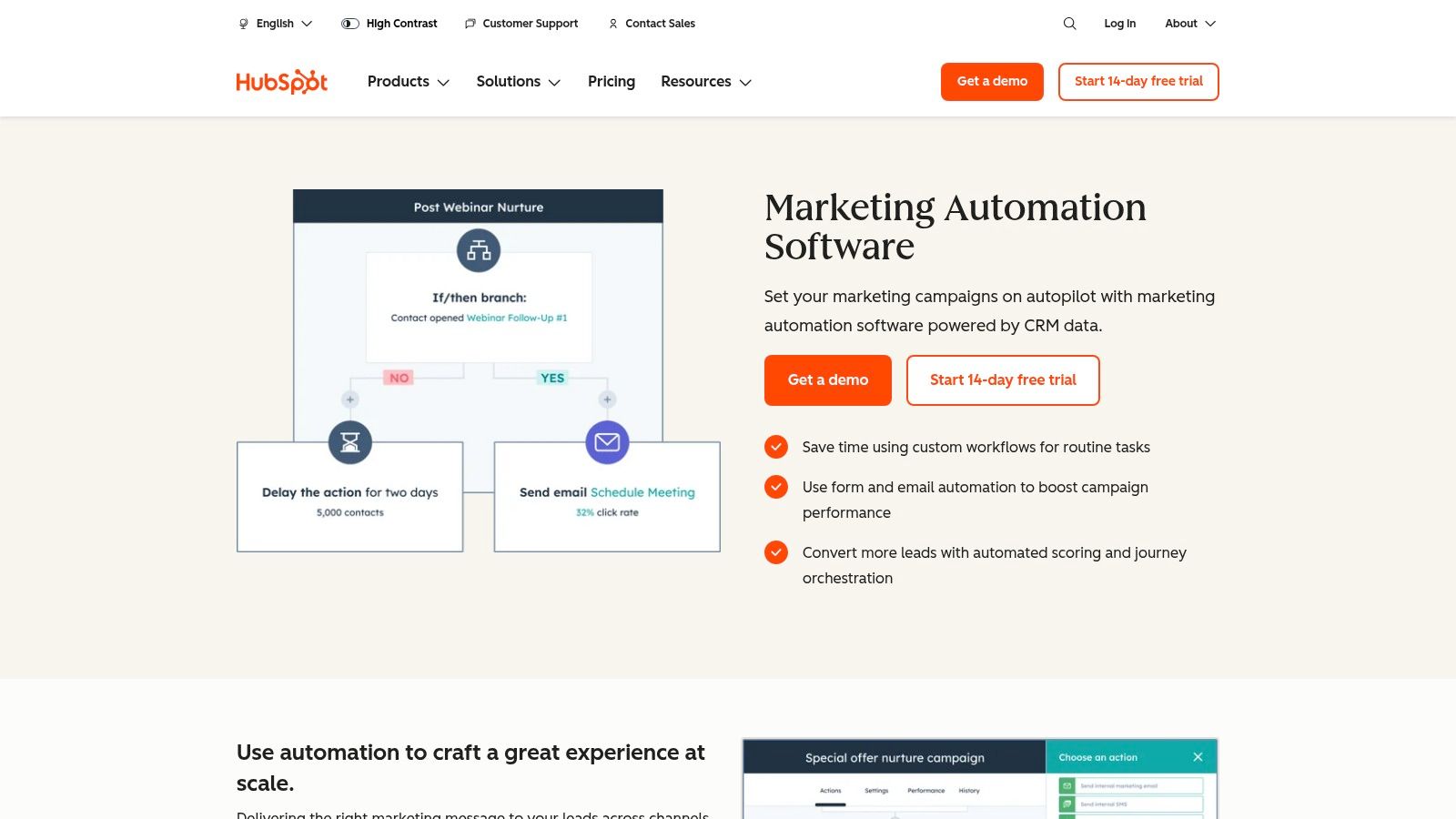
Its visual workflow builder is a core strength, allowing users to create complex, multi-step automation sequences using if/then logic, delays, and internal notifications with ease. For businesses focused on growth, HubSpot provides a clear, scalable path from a generous free tier to robust enterprise solutions, ensuring the platform can grow alongside your needs.
Key Strengths & Use Cases
- Best for: Businesses of all sizes looking for an integrated, all-in-one marketing and sales solution with a strong CRM backbone. It’s particularly effective for companies focused on inbound marketing strategies.
- Visual Workflows: Create sophisticated automation for lead nurturing, internal task assignments, and data management without needing to code.
- Native CRM Integration: All marketing actions are directly tied to contact records, providing a complete view of every interaction and enabling highly personalized campaigns.
- Education & Support: HubSpot Academy and its extensive partner network provide unparalleled resources for training and implementation.
Pricing & Limitations
Pricing is tiered and scales based on your number of marketing contacts and the feature set you require. While the free tools are excellent for startups, the Professional and Enterprise plans represent a significant investment, often including a mandatory onboarding fee. The platform’s vastness can also introduce complexity, requiring dedicated administration at higher tiers. To ensure you’re getting the most out of your spend, it’s crucial to maintain a clean contact list, which directly impacts your marketing automation ROI.
Website: https://www.hubspot.com/products/marketing/marketing-automation
2. Mailchimp
Mailchimp is one of the most recognizable names in email marketing, renowned for its user-friendly interface and approachable design. It serves as an excellent entry point into the world of marketing automation, particularly for small to mid-sized businesses that prioritize ease of use and rapid implementation. The platform excels at making core automation tasks, such as welcome series and abandoned cart emails, accessible to non-technical users through pre-built journeys and a vast template library.
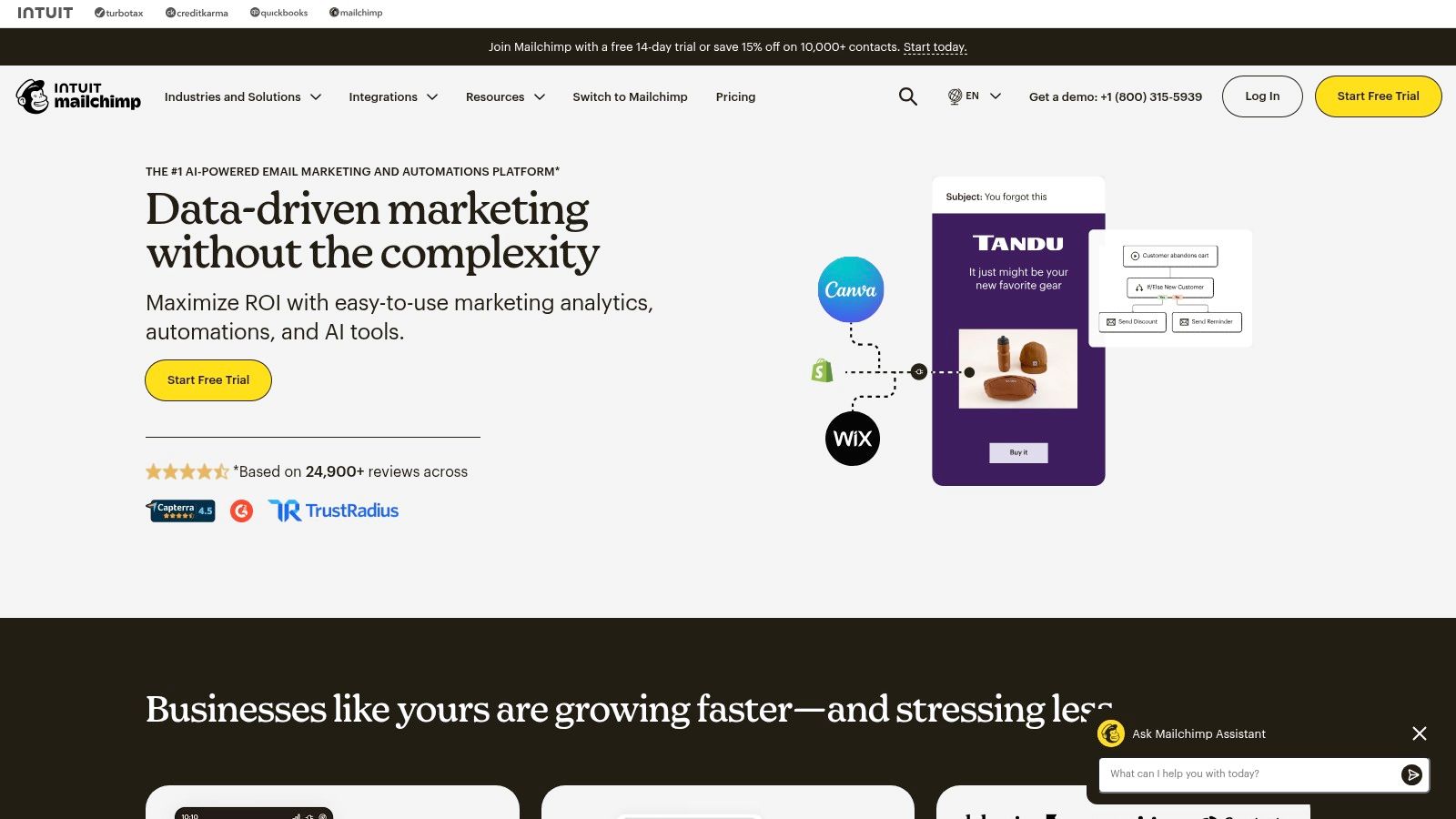
While it may not offer the multi-channel complexity of enterprise-level systems, Mailchimp provides a solid foundation with tools for email, SMS, landing pages, and forms. Its straightforward visual builder allows users to quickly set up linear automation paths based on triggers like opens, clicks, or purchases. This focus on simplicity makes it a top choice for teams needing effective, no-fuss automation without a steep learning curve or significant upfront investment.
Key Strengths & Use Cases
- Best for: Small businesses, e-commerce stores, and creators looking for an easy-to-use platform with strong email capabilities and straightforward automation.
- Pre-built Journeys: A large library of templates and pre-configured automation workflows helps users get started quickly with proven strategies.
- Flexible Billing: Offers both traditional monthly subscriptions and pay-as-you-go credit options, providing flexibility for inconsistent or seasonal senders.
- Strong Deliverability: Mailchimp has a strong reputation and provides tools to help mainstream senders maintain high deliverability rates.
Pricing & Limitations
Mailchimp’s pricing is tiered, starting with a free plan and scaling up based on contact count and feature access. While its entry-level plans are affordable, the cost can escalate quickly as your audience grows or you need more advanced features like A/B testing and predictive segmentation, which are reserved for higher tiers. The platform’s automation capabilities are less sophisticated than competitors, lacking complex conditional logic for truly dynamic journeys. To maximize deliverability and avoid extra costs from inactive subscribers, using an email address existence checker on new signups and running a periodic bulk email verification on your full list is highly recommended.
Website: https://mailchimp.com
3. ActiveCampaign
ActiveCampaign has carved out a powerful niche by combining advanced marketing automation and a light CRM with a focus on email marketing excellence. It excels by offering enterprise-grade automation capabilities at a price point accessible to small and mid-sized businesses. The platform is built around a highly flexible visual workflow builder that allows for sophisticated segmentation, goal tracking, and multichannel messaging across email, SMS, and site messages.
Its core differentiator is the depth of its automation logic. Users can create intricate sequences based on site/event tracking, lead scores, and e-commerce data, making it one of the best marketing automation software choices for businesses that need granular control over the customer journey. Features like predictive sending and a vast library of over 1,000 integrations further enhance its power, ensuring it connects seamlessly with your existing tech stack.
Key Strengths & Use Cases
- Best for: SMBs and e-commerce businesses needing robust, email-centric automation without the cost and complexity of an all-in-one suite. It’s ideal for users who prioritize powerful workflow logic.
- Visual Automation Builder: Design complex automations with split paths, goal tracking, and webhooks to manage everything from lead nurturing to customer onboarding.
- Multichannel Messaging: Engage contacts via email, SMS, and on-site messages from within a single automation workflow, creating a unified customer experience.
- Extensive Integrations: A massive app ecosystem, including deep integrations with Shopify, Salesforce, and WordPress, allows for easy data synchronization.
Pricing & Limitations
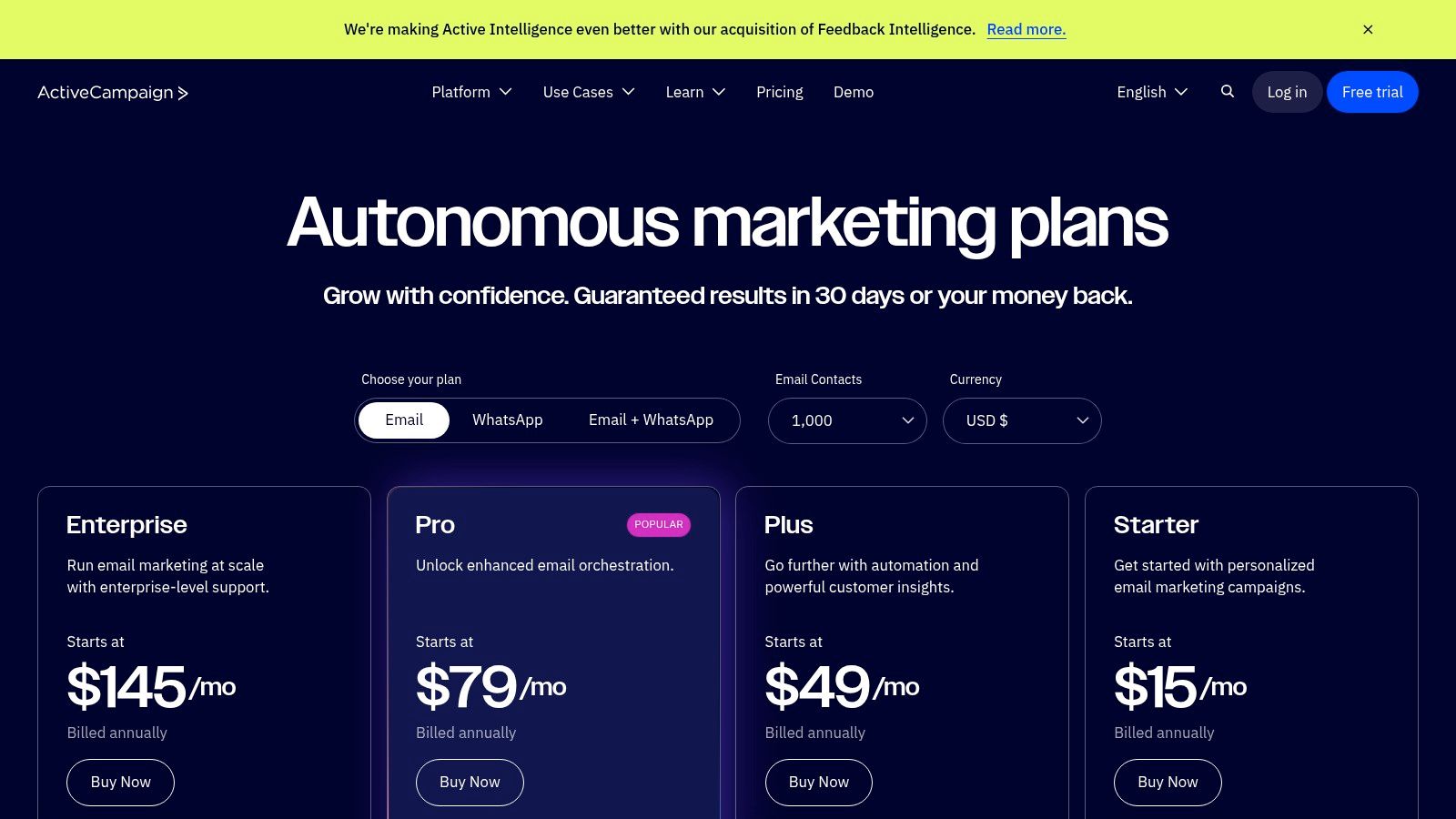
ActiveCampaign’s pricing is primarily based on the number of contacts, with different tiers unlocking more advanced features like split automations and predictive sending. The entry-level Marketing Lite plan offers significant automation power for its price. However, the exact cost can be less transparent as it relies on a calculator, and scaling to higher contact bands or needing enterprise features will increase the investment. The built-in CRM is functional but not as comprehensive as dedicated solutions like HubSpot.
Website: https://www.activecampaign.com/pricing
4. Klaviyo
Klaviyo has carved out a dominant position in the marketing automation space by focusing intently on ecommerce. It excels at leveraging deep, real-time data from platforms like Shopify, BigCommerce, and Magento to power highly personalized email and SMS campaigns. Unlike more generalist tools, Klaviyo is built from the ground up to understand and act on customer behavior such as products viewed, items added to a cart, and past purchase history. This makes it an indispensable tool for direct-to-consumer (DTC) brands aiming to drive revenue directly from their marketing efforts.
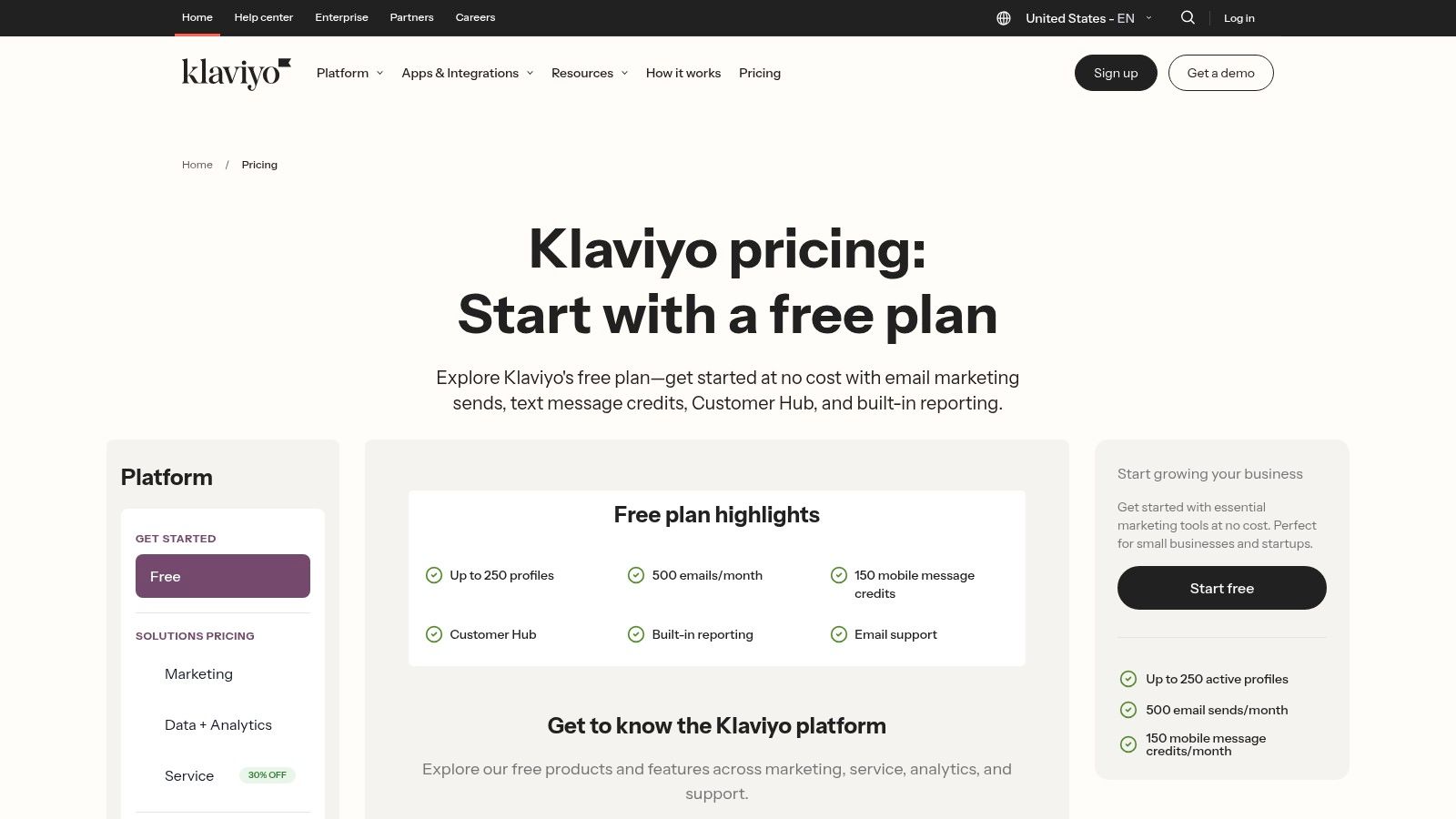
The platform’s strength lies in its pre-built, event-driven flows that are proven to convert. Automations for abandoned carts, browse abandonment, post-purchase follow-ups, and customer win-backs can be deployed quickly and are enhanced with powerful segmentation capabilities. This allows brands to create distinct experiences for first-time buyers versus loyal VIP customers, all within a unified interface that combines email and SMS for a cohesive communication strategy.
Key Strengths & Use Cases
- Best for: Ecommerce and direct-to-consumer (DTC) brands that need to translate customer data directly into sales. It is one of the best marketing automation software choices for stores on platforms like Shopify or BigCommerce.
- Event-Driven Flows: Trigger automations based on real-time customer actions, such as abandoning a cart, viewing a specific product, or completing a purchase.
- Deep Ecommerce Integration: Seamlessly syncs customer, order, and catalog data to enable hyper-specific segmentation and personalization that other platforms struggle to match.
- Unified Email & SMS: Manage and automate both channels from a single platform, creating cohesive lifecycle marketing campaigns with clear revenue attribution.
Pricing & Limitations
Klaviyo’s pricing is based on the number of email contacts and SMS credits you need. A free tier is available for up to 250 contacts, making it accessible for new stores. However, costs can scale quickly as your contact list and SMS sending volume grow. The platform delivers its highest value when connected to a supported ecommerce platform; businesses outside the retail or DTC space may find its feature set too narrowly focused and less cost-effective than other solutions.
Website: https://www.klaviyo.com/pricing/
5. Salesforce Marketing Cloud Account Engagement (formerly Pardot)
Salesforce Marketing Cloud Account Engagement, widely known by its former name Pardot, is a B2B marketing automation powerhouse designed for businesses deeply embedded in the Salesforce ecosystem. It excels at aligning marketing and sales teams by offering advanced lead management, intricate nurturing programs, and detailed ROI reporting directly within the Salesforce environment. This tight integration makes it a top choice for organizations that need to track complex, long sales cycles from initial engagement to close.
The platform’s strength lies in its Engagement Studio, a sophisticated journey builder that allows marketers to create dynamic, personalized paths for prospects based on their behavior, grade, and score. For enterprise teams, its governance features and customizable analytics provide the control and insight necessary to manage large-scale marketing operations and prove marketing’s impact on revenue. It is one of the best marketing automation software choices for existing Salesforce users.
Key Strengths & Use Cases
- Best for: Mid-market and enterprise B2B companies that use Salesforce Sales Cloud as their core CRM and require deep sales and marketing alignment.
- Deep Salesforce Integration: Natively connects with Salesforce objects, fields, and workflows, creating a single source of truth for all customer and prospect data. This is a key feature when comparing the best CRMs with email marketing capabilities.
- Advanced Lead Management: Utilizes robust scoring and grading models to qualify leads, ensuring sales teams focus their efforts on the most promising opportunities.
- B2B Marketing Analytics: Provides out-of-the-box dashboards and customizable reports to track campaign performance, pipeline influence, and marketing ROI.
Pricing & Limitations
Salesforce Account Engagement is priced for the enterprise and mid-market segments, with plans requiring an annual contract. The higher-tier plans unlock advanced features like B2B Marketing Analytics Plus and predictive lead scoring. The platform’s complexity and deep feature set often necessitate a significant implementation effort and dedicated administrator resources to manage effectively. This is not a tool for small businesses or those seeking a simple, plug-and-play solution.
Website: https://www.salesforce.com/products/marketing-cloud/pricing/b2b-marketing-automation/
6. Adobe Marketo Engage
Adobe Marketo Engage is a powerhouse enterprise-level platform designed for complex B2B marketing and sales cycles. It excels in delivering deep automation logic, robust account-based marketing (ABM) capabilities, and sophisticated revenue attribution. Marketo is built for large teams that require granular control over lead lifecycle management, smart campaigns, and multi-touch journey analytics, making it a top choice for organizations prioritizing deep integration and data-driven strategies.
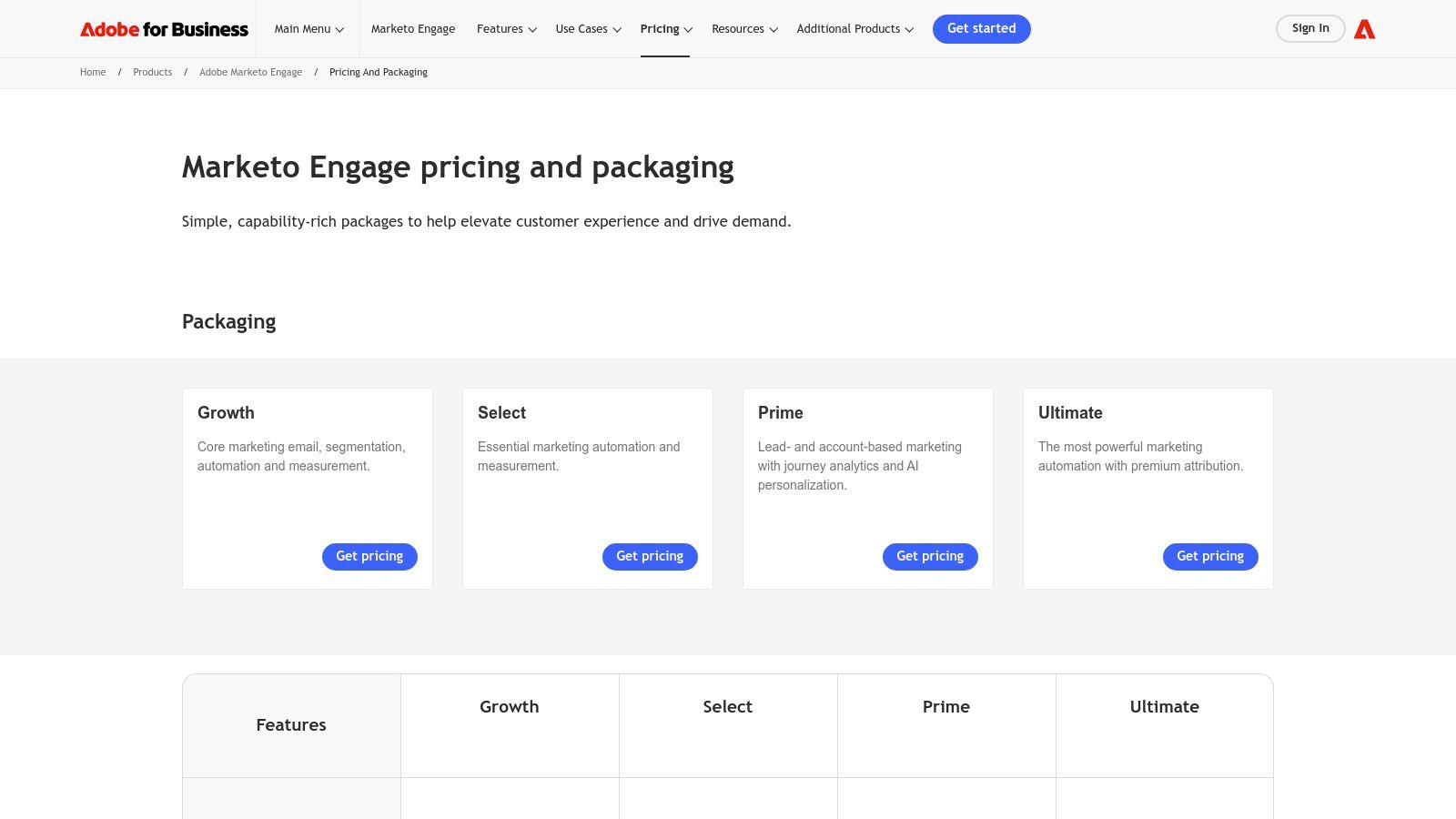
Its core strength lies in its flexibility and scalability, offering powerful native CRM integrations with Salesforce and Microsoft Dynamics. The platform allows marketers to build highly customized automation rules and use AI-powered features for advanced content personalization. For businesses that need to connect marketing efforts directly to revenue and manage intricate sales funnels, Marketo provides the depth and governance required for success.
Key Strengths & Use Cases
- Best for: Large B2B enterprises and marketing teams needing sophisticated automation logic, deep CRM integration, and advanced revenue attribution models.
- Flexible Automation: Create complex smart campaigns and lead lifecycle models that adapt to intricate buyer journeys and sales processes.
- Strong ABM Capabilities: Execute and measure account-based marketing strategies with tools built for targeting, engaging, and analyzing key accounts.
- Robust API & Integrations: A powerful API allows for extensive customization and seamless connection with a wide ecosystem of business tools.
Pricing & Limitations
Marketo Engage’s pricing is quote-based and tailored to specific business needs, positioning it as a premium investment. The platform’s extensive capabilities come with a significant learning curve, often requiring dedicated administrators or specialized expertise to unlock its full potential. While it is one of the best marketing automation software options for the enterprise market, its complexity and cost may be prohibitive for smaller businesses or teams seeking a more straightforward, out-of-the-box solution.
Website: https://business.adobe.com/products/marketo/pricing.html
7. Brevo (formerly Sendinblue)
Brevo, formerly known as Sendinblue, has established itself as a powerful all-in-one marketing platform that extends far beyond traditional email. It integrates email marketing, SMS, WhatsApp, chat, and a native CRM into a single, cohesive system. This makes it a standout choice for businesses aiming to manage multi-channel customer communication without the complexity and cost of multiple vendors, positioning it as some of the best marketing automation software for unified outreach.
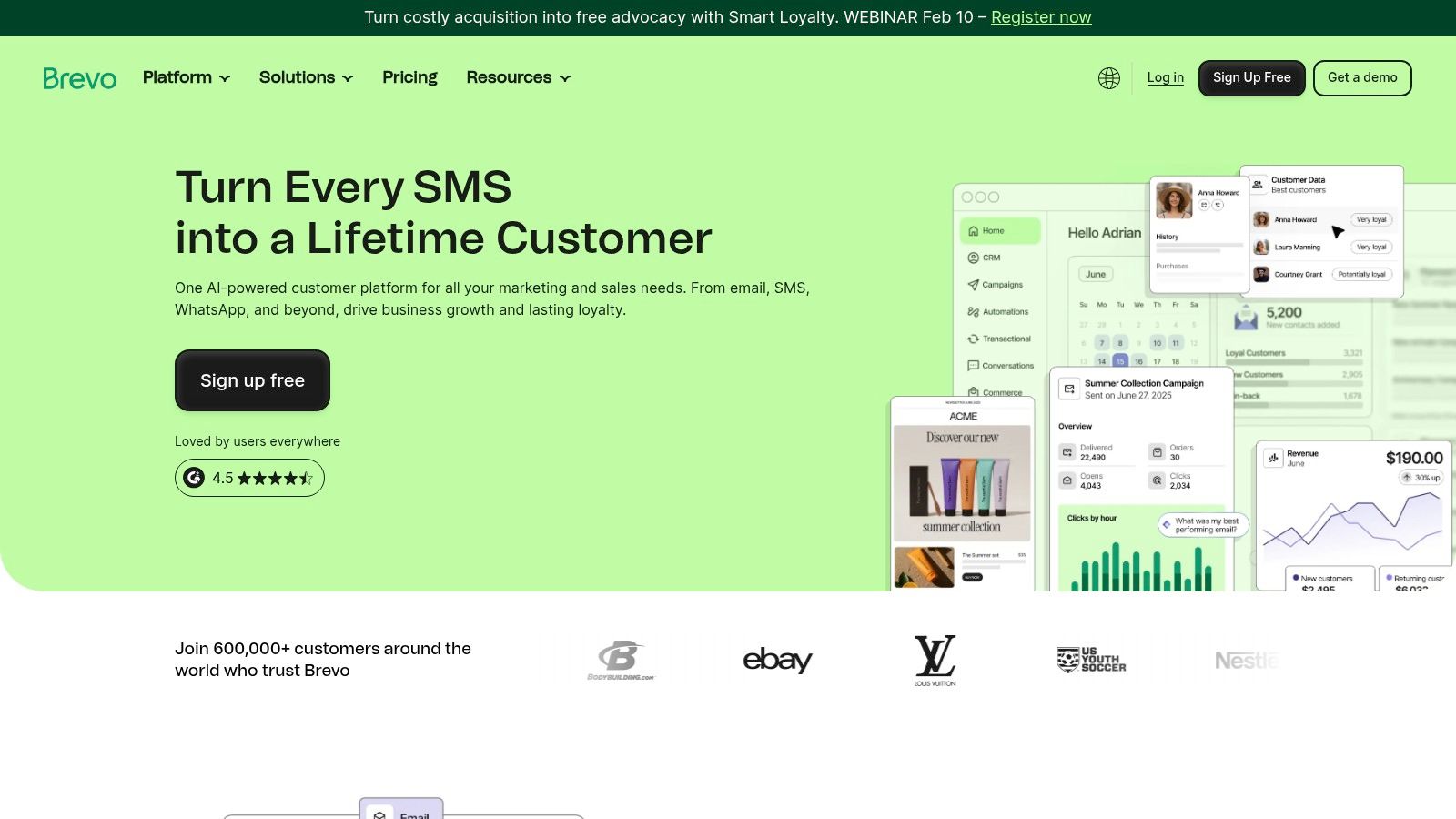
The platform’s visual automation builder allows users to design sophisticated workflows that engage contacts across different channels based on their behavior. Brevo’s strength lies in its ability to centralize diverse marketing activities, from transactional emails and push notifications to lead scoring and segmentation, all while maintaining an accessible and competitive pricing model.
Key Strengths & Use Cases
- Best for: Small to medium-sized businesses and e-commerce stores looking for an affordable, multi-channel marketing solution with robust automation capabilities.
- Unified Multi-Channel Campaigns: Seamlessly combine email, SMS, and WhatsApp messages within a single automation workflow for a comprehensive customer journey.
- Generous Free Tier: Brevo’s free plan is one of the most generous available, offering core automation features and up to 300 emails per day, making it ideal for startups.
- Transactional Messaging: Offers a reliable and scalable solution for sending transactional emails (like order confirmations and password resets), with options for a dedicated IP address.
Pricing & Limitations
Brevo’s pricing is highly competitive, starting with a free plan and scaling with affordable paid tiers based on email volume rather than contact count. This makes it budget-friendly for users with large lists but lower sending frequencies. However, while the core platform is rich in features, some advanced enterprise functionalities like SAML SSO are reserved for the highest-tier plans or are available as add-ons. Its user interface and integration ecosystem, while functional, may feel less extensive compared to larger, US-centric competitors.
Website: https://www.brevo.com
8. Omnisend
Omnisend is a highly focused marketing automation platform designed specifically for ecommerce businesses. It carves out its niche by deeply integrating with platforms like Shopify, WooCommerce, and BigCommerce, offering a unified solution for email, SMS, and push notifications. This sharp focus allows it to excel at ecommerce-specific challenges, providing pre-built workflows for cart abandonment, welcome series, and transactional messages that online stores can deploy in minutes.
The platform stands apart from general-purpose tools by building its features around the ecommerce customer lifecycle. Its segmentation capabilities are directly tied to shopping behavior, such as purchase history and on-site activity, enabling merchants to send highly relevant, product-focused campaigns. For stores wanting a powerful, multi-channel tool without the complexity of a broad-spectrum marketing automation software, Omnisend is an excellent fit.
Key Strengths & Use Cases
- Best for: Ecommerce stores, particularly on Shopify or WooCommerce, that need a fast, effective way to automate multi-channel marketing (email, SMS, push) without extensive setup.
- Pre-built Ecommerce Workflows: Launch proven automation sequences for cart recovery, customer win-back, and cross-selling almost instantly with ready-made templates.
- Unified Channel Messaging: Combine email, SMS, and web push notifications within a single automation workflow for a seamless and persistent customer experience.
- Ecommerce Segmentation: Utilize shopper data and product feeds to create dynamic segments for personalized promotions and product recommendations.
Pricing & Limitations
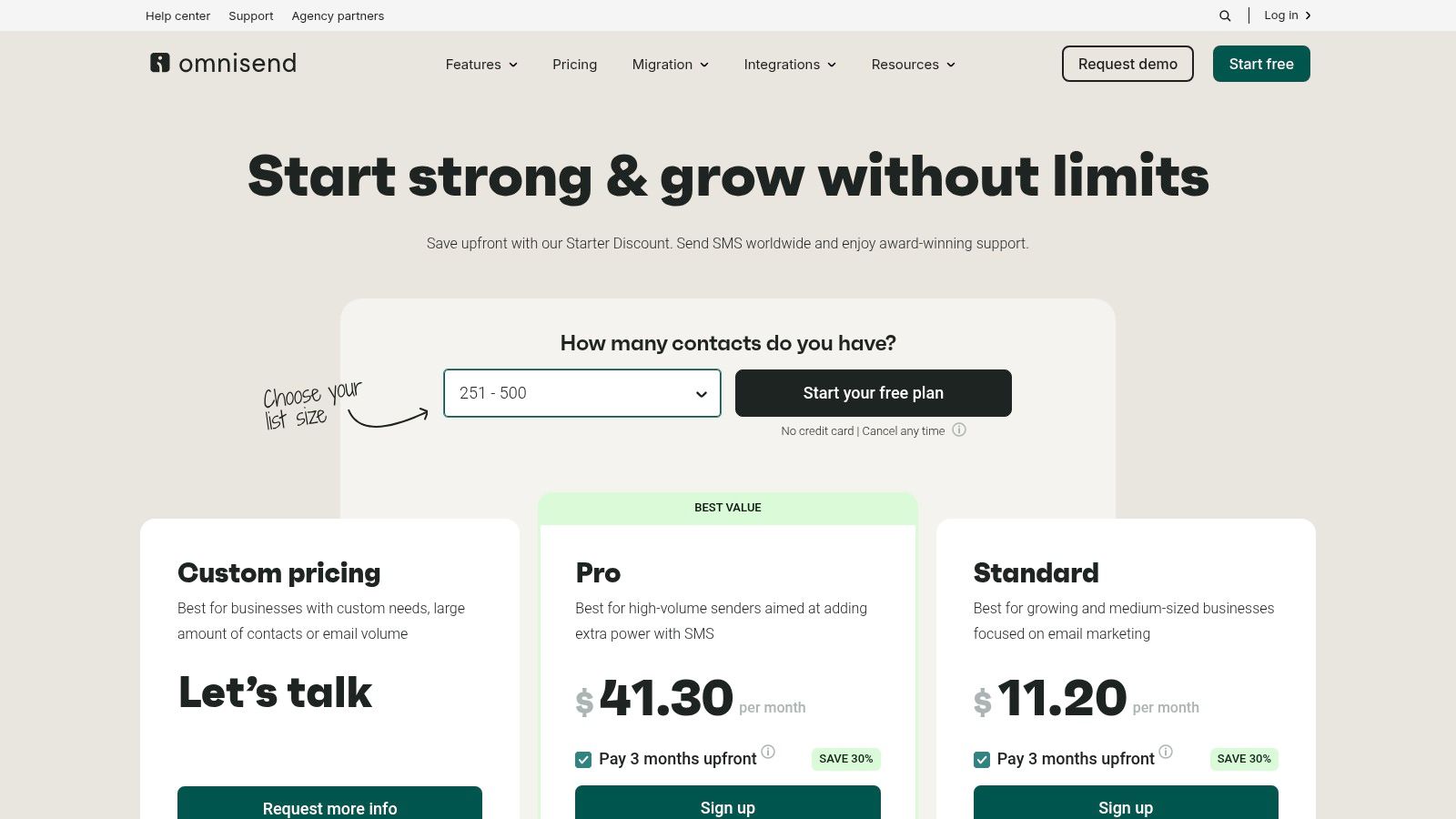
Omnisend offers a free plan for up to 250 contacts, making it accessible for new stores. Paid plans, Standard and Pro, scale based on contact list size and offer more advanced features like unlimited push notifications and advanced reporting. While the entry-level pricing is transparent, advanced reporting and dedicated customer support are reserved for the higher-tier Pro plan. Its primary limitation is its specialization; it is not designed as a general-purpose marketing automation platform for B2B, SaaS, or non-retail businesses.
Website: https://www.omnisend.com/pricing/
9. Drip
Drip is a powerful marketing automation platform built specifically for the unique needs of ecommerce brands. It distinguishes itself by deeply integrating customer and product data from stores on Shopify, WooCommerce, and BigCommerce to fuel highly personalized, revenue-focused automation. This focus makes it an exceptional choice for online retailers aiming to drive sales through targeted communication rather than generic broadcast emails.
The platform’s strength lies in its ability to translate store activity into actionable marketing triggers. Its visual workflow builder and pre-built playbooks for abandoned carts, post-purchase follow-ups, and win-back campaigns allow store owners to deploy sophisticated strategies quickly. By combining a clean user interface with robust revenue attribution dashboards, Drip provides clear insights into how marketing efforts directly impact the bottom line.
Key Strengths & Use Cases
- Best for: Ecommerce businesses that want to leverage deep customer and product data for advanced segmentation and revenue-driven email automation.
- Deep Ecommerce Integrations: Native connections with major platforms like Shopify pull in product catalogs, purchase history, and browsing behavior for precise targeting.
- Revenue-Focused Workflows: Utilize pre-built automation for abandoned carts, welcome series, and post-purchase nurturing designed to increase customer lifetime value.
- Visual Builder & Segmentation: Create complex automation flows and granular segments based on specific actions, like viewing a product or making a purchase, without needing technical skills.
Pricing & Limitations
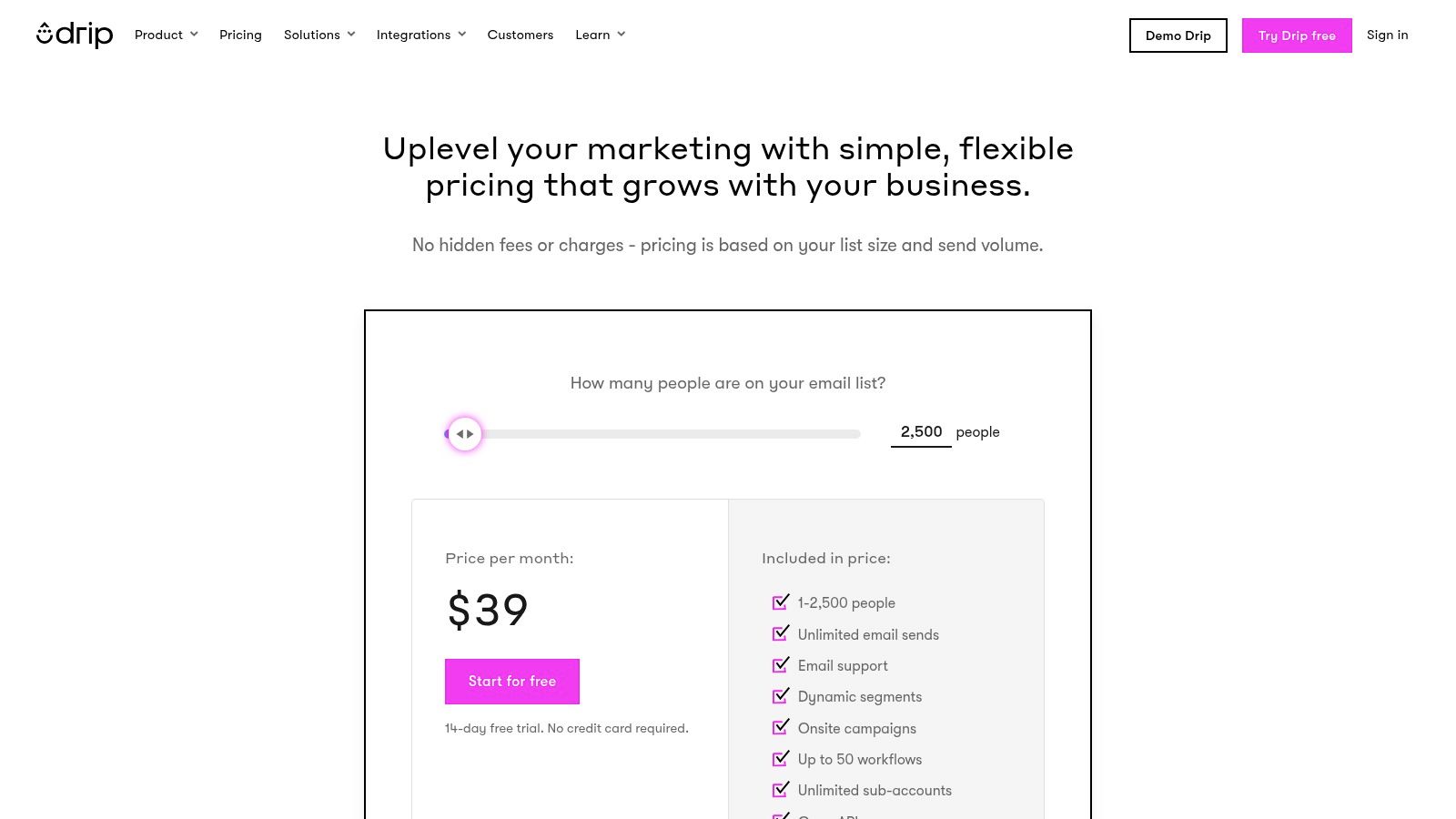
Drip’s pricing is entirely based on the number of contacts in your list, which you can calculate on their website. There are no distinct feature tiers, giving all users access to the full platform. However, this model means costs scale directly with list growth. A significant limitation is that live chat support is restricted to accounts that meet a certain monthly spending threshold, which could be a drawback for smaller businesses needing immediate assistance.
Website: https://www.drip.com/pricing
10. Customer.io
Customer.io is a powerful, event-driven messaging platform designed for product-led and SaaS businesses. It excels at leveraging real-time behavioral data to trigger hyper-relevant communications across multiple channels, including email, push notifications, in-app messages, and SMS. The platform’s strength lies in its flexible data model, which allows marketers to build sophisticated segments and automation workflows based on complex user actions and attributes within a product.
Unlike traditional marketing automation software that is often contact-centric, Customer.io is fundamentally event-centric. This makes it the ideal choice for businesses that need to automate messages based on what users do (or don’t do) in their app. Its visual workflow builder and multi-channel orchestration capabilities empower teams to create seamless onboarding sequences, feature adoption campaigns, and re-engagement journeys tied directly to the product experience.
Key Strengths & Use Cases
- Best for: SaaS, mobile app, and product-led companies that need to send automated messages based on real-time user behavior and complex data.
- Event-Driven Automation: Trigger campaigns from any custom event or attribute, enabling highly contextual communication like trial expiration warnings or feature discovery tips.
- Multi-Channel Messaging: Orchestrate campaigns across email, push, SMS, and in-app messages from a single workflow to reach users on their preferred channel.
- Flexible Data Model: A developer-friendly platform that supports complex data structures and objects, providing the backbone for truly personalized lifecycle messaging.
Pricing & Limitations
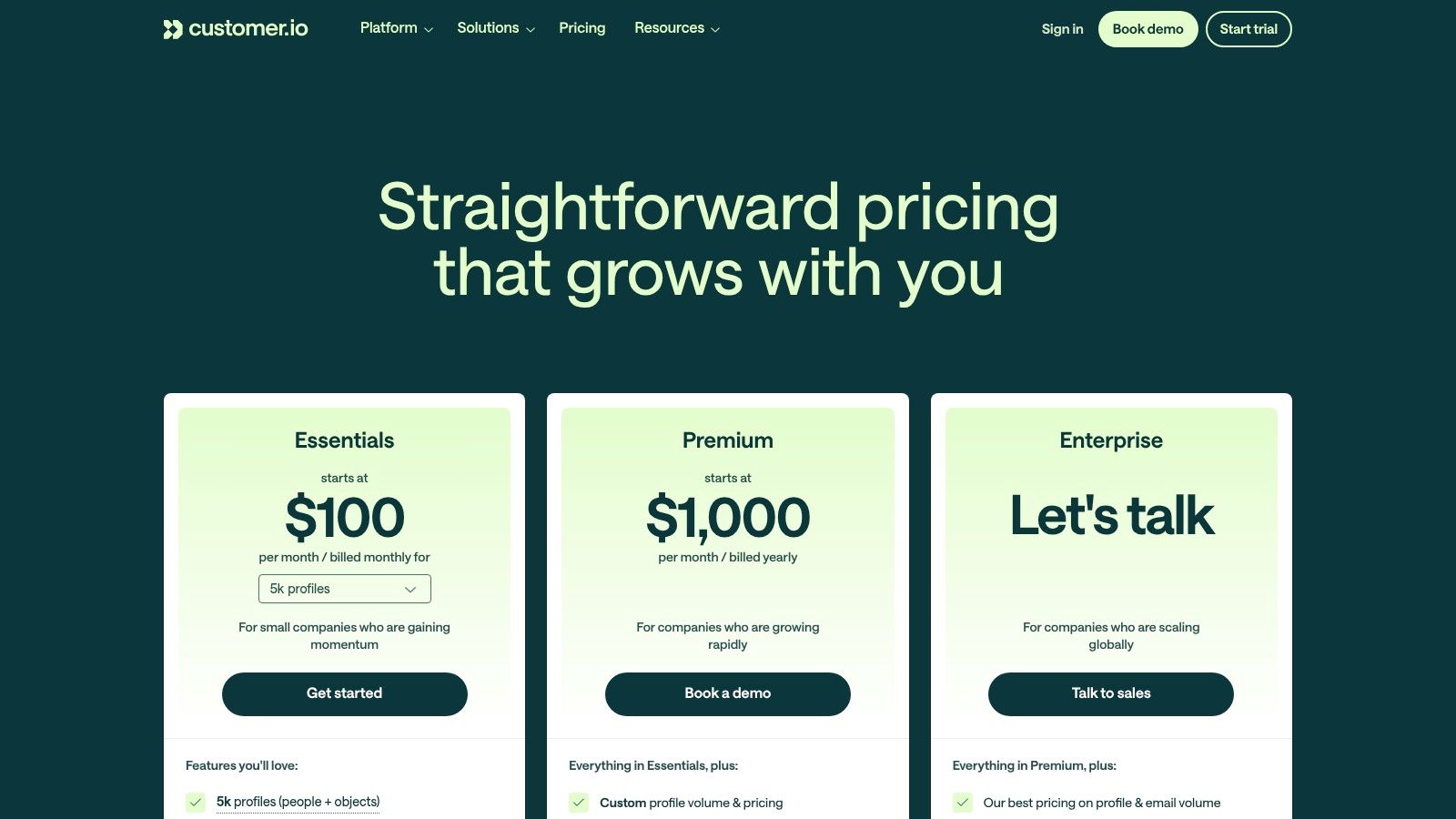
Customer.io offers tiered pricing based on the number of user profiles, with plans like Essentials, Premium, and Enterprise. While the Essentials tier is accessible, maximizing its value requires careful data planning and integration from the start. The higher tiers, which include advanced features like HIPAA compliance, SSO, and premium integrations, are priced for enterprise needs and represent a significant investment. Its technical flexibility can also mean a steeper learning curve for non-technical marketers.
Website: https://customer.io/pricing/
11. Capterra (Marketing Automation Software Category)
While not a marketing automation platform itself, Capterra is an indispensable research destination for anyone evaluating their options. It functions as a comprehensive software directory where buyers can discover, compare, and shortlist the best marketing automation software based on specific needs. The platform consolidates hundreds of tools into a single, filterable category, providing an objective starting point for your search.
Capterra’s strength lies in its vast library of verified user reviews and side-by-side comparison features. This allows you to move beyond marketing copy and understand real-world user experiences, from implementation challenges to standout features. By aggregating detailed product information, user ratings, and expert-written buyer’s guides, it empowers teams to make more informed purchasing decisions without visiting dozens of vendor websites individually.
Key Strengths & Use Cases
- Best for: Teams in the initial research and shortlisting phase of selecting a new marketing automation tool. It’s also valuable for businesses wanting to compare their current solution against competitors.
- Verified User Reviews: Gain authentic insights into a platform’s pros and cons from a large base of real users, with strong review moderation to ensure credibility.
- Advanced Filtering: Narrow down the options by features, business size, industry, and pricing models to quickly find solutions that match your specific requirements.
- Side-by-Side Comparisons: Directly compare key features, pricing, and user ratings for up to four different platforms in a clear, easy-to-read format.
Pricing & Limitations
Using Capterra for research is completely free for buyers. However, it’s crucial to be aware that sponsored placements can influence the order in which software is listed, so it’s wise to use the filters and sort options to get a more neutral view. Always click through to the vendor’s official site to confirm the most up-to-date pricing and feature details, as information on Capterra can occasionally lag behind.
Website: https://www.capterra.com/marketing-automation-software/
12. GetApp (Marketing Automation Category)
GetApp, part of the Gartner Digital Markets family, serves not as a software platform itself, but as a crucial discovery tool for businesses navigating the crowded marketing automation landscape. It provides a curated directory where users can compare hundreds of tools based on real-time user ratings, detailed feature filters, and objective analysis. This makes it an invaluable starting point for teams looking to shortlist potential vendors before diving into demos and trials.
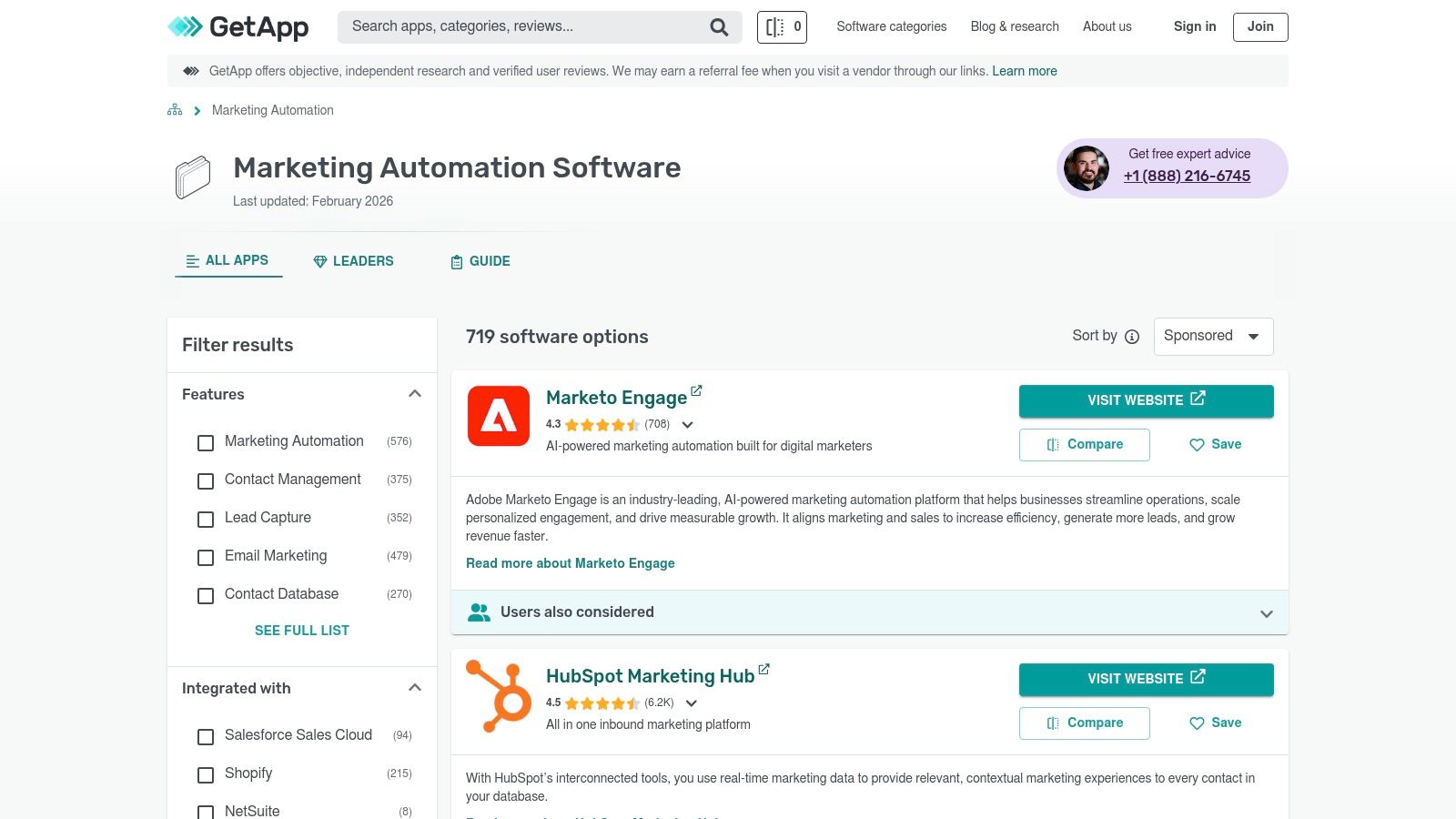
Unlike a direct vendor, GetApp’s strength lies in its ability to offer a bird’s-eye view of the market, complete with user-generated reviews and side-by-side comparisons. Its “Category Leaders” reports and filtering options allow buyers to drill down into specific needs, such as finding the best marketing automation software with lead scoring or social media integration, helping them make more informed decisions quickly.
Key Strengths & Use Cases
- Best for: SMBs and marketing teams in the initial research phase, seeking to discover and compare a wide range of marketing automation solutions, from popular leaders to niche players.
- Comprehensive Filtering: Users can filter platforms by specific features, pricing models, supported devices, and business size to narrow down the options effectively.
- User-Sourced Reviews: Access thousands of verified user reviews and ratings to gain honest insights into a platform’s strengths, weaknesses, and overall user experience.
- Market Education: GetApp provides buyer’s guides, articles, and research that help educate users on what to look for when selecting software.
Pricing & Limitations
Using GetApp is completely free for software buyers. The platform is vendor-supported, which means some profiles and placements may be sponsored. While this doesn’t detract from the value of the organic listings and reviews, users should be aware of the distinction. Pricing information is often presented as a “starting-from” figure, so it’s always essential to click through to the vendor’s official site for complete and accurate details.
Website: https://www.getapp.com/marketing-software/marketing-automation/
How to choose: a decision framework by business model
Before booking demos, narrow the field by answering four questions.
1. What’s your business model?
- B2B with long sales cycles: lead scoring, CRM handoff, ABM. Look at HubSpot, Salesforce Account Engagement, Marketo Engage.
- DTC or ecommerce: revenue attribution, product-feed personalization, cart recovery. Klaviyo, Omnisend, and Drip are purpose-built for this.
- Product-led SaaS: event-driven messaging tied to in-app behavior. Customer.io was built for this; HubSpot can do it but feels heavier.
- Small business or solo founder: optimize for time-to-first-campaign. Mailchimp and Brevo let you ship in an afternoon.
2. How big is your list, and how fast is it growing? Most platforms price per contact, and the curves get steep. Run the math at current, 12-month, and 24-month list sizes — a platform that’s affordable at 5,000 contacts can be punishing at 50,000. Also check whether features like predictive sending sit behind a higher tier you don’t want.
3. What’s your team’s technical capacity? Webhook-driven workflows are useless if no one can wire them up. A drag-and-drop builder frustrates a developer. Match the tool to the operator, not the org chart.
4. What’s your existing stack? Inventory your CRM, CDP, ecommerce platform, and analytics, then check each candidate’s native integration list. Native integrations beat middleware like Zapier for high-volume sync.
Common pitfalls
- Choosing on feature count instead of fit. The features you exercise weekly are the only ones that matter.
- Underestimating onboarding cost. Enterprise tools often need six-figure implementations on top of the license.
- Lock-in through deep custom integrations. The more you customize, the harder it is to leave.
- Ignoring data quality at the gate. Segmentation and deliverability are only as good as the contacts you feed in.
What’s changing in marketing automation in 2026
If you last evaluated this category in 2023 or 2024, three shifts are worth knowing.
AI-assisted journey building. Every major platform now ships AI workflow drafting, subject-line suggestions, and copy variations. Quality varies — treat suggestions as a starting point. The bigger payoff is in analytics: AI is meaningfully better at surfacing underperforming segments and quietly broken automations. A related shift: tools at the edges of your stack are starting to expose MCP servers so operators can drive them from Claude, Cursor, or Copilot in plain English — “validate the list I just imported and tell me how many disposables it has” — without writing a workflow first.
Predictive send-time and channel optimization. Send-time optimization is table stakes. The newer wave predicts which channel (email, SMS, push, in-app) a user will engage with at a given moment. Klaviyo, Customer.io, and Brevo lead here. The catch: these models need engagement signal, which degrades fast when you’re sending to invalid or stale addresses.
Cookieless tracking and first-party data. Chrome’s third-party cookie deprecation has arrived, and cross-site attribution is unreliable. Platforms with CDP-style first-party data layers (Customer.io, HubSpot, Klaviyo) have a structural advantage, which makes the quality of your email list a more strategic asset than it was three years ago.
Where email validation fits in your marketing automation stack
Every platform on this list assumes the email addresses you feed it are real. Their segmentation, deliverability metrics, predictive models, and attribution math all depend on it.
When that assumption breaks, bounce rates climb, sender reputation drops, inbox placement craters, the “engaged” segment is half ghosts, and the send-time model optimizes for users who don’t exist. The MA platform reports what it can see and assumes the inputs are clean.
That’s why validation belongs before the marketing automation layer, not as a feature inside it. Sending the right message is one job; verifying the address is real is a different one.
The two-layer pattern that works:
- At capture: Validate every new email before it lands in your MA tool. Real-time checks on signup forms, lead gen forms, and imports catch typos (
gmial.com,yaho.com), disposables, role accounts, and bad syntax. See JavaScript email validation or hit a validate email API from your backend. - On a schedule: Even validated addresses go stale. People change jobs, abandon Gmail accounts. Quarterly re-validation — monthly if you send heavily — catches the decay before it shows up as bounces. This is what dedicated email list cleaning services exist to do.
Platforms that bake validation in (Mailchimp, HubSpot, others) typically run syntax checks or a basic SMTP ping. Better than nothing, but they miss accept-all domains, catch-all setups, and addresses that look valid but bounce. If your emails are going to spam or bouncing back despite a “validated” list, this is almost always why.
Truelist sits at this layer — outside the MA platform, validating before and after. A typical setup: API-based validation on every form submission, plus a recurring validation schedule that re-checks the whole list and flags decayed addresses for suppression. For the underlying mechanics, see our explainer on sender reputation scores and SMTP authentication.
Top 12 Marketing Automation Platforms Comparison
| Product | Core features | Quality ★ | Value / Price 💰 | Target 👥 | USP ✨/🏆 |
|---|---|---|---|---|---|
| HubSpot Marketing Hub | Visual workflows, native CRM, landing pages, ads, reporting | ★★★★★ | 💰 Scales with contacts; costly at Pro/Enterprise | 👥 Mid‑market → Enterprise marketing teams & agencies | 🏆 All‑in‑one CRM + marketing; mature partner ecosystem |
| Mailchimp | Templates, prebuilt journeys, email & SMS add‑on, forms | ★★★★☆ | 💰 Flexible (monthly or pay‑as‑you‑go); SMB friendly | 👥 Small & mid‑sized teams, freelancers | ✨ Fast time‑to‑value; large template library |
| ActiveCampaign | Visual automations, predictive sending, site/event tracking | ★★★★☆ | 💰 SMB‑friendly entry; pricing by contact bands | 👥 SMBs & growth teams needing robust workflows | ✨ Powerful automation builder at competitive SMB price |
| Klaviyo | Event‑driven ecommerce flows, segmentation, revenue attribution | ★★★★★ | 💰 Cost rises with profiles & SMS volume | 👥 DTC & ecommerce brands (Shopify, BigCommerce) | 🏆 Deep ecommerce data & revenue‑focused reporting |
| Salesforce Marketing Cloud Account Engagement | Engagement programs, lead scoring, deep Salesforce CRM integration | ★★★★★ | 💰 Enterprise‑priced, annual contracts required | 👥 B2B enterprises using Salesforce CRM | 🏆 Tight Salesforce alignment; enterprise governance |
| Adobe Marketo Engage | Smart campaigns, CRM integrations, personalization & APIs | ★★★★★ | 💰 Quote‑based; expensive for enterprise deployments | 👥 Enterprise B2B & ABM teams | ✨ Deep automation logic & advanced ABM tools |
| Brevo (Sendinblue) | Email, SMS, WhatsApp, visual automations, transactional messaging | ★★★★☆ | 💰 Affordable entry; generous free tier & add‑ons | 👥 Growing teams wanting multi‑channel in one vendor | ✨ Multi‑channel + competitive pricing |
| Omnisend | Prebuilt ecommerce workflows, unified email/SMS/push, product feeds | ★★★★ | 💰 Transparent entry pricing; seasonal discounts | 👥 Ecommerce stores (Shopify/WooCommerce/Wix) | ✨ Quick launch for stores; strong cart recovery |
| Drip | Ecommerce integrations, revenue flows, visual campaign editor | ★★★★ | 💰 Contact‑based pricing via calculator | 👥 Ecommerce brands focused on revenue attribution | ✨ Product‑level targeting; clean UI for store owners |
| Customer.io | Event‑driven workflows, data objects, email/push/in‑app/SMS | ★★★★☆ | 💰 Flexible but requires thoughtful data design; premium tiers pricier | 👥 Product‑led & SaaS teams, engineering‑centric marketers | ✨ Highly flexible data model; scales to enterprise needs |
| Capterra (Directory) | Category pages, filters, buyer guides, verified reviews | ★★★★ | 💰 Free to browse; vendor listings may be sponsored | 👥 Buyers researching & shortlisting marketing tools | ✨ Verified user reviews & helpful shortlist reports |
| GetApp (Directory) | Rankings, feature filters, screenshots, pricing callouts | ★★★★ | 💰 Free discovery; sponsored profiles appear alongside organic results | 👥 Buyers discovering both major & niche tools | ✨ Fresh category updates & buyer education content |
Making Your Final Decision and Ensuring Success
We’ve explored a comprehensive landscape of the industry’s top marketing automation platforms, from all-in-one powerhouses like HubSpot to specialized e-commerce champions like Klaviyo and Omnisend. Your journey through this list, comparing features, pricing, and “best-for” scenarios, has likely brought you closer to identifying a frontrunner for your business. However, selecting the best marketing automation software is not the finish line; it’s the starting block of a much larger race. The ultimate success of your chosen platform hinges less on its inherent power and more on how you implement and maintain it.
The most sophisticated automation engine in the world will sputter and fail if it’s fueled by poor-quality data. Think of it this way: your marketing automation tool is the high-performance vehicle, but your email list is the fuel. If that fuel is contaminated with invalid, outdated, or risky email addresses, your engine will clog, your performance will plummet, and you’ll end up stranded on the side of the road with a damaged sender reputation.
From Selection to Strategic Implementation
Moving from a shortlist to a final decision requires a final, introspective look at your organization’s unique DNA. Don’t be swayed by the biggest name or the longest feature list. Instead, anchor your choice in your specific operational reality.
Here are the critical questions to ask before you sign any contract:
- What is our primary goal? Are you a B2B company focused on lead nurturing and sales alignment, making a tool like Salesforce Marketing Cloud or Marketo a logical fit? Or are you an e-commerce brand obsessed with customer lifetime value, pointing you toward Drip or Klaviyo? Define your number one objective.
- What is our team’s technical skill level? Be honest. An intuitive, user-friendly interface like Mailchimp’s or Brevo’s is ideal for teams without dedicated IT support. In contrast, a platform like Customer.io or Adobe Marketo Engage offers immense power but demands a higher level of technical expertise to unlock its full potential.
- How will this tool scale with us? Your choice today must support your vision for tomorrow. A startup might begin with a cost-effective, all-in-one solution, but it’s crucial to understand the platform’s ability to handle increasing contact volume, more complex workflows, and deeper integrations as you grow.
- What does our existing tech stack look like? The best marketing automation software for your business will integrate seamlessly with the tools you already use daily, like your CRM, e-commerce platform, and analytics dashboards. A lack of native integration can create data silos and manual work, defeating the purpose of automation.
The Non-Negotiable Foundation: Data Hygiene
Once you’ve made your choice, the most critical implementation step is establishing a rigorous process for data hygiene. High bounce rates are a primary factor that email service providers use to flag senders as spammers. Consistently sending to invalid addresses will damage your sender reputation, causing your carefully crafted emails to land in the spam folder, unseen by even your most engaged prospects.
This is not a one-time task. Your email list is a living entity; it decays as people change jobs, abandon old addresses, or make typos during sign-up. Proactive, continuous email validation is essential. Integrating a tool like Truelist.io directly into your workflows ensures that every new contact is verified at the point of entry and that your existing list is regularly scrubbed.
By pairing a powerful marketing automation platform with an unwavering commitment to clean data, you create a symbiotic system. Your automation software executes the strategy, while your pristine email list ensures the message is delivered effectively. This dual approach is the only sustainable path to maximizing engagement, protecting your investment, and achieving a measurable return on your marketing efforts.
Stop validating once and hoping for the best. Truelist’s recurring validation automatically re-checks your lists on a schedule — catching new bounces, dead mailboxes, and risky addresses before they damage your sender reputation. Pay-as-you-go credits that never expire, plus unlimited plans for high-volume senders.