
 Claude
  Perplexity
8 Essential API Management Best Practices for 2025
Discover 8 essential API management best practices for 2025. Learn to secure, design, and scale your APIs with expert insights and real-world examples.
TL;DR: Discover 8 essential API management best practices for 2025. Learn to secure, design, and scale your APIs with expert insights and real-world examples.
In today’s interconnected software landscape, APIs are the foundational pillars of modern applications, driving everything from mobile apps to complex enterprise systems. However, as API ecosystems grow, they can quickly become chaotic and unmanageable, leading to security vulnerabilities, poor performance, and frustrated developers. The key to transforming this complexity into a strategic advantage lies in adopting robust API management best practices. This guide cuts through the noise to provide a detailed, actionable roundup of the eight most critical practices you need to implement now.
To truly master your API ecosystem, it’s essential to understand fundamental concepts such as API integration, which forms the basis for how these services communicate and share data. We’ll explore how concepts like versioning, security-first design, and effective monitoring apply to real-world scenarios, using an email validation service as a practical example throughout.
By mastering these principles, you can build a scalable, secure, and developer-friendly API program that accelerates innovation and delivers lasting value. You will learn to move from a reactive state of fixing problems to a proactive one of strategic control, ensuring your APIs are reliable assets rather than technical liabilities. Let’s dive into the practices that will bring order to your API environment.
What’s Changed in 2026
The API landscape in 2026 looks different from even two years ago. Three shifts now shape every serious API program:
- LLM and agent APIs are first-class consumers. Your API may now be called by an autonomous agent that retries on failure, parses your error messages as natural language, and chains your endpoint into a multi-step plan. That changes how you write error bodies, how strict your rate limits should be, and why structured-output validation matters more than ever.
- REST alone is no longer enough. Event-driven architectures, webhooks, and streaming responses are now table stakes. AsyncAPI sits next to OpenAPI in mature programs. If you’re weighing the trade-offs, our breakdown of webhooks vs REST APIs covers when each pattern fits.
- OAuth 2.1 is the current standard. OAuth 2.0 is still everywhere, but OAuth 2.1 consolidates a decade of security guidance (PKCE everywhere, no implicit flow, short-lived tokens by default). New APIs should start here.
We’ll reference an email validation API (Truelist’s verify_inline endpoint) as a concrete example throughout — bearer auth, clear status codes, predictable response shape — so the practices stay grounded in real implementation choices.
1. Implement Comprehensive API Versioning
API versioning is a critical practice for managing changes to your API over time. It allows you to evolve your service, add features, and modify data structures without breaking the integrations built by your existing users. By creating distinct, numbered versions of your API, you provide a stable, predictable environment for consumers while retaining the flexibility to innovate.

This approach is one of the most fundamental API management best practices because it directly impacts developer experience and service reliability. For an email validation service, this means you could introduce a new, more detailed “risk_score” field in v2 without removing the simpler “is_deliverable” boolean from v1, giving developers ample time to adapt.
Why Versioning is Essential
Without versioning, any change, no matter how small, becomes a potential breaking change. This forces consumers to constantly monitor your API and react to updates, creating friction and instability. Companies like Stripe and AWS are known for their exemplary versioning strategies, which build trust and encourage long-term adoption. By maintaining multiple stable versions simultaneously, they guarantee that a user’s integration will continue to work even as the API evolves.
Actionable Implementation Tips
- Choose a Clear Strategy: For most REST APIs, URI versioning (e.g.,
/api/v1/validate,/api/v2/validate) is the simplest and most explicit method. It’s easy for developers to see which version they are using directly in the request path. - Communicate Deprecations Early: Announce the sunsetting of an old version at least 6 to 12 months in advance. Use developer newsletters, API documentation headers, and changelogs to ensure the message is widely received.
- Limit Active Versions: To manage complexity, aim to support only 2-3 versions at once: the stable version, a previous version, and potentially a new version in beta. This prevents your maintenance overhead from spiraling out of control.
- Maintain a Detailed Changelog: Document every change, big or small, in a public changelog. This transparency helps developers understand the value of upgrading and plan their migration efforts accordingly.
2. Design APIs with Security-First Principles
Designing with a security-first mindset means embedding robust security measures into the API’s architecture from day one, not bolting them on as an afterthought. This proactive approach involves multiple layers of protection, including strong authentication, granular authorization, data encryption, and rate limiting, to create an API that is resilient by design against common threats and vulnerabilities.

This practice is one of the most crucial API management best practices as it protects both your infrastructure and your users’ sensitive data. For an email validation API, a security-first approach would prevent a malicious actor from abusing the service to harvest valid email addresses or from intercepting a list of customer emails during a bulk validation request.
Why Security-First is Essential
APIs are gateways to your application’s data and functionality, making them prime targets for attackers. A security breach can lead to devastating data loss, regulatory fines, and a complete erosion of customer trust. Leading platforms like Google Cloud and Salesforce build their APIs on security-first principles, using standards like OAuth 2.0 and fine-grained permissions to ensure that only authenticated and authorized clients can access specific resources. This builds a foundation of trust essential for enterprise adoption.
Actionable Implementation Tips
- Enforce Encryption Everywhere: Mandate HTTPS/TLS for all API endpoints without exception. This encrypts data in transit, preventing man-in-the-middle attacks and ensuring data privacy.
- Implement Modern Authentication: Use a token-based authentication standard like OAuth 2.0 with JSON Web Tokens (JWT). Configure short token expiration times and implement a secure refresh token rotation strategy.
- Centralize Security with an API Gateway: Use an API gateway to enforce security policies like authentication, rate limiting, and access control consistently across all your microservices.
- Log and Monitor Aggressively: Keep detailed logs of all API requests, including successes and failures. Use this data to monitor for suspicious activity, such as failed login attempts or unusual traffic patterns, and set up alerts for potential threats.
Modern Auth in 2026: OAuth 2.1, mTLS, and Short-Lived Tokens
A pragmatic 2026 auth baseline:
- Bearer tokens for public APIs. A simple
Authorization: Bearer <token>header (the same pattern Truelist uses onverify_inline) works for most public APIs with short token lifetimes and TLS everywhere. Keep secrets out of query strings. - OAuth 2.1 for user-delegated access. Now the standard for third-party apps. Mandates PKCE for authorization-code flows, drops the implicit grant, and pushes short-lived tokens with refresh rotation. A concrete example: Truelist’s MCP server uses OAuth instead of an API key, so an AI assistant authorizes the user’s account in their browser once and never sees a long-lived secret.
- mTLS for service-to-service. Mutual TLS gives cryptographic identity on both ends without managing bearer secrets. Default for internal traffic at most large API programs.
- Zero-trust by default. Never trust a request because it came from inside the network. Every call should be authenticated, authorized, and logged — even between microservices.
- Defend against prompt injection. If your API is consumed by LLM agents, sanitize user-supplied content flowing into prompts and validate structured outputs against a schema before acting on them.
3. Establish Robust API Documentation and Developer Experience
Comprehensive API documentation is the foundation of developer adoption and successful integration. This practice involves creating clear, interactive, and maintainable documentation that guides developers through every step, from authentication and endpoints to parameters, responses, and error handling. Modern documentation transcends static text, incorporating interactive examples, SDKs, and sandbox environments to accelerate the integration process.

A positive developer experience is a core component of effective API management best practices. For an email validation API, this means providing a “Getting Started” guide that allows a developer to make their first successful API call in under five minutes. This immediate success builds confidence and significantly reduces integration friction, turning a potentially complex task into a straightforward one.
Why Documentation is Essential
Without clear documentation, even the most powerful API is unusable. Developers will abandon an API if they cannot quickly understand its value and how to implement it. Companies like Stripe and Twilio have set the gold standard with their developer-centric documentation, featuring interactive examples and code snippets in multiple languages. This commitment to developer experience directly translates into faster adoption and higher user satisfaction.
Actionable Implementation Tips
- Generate from Code: Use industry standards like the OpenAPI Specification (formerly Swagger) to generate and maintain documentation automatically. This ensures your documentation always stays in sync with the actual API code.
- Provide Copy-Paste Code: Offer working code examples for common use cases in popular languages like Python, JavaScript, and PHP. This allows developers to get started immediately without writing boilerplate code.
- Create a “Getting Started” Guide: Design a concise tutorial that walks new users through obtaining API keys, making their first request, and interpreting the response. The goal is a quick, tangible success.
- Maintain Versioned Docs: Your documentation must align with your API versions. Provide an easy way for developers to switch between documentation for v1, v2, etc., to avoid confusion. To further enhance your strategy, consider these 8 API Documentation Best practices for 2025.
4. Implement Effective Rate Limiting and Throttling
Rate limiting is a control mechanism that restricts how many API requests a user can make in a given time frame. It is an essential defensive measure to protect your API from being overwhelmed, whether by malicious attacks like DDoS or by a single consumer’s malfunctioning script. By setting sensible usage quotas, you ensure fair resource allocation and maintain a high-quality, reliable service for all users.
This practice is one of the most crucial API management best practices for service stability and security. For an email validation service, it prevents one user from submitting a million addresses at once and monopolizing server resources, ensuring that other customers continue to receive real-time validation responses without delay.
Why Rate Limiting is Essential
Without rate limiting, your API infrastructure is vulnerable to excessive traffic that can degrade performance or cause complete service outages. It also provides a clear framework for monetizing your API, allowing you to offer different tiers of access with higher limits. Industry leaders like GitHub and Twitter use sophisticated, well-documented rate limits to protect their platforms and provide a predictable developer experience. This builds trust and clearly defines the “rules of the road” for consumers.
This infographic outlines the core components of a well-structured rate limiting strategy.
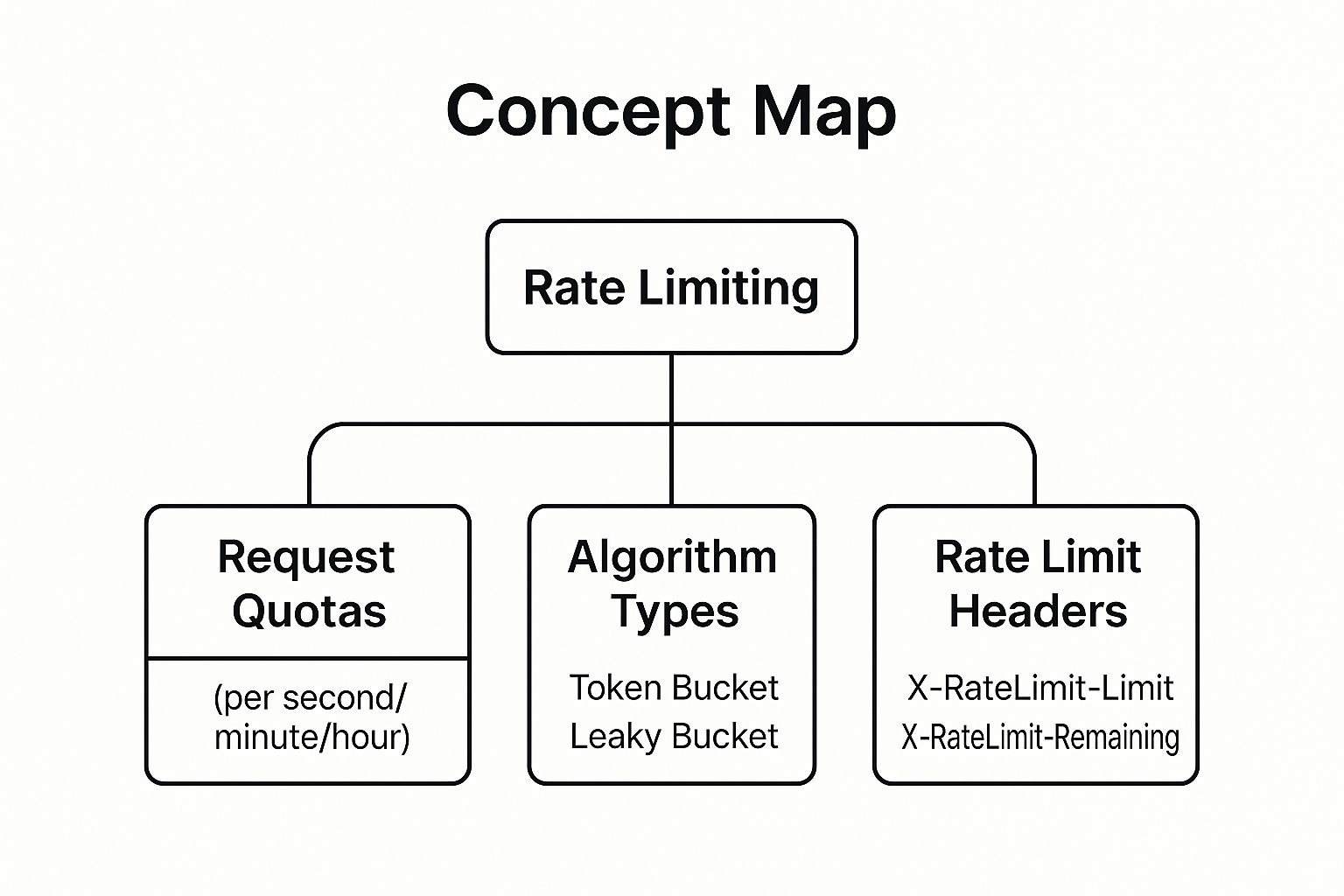
As shown, a robust approach combines defined request quotas, proven algorithms like the token bucket, and clear communication through response headers.
Actionable Implementation Tips
- Communicate Limits via Headers: Always include headers like
X-RateLimit-Limit(the quota),X-RateLimit-Remaining(requests left), andX-RateLimit-Reset(when the quota resets) in every API response. This gives developers real-time visibility into their usage. - Use the Right Status Code: When a user exceeds a limit, respond with an HTTP
429 Too Many Requestsstatus code. Critically, include aRetry-Afterheader to tell the client when they can safely send another request. - Implement Tiered Limits: Differentiate limits based on authentication status or subscription level. For instance, grant authenticated users a significantly higher request quota than anonymous users.
- Document Everything Clearly: Your API documentation must explicitly state all rate limits. Detail the different quotas, how they are measured, and what happens when they are exceeded, leaving no room for ambiguity.
Idempotency Keys, Pagination, and Retry-After
Rate limiting is one of three patterns that turn a “works on my machine” integration into a production-grade one. The other two are worth implementing alongside it:
- Idempotency keys for unsafe operations. Any
POST,PUT,PATCH, orDELETEthat triggers a side effect (a charge, a send, a creation) should accept anIdempotency-Keyheader from the client. Store the request hash plus the response for 24 hours and replay the cached response on duplicates. This is how clients can safely retry on network failure without double-charging users or sending duplicate emails. - Cursor-based pagination over offset. For any list endpoint that might return more than a few hundred records, return a
next_cursorfield rather than relying on?page=N&limit=M. Offset pagination breaks under inserts and gets slow at scale; cursors stay stable and fast. For a bulk email validation API that returns thousands of results, this is the difference between a usable feed and a timeout. Retry-Afteron every 429 and 503. When you say “slow down” or “I’m overloaded,” tell the client how long to wait. The header accepts either a number of seconds or an HTTP date. Without it, clients either retry too aggressively (compounding the problem) or back off too long (eroding throughput).
5. Design RESTful APIs Following Standard Conventions
Designing a RESTful API involves adhering to established architectural principles to create an interface that is intuitive, predictable, and scalable. By leveraging standard HTTP methods, status codes, and resource naming conventions, you create an API that developers can understand and integrate with minimal friction. This predictability is a cornerstone of a positive developer experience and a hallmark of professional API design.
This practice is fundamental to API management best practices because it reduces the cognitive load on developers. For an email validation API, this means a developer would intuitively know to use GET /v1/validations to retrieve a list of past checks and POST /v1/validations to submit a new email for validation, without needing to constantly consult the documentation for basic operations.
Why Standard Conventions are Essential
APIs that ignore REST conventions force developers to learn a custom, proprietary set of rules for every endpoint. This increases integration time, leads to more errors, and ultimately frustrates your user base. Well-respected APIs, like those from Stripe and GitHub, follow these standards rigorously, making them feel familiar and reliable even to first-time users. This consistency builds trust and encourages broader adoption.
Actionable Implementation Tips
- Use Plural Nouns for Resources: Collections should always be named with plural nouns to represent a set of resources. For example, use
/api/v1/emailsinstead of/api/v1/email. - Apply HTTP Methods Correctly: Use verbs for actions, not in the URI.
GETshould retrieve data,POSTshould create a new resource,PUT/PATCHshould update an existing one, andDELETEshould remove it. - Return Standard Status Codes: Use appropriate HTTP status codes to communicate outcomes. For instance, return
201 Createdwith aLocationheader after a successfulPOST, and204 No Contentafter a successfulDELETErequest. - Structure Endpoints Logically: Nest resources to show relationships. For example, to retrieve all validation checks for a specific user, a logical endpoint would be
/api/v1/users/{userId}/validations.
A Concrete Example: Truelist’s verify_inline Endpoint
A small real API shows these principles in action. The Truelist email validation endpoint:
- Endpoint:
POST https://api.truelist.io/api/v1/verify_inline?email=<email> - Auth:
Authorization: Bearer <TOKEN>— token in the header, never the URL. - Versioning:
v1is right in the path. A futurev2lives alongside without breaking integrations. - Response shape:
{ "emails": [{ "email_state", "email_sub_state", ... }] }— a consistent envelope so SDKs iterate the same way for one or many. The validate email API guide and JavaScript email validation walkthrough show clients consuming it from different stacks. - Result enum:
email_stateis one ofok,email_invalid,risky,accept_all,unknown. Five values, stable across versions, easy to switch on.
What’s notable is what the endpoint does not do: no stack traces on error, no 200 for failures (4xx surfaces the problem), and no response-shape changes between free tier (100 validations) and paid tiers. Boring consistency is the goal.
6. Implement Comprehensive Monitoring, Logging, and Analytics
Effective API management requires visibility into your API’s performance, usage, and health. Comprehensive monitoring, logging, and analytics provide the necessary insights to operate a reliable and efficient service. By systematically tracking metrics, recording events, and analyzing data, you can proactively identify issues, understand user behavior, and make informed decisions about scaling and feature development.
This approach is one of the most crucial API management best practices because you cannot manage what you cannot measure. For an email validation service, this means monitoring endpoint latency to ensure quick responses, logging error codes to identify problematic validation patterns, and analyzing usage trends to forecast infrastructure needs. Without this data, you are operating blindly.
Why Monitoring is Essential
Without a robust monitoring and logging framework, diagnosing problems becomes a reactive, time-consuming process. You might only learn about an outage from customer complaints, by which time trust has already been eroded. Companies like Netflix and Google have pioneered SRE (Site Reliability Engineering) practices that place monitoring at the core of operations. They use real-time data to detect anomalies, trigger automated responses, and maintain high availability across their vast microservice architectures.
Actionable Implementation Tips
- Monitor the Four Golden Signals: Track latency (response time), traffic (requests per second), errors (rate of failed requests), and saturation (how “full” your service is). These metrics provide a high-level overview of your API’s health.
- Use Correlation IDs: Implement a unique ID for each request that is passed through all services. This allows you to trace a single user’s journey through a distributed system, making debugging complex issues much simpler.
- Implement Structured Logging: Log events in a machine-readable format like JSON. This makes logs easier to parse, query, and analyze using tools like the ELK Stack (Elasticsearch, Logstash, Kibana) or Splunk.
- Set Up Proactive Alerting: Configure alerts for critical thresholds, such as spikes in error rates or increased latency. This ensures your team is notified of potential problems before they impact a significant number of users.
OpenTelemetry, SLOs, and Distributed Tracing
Observability has consolidated around one open standard. If you’re starting fresh:
- OpenTelemetry is the default. OTel covers traces, metrics, and logs in one SDK across every major language. Datadog, New Relic, and Honeycomb all consume OTel directly. Instrument once, route anywhere.
- Set SLOs, not just alerts. An SLO (“99.9% of requests under 500ms over 30 days”) tells you whether the API is meeting its contract. Error-budget burn rates beat threshold-based alarms, which fire on noise and miss slow degradations.
- Trace across service boundaries. When
/verify_inlinefans out to syntax checking, MX lookup, and SMTP probing, a distributed trace stitches spans together so you can see which step caused tail-latency outliers. Correlation IDs alone won’t do this. - Cardinality discipline in metrics. Tagging with
email_domainwill blow up your time-series DB. Tag withemail_state(5 values) instead. Reserve high-cardinality fields for traces and logs.
7. Enable Effective Error Handling and Status Code Management
Effective error handling is the practice of providing clear, consistent, and actionable feedback when an API request fails. Instead of returning a generic error, a well-designed API uses standard HTTP status codes and detailed response bodies to help developers quickly diagnose and resolve issues. This reduces friction and dramatically improves the developer experience.
This discipline is one of the most crucial API management best practices because it transforms a frustrating debugging session into a guided fix. For an email validation API, this means returning a 422 Unprocessable Entity response with a body like {"error_code": "invalid_format", "message": "Email address does not contain a valid domain."} instead of a vague 500 Internal Server Error.
Why Effective Error Handling is Essential
Without a clear error handling strategy, developers are left guessing what went wrong. This guesswork wastes time, increases support tickets, and can lead to incorrect integration logic. Companies like Stripe and Twilio set the standard by returning structured error objects that include a unique error code, a human-readable message, and often a link to relevant documentation, empowering developers to solve problems independently.
Actionable Implementation Tips
- Use Standard HTTP Status Codes: Adhere to HTTP conventions. Use
400for bad client requests,401for missing authentication,403for permission issues,404for missing resources, and500for server-side failures. - Provide a Detailed Error Body: Include a machine-readable error code (e.g.,
invalid_api_key), a clear message, and a uniquerequest_id. Thisrequest_idis invaluable for correlating client-side issues with server-side logs during support interactions. - Never Expose Sensitive Data: Your error responses should never reveal internal system details like stack traces, database queries, or server file paths. Log these details internally but return a sanitized, helpful message to the client.
- Standardize Your Error Format: Adopt a consistent error schema across all endpoints. Using a standard like RFC 7807 (Problem Details for HTTP APIs) ensures predictability and makes it easier for developers to build robust error-handling logic.
8. Implement API Gateway and Microservices Architecture Support
An API Gateway acts as a single, unified entry point for all client requests, abstracting the complexity of your backend services. This architectural pattern is crucial for microservices, as it centralizes cross-cutting concerns like authentication, rate limiting, logging, and routing, providing a consistent and secure interface for all consumers.
Adopting this pattern is one of the most impactful API management best practices because it decouples clients from the internal architecture. For an email validation platform, a gateway can route a simple /validate?email=... request to one microservice for syntax checks and another for SMTP verification, then aggregate the results into a single, cohesive response without the client ever knowing about the internal complexity.
Why an API Gateway is Essential
In a microservices environment, clients would otherwise need to know the endpoint for every individual service, handle authentication for each one, and manage complex call chains. An API Gateway simplifies this by providing a single front door. This approach is famously used by companies like Netflix with their Zuul gateway and Amazon with its AWS API Gateway, which manage billions of daily requests and provide robust security and traffic management across hundreds of backend services.
Actionable Implementation Tips
- Centralize Cross-Cutting Concerns: Implement authentication, rate limiting, and logging at the gateway level to avoid duplicating this logic in every microservice.
- Implement Health Checks and Circuit Breakers: Configure your gateway to monitor the health of backend services. Use circuit breakers to stop routing traffic to failing services, preventing cascading failures across your system.
- Cache Aggressively: For frequently requested, non-sensitive data, implement caching at the gateway layer. This reduces latency and offloads work from your backend services.
- Use for API Composition: Design gateway endpoints that fetch data from multiple microservices and combine it into a single response. This reduces the number of round-trip calls a client needs to make, improving performance.
Choosing a Gateway: Kong, Apigee, AWS, Cloudflare, Tyk
The “which gateway?” question depends on where your services run and how much customization you need. A 2026 cheat sheet:
- AWS API Gateway: Path of least resistance on AWS Lambda or ECS. Tight IAM integration, per-call pricing — cheap at low volume, expensive at high volume.
- Cloudflare (API Gateway / Workers): Edge-first. Auth and rate limits run at the CDN tier before requests reach your origin. Right when global latency and bundled bot/DDoS protection matter.
- Kong: The dominant open-source choice. Self-hosted or Kong Konnect, extensible via Lua and Go plugins. Right when you want full control and have ops to run it.
- Apigee (Google Cloud): Enterprise-heavy. Strong analytics, developer portal, and monetization. Right when you’re selling API access as a product with contract-grade governance.
- Tyk: Lighter than Apigee, open-source core. Right for mid-size teams wanting self-hosted control without Kong’s surface area.
A reasonable default for a new SaaS in 2026: Cloudflare at the edge plus a lightweight in-app middleware layer for auth scopes, idempotency, and structured errors. Reach for Kong or Apigee when scale or governance demands it.
Beyond REST: AsyncAPI, Webhooks, and Event-Driven APIs
More of modern API surface area is asynchronous. A bulk validation finishes ten minutes after it starts. A new lead enters the CRM and an enrichment pipeline reacts. These flows want events, not polling. Treat event streams and webhooks with the same discipline as REST endpoints.
- Specify webhooks with AsyncAPI. AsyncAPI 3.0 is the OpenAPI equivalent for event-driven APIs — event schemas, channels, and delivery guarantees, all in one spec.
- Sign every delivery. HMAC signature header computed from the raw body and a per-customer secret. Receivers verify before processing.
- Make webhooks idempotent. Every event needs a stable
event_id. Senders retry with exponential backoff for 24-72 hours. Receivers deduplicate onevent_id. - Offer push and pull. Webhook streams for high-volume consumers, a
GET /events?since=<cursor>endpoint for consumers behind firewalls. Mature programs offer both. - Pick the right pattern per integration. The webhook vs REST API deep dive walks through the decision framework.
8-Point API Management Best Practices Comparison
| Item | Implementation Complexity 🔄 | Resource Requirements ⚡ | Expected Outcomes 📊 | Ideal Use Cases 💡 | Key Advantages ⭐ |
|---|---|---|---|---|---|
| Implement Comprehensive API Versioning | Medium to High 🔄 - managing multiple versions, documentation | Moderate ⚡ - requires version lifecycle management and testing | Stable API evolution without breaking clients 📊 | APIs needing backward compatibility and continuous updates 💡 | Flexibility, backward compatibility, planned deprecation ⭐ |
| Design APIs with Security-First Principles | High 🔄 - multiple security layers, ongoing maintenance | High ⚡ - requires secure infrastructure, audits | Secure, compliant API resistant to breaches 📊 | APIs handling sensitive data or regulated environments 💡 | Strong security, trust, compliance ⭐ |
| Establish Robust API Documentation & DX | Medium 🔄 - significant initial and ongoing effort | Moderate ⚡ - tooling and tech writers needed | Higher adoption, reduced support, faster onboarding 📊 | Public APIs targeting many developers 💡 | Improved developer experience, easier integration ⭐ |
| Implement Effective Rate Limiting & Throttling | Medium 🔄 - complex algorithms and fine-tuning | Moderate ⚡ - monitoring and infrastructure for limits | Protects API stability, prevents abuse 📊 | High-traffic APIs, monetized or tiered plans 💡 | Resource protection, fair usage, monetization ⭐ |
| Design RESTful APIs Following Conventions | Low to Medium 🔄 - adherence to standards, less complex | Low to Moderate ⚡ - standard HTTP protocols | Intuitive, predictable, maintainable APIs 📊 | General-purpose RESTful APIs for wide adoption 💡 | Compatibility, tooling support, ease of use ⭐ |
| Implement Comprehensive Monitoring, Logging, Analytics | High 🔄 - large data volumes, integration complexity | High ⚡ - storage, processing, monitoring tools | Proactive issue detection, data-driven decisions 📊 | APIs requiring reliability and performance insights 💡 | Improved stability, insight, compliance ⭐ |
| Enable Effective Error Handling & Status Codes | Low to Medium 🔄 - consistent design and discipline | Low ⚡ - mostly design and implementation effort | Improved developer experience, faster debugging 📊 | All APIs aiming for usability and clear communication 💡 | Clarity, reduced support, automated handling ⭐ |
| Implement API Gateway & Microservices Support | High 🔄 - infrastructure setup, routing, resilience | High ⚡ - infrastructure and maintenance intensive | Simplified client integration, centralized control 📊 | Complex microservices architectures at scale 💡 | Scalability, security centralization, flexibility ⭐ |
Build Better: Your Next Steps in API Excellence
Navigating the complexities of the digital landscape requires more than just functional APIs; it demands a strategic, disciplined approach to their entire lifecycle. The eight API management best practices we’ve explored serve as a comprehensive blueprint for building a resilient, secure, and user-friendly API ecosystem. Moving beyond mere technical checklists, these principles represent a fundamental shift towards treating your APIs as core products that empower developers, delight users, and drive business value.
From implementing a security-first design and a clear versioning strategy to establishing robust monitoring and excellent developer documentation, each practice interconnects. A well-documented API is useless if it’s unreliable, and a reliable API is a liability if it’s insecure. True excellence is achieved when these components work in harmony, creating a seamless and trustworthy experience for everyone who interacts with your digital services.
Your Path to Implementation
Adopting these standards is a journey, not a destination. For teams managing high-volume email lists or integrating automated validation into their workflows, the impact is immediate. You can start by performing a thorough audit of your existing API management lifecycle against the benchmarks discussed. Identify the most critical gaps, whether in security, documentation, or performance monitoring, and prioritize them based on business impact and user experience.
Here are your actionable next steps:
- Audit and Prioritize: Review your current APIs against each of the eight best practices. Where are the most significant weaknesses? Start there.
- Create an Internal Playbook: Standardize your approach by documenting your chosen conventions for versioning, error handling, and security. Make this playbook accessible to all developers.
- Invest in Tooling: Leverage API gateways, monitoring solutions, and documentation platforms to automate and enforce these standards, freeing your team to focus on innovation.
The Strategic Value of API Excellence
Mastering these API management best practices is a strategic investment that pays dividends across the organization. It reduces integration friction for partners, minimizes security risks, and provides the scalability needed to adapt to future demands. For a sales development representative, it means their cold outreach tools work flawlessly. For an e-commerce platform, it ensures transactional email deliverability remains high.
By committing to this framework, you are not just building better APIs; you are building a stronger, more agile, and more competitive business. The effort invested today in creating a robust and well-managed API program will become the foundation for your success tomorrow, enabling you to innovate faster and build lasting trust with your users and partners.
Related Reading
If you’re applying these practices to email or data-quality use cases, these guides go deeper:
- Validate email API and API integration platforms — endpoint design and when to reach for an iPaaS instead.
- Python email validation and PHP email verification — language-specific implementations.
- Email address existence checker, format of email address, and MX record lookup — the validation logic underneath the API.
Ready to see these principles in action? The Truelist email validation API was built from the ground up with these best practices at its core, offering developers a secure, reliable, and exceptionally well-documented integration experience. Explore how a commitment to API excellence translates into superior performance and start cleaning your email lists with confidence today at Truelist.