 Claude
  Perplexity
13 Best Email Marketing Software for Ecommerce in 2026
Compare the top 13 email marketing platforms for ecommerce in 2026. Klaviyo, Omnisend, Drip, Shopify Email and more — automations, pricing, and integrations.
TL;DR: Discover the top 13 email marketing software for ecommerce stores. Compare features, pricing, and integrations to find the best platform for your business.
In the competitive world of online retail, your email list is one of your most valuable assets. But simply collecting emails isn’t enough; you need a powerful engine to turn subscribers into loyal, repeat customers. This is where dedicated email marketing software for ecommerce becomes a non-negotiable part of your tech stack. It’s the difference between sending generic newsletters and deploying highly personalized, automated campaigns that drive real revenue.
This guide dives deep into the best platforms available, moving beyond generic feature lists to give you practical, actionable insights. We’ll analyze tools based on how well they integrate with stores like Shopify and WooCommerce, their automation capabilities for crucial tasks like recovering lost sales, and their ability to segment customers based on actual purchase behavior. For instance, a key function is crafting automated email sequences to reduce shopping cart abandonment, a major revenue leak for many online stores.
Our goal is to help you find the perfect fit for your specific needs. We’ll cover everything from industry leaders like Klaviyo and Omnisend to platform-specific solutions like Shopify Email and extensions for WooCommerce. Each review includes a detailed breakdown of ecommerce-specific features, honest assessments of their limitations, and clear use-case recommendations. You’ll find direct links and screenshots to help you visualize how each platform works.
Whether you’re a startup on a tight budget, a developer seeking robust API integrations, or a scaling DTC brand ready for advanced automation, this comprehensive comparison will help you select the ideal email marketing software for ecommerce to build lasting customer relationships and grow your business in 2026.
What changed in ecommerce email in 2026
The ecommerce email playbook has shifted meaningfully over the last year, and the platform you choose in 2026 needs to keep pace. Three forces are now reshaping how stores send:
- AI product recommendations are table-stakes, not premium. Klaviyo, Omnisend, and Drip now ship native AI recommender blocks that pull live catalog data, predict the next-best product per recipient, and render inside the email at open time. Generic “you might also like” rails are out — per-recipient ranking based on purchase history, browse depth, and look-alike cohorts is in.
- Predictive churn modeling moved downmarket. Predictive lifetime value, predicted next-order date, and “likely to churn” scores were Klaviyo Plus features two years ago. In 2026 they appear in Drip, Omnisend, and even some Mailchimp tiers, which means win-back flows can fire on a model rather than a hard 60-day silence rule.
- Headless commerce changed how data gets in. More DTC brands are running Shopify Hydrogen, Commerce.js, Medusa, or custom Next.js storefronts in front of a headless backend. Email platforms that used to rely on the Shopify storefront pixel now lean on server-side events through Shopify’s Customer Events, Segment, or direct API ingestion. If you’re going headless, vet the ESP’s API integration patterns and webhook support before you sign.
The practical upshot: data plumbing matters more than the email editor. The best email marketing software for ecommerce in 2026 wins on how cleanly it ingests store events, scores customers, and triggers the right message — not on how pretty the drag-and-drop builder is.
1. Klaviyo
Klaviyo stands out as a dominant force in the world of email marketing software for ecommerce, primarily because it was built from the ground up with online stores in mind. Its core strength lies in its deep, real-time data synchronization with major platforms like Shopify, BigCommerce, and WooCommerce. This isn’t just a basic contact sync; it pulls in detailed customer behavior data, such as products viewed, items added to carts, and past purchase history, allowing for incredibly granular audience segmentation.
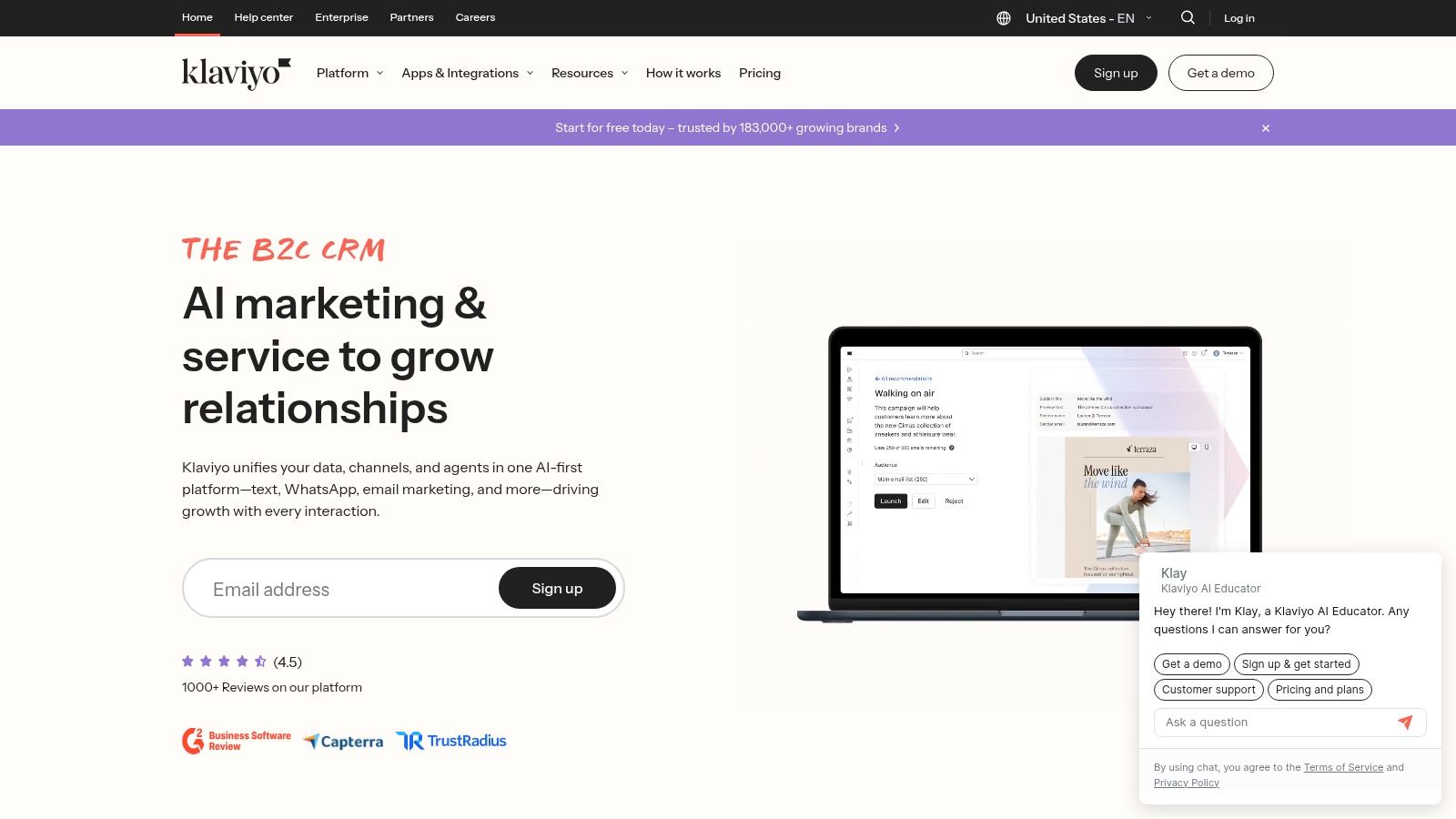
This level of data integration empowers merchants to create highly targeted and automated marketing flows. For example, you can build a “browse abandonment” flow that sends a follow-up email featuring the exact product a customer viewed but didn’t add to their cart. This direct link between customer action and marketing reaction is what makes Klaviyo uniquely powerful for driving revenue.
Key Features & Use Cases
- Ecommerce-First Automations: Go beyond standard newsletters with pre-built, revenue-focused flows for abandoned carts, post-purchase follow-ups, and customer win-back campaigns.
- Advanced Segmentation: Create dynamic segments based on predictive analytics, like “likely to churn” or “high lifetime value,” to tailor your messaging and offers.
- Unified SMS Marketing: Natively integrate SMS campaigns into your marketing flows, providing a seamless multi-channel experience without needing a separate tool.
- Robust A/B Testing: Test everything from subject lines and sender names to email content and send times within automated flows to continuously optimize performance.
Pricing and Implementation
Klaviyo offers a free tier for up to 250 contacts and 500 email sends, making it accessible for new businesses. Paid plans are based on contact and SMS volume, which can become costly as you scale. While the user interface is clean, mastering the advanced segmentation and flow-building features can have a learning curve for beginners.
Our Take: Klaviyo is the best-in-class choice for data-driven DTC brands, especially those on Shopify Plus, that want to maximize customer lifetime value through hyper-personalized automation.
To ensure your campaigns reach the inbox, it’s crucial to maintain a healthy contact list. You can explore a deeper dive into best practices for email list cleaning to maximize deliverability with Klaviyo.
- Website: https://klaviyo.com
2. Mailchimp (by Intuit)
Mailchimp is one of the most recognized names in email marketing, serving as an approachable and powerful entry point for businesses diving into email marketing software for ecommerce. Its reputation is built on an exceptionally user-friendly interface, beautiful email templates, and reliable deliverability, making it simple for merchants to get started. While not as ecommerce-native as Klaviyo, it offers robust integrations with platforms like Shopify (via third-party apps), WooCommerce, and BigCommerce to enable core ecommerce functionalities.
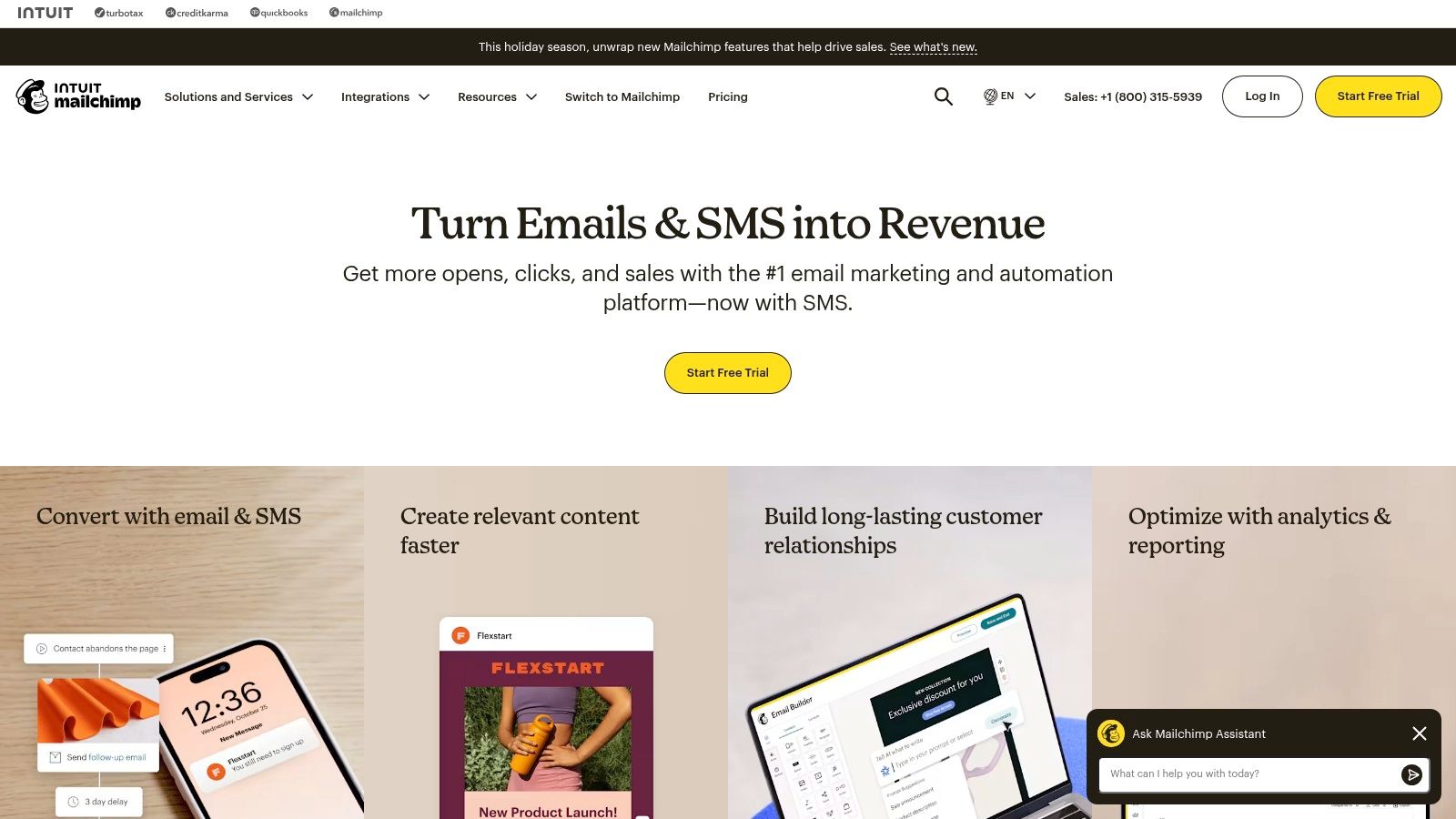
The platform connects customer data to your marketing efforts, allowing you to send targeted campaigns based on purchase history and website activity. It excels at helping businesses build their brand with its creative assistant and content studio, simplifying the process of creating professional-looking emails, landing pages, and social media posts all from one place.
Key Features & Use Cases
- User-Friendly Campaign Builder: A drag-and-drop editor and a vast library of templates make it easy to design visually appealing emails without coding knowledge.
- Core Ecommerce Automations: Set up essential automations like abandoned cart reminders, order notifications, and product recommendations to engage customers at key moments.
- Multivariate Testing: Higher-tier plans allow for testing up to eight variations of a single campaign to optimize for engagement and conversions.
- All-in-One Marketing Platform: Includes tools for building landing pages, pop-up forms, and managing social media ads, providing a centralized hub for marketing activities.
Pricing and Implementation
Mailchimp offers a free plan for up to 500 contacts and 1,000 email sends per month, but with limited features. Paid plans scale based on contact count and feature access, which can become expensive for stores with large lists needing advanced automation. The interface is intuitive, but unlocking its full ecommerce potential requires a Standard plan or higher.
Our Take: Mailchimp is an excellent choice for new and growing ecommerce businesses that prioritize ease of use, great design, and a solid all-in-one marketing toolkit.
To ensure your campaigns are effective, it’s vital to connect your tools properly. You can find detailed instructions for setting up the Mailchimp integration to keep your lists clean and maximize deliverability.
- Website: https://mailchimp.com
3. Omnisend
Omnisend positions itself as an all-in-one email marketing software for ecommerce designed for speed and simplicity. Its main advantage is combining email, SMS, and web push notifications into a single, cohesive platform, allowing merchants to launch sophisticated, multi-channel campaigns without the complexity of managing separate tools. It integrates deeply with Shopify, WooCommerce, and BigCommerce, pulling in store data to fuel its powerful automations.
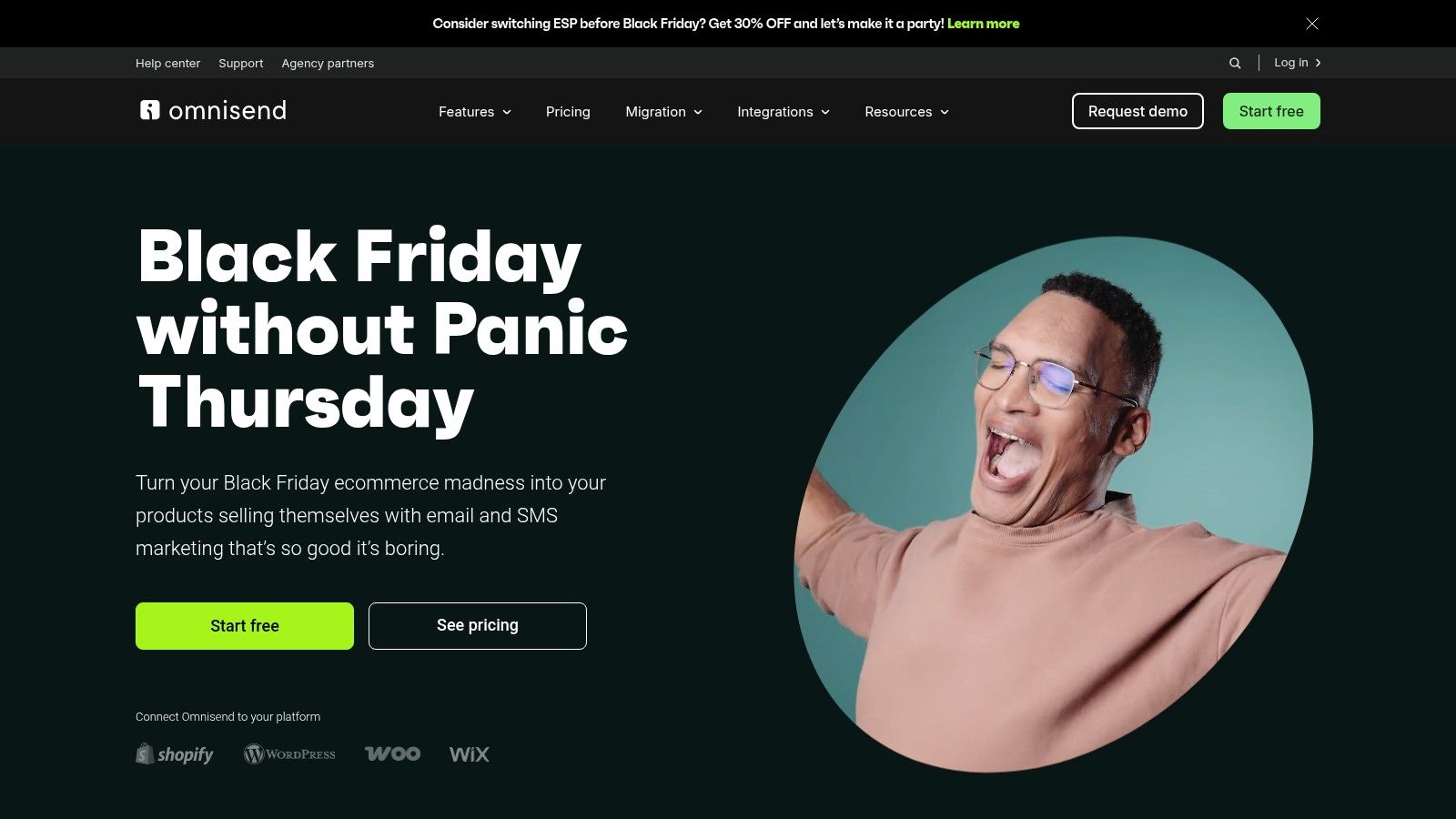
Unlike platforms with a steeper learning curve, Omnisend focuses on providing a large library of pre-built workflows for common ecommerce scenarios. This allows store owners to quickly set up revenue-driving automations like welcome series, cart abandonment reminders, and cross-sell campaigns that work across email and SMS right out of the box.
Key Features & Use Cases
- Integrated Multi-Channel Workflows: Combine email, SMS, and web push notifications within a single automation flow to reach customers on their preferred channel.
- Pre-built Ecommerce Automations: Launch campaigns fast with a library of templates for welcome series, abandoned carts, and transactional emails.
- Product Recommender Blocks: Easily drag and drop dynamic product recommendations into your emails based on a customer’s browsing or purchase history.
- Advanced Reporting & Attribution: Clearly see which campaigns, automations, and channels are driving the most sales with built-in revenue attribution.
Pricing and Implementation
Omnisend offers a free plan for up to 250 contacts and 500 emails per month, including all core features. Paid plans are competitively priced based on contact list size, offering excellent value. While the platform is very intuitive for launching pre-built flows, some users find the user interface can feel a bit crowded when building custom segments or complex automations from scratch.
Our Take: Omnisend is an excellent choice for small to mid-sized ecommerce businesses that need a powerful, multi-channel marketing tool that is easy to set up and provides a clear return on investment.
- Website: https://www.omnisend.com
4. Drip
Drip positions itself as a powerful email marketing software for ecommerce by focusing on sophisticated, yet user-friendly, automation workflows. While many platforms offer automation, Drip’s strength is its visual journey builder, which makes it easier for marketers to map out complex customer lifecycle campaigns. It integrates deeply with Shopify, BigCommerce, and WooCommerce to pull in crucial behavioral data, such as products viewed, cart activity, and purchase history.
This focus on the entire customer journey allows merchants to build long-term relationships beyond just one-off promotional campaigns. For example, you can create a detailed post-purchase sequence that nurtures a first-time buyer into a loyal, repeat customer, complete with personalized product recommendations and check-in emails based on their specific purchase. The platform is designed to make this level of lifecycle marketing accessible.
Key Features & Use Cases
- Behavior-Based Journeys: Utilize the visual workflow builder to create dynamic automations that react to customer actions, from first website visit to repeat purchase.
- Onsite Popups & Forms: Capture leads directly on your site with customizable forms and popups that can trigger specific marketing automation sequences.
- Dynamic Segmentation: Segment customers based on their actions, purchase frequency, or specific tags to send highly relevant and timely email campaigns.
- Revenue Dashboards: Track the direct revenue impact of your email campaigns and automations with clear, ecommerce-focused reporting and analytics.
Pricing and Implementation
Drip’s pricing is based on the number of contacts in your list, starting with a 14-day free trial. The user experience is generally approachable, especially the visual workflow builder. A notable downside is that live chat support is reserved for higher-priced plans, and the platform has fewer built-in channels like SMS compared to some all-in-one competitors.
Our Take: Drip is an excellent choice for ecommerce brands that want to master customer lifecycle marketing through powerful, visual automations without the steep learning curve of more complex platforms.
- Website: https://www.drip.com
5. ActiveCampaign
ActiveCampaign positions itself as a customer experience automation platform, extending beyond typical email marketing software for ecommerce into a more holistic CRM and marketing suite. Its primary differentiator is the sheer power and flexibility of its visual automation builder, which allows for intricate workflows based on deep conditional logic, site tracking, and lead scoring. This makes it ideal for stores that have a more considered purchase cycle or require a handoff between marketing and sales teams.
Unlike platforms built solely for DTC product sales, ActiveCampaign excels at managing the entire customer lifecycle. You can track when a user visits a specific product page multiple times, automatically tag them as a hot lead, increase their lead score, and trigger an internal notification to a sales rep, all within a single automated flow. It’s this combination of marketing automation and sales CRM functionality that makes it uniquely versatile.
Key Features & Use Cases
- Powerful Automation Builder: Create sophisticated workflows with multiple starting conditions, if/else branching, and goal-based triggers that are more advanced than many competitors.
- Built-in CRM & Lead Scoring: Manage customer relationships and sales pipelines directly within the platform, scoring leads based on email engagement and site activity.
- Extensive Integrations: Connect seamlessly with over 1,000 apps, including Shopify, BigCommerce, and WooCommerce, plus a native WhatsApp option for multi-channel messaging.
- Site Tracking: Monitor what pages and products your contacts are viewing on your website and use that behavioral data to trigger hyper-relevant automations and personalization.
Pricing and Implementation
ActiveCampaign’s pricing is based on contact count and feature tiers, starting with its “Marketing Lite” plan. Enterprise-grade automation is accessible even on lower-priced plans, offering significant value. However, the depth of the platform means there is a steeper learning curve, and the interface can feel overwhelming for users seeking simple newsletter functionality. Understanding which features are included in each plan requires careful review.
Our Take: ActiveCampaign is the top choice for ecommerce businesses with a longer sales cycle or those that need to seamlessly blend marketing automation with a hands-on sales process.
For those migrating complex workflows into ActiveCampaign, ensuring a clean starting list is critical. Services like Truelist can validate your existing contacts before import, preserving your sender reputation from day one.
- Website: https://www.activecampaign.com
6. Brevo (formerly Sendinblue)
Brevo, formerly known as Sendinblue, positions itself as an all-in-one marketing suite that offers more than just email. It’s an attractive piece of email marketing software for ecommerce for businesses seeking a powerful, multi-channel platform without the premium price tag. Its key differentiator is combining email, SMS, WhatsApp, push notifications, and even a simple CRM into one unified dashboard, providing a holistic view of customer interactions.
For ecommerce stores, this means you can set up an abandoned cart flow that starts with an email and follows up with an SMS message if the email isn’t opened. This multi-pronged approach helps merchants connect with customers on their preferred channels, all managed from a single, budget-friendly tool.
Key Features & Use Cases
- Multi-Channel Workflows: Build automation sequences that incorporate email, SMS, and WhatsApp messages to recover more sales and engage customers effectively.
- Generous Free Plan: Get started with up to 300 emails per day and unlimited contacts, making it a great entry point for new or small online stores.
- Transactional Email Support: Use Brevo’s reliable SMTP service to send order confirmations, shipping notifications, and password reset emails with dedicated tracking.
- Built-in Landing Pages & Forms: Create lead capture forms and simple landing pages directly within the platform to grow your email list without needing extra tools.
Pricing and Implementation
Brevo’s pricing is one of its biggest draws. The free plan is robust, and paid tiers are based on email volume rather than contact count, which can be very cost-effective for businesses with large lists but moderate sending frequency. The main downsides can be a strict account verification process and reports of delayed customer support on lower-tier plans.
Our Take: Brevo is the ideal choice for budget-conscious SMB ecommerce businesses that need a comprehensive, all-in-one marketing platform to engage customers across multiple channels.
- Website: https://www.brevo.com
7. Constant Contact
Constant Contact is one of the longest-standing players in the email marketing space, evolving to offer a suite of tools that appeal to small ecommerce businesses. Its primary advantage is its user-friendly approach, combining a simple email editor with robust customer support, making it an excellent starting point for merchants who need guidance and a straightforward platform without an overwhelming number of features.
While not as data-intensive as platforms like Klaviyo, Constant Contact provides essential ecommerce functionality. It integrates well with Shopify, allowing users to easily drag and drop product listings directly into emails and segment audiences based on purchase activity. The platform extends beyond email, incorporating tools for social media posting and basic ad creation, offering a more holistic marketing hub for small business owners.
Key Features & Use Cases
- Drag-and-Drop Email Editor: An intuitive editor complemented by an AI Content Generator helps create professional-looking emails quickly, even for non-designers.
- Essential Ecommerce Automations: Set up welcome series for new subscribers and automated emails for abandoned carts to recover potential lost sales.
- Integrated Social & Ad Tools: Manage social media posts and run simple digital ads directly from the Constant Contact dashboard, centralizing marketing efforts.
- Event Marketing Tools: Unique among competitors, it includes powerful features for managing and promoting events, perfect for brands that run workshops or pop-ups.
Pricing and Implementation
Constant Contact’s pricing is based on the number of contacts in your list, starting with plans that cater to small and growing businesses. The setup is simple, and the platform is known for its excellent live phone and chat support, providing valuable onboarding assistance. However, advanced ecommerce automation is more limited, and costs can increase as your contact list grows.
Our Take: Constant Contact is an ideal choice for small ecommerce shops and beginners who prioritize ease of use and award-winning live support over complex, data-heavy automation.
To ensure your promotional and abandoned cart emails are effective, maintaining high deliverability is key. Regularly verifying your list with a service like Truelist prevents bounces and protects your sender reputation.
- Website: https://www.constantcontact.com
8. Twilio SendGrid – Marketing Campaigns
Twilio SendGrid is renowned as a powerhouse for email deliverability, primarily through its robust API for transactional emails. Its Marketing Campaigns product extends this technical excellence to marketers, offering a platform that unifies both promotional and system-generated emails. This is particularly valuable for ecommerce businesses that need to ensure critical messages like order confirmations and shipping alerts arrive reliably, while also managing their marketing newsletters and automations from the same trusted infrastructure.
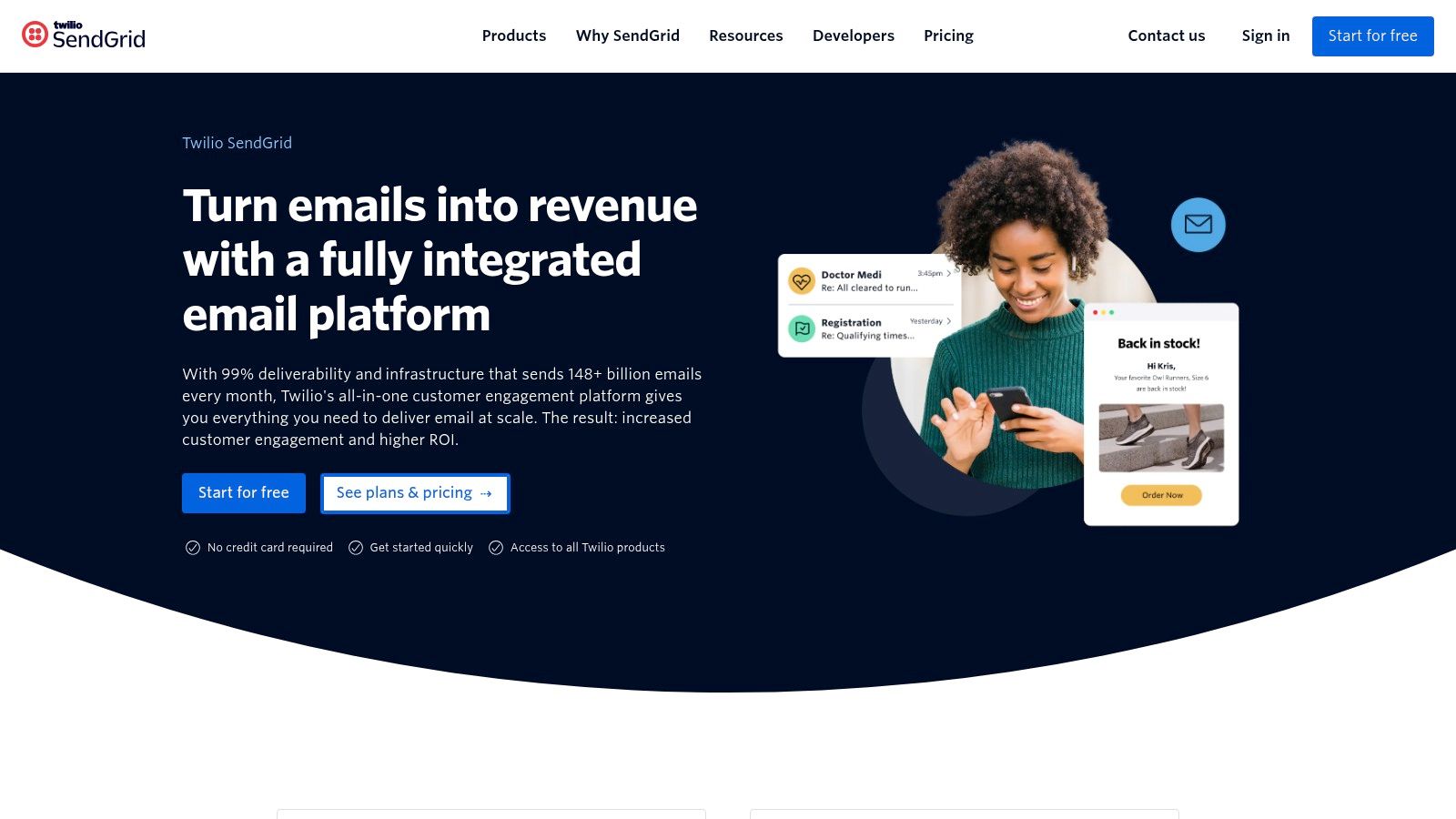
The primary advantage of SendGrid is its scale and reliability. For businesses sending hundreds of thousands or millions of emails, SendGrid’s infrastructure provides peace of mind. While its marketing automation and segmentation tools are not as deeply integrated with ecommerce platforms as specialist tools, it offers a solid foundation for businesses that prioritize deliverability above all else or already use Twilio for other communication channels.
Key Features & Use Cases
- Unified Email Platform: Manage both high-volume transactional emails (like receipts and password resets) and marketing campaigns from a single provider with a shared reputation.
- Strong Deliverability Tools: Access detailed analytics, reputation monitoring, and expert support to maximize inbox placement, a crucial factor for any email marketing software for ecommerce.
- Flexible API and SMTP Relay: Leverage powerful APIs to build custom email functionality or use the simple SMTP service for easy integration with any application.
- Visual Editor & Automation: Build and automate marketing campaigns using a drag-and-drop editor, segmentation tools, and A/B testing capabilities.
Pricing and Implementation
SendGrid offers a free plan allowing for 100 emails per day. Paid plans are flexible, with options based on email volume or contact list size, making it adaptable to different sending needs. The setup can be more technical compared to plug-and-play ecommerce platforms, especially if you plan to utilize the API for deep customization.
Our Take: SendGrid is the ideal choice for technically-inclined businesses and high-volume senders who want to consolidate their transactional and marketing email onto one ultra-reliable platform.
- Website: https://sendgrid.com
9. Shopify Email (Shopify-built app)
For merchants deeply embedded in the Shopify ecosystem, Shopify Email presents the most streamlined path to launching campaigns. As a native app, it eliminates the need for a separate platform, allowing you to build, send, and track campaigns directly within your Shopify admin. Its primary advantage is its zero-friction integration, automatically pulling in your branding, products, and customer data without any complex setup.
This tool is designed for simplicity and speed. You can quickly drag and drop product listings from your store into an email template, create a discount code, and send it to a customer segment in minutes. While it lacks the advanced automation and deep segmentation of dedicated platforms, its directness makes it an excellent choice for straightforward promotional sends and basic welcome series.
Key Features & Use Cases
- Native Shopify Integration: Manage all your marketing directly from the Shopify dashboard you already use every day.
- Simple Campaign Builder: Utilize pre-built, customizable templates that automatically pull in your store’s logo, colors, and product information for fast campaign creation.
- Basic Segmentation: Create segments based on customer data available in Shopify, such as purchase history, location, or email subscription status.
- Performance Tracking: Monitor key metrics like open rates, click-through rates, and sales attributed to each email campaign directly within Shopify reports.
Pricing and Implementation
Shopify Email offers a generous free plan, including 10,000 email sends per month at no cost. After that, pricing is a very competitive $1 for every 1,000 additional emails sent. Implementation is as simple as installing the app from the Shopify App Store; there are no scripts to install or APIs to connect. The user interface is intuitive for anyone familiar with Shopify.
Our Take: Shopify Email is the ideal starting point for new or smaller Shopify merchants who need a simple, low-cost solution for sending newsletters and promotional emails without leaving their admin dashboard.
As you grow, it’s vital to focus on collecting subscribers effectively. You can get tips on how to build email lists that will seamlessly integrate with your Shopify customer data.
10. Retainful
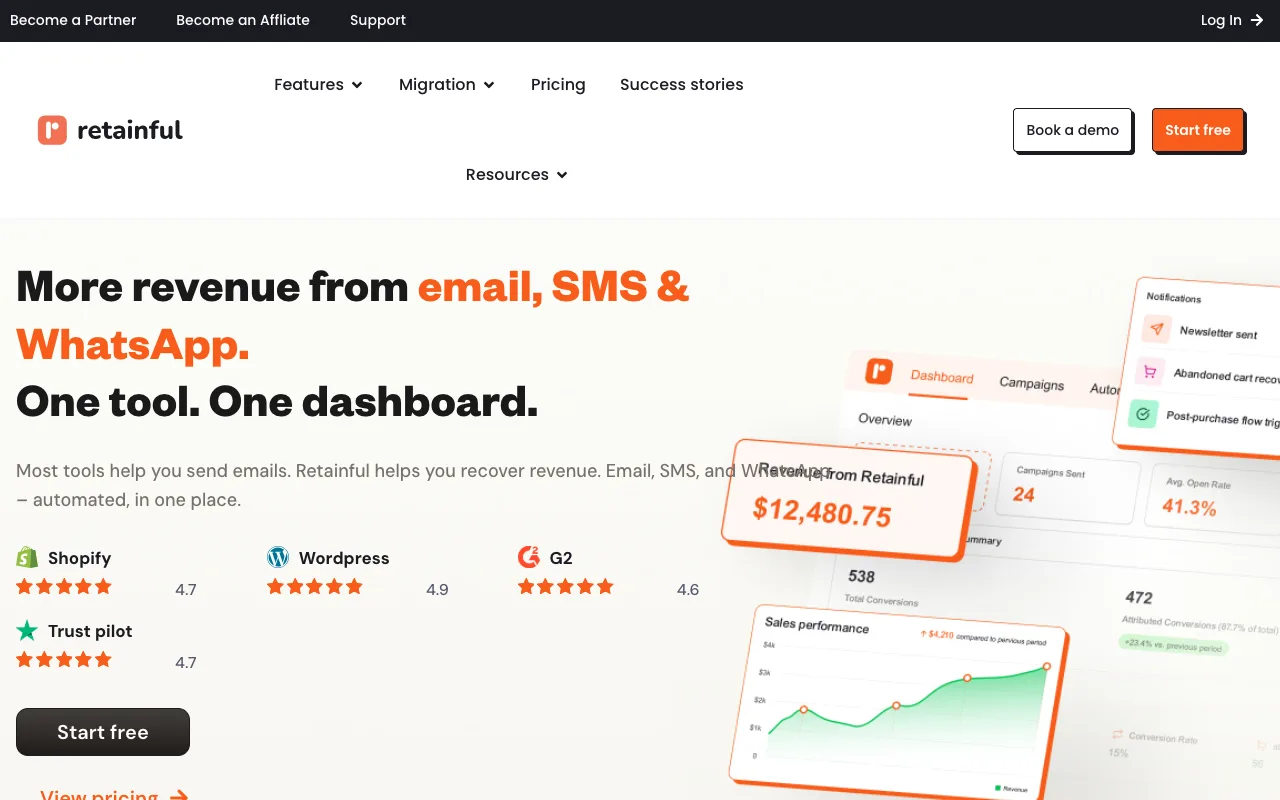
Unlike all-in-one suites that pile on features small stores never touch, Retainful focuses on doing three channels well: email, SMS, and WhatsApp in a single dashboard, built specifically for Shopify and WooCommerce. This lets store owners launch revenue-driving automations like cart recovery, welcome series, and win-back campaigns across all three channels without a developer, an agency, or enterprise pricing. The company says it’s used by more than 20,000 ecommerce brands.
Key Features & Use Cases
- Omnichannel Automation Flows: Combine email, SMS, and WhatsApp in a single automation to reach customers on whichever channel they actually open.
- Pre-built Cart Recovery & Coupons: Launch fast with ready-made flows for abandoned carts, welcome series, and post-purchase follow-ups, with dynamic coupon codes generated inside the flow to nudge the return.
- Popups & Signup Forms: Capture emails and phone numbers with add-to-cart, exit-intent, and welcome forms, using 100+ pre-built designs to grow your list before visitors leave.
- Revenue Attribution & Analytics: Clearly see which campaigns, automations, and channels are driving the most sales with built-in revenue tracking.
Pricing and Implementation
Retainful offers a free plan with all core features, capped at 500 emails per month with unlimited contacts. Paid Pro plans start at $14/month for up to 1,000 contacts and 10,000 emails, scaling competitively by contact list size for solid value at the small and mid-size end. SMS runs through your own Twilio account (currently USA and Canada) and WhatsApp through Meta, both billed at provider rates with no markup. The platform is quick to set up and intuitive for launching pre-built flows, though stores with very large lists or complex multi-channel marketing needs may eventually want the deeper CDP and personalization tooling that heavier enterprise platforms provide.
Our Take: Retainful is an excellent choice for small and mid-size Shopify and WooCommerce stores that want affordable, focused retention marketing across email, SMS, and WhatsApp without the cost or complexity of an enterprise suite.
- Website: https://www.retainful.com
11. Shopify App Store – Email Marketing Category
Instead of a single platform, this entry is the source itself: the Shopify App Store. For merchants on the world’s most popular ecommerce platform, this marketplace is the ultimate starting point for finding the best email marketing software for ecommerce. It centralizes hundreds of options, from giants like Klaviyo to niche tools like Seguno, allowing for direct comparison based on real user reviews, feature sets, and pricing structures.
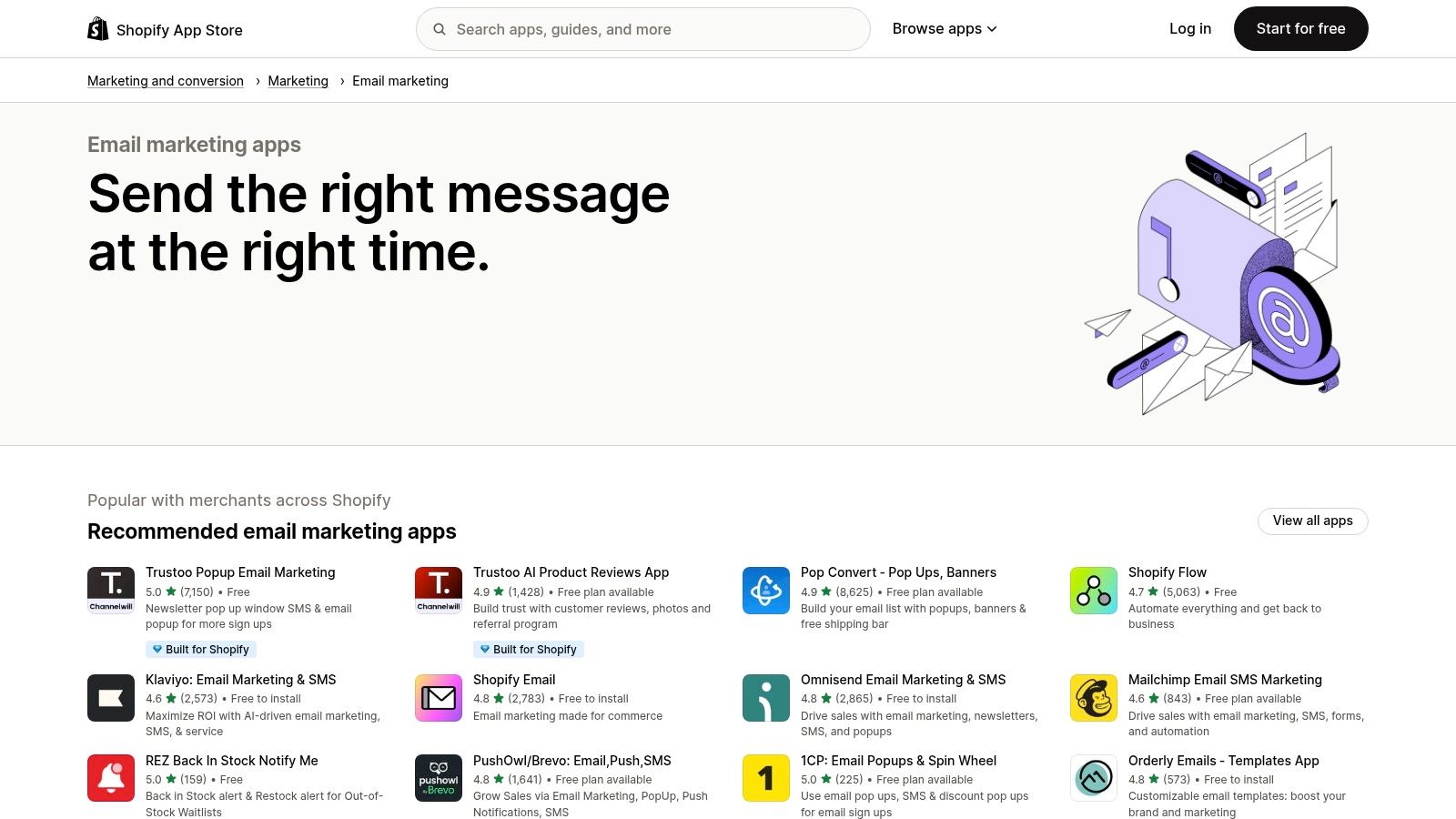
The primary advantage is seamless integration. Apps with the “Built for Shopify” badge offer a level of embedded functionality and data sync that standalone platforms often struggle to match. Installation is typically a one-click process, and billing is conveniently consolidated into your existing Shopify subscription, simplifying your operational overhead.
Key Features & Use Cases
- Curated Discovery: Filter apps based on specific needs like automations, pop-ups, or SMS capabilities, and use authentic merchant reviews to guide your decision.
- One-Click Installation: Eliminate complex setup processes. Most apps integrate directly into your Shopify admin, pulling customer and product data automatically.
- Unified Billing: Manage all your app subscriptions directly through your Shopify account, streamlining payments and financial tracking.
- Trusted Ecosystem: Rely on Shopify’s vetting process, which ensures apps meet certain standards for security, performance, and support.
Pricing and Implementation
Pricing varies dramatically from free plans to enterprise-level subscriptions, but the store provides transparent breakdowns for each app. Implementation is the App Store’s greatest strength; it’s designed for simplicity. However, be mindful that sponsored placements can influence rankings, so always look beyond the first few results.
Our Take: The Shopify App Store is an essential research tool for any Shopify merchant. It offers the fastest, most reliable way to discover, test, and implement an email marketing solution that is guaranteed to work with your store’s data.
12. BigCommerce App Marketplace – Email Marketing
For merchants on the BigCommerce platform, their native App Marketplace is the ideal starting point for discovering and vetting email marketing software for ecommerce. Rather than being a single software, it’s a curated directory of tools specifically designed to integrate with the BigCommerce ecosystem. This approach significantly simplifies the discovery process, ensuring that any app you choose is compatible and often offers one-click installation.
The marketplace provides crucial at-a-glance information, including user reviews, pricing structures, and compatibility indicators like multi-storefront support. This allows store owners to quickly compare popular solutions like Klaviyo, Mailchimp, and Omnisend in a single, trusted environment. The ability to filter apps by price, rating, and features makes it an efficient research hub for finding the perfect marketing fit.
Key Features & Use Cases
- Vetted Integrations: Find apps guaranteed to work with BigCommerce, reducing the technical risk and setup time associated with third-party tools.
- Centralized Discovery: Compare different email marketing providers based on features and real user reviews directly within your ecommerce platform’s ecosystem.
- Simplified Billing: Many apps offer unified billing through your BigCommerce account, consolidating your software expenses into a single invoice.
- Compatibility Flags: Easily identify apps that support key BigCommerce features, such as multi-storefront capabilities, before you commit to an installation.
Pricing and Implementation
Pricing is determined by the individual app developers, not BigCommerce, so costs vary widely from free plans to enterprise-level subscriptions. The main benefit is the streamlined implementation process; installing an app is typically a straightforward, guided procedure. However, the quality and support level can differ between app developers, so it’s essential to perform due diligence by reading recent reviews and understanding each app’s support policy.
Our Take: The BigCommerce App Marketplace is the most practical and secure place for BigCommerce merchants to begin their search. It removes the guesswork of compatibility and centralizes the research process, saving valuable time.
13. WooCommerce Marketplace (Marketing Automation extension example)
For ecommerce merchants committed to the WordPress ecosystem, the official WooCommerce Marketplace offers a distinct approach to email marketing software for ecommerce. Instead of a SaaS platform, you can find powerful extensions like Marketing Automation by Icegram that integrate directly into your WordPress dashboard. This model appeals to those who prioritize data ownership and prefer a self-hosted solution.
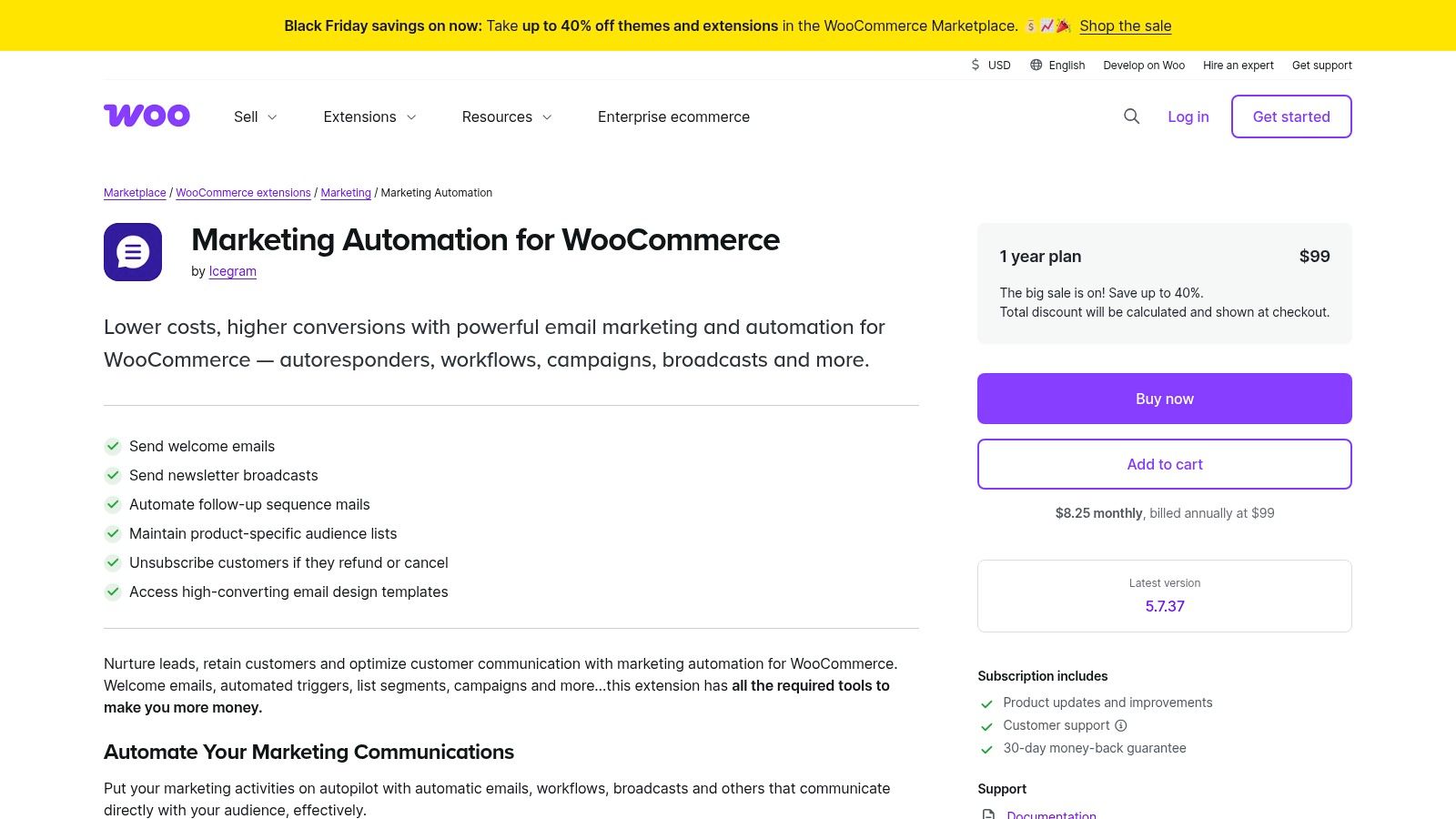
The primary benefit is that all your customer and marketing data remains on your own server. These extensions tap directly into your WooCommerce data, enabling you to build campaigns based on triggers like recent purchases, customer inactivity, or specific product interactions. This setup avoids the recurring monthly fees tied to contact list size, which is a common feature of SaaS providers.
Key Features & Use Cases
- WordPress-Native Experience: Manage all your marketing automation, from broadcasts to complex workflows, directly within the familiar WordPress admin area.
- Ecommerce Triggers: Build automated sequences based on real-time customer actions such as order completion, cart abandonment, and refund requests.
- Data Ownership: Keep full control over your customer and campaign data on your own hosting, a key advantage for privacy-focused businesses.
- Cost-Effective Licensing: Extensions are typically purchased with a one-time fee or an annual license, avoiding the scaling costs of per-subscriber SaaS billing models.
Pricing and Implementation
Pricing is based on the specific extension, usually involving a yearly license fee that is significantly more predictable than per-contact pricing. However, this approach requires more hands-on setup and maintenance. You are responsible for server performance, plugin updates, and ensuring deliverability, often by configuring an external SMTP service. The feature depth will vary widely between different plugins on the marketplace.
Our Take: WooCommerce extensions are ideal for technically savvy merchants who want to keep their marketing stack within WordPress and avoid the escalating costs of SaaS tools as their contact list grows.
This approach puts the responsibility for deliverability squarely on your shoulders, making list hygiene critical. Using an email verification service can help maintain a strong sender reputation from your own server.
13 Ecommerce Email Marketing Tools — Comparison
| Product | Core features | Quality & UX (★) | Pricing & Value (💰) | Best for (👥) | Standout (✨/🏆) |
|---|---|---|---|---|---|
| Klaviyo | Real-time ecomm data sync, advanced segmentation & flows | ★★★★☆ strong analytics; learning curve | 💰 Higher as contacts grow; ROI-focused | 👥 DTC brands & Shopify merchants | ✨ Shopify-native data + revenue automation 🏆 |
| Mailchimp (by Intuit) | Templates, basic automations, multichannel add-ons | ★★★☆☆ approachable UI; reliable deliverability | 💰 Free tier; can get costly at scale | 👥 Small businesses & beginners | ✨ Easy to use + large ecosystem |
| Omnisend | Prebuilt ecomm workflows; email + SMS + web push | ★★★★☆ fast to launch; UI can feel busy | 💰 Good value; clear pricing | 👥 Shopify/Woo merchants needing multichannel | ✨ Multichannel + product recommender blocks |
| Drip | Behavior-based journeys, onsite forms, product feeds | ★★★★☆ strong automation with friendly UX | 💰 Mid-tier; lifecycle-value focused | 👥 Ecommerce marketers & creators | ✨ Visual workflows for lifecycle marketing |
| ActiveCampaign | Advanced automation builder, CRM, site tracking | ★★★★☆ powerful but complex interface | 💰 SMB→enterprise pricing; high capability | 👥 Growth teams & sales-marketing handoff | 🏆 Enterprise-grade automation at SMB price |
| Brevo (Sendinblue) | Email, SMS, WhatsApp, forms, simple CRM | ★★★☆☆ budget-friendly; some limits | 💰 Aggressive pricing + generous free tier | 👥 SMBs on tight budgets | ✨ Low-cost multichannel option |
| Constant Contact | Drag-and-drop editor, automations, social & events | ★★★☆☆ very easy setup; strong live support | 💰 Mid; costs scale with contacts & add-ons | 👥 Small shops needing hands-on support | ✨ Excellent live onboarding & phone support |
| Twilio SendGrid – Marketing Campaigns | Deliverability-focused API/SMTP + campaign editor | ★★★★☆ excellent deliverability; lean marketing features | 💰 Scales well for high volume; technical setup | 👥 Developers & high-volume transactional senders | 🏆 Robust infra + combined transactional+marketing |
| Shopify Email | Shopify-native templates, basic automations | ★★★☆☆ seamless inside Shopify; very simple | 💰 Very low cost for moderate sending | 👥 Shopify merchants wanting minimal setup | ✨ Zero-friction, product-linked emails |
| Retainful | Email + SMS + WhatsApp flows, cart recovery, popups | ★★★★☆ quick setup; focused feature set | 💰 Free plan; Pro from $14/mo, scales by contacts | 👥 Small/mid Shopify & Woo stores | ✨ Affordable omnichannel retention |
| Shopify App Store – Email Category | Curated app listings, reviews, one-click installs | ★★★★☆ easy discovery; mixed app quality | 💰 Varies by app; unified Shopify billing | 👥 Shopify merchants comparing tools | ✨ Fast discovery + Built-for-Shopify badges |
| BigCommerce App Marketplace – Email | Filtered app listings, compatibility flags | ★★★☆☆ smaller catalog vs Shopify | 💰 Varies; some unified billing | 👥 BigCommerce merchants | ✨ Compatibility indicators for storefronts |
| WooCommerce Marketplace | WordPress-native extensions & automation plugins | ★★★☆☆ flexible but needs maintenance | 💰 Often one-time/year licenses; cost-effective long-term | 👥 WordPress/Woo merchants valuing ownership | ✨ Data ownership & non-SaaS license options |
The Ecommerce Email Automation Playbook
Platform comparisons only go so far if you don’t know which flows actually move revenue. Every serious ecommerce program in 2026 runs these automations — the platform you pick should ship all of them out of the box.
- Welcome series (2-4 emails). Email one fires within 5 minutes with the promised lead-magnet or first-order discount; subsequent emails surface bestsellers and reinforce the value prop. Engagement decays sharply after the first 10 minutes — don’t delay the first send.
- Abandoned cart (3 emails). Highest-ROI flow in ecommerce. Cadence: 1 hour, 24 hours, 72 hours. Friendly nudge, then social proof or urgency, then discount. Klaviyo’s flow is the gold standard because it pulls live cart contents and line-item images directly from Shopify. Our piece on transactional email examples covers the order-state messaging that runs alongside.
- Browse abandonment (1-2 emails). Triggered when someone viewed a product or category but didn’t add to cart. Lower intent than cart abandonment — message helpfully, not pushily.
- Post-purchase sequence (4-6 emails). Order confirmation, day-3 check-in, day-7 how-to/care-instructions, day-14 review request, day-30 cross-sell or replenishment. Brands that get post-purchase right see repeat-purchase rates jump 15-30%. Match cadence to consumption cycle — coffee at 30 days, vitamins at 60.
- Win-back / lapsed customer flow. In 2026, predictive churn scores drive this instead of static “no purchase in 90 days” rules. Three emails: “we miss you,” curated bestsellers, sunset offer. Non-engagers get suppressed from broadcasts — see email sender reputation score for why that pruning matters.
- Replenishment reminders. For consumables, fire 7-10 days before the predicted reorder window with a one-click reorder CTA. Klaviyo and Omnisend ship predicted-next-order-date models out of the box.
- VIP and loyalty segments. Top 5-10% of customers by revenue or LTV deserve their own track: early access, no-discount messaging, and the occasional surprise gift.
Shopify and Headless Commerce Integration Patterns
How the data gets into your ESP matters more than how it looks once it’s in. Three patterns dominate in 2026:
- Standard Shopify (Liquid storefronts). Klaviyo, Omnisend, and Drip all install via the official Shopify App Store and ingest data through Shopify’s Customer Events API. You get out-of-the-box flows for
checkout_started,product_viewed,order_created, andorder_fulfilled. One-click, no engineering. - Shopify Hydrogen and other headless React storefronts. The legacy storefront pixel doesn’t fire by default. You’ll instrument your storefront to emit Customer Events manually — either through Shopify’s web pixel API, Segment, RudderStack, or a custom webhook endpoint. Klaviyo’s Server-Side Events API is the cleanest target. Budget an engineering week.
- Non-Shopify headless stacks (Commerce.js, Medusa, Saleor). Pure API integration. Write a small middleware service that forwards commerce-backend webhooks to your ESP. Klaviyo and ActiveCampaign have the most mature server-side event APIs. Our notes on API management best practices cover the patterns that keep these pipelines reliable.
For multi-storefront brands (Shopify Markets, regional Hydrogen instances, sister BigCommerce stores), centralize on one ESP account with store-tagged contacts rather than separate accounts per region. Klaviyo, Omnisend, and ActiveCampaign all support this cleanly.
Ecommerce-Native vs General-Purpose ESPs
Defaulting to a general-purpose tool like Mailchimp or HubSpot because the name is familiar is the most common ecommerce email mistake in 2026.
Pick ecommerce-native (Klaviyo, Omnisend, Drip, Postscript) when revenue depends on repeat purchases, you need predictive LTV or churn scores, you want SMS and email in one tool (Postscript is the SMS-first pairing for Klaviyo; Omnisend bundles both), or you’re on Shopify/BigCommerce/WooCommerce.
Pick general-purpose (Mailchimp, HubSpot, ActiveCampaign) when you’re a service business with a small storefront, you need CRM and deal pipelines, your sending volume is genuinely low, or you’re a B2B store with a long sales cycle (ActiveCampaign especially).
The most common failure mode: a fast-growing DTC brand stays on Mailchimp because migration feels scary. By the time they switch, they’ve left 6-12 months of compounding LTV on the table. If you cross $100k MRR and you’re still on a general-purpose tool, schedule the migration.
Common Ecommerce Email Mistakes
Even with the right platform, most stores leave money on the table on the fundamentals:
- No SMS opt-in at checkout. Email opens hover at 25-30%; SMS sits above 90%. Omnisend, Klaviyo, and Postscript make this a one-checkbox addition.
- No review-request automation. A day-14 post-delivery review request lifts on-site conversion and feeds retention messaging. Most stores either don’t run one or send it before the customer has used the product.
- Dirty post-purchase lists. Customers churn email addresses constantly (job changes, alias services like Hide My Email). Without periodic email list cleaning, open rates drop and sender reputation bleeds. Sweep quarterly with a bulk email verifier.
- No engagement-based pruning. A subscriber who hasn’t opened in 6 months hurts deliverability. Run a sunset flow followed by automatic suppression — Klaviyo, Omnisend, and Drip have native templates. Skip this and you drift toward Promotions then Spam (see how to prevent emails from going to spam).
- Broadcasting to the entire list. Filter every broadcast by engagement (opened in last 90 days) at minimum. Segment further by purchase history and predicted LTV where you can.
- Accepting any signup. Disposable, role-based, and typo’d emails flood ecommerce forms — promo-code seekers especially. Each bad signup is a future hard bounce. Fix with real-time validation at the form, plus an email bounce checker sweep before large sends.
Where Email Validation Fits in an Ecommerce Stack
Ecommerce signup forms attract the worst-quality email addresses on the open web. Discount-seekers enter throwaway addresses to claim first-order coupons, disposable services like Hide My Email and Mailinator now account for 5-10% of new-customer addresses at many DTC brands, and a credit-card order paired with a fresh disposable address is a chargeback red flag.
The fix is a real-time validation API at the signup form and checkout that:
- Blocks invalid syntax (see format of email address)
- Verifies MX records for the domain (see MX record lookup)
- Catches disposable and role-based addresses
- Confirms the mailbox exists via SMTP probing (see email address existence checker)
Truelist’s verify_inline endpoint runs all four checks in under 500ms — drop-in on the signup form without hurting conversion. Free tier covers 100 validations.
const res = await fetch(
  `https://api.truelist.io/api/v1/verify_inline?email=${encodeURIComponent(email)}`,
  { headers: { Authorization: `Bearer ${TRUELIST_API_KEY}` } }
)
const result = await res.json()
if (result.status !== 'ok') {
  showError('Please enter a valid email address.')
  return
}
Validation happens at the form, then clean data flows into your ESP (Klaviyo, Omnisend, etc.), which then drives the lifecycle flows above. For language-specific examples, see JavaScript validate email, Python email validation, or PHP verification email.
FAQ
What’s the best email marketing software for a Shopify store in 2026?
For most Shopify stores doing more than $10k MRR, Klaviyo is the default answer — its data integration is the deepest, the templates are battle-tested, and the predictive segments unlock real lifecycle marketing. Below that revenue tier, Shopify Email (for the simplest setups) or Omnisend (for multi-channel email + SMS) are stronger fits because the cost scales more gently.
How is Klaviyo different from Mailchimp for ecommerce?
Klaviyo was built for ecommerce data. Mailchimp was built for general newsletters and bolted on ecommerce features later. The practical difference: Klaviyo’s segments, flows, and reporting all assume you have purchase history, browse events, and product catalog data — and it makes using them trivial. Mailchimp can do it, but the workflows are clunkier and the integration is shallower.
Do I still need a transactional email provider if I have Klaviyo or Omnisend?
For most stores, no — Klaviyo and Omnisend now handle order confirmations and shipping notifications well enough that a separate transactional ESP isn’t required. High-volume stores (or those needing strict deliverability separation between marketing and transactional traffic) still benefit from SendGrid or Postmark as a dedicated transactional sender on a separate IP and domain.
What’s the right cadence for marketing emails to ecommerce customers?
A reasonable baseline is 2-4 broadcasts per week to engaged subscribers, plus whatever lifecycle flows fire automatically. Less than once a week and you fade from memory; more than four and you train unsubscribes. Always segment by engagement so inactive subscribers receive fewer messages, not more. For subject-line guidance that improves the open rate at any cadence, see our notes on email subject line best practices.
How do I keep my ecommerce email list clean?
Three things, in order of impact: (1) real-time validation at the signup form to block bad addresses on the way in, (2) engagement-based suppression of subscribers who haven’t opened in 6 months, and (3) a quarterly bulk verification sweep with a tool like Truelist or another email list cleaning service. Doing one without the other two leaves money on the table.
Can I run email marketing on a fully headless ecommerce stack?
Yes. The ESP doesn’t care whether your storefront is Liquid, Hydrogen, Next.js, or custom React — it just needs the customer and order events. You’ll need to instrument your storefront to fire cart_started, product_viewed, order_created, and similar events to the ESP’s server-side events API. Klaviyo, ActiveCampaign, and Drip all have mature server-side event APIs; budget an engineering week for the integration on a non-trivial storefront.
The Final Verdict: Matching the Platform to Your Ambition
Navigating the landscape of email marketing software for ecommerce can feel overwhelming. With a dozen powerful contenders, each boasting unique strengths, the “best” platform is not a universal title but a subjective one, deeply tied to your business’s specific stage, goals, and technical stack. We’ve journeyed through the deep data prowess of Klaviyo, the all-in-one marketing automation of ActiveCampaign, and the user-friendly entry points of Shopify Email. Now, it’s time to synthesize these insights into a clear, actionable path forward.
Your final decision hinges on an honest assessment of your current needs versus your future ambitions. A brand new store on Shopify just needs to get its first welcome series and abandoned cart flow running. In this case, starting with Shopify Email is a logical, low-friction choice. However, a rapidly scaling DTC brand that foresees complex segmentation based on predictive analytics will quickly outgrow basic tools and find a home with a more robust, data-centric platform like Klaviyo or Drip.
Distilling Your Decision: Key Takeaways
The core theme emerging from our analysis is the spectrum of complexity versus accessibility. On one end, you have platforms like Omnisend and Mailchimp, which offer a brilliant balance of powerful ecommerce features and an intuitive user interface, making them fantastic all-rounders. On the other end, you have specialized or more complex tools. Twilio SendGrid excels in transactional email deliverability at scale, making it a developer’s choice, while Brevo (formerly Sendinblue) packs an incredible suite of tools-including SMS, chat, and CRM-into a budget-friendly package.
Remember these crucial takeaways as you deliberate:
- Integration is Non-Negotiable: Your chosen platform must seamlessly connect with your ecommerce platform (Shopify, BigCommerce, WooCommerce) and other critical tools. A disconnected system creates data silos and missed opportunities.
- Scalability Matters: The tool that’s perfect for you today might hinder your growth tomorrow. Consider the pricing tiers and feature unlocks. Will the platform grow with you from 1,000 to 100,000 subscribers without crippling costs or forcing a painful migration?
- Data is Your Foundation: The most advanced email marketing software for ecommerce is only as good as the data you feed it. Prioritize platforms that offer deep integration with your store’s data, allowing you to segment based on purchase history, browsing behavior, and customer lifetime value.
- Usability Impacts Adoption: Don’t underestimate the importance of a clean interface and good support. If your team finds the platform clunky or difficult to use, they won’t leverage its full potential.
Your Actionable Next Steps
To move from analysis to action, follow this simple framework:
- Define Your Core Needs: List the top three to five essential features you need right now. Is it a visual automation builder? Advanced segmentation? Or simply reliable abandoned cart emails?
- Shortlist 2-3 Contenders: Based on our reviews and your core needs, select a few platforms for a deeper look. If you’re a high-growth brand, your shortlist might be Klaviyo, Drip, and Omnisend. If you’re a small business on a budget, it might be Mailchimp, Brevo, and Constant Contact.
- Run a Trial or Demo: Never commit without a hands-on experience. Sign up for a free trial or schedule a sales demo. Use this time to build a test automation, import a small segment of your list, and explore the reporting dashboard. This practical test is the single most important step in the selection process.
Ultimately, choosing your email marketing platform is a strategic decision that will directly impact your revenue and customer relationships. It’s the engine of your retention marketing. Choose the tool that not only solves today’s problems but also empowers you to build the ambitious, multi-channel marketing machine your brand deserves. If you’re still researching, our broader email marketing platforms comparison and our guide to the best email marketing software for small business cover the platforms that didn’t fit this ecommerce-specific list.
No matter which platform you select, the quality of your email list is the bedrock of your success. Protect your sender reputation and maximize your ROI by ensuring every email you send is to a valid, engaged recipient. Truelist offers real-time email verification to clean your lists, reduce bounce rates, and improve the deliverability of every campaign, from welcome series to promotional blasts. Integrate Truelist with your chosen software to build a healthier, more profitable email marketing program from day one — start with the free email validation tier and validate your first 100 emails at no cost.